Key takeaways
- A typical North American home panel is a 120/240 V split-phase load center rated 100, 150, 200 or 400 A, listed to UL 67 for panelboards.
- Breakers on alternate busbar stabs connect to opposite legs, so a 240 V double-pole breaker spans both legs while 120 V breakers use one leg and the neutral.
- Neutral current in a split-phase panel equals the difference between leg currents, so balancing 120 V loads across both legs reduces neutral loading and voltage drop.
- NEC 110.26 requires working space generally 30 in wide, 36 in deep and 6.5 ft high in front of panels operating at up to 150 V to ground.
- Panel replacement is common when upgrading service capacity, replacing fuse panels or obsolete equipment, adding EV charging or heat pumps, or after water or heat damage.
Quick answer: An electrical panel, also called a breaker box or service panel, receives power from the utility service and divides it into branch circuits, each protected by a circuit breaker. A main breaker disconnects the whole building, busbars carry current to branch breakers, and separate neutral and ground bars return current and bond metal parts safely to earth.
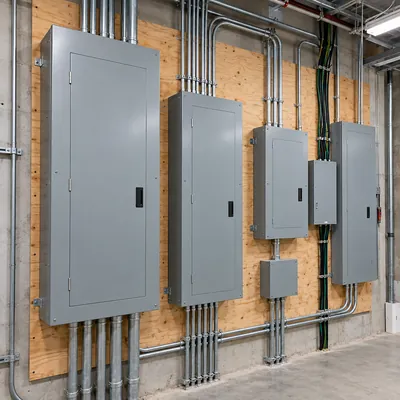
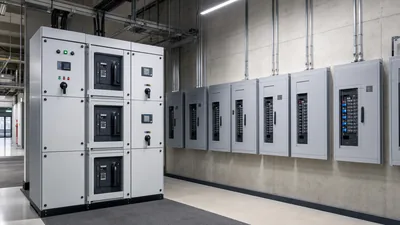
Every building with grid power has at least one electrical panel. In a house it is a gray metal box in the garage or utility room; in a factory it may be a row of floor-standing switchboards. The principle is the same: take one large supply, divide it into smaller protected circuits, and give people a safe way to switch it off.
This guide explains how electrical panels work, names the parts inside, compares fuse boxes with breaker panels, and covers when and why panels are replaced. It is written for homeowners, facility staff and electrical buyers who want to understand the equipment, not to work on it. Work on service equipment must follow local code and be done by a licensed electrician.
What Is an Electrical Panel?
An electrical panel is an enclosure containing busbars and overcurrent protective devices that distributes power from a supply into separate branch circuits. The terms overlap:
- Service panel / main electrical service panel: the first panel after the utility meter, containing the service disconnect.
- Breaker box / circuit breaker panel box: everyday names for a panel using circuit breakers.
- Load center: a residential or light commercial panelboard designed for plug-on breakers.
- Panelboard / electrical panel board: the code and standards term (NEC Article 408, UL 67) for a panel accessible only from the front.
- Subpanel: a downstream panel fed from another panel; see the sub panel guide.
- Switchboard: larger, floor-standing equipment for commercial and industrial services, explained in switchboard vs panelboard.
A house panel is a home electrical distribution panel for 120/240 V single-phase power. Commercial buildings usually have three-phase panels at 208Y/120 V or 480Y/277 V, covered in the 3 phase panel guide.
Each panel has three ratings that matter: the bus rating in amps (how much current the busbars can carry), the main breaker rating (which may be equal to or lower than the bus), and the short-circuit current rating in kA (the fault current it can safely withstand). Residential panels are commonly rated 10 kA, with 22 kA versions available where the utility transformer is close and fault current is higher.
How Does an Electrical Panel Work?
Power arrives from the utility transformer through the service drop or lateral and the meter. In a 120/240 V split-phase service there are two ungrounded conductors (L1 and L2), each 120 V to neutral and 240 V to each other, plus a grounded neutral. The split-phase system is explained in 240 V single phase split phase.
- Service conductors land on the main lugs or the line side of the main breaker.
- The main breaker feeds two vertical busbars, one per leg.
- Busbar stabs alternate between L1 and L2 down the panel, so adjacent breaker spaces sit on opposite legs.
- Single-pole breakers clip onto one stab for 120 V circuits; double-pole breakers span two adjacent stabs for 240 V circuits.
- Neutral conductors return to the neutral bar; equipment grounding conductors land on the ground bar.
- At the service panel only, the main bonding jumper connects neutral and ground to the enclosure and grounding electrode system (NEC 250.24).
A breaker trips on overload by a thermal bimetal element and on short circuit by a magnetic element; types are covered in the circuit breaker types guide.
Worked example, leg balance: L1 carries 30 A of 120 V loads, L2 carries 18 A of 120 V loads, and a 240 V water heater draws 24 A on both legs. Leg currents are L1 = 30 + 24 = 54 A and L2 = 18 + 24 = 42 A. Neutral current is the difference of the 120 V loads: I_N = 30 − 18 = 12 A. Moving 6 A of 120 V load from L1 to L2 would bring the neutral current to zero and equalise the legs at 48 A.
Electrical Panel Parts: Names and Functions
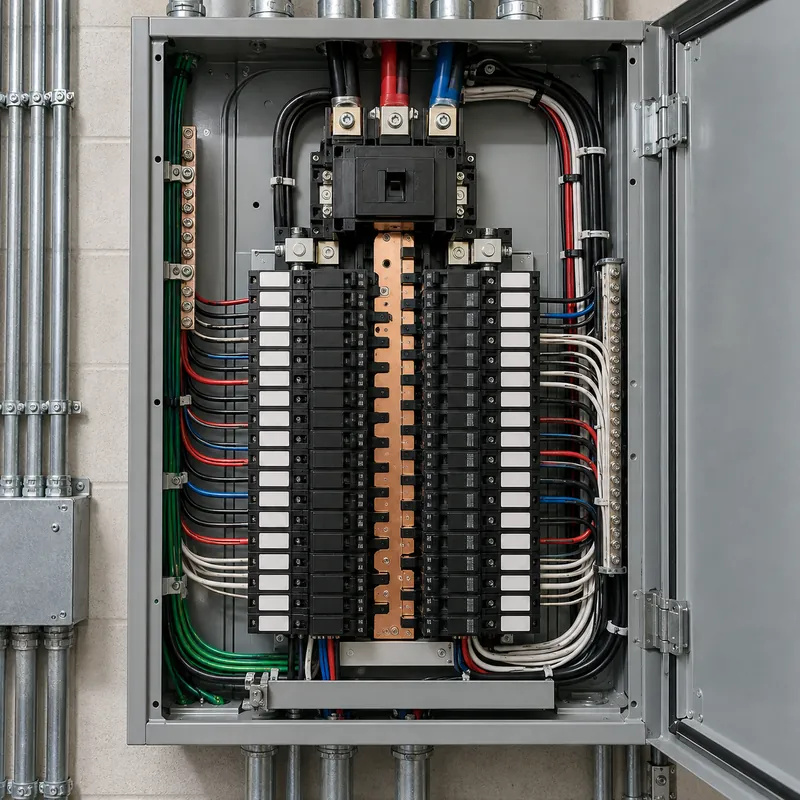
Opening the door of a panel shows only the dead front. Behind it, the main electrical panel parts are:
| Part | Function |
|---|---|
| Enclosure (can or tub) | Steel box with knockouts for conductors, rated NEMA 1 indoors or NEMA 3R outdoors |
| Door and dead front (trim, cover) | Door covers the breaker handles; dead front shields live parts while allowing breaker operation |
| Main breaker or main lugs | Service disconnect and overcurrent protection, or terminals only (MLO) |
| Busbars and stabs | Copper or aluminum bars that carry current to the breakers |
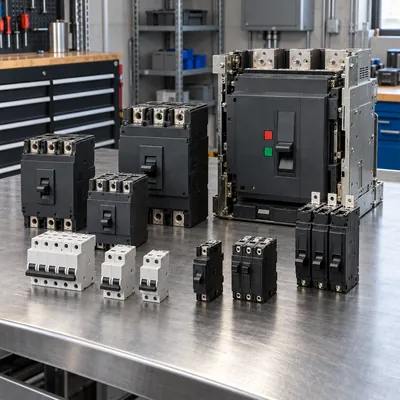
| Branch circuit breakers | Protect individual circuits; single-pole, double-pole, GFCI, AFCI, dual function |
| Neutral bar | Terminates grounded (neutral) conductors |
| Ground bar | Terminates equipment grounding conductors |
| Main bonding jumper (screw or strap) | Connects neutral to enclosure at the service equipment only |
| Grounding electrode conductor terminal | Connects to ground rods, water pipe or concrete-encased electrode |
| Circuit directory | Label identifying each circuit, required by NEC 408.4 |
| Filler plates | Close unused breaker openings in the dead front |
An inside electrical panel view also shows the conductor routing: incoming service cables at the top or bottom, branch circuit cables entering through clamps or connectors, and neutrals and grounds dressed to their bars. Copper bus offers lower resistance and better corrosion resistance; tin-plated aluminum bus is lighter and lower cost and performs well when terminations are torqued correctly.
Equipment grounding conductor sizing for feeders and circuits follows NEC Table 250.122; see equipment grounding conductor sizing.
Fuse Box vs Circuit Breaker Panel
Before circuit breakers became standard in homes, fuse panels did the same job. A fuse box electrical panel uses replaceable fuses: screw-in plug fuses for 120 V circuits and cartridge fuses in pull-out blocks for the main and 240 V appliance circuits.
| Feature | Fuse panel | Circuit breaker panel |
|---|---|---|
| Reset after fault | Replace fuse | Reset breaker handle |
| Tamper risk | Oversized fuse can be inserted unless Type S rejection bases are used | Breaker rating fixed by the device |
| Fault interruption | Fast; current-limiting fuses can have very high interrupting ratings | Typically 10–22 kA for residential breakers |
| GFCI and AFCI protection | Not built in | Available as breakers |
| Typical capacity | Often 30–100 A in older homes | 100–400 A |
| Insurance and resale | Some insurers question older fuse panels | Generally accepted |
Fuses themselves are not unsafe. Many commercial and industrial boards still use fuses for their high interrupting capacity and current limitation. The problems with old house fuse panels are low capacity, lack of modern protection, deteriorated insulation and the temptation to install a larger fuse than the wire can carry.
A house fuse panel diagram typically shows a main pull-out, a range pull-out and four to eight plug fuse sockets, which limits the number of circuits compared with a modern 30- to 42-space panel.
When Do You Need a New Electrical Panel?
Common reasons for breaker panel replacement or an upgrade to a new electrical panel:
- Insufficient capacity: adding EV chargers, heat pumps, induction ranges or battery storage beyond what the existing service and panel can supply.
- No spare spaces: tandem breakers cannot be added beyond what the panel listing allows.
- Obsolete or recalled equipment: older panels with known breaker reliability issues or no replacement breakers available.
- Damage: corrosion, water ingress, heat discoloration, melted insulation or loose bus connections.
- Fuse panels and very old 60 A services.
- Renovation that triggers code requirements for AFCI and GFCI protection.
Warning signs that need an electrician promptly: breakers that are hot to touch, burning smell, buzzing, frequent nuisance tripping, flickering lights on large loads, or any sign of arcing.
How much is an electrical panel replacement?
Prices vary widely by market, date and scope, so treat any figure as indicative. In the US, replacing a residential panel at the same amperage commonly falls in the low thousands of dollars, while a service upgrade from 100 A to 200 A, including meter base, service conductors and utility coordination, often costs considerably more. The main cost drivers are the amperage, whether the service entrance and meter must change, permit and inspection fees, local labor rates, the number of circuits to reconnect, AFCI/GFCI breakers required by current code, and any drywall, grounding or trenching work.
Panel sizing and amperage choices are covered in electrical panel sizes and dimensions. Panel work must be permitted and carried out by a licensed electrician.
How to Choose the Best Breaker Panel for a Home or Building
Rather than picking an electrical panel brand, compare panels on objective criteria:
- Listing: UL 67 listed and marked with bus rating, voltage and short-circuit current rating.
- Amperage: bus and main rating that cover the calculated load plus growth; 200 A is the common choice for new single-family homes.
- Spaces: enough full-size spaces for current circuits plus 20–30% spare; tandem breakers should not be relied on for growth.
- Short-circuit rating: 10 kA minimum, 22 kA where available fault current is higher.
- Bus material: copper or plated aluminum with suitable termination ratings.
- Breaker availability: GFCI, AFCI, dual-function and surge protective devices available for that panel family.
- Enclosure: NEMA 1 indoor or NEMA 3R outdoor, surface or flush mount.
- Future loads: provisions for a generator interlock, transfer switch or smart load management; see the smart electrical panel guide.
Commercial and industrial buildings move beyond residential load centers to panelboards and switchboards. A small office may have one 225 A three-phase panelboard; a factory has a main switchboard feeding motor control centers and distribution boards. Those boards are type-tested assemblies, in IEC markets to IEC 61439, and engineered for higher fault levels, larger busbars and withdrawable devices. See the electrical panel board engineering guide for that transition.
Next Steps: Specifying and Sourcing Commercial Electrical Panels
MARS does not manufacture residential breaker panels or load centers. For commercial, industrial and infrastructure projects, MARS manufactures IEC 61439 low-voltage switchboards (GGD fixed type, GCS and MNS withdrawable types), KYN28 metal-clad MV switchgear and SF6 ring main units, plus the distribution transformers that feed them.
For a commercial or industrial panel RFQ, specify:
- System voltage, phases, wires and frequency (for example 400/230 V 3-phase 4-wire 50 Hz, or 480Y/277 V 60 Hz)
- Main busbar rating and short-circuit withstand (Icw in kA for 1 s)
- Incoming device type (ACB or MCCB) and outgoing feeder schedule
- Form of internal separation and IP rating
- Metering, communication and surge protection requirements
- Applicable standard: IEC 61439 or UL 891/UL 67 equivalents for the target market
A completed panel schedule is the fastest way to brief a manufacturer. Browse the HV and LV switchgear range, and send your single-line diagram and feeder list through the quote request page. Typical lead time is 25–45 days.
Frequently asked questions
How does a breaker panel work?
Utility power enters through the main breaker, which feeds two busbars in a 120/240 V panel. Branch breakers clip onto the busbars and feed individual circuits. Current returns through neutral conductors to the neutral bar. If a circuit overloads or short-circuits, its breaker trips and disconnects only that circuit, while the main breaker can switch off the whole building.
What is the difference between a main breaker panel and a main lug panel?
A main breaker panel has a large breaker that disconnects and protects the entire panel. A main lug only panel has terminals but no main breaker, so it must be protected by a breaker upstream. Main breaker panels are used as service equipment; main lug panels are common as subpanels near the panel that feeds them.
What are the main parts of an electrical panel?
The main parts are the steel enclosure, door and dead front cover, main breaker or main lugs, busbars, branch circuit breakers, neutral bar, ground bar, the main bonding jumper at service equipment, the grounding electrode conductor terminal, filler plates for unused openings and the circuit directory label required by code.
How long does an electrical panel last?
A well-installed panel in a dry location commonly lasts several decades, often 25 to 40 years or more. Life is shortened by moisture, corrosion, loose terminations, overloading and obsolete breaker designs. Replacement is usually driven by capacity upgrades, damage or unavailable replacement breakers rather than age alone.
Is it safe to replace an electrical panel yourself?
No. Panel replacement involves service conductors that remain energized from the utility even with the main breaker off, and it requires a permit, utility coordination and inspection in most jurisdictions. It must follow local code and be done by a licensed electrician. Homeowners can safely reset tripped breakers and keep the directory up to date.
What is the difference between an electrical panel and a fuse box?
Both divide power into protected circuits. A fuse box uses fuses that melt on overcurrent and must be replaced, while a breaker panel uses resettable circuit breakers. Breaker panels support GFCI and AFCI protection and usually have more capacity. Fuses remain common in commercial and industrial equipment for their high interrupting ratings.
Written and reviewed by the MARS application engineering team in Shanghai, who specify and test transformers, switchgear, substations and battery storage for projects in 40+ countries. Last updated .
Tags: electrical panel circuit breaker box electrical panel parts main breaker panel breaker panel replacement