Key takeaways
- Thermal-magnetic breakers trip on overload through a bimetal strip with inverse-time delay and on short circuit through an instantaneous magnetic trip, typically within one cycle.
- IEC 60898-1 MCB curves trip instantaneously at 3 to 5 times rated current for type B, 5 to 10 times for type C and 10 to 20 times for type D.
- NEC 210.20(A) requires branch breakers rated at least 125 percent of continuous load, so a 16 A continuous load needs a 20 A breaker unless the assembly is 100 percent rated.
- Residential breakers commonly carry 10 kA interrupting ratings, molded-case breakers 14 to 100 kA or more, and the rating must equal or exceed available fault current per NEC 110.9.
- NEC 408.7 requires unused breaker openings in a panel's dead front to be closed with identified closures, and only covers listed for that panel should be used.
Quick answer: Electrical breakers are automatic switches that open a circuit on overload or short circuit. Homes use plug-on miniature breakers of 15–60 A, including standard, GFCI, AFCI and dual-function types. Commercial and industrial systems use MCBs, molded-case breakers to UL 489 or IEC 60947-2, and air circuit breakers up to several thousand amps. A replacement breaker must be listed for the specific panel.
A circuit breaker is the most frequently operated safety device in any electrical system. It protects conductors from overheating, clears faults before they become fires, and doubles as the switch used to isolate a circuit. Choosing the wrong type or an incompatible breaker for a panel defeats that protection.
This guide is for homeowners who want to understand their breaker box switches, facility staff maintaining commercial panels and buyers specifying industrial switchboards. It covers how breakers work, household and industrial types, sizing rules, breaker panel covers and doors, replacement and scoping a breaker or panel upgrade proposal. Work inside panels must follow local code and be performed by a licensed electrician.
Understanding Circuit Breakers: How Do They Work?
A circuit breaker is a mechanical switching device that carries current under normal conditions and automatically interrupts it under abnormal conditions such as overload or short circuit. Most low-voltage electrical breakers combine two trip elements:
- Thermal element: a bimetal strip heated by load current bends and releases the latch. Trip time falls as current rises, so a 30% overload may take minutes while a 300% overload trips in seconds. This protects cable insulation from sustained heating.
- Magnetic element: a coil or yoke around the current path pulls an armature when current reaches a high multiple of rating, tripping without intentional delay, typically within one cycle.
When contacts separate under load, an arc forms. Arc chutes or splitter plates stretch, cool and divide the arc until current passes through zero and the arc extinguishes. The breaker's interrupting rating states the maximum fault current it can clear safely.
Larger breakers replace thermal-magnetic elements with electronic trip units that measure current through sensors and offer adjustable long-time, short-time, instantaneous and ground fault (LSIG) settings. Adjustability allows coordination, so the breaker closest to a fault trips first.
Breakers also serve as circuit breaker switches. Turning a handle to OFF isolates the circuit for lamp changes or appliance work, though for maintenance on equipment, lockout and verification of absence of voltage per NFPA 70E remain required. Drawing symbols for breakers and fuses are explained in circuit breaker and fuse symbols.
Types of Household Circuit Breakers
Residential load centers use plug-on or bolt-on miniature breakers rated 120/240 V, 15–60 A for branch circuits and 100–225 A for mains. The main types:
| Breaker type | Protects against | Typical use | Code driver |
|---|---|---|---|
| Standard single-pole | Overload, short circuit | 120 V lighting and receptacle circuits | NEC 240 |
| Standard double-pole | Overload, short circuit on both legs | 240 V ranges, dryers, water heaters, AC units | NEC 240 |
| Tandem (twin) | Two 120 V circuits in one space | Panels with limited spaces, where the panel listing permits | Panel labeling |
| GFCI | Ground fault above about 5 mA, shock protection | Bathrooms, kitchens, outdoors, garages | NEC 210.8 |
| AFCI (combination type) | Series and parallel arcing faults | Bedrooms, living areas, most dwelling 120 V circuits | NEC 210.12 |
| Dual-function (AFCI/GFCI) | Both arcing and ground fault | Kitchens, laundry areas | NEC 210.8 and 210.12 |
| Main / service breaker | Whole-panel overload and short circuit | Service disconnect | NEC 230 |
Common breaker sizes are 15 A for 14 AWG copper, 20 A for 12 AWG, 30 A for 10 AWG, and 40–60 A for larger appliance and EV circuits, following NEC 240.4(D) small-conductor limits and the ampacity tables.
A breaker switch at home is often described by its handle color or trip indicator, but the reliable identification is the printed rating, interrupting rating and listing on the breaker body. Panel parts and layout are covered in the electrical panel guide.
Commercial and Industrial Breaker Types
Above household scale, electrical breakers are classified by construction and standard:
| Type | Typical range | Standard | Features |
|---|---|---|---|
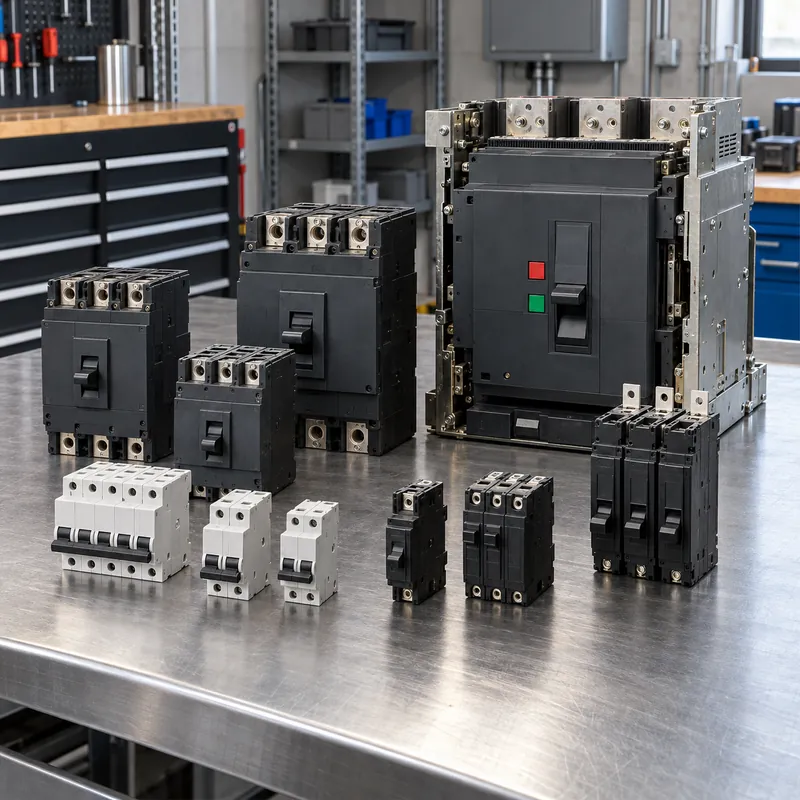
| MCB (miniature) | 0.5–125 A | IEC 60898-1, UL 489 for branch use | Fixed thermal-magnetic, DIN-rail mounting, curves B/C/D |
| RCBO / RCD | 6–63 A, 10–300 mA sensitivity | IEC 61009-1 / IEC 61008-1 | Combined overcurrent and residual current protection |
| MCCB (molded case) | 15–2,500 A | UL 489, IEC 60947-2 | Thermal-magnetic or electronic trip, interrupting ratings of tens of kA |
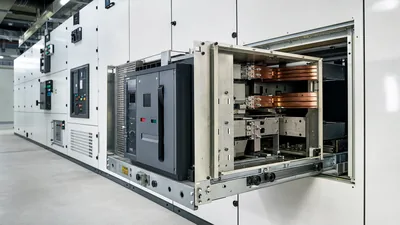
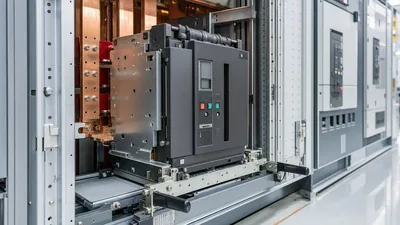
| ACB (air circuit breaker) | 630–6,300 A | IEC 60947-2, UL 1066 / ANSI C37.13 for LV power breakers | Withdrawable, electronic LSIG trip, high short-time withstand |
| Vacuum circuit breaker | 3.6–40.5 kV | IEC 62271-100, IEEE C37.04/C37.09 | MV switchgear, frequent switching |
MCB trip curves define the instantaneous band: type B trips at 3–5 × In for resistive loads and long cables, type C at 5–10 × In for general commercial loads and small motors, and type D at 10–20 × In for transformers and high-inrush equipment.
A main circuit breaker panel or breaker switchboard in a commercial building usually has an MCCB or ACB main with MCCB feeders. Selection criteria such as frame size, trip unit and interrupting rating are compared in the low-voltage circuit breaker selection guide and industrial circuit breakers selection guide. Withdrawable designs are explained in the drawout circuit breaker guide.
How to Choose the Right Breaker for a Panel
A breaker for a panel must satisfy four checks: compatibility, current rating, interrupting rating and protection type.
- Compatibility: use breakers listed for that panel, as stated on the panel's label. Classified replacement breakers are acceptable only where they are specifically listed for use in that panel model.
- Conductor protection: breaker rating must not exceed the conductor ampacity, subject to NEC 240.4.
- Continuous load: per NEC 210.20(A), rating must be at least 125% of the continuous load plus 100% of the non-continuous load.
- Interrupting rating: at least equal to the available fault current at the panel (NEC 110.9), or a listed series rating.
- Protection type: GFCI, AFCI or dual-function where NEC 210.8 and 210.12 require it.
Worked example 1, lighting circuit: LED lighting drawing 16 A for more than 3 hours is a continuous load. Required rating: 16 × 1.25 = 20 A. Use a 20 A breaker with 12 AWG copper.
Worked example 2, EV charger: a 48 A charger is a continuous load. 48 × 1.25 = 60 A. A 60 A double-pole breaker with 6 AWG copper (65 A at 75 °C in NEC Table 310.16) is typical, subject to terminal ratings and the charger's instructions.
Worked example 3, interrupting rating: a 75 kVA, 208Y/120 V transformer with 3% impedance can deliver roughly I_sc = I_FL / Z = 208 / 0.03 ≈ 6,940 A at its terminals. Breakers rated 10 kA are adequate; a larger or lower-impedance transformer may require 22 kA or higher devices. For a full method, see the fault current calculation guide and conductor sizing in the wire size calculator guide.
Breaker Panel Covers, Doors and Dead Fronts
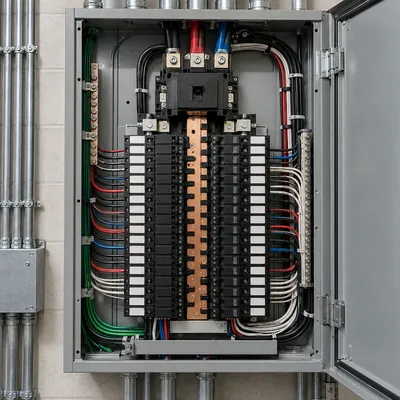
The breaker panel cover, also called the trim or dead front, is the steel plate that surrounds breaker handles and shields energized busbars and terminals from contact. The electrical panel door is the hinged outer panel that covers the handles. Together they form the barrier between people and live parts.
Key points for circuit breaker panel covers and doors:
- Use the listed cover: covers are specific to the panel model and amperage. A generic cover may leave gaps or fail to align with breaker openings.
- Close unused openings: NEC 408.7 requires unused openings for breakers to be closed with identified closures, usually snap-in filler plates.
- Never leave the dead front off: an energized panel without its cover exposes live parts; removing it is a task for a qualified person following NFPA 70E.
- Outdoor panels: NEMA 3R doors include gaskets or drip shields and often a padlock hasp; damaged doors let water in and corrode busbars.
- Decorative covers: art frames or cabinets over a panel must open freely and must not obstruct the NEC 110.26 working space.
- Directory: the circuit directory is usually on the inside of the door; NEC 408.4 requires it to be legible and specific.
Replacement covers and doors are often available from the original manufacturer by panel catalog number, which is printed on the label inside the enclosure. If the panel is obsolete and no listed cover exists, panel replacement may be the safer option.
Electric Panel Breaker Replacement: When and How
Breakers wear out mechanically and thermally. Replacement is indicated when a breaker:
- trips repeatedly at loads well below its rating
- will not reset or will not stay in the ON position
- is hot to touch, discolored, or smells of burnt insulation
- shows scorching on the busbar stab or loose connection
- has been through a major fault or water exposure
- needs upgrading to AFCI, GFCI or dual-function protection
A licensed electrician typically follows this sequence:
- Identify the circuit, confirm the replacement is listed for the panel and matches rating, poles and protection type.
- Switch off and lock out the main disconnect where practicable, following NFPA 70E for the panel's shock and arc flash hazard.
- Remove the dead front and test for absence of voltage with a verified tester.
- Remove the old breaker, inspect the bus stab and conductor for heat damage.
- Install the new breaker, terminate conductors at the manufacturer's torque value and land neutral pigtails for AFCI or GFCI types.
- Refit the dead front, energize, test GFCI or AFCI functions and update the directory.
Line-side service conductors remain energized even with the main breaker off, which is one reason this work is not suitable for untrained persons. In commercial panels, arc flash labels per NFPA 70E indicate the required PPE; see the arc flash study guide.
Writing a Circuit Breaker or Panel Upgrade Proposal
A new circuit breaker wiring proposal or a whole house circuit breaker panel proposal should let an owner compare contractors on equal terms. A clear scope includes:
- Existing conditions: service size, panel make-up, spaces used, known defects, grounding and bonding condition.
- Load calculation: NEC Article 220 result showing why the proposed panel or service size is needed.
- Equipment list: main breaker panel rating, bus material, number of spaces, interrupting rating, and every breaker by type and rating.
- Circuit work: new circuits, rerouted circuits, AFCI/GFCI upgrades, surge protective device.
- Utility and permits: disconnect and reconnect coordination, permit and inspection responsibilities.
- Schedule and outage time.
- Deliverables: updated panel directory and as-built panel schedule.
For commercial projects, the proposal should reference a single-line diagram and a panel schedule, which together define the breaker for power distribution at each level; see the panel schedule guide. Where a new downstream panel is added for a garage, workshop or addition, the feeder and grounding details in the sub panel guide belong in the scope too.
Next Steps: Specifying and Sourcing Commercial Breaker Assemblies
MARS does not sell individual household breakers or residential load centers. For commercial, industrial and utility projects, MARS manufactures complete switchgear assemblies with breakers integrated and type-tested: IEC 61439 LV switchboards (GGD, GCS, MNS) with ACB mains and MCCB feeders, KYN28 metal-clad MV switchgear with withdrawable vacuum circuit breakers, and SF6 ring main units.
For an RFQ, specify:
- System voltage, frequency and earthing system
- Prospective short-circuit current and required breaking capacity (Icu/Ics) or interrupting rating
- Main and feeder breaker ratings, trip unit type and settings range
- Fixed or withdrawable devices, form of separation and IP rating
- Protection, metering and communication requirements
Browse the HV and LV switchgear range and the vacuum circuit breaker guide, then send your single-line diagram through the quote request page. Typical switchgear lead time is 25–45 days with routine tests and optional FAT.
Frequently asked questions
What are the main types of electrical breakers?
Household types include standard single-pole and double-pole breakers, tandem breakers, GFCI, AFCI and dual-function breakers. Commercial and industrial types include miniature circuit breakers, RCBOs, molded-case circuit breakers and air circuit breakers at low voltage, plus vacuum and SF6 circuit breakers in medium-voltage switchgear.
Can I use any brand of breaker in my panel?
No. Use breakers listed for that panel as shown on the panel label. Some classified breakers are listed for use in specific other panels, but mixing unlisted breakers can cause poor bus contact, overheating and voided listings. A licensed electrician should confirm compatibility before installation.
How do I know what size breaker I need?
Match the breaker to the conductor and load. Common pairings are 15 A for 14 AWG copper, 20 A for 12 AWG and 30 A for 10 AWG. For continuous loads, the breaker must be at least 125 percent of the load per NEC 210.20(A). Appliance and EV charger instructions may also specify a breaker size.
Why does my breaker keep tripping?
Common causes are overload from too many devices on a circuit, a short circuit in wiring or an appliance, a ground fault detected by a GFCI, an arcing fault detected by an AFCI, or a worn breaker. Repeated tripping should be investigated by an electrician rather than resolved by fitting a larger breaker.
Do I need a cover on my breaker panel?
Yes. The dead front cover prevents contact with energized busbars and terminals and is part of the panel's listing. Unused breaker openings must be closed with identified filler plates under NEC 408.7. Operating a panel without its cover is a shock and arc flash hazard.
What is the difference between an MCB and an MCCB?
An MCB is a miniature breaker, usually up to 125 A, with fixed thermal-magnetic trip and modest breaking capacity, used for final circuits. An MCCB is a molded-case breaker from about 15 to 2,500 A with higher interrupting ratings and often adjustable or electronic trip units, used for feeders and mains.
Written and reviewed by the MARS application engineering team in Shanghai, who specify and test transformers, switchgear, substations and battery storage for projects in 40+ countries. Last updated .
Tags: electrical breakers breaker for panel breaker panel cover circuit breaker switches electric panel breaker replacement