Key takeaways
- An electrical panel schedule records each circuit's number, description, breaker trip and poles, wire size and connected VA per phase, plus panel voltage, bus, main and AIC rating.
- In a three phase panel schedule, rows rotate A, B, C, so circuits 1-2 are on phase A, 3-4 on B and 5-6 on C, and three-pole loads split evenly across all phases.
- Phase current is phase VA divided by line-to-neutral voltage, so 9,210 VA on phase A of a 208Y/120 V panel is about 77 A on that phase.
- Phase imbalance is the maximum deviation from average phase current divided by the average; keeping it below about 10 percent reduces neutral current and voltage unbalance.
- NEC 408.4(A) requires every circuit to be legibly identified by specific purpose or use, with spares marked, and not described by transient conditions such as current occupants.
Quick answer: A panel schedule is a table that lists every circuit in an electrical panel with its number, description, breaker poles and rating, connected load in VA by phase, and the panel's voltage, bus rating, main device and interrupting rating. It totals load per phase to check balance and capacity, and it doubles as the circuit directory required by NEC 408.4.
Every panel on a set of electrical drawings has a schedule beside it, and every panel in a building should have a directory on its door. They are the same information in two forms: the designer's load calculation and the maintenance team's map. A clear schedule prevents overloaded phases, mislabelled circuits and wrong breakers during later changes.
This guide is for designers, estimators, electricians and facility managers who build or maintain schedules. It explains what goes in an electrical panelboard schedule, how single phase and three phase layouts differ, works through a sample 208Y/120 V schedule with phase totals, and shows how to set up a reusable panel schedule template in Excel.
What Is a Panel Schedule?
A panel schedule is a tabular record of a panelboard's ratings and of every circuit it supplies, with the load on each circuit and the total load on each phase. On construction drawings it is the designer's instruction to the installer; after construction it is the reference for operation, maintenance and future additions.
A panel schedule serves four purposes:
- Load calculation: totals connected and demand load per phase to confirm the bus, main breaker and feeder are adequate.
- Balancing: shows how single-phase loads are spread across phases.
- Installation instruction: tells the electrician which breaker, wire size and position each circuit uses.
- Circuit directory: identifies each circuit so it can be isolated safely.
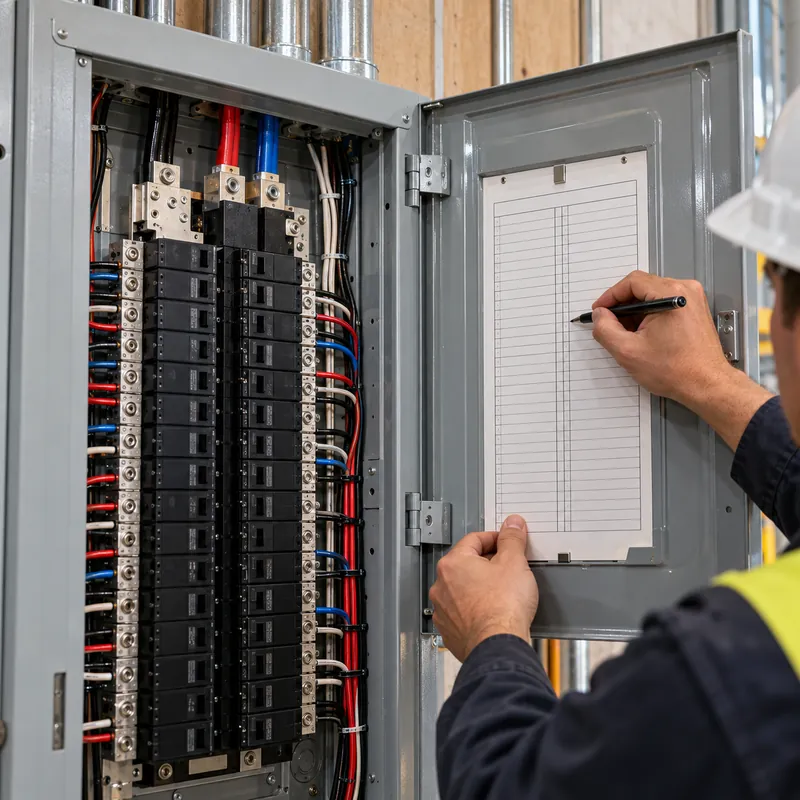
The directory function is a code requirement. NEC 408.4(A) requires every circuit and circuit modification to be legibly identified as to its clear, evident and specific purpose or use, with spare positions marked, on a directory located on the face or inside of the panel door. Descriptions must not depend on transient conditions of occupancy, so "Room 104 receptacles" is acceptable but "Smith office" is not.
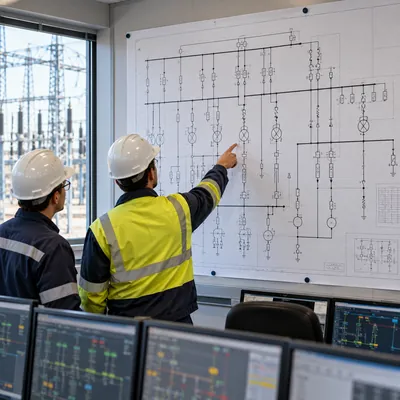
Panel schedules are one layer of a drawing set that starts with the single-line diagram; see the single line diagram guide. The panels they describe are explained in the electrical panel guide.
What Goes on an Electrical Panel Schedule?
A complete electrical panel board schedule has a header block and a circuit table.
| Field | Example | Why it matters |
|---|---|---|
| Panel name and location | LP-2A, Electrical Room 201 | Links schedule to drawings and labels |
| Voltage, phase, wires | 208Y/120 V, 3-phase, 4-wire | Sets VA-to-amps conversion and breaker types |
| Bus rating | 225 A | Upper limit for main and load |
| Main device | 225 A 3-pole main breaker or MLO | Protection and disconnect |
| Short-circuit rating (AIC) | 22 kA | Must meet available fault current |
| Mounting and enclosure | Surface, NEMA 1 | Procurement and installation |
| Fed from and feeder size | MDP circuit 7, 4#4/0 + 1#4 Cu | Traceability to upstream equipment |
| Circuit number | 1, 3, 5 / 2, 4, 6 | Position on bus and phase |
| Description | Lighting, open office north | Directory function |
| Breaker trip and poles | 20 A / 1P | Protection and phase connection |
| Wire and conduit | 2#12, 1#12G, 3/4 in EMT | Installation instruction |
| Load VA by phase | A: 1,440 | Phase totals and balance |
| Load type | L, R, M, H, K (lighting, receptacle, motor, heating, kitchen) | Applying NEC demand factors |
| Notes | GFCI, AFCI, shunt trip, lock-on | Special devices |
Abbreviations such as MLO, AIC, EMT and GFCI are standard on drawings; a reference list is in electrical abbreviations.
Single Phase vs Three Phase Panel Schedule Layout
Layout follows the busbar arrangement of the panel.
| Feature | Single phase panel schedule | Three phase panel schedule |
|---|---|---|
| System | 120/240 V, 3-wire | 208Y/120 V or 480Y/277 V, 4-wire |
| Phase columns | L1 (A), L2 (B) | A, B, C |
| Phase rotation by row | A, B, A, B | A, B, C, A, B, C |
| Multi-pole breakers | 2-pole spans A and B | 2-pole spans two phases; 3-pole spans A, B and C |
| Phase current | VA per leg / 120 V | VA per phase / 120 V or 277 V |
| Total current | Total VA / 240 V (balanced) | Total VA / (√3 × V_LL) (balanced) |
| Typical use | Residential panel schedule, small shops | Commercial and industrial panels |
Odd-numbered circuits run down the left side and even-numbered down the right. In a three phase panel, circuits 1 and 2 share phase A, 3 and 4 phase B, 5 and 6 phase C, then the pattern repeats. A 3-pole breaker at 1-3-5 puts one third of its load on each phase. A 2-pole 208 V load on positions 2-4 puts half its load on A and half on B.
For a residential panel schedule, the same structure applies with two phases. Many homeowners only need the directory part, but a VA column is valuable when adding EV chargers or heat pumps, because it shows how close each leg already is to the main breaker rating. Three-phase panel construction is explained in the 3 phase panel guide.
Sample Electrical Panel Schedule: 208Y/120 V Worked Example
Panel LP-1, 208Y/120 V, 3-phase, 4-wire, 125 A bus, main lug only, fed from a 125 A breaker. Loads in VA:
| Ckt | Description | Brkr | A | B | C |
|---|---|---|---|---|---|
| 1 | Lighting, office | 20/1 | 1,440 | ||
| 2 | Receptacles, office | 20/1 | 1,080 | ||
| 3 | Lighting, corridor | 20/1 | 960 | ||
| 4 | Receptacles, reception | 20/1 | 1,260 | ||
| 5 | Lighting, exterior | 20/1 | 720 | ||
| 6 | Copier | 20/1 | 1,500 | ||
| 7-9-11 | RTU-1 | 40/3 | 3,000 | 3,000 | 3,000 |
| 8 | Receptacles, break room | 20/1 | 1,440 | ||
| 10 | Refrigerator | 20/1 | 900 | ||
| 12 | Microwave | 20/1 | 1,500 | ||
| 13-15 | Water heater, 208 V | 30/2 | 2,250 | 2,250 | |
| Phase totals | 9,210 | 8,370 | 6,720 |
Phase currents: I = VA / 120, giving A = 76.8 A, B = 69.8 A, C = 56.0 A.
Total: 24,300 VA; balanced equivalent 24,300 / (1.732 × 208) ≈ 67.5 A.
Imbalance: (76.8 − 67.5) / 67.5 ≈ 13.8%. Moving circuit 8 (1,440 VA) to a phase C position gives 7,770 / 8,370 / 8,160 VA, or 64.8 / 69.8 / 68.0 A, and imbalance falls to about 3.3%.
Feeder check: adding 25% of continuous lighting load (3,120 VA × 0.25 = 780 VA) gives about 25,080 VA, or 70 A. The 125 A bus leaves roughly 40% for growth.
How to Build a Panel Schedule Template in Excel
An electrical panel schedule template in Excel saves time and removes arithmetic errors. A practical layout:
- Header block at the top with named cells for voltage line-to-neutral (V_LN), line-to-line (V_LL), phases, bus rating and main.
- Circuit table with columns: circuit number, description, load type, poles, trip, wire, and one VA column per phase. Use two mirrored tables for left (odd) and right (even) sides.
- Phase assignment column generated from circuit number. For three phase:
=CHOOSE(MOD(INT((n-1)/2),3)+1,"A","B","C"), where n is the circuit number. - VA split for multi-pole loads: divide the load by the number of poles and place it in each phase column the breaker spans.
- Phase totals with
=SUM()per phase column across both sides, and phase amps as total VA divided by V_LN. - Balanced current as
=Total_VA/(SQRT(3)*V_LL)for three phase or=Total_VA/240for single phase. - Imbalance as
=(MAX(Ia,Ib,Ic)-AVERAGE(Ia,Ib,Ic))/AVERAGE(Ia,Ib,Ic), with conditional formatting above 10%. - Demand summary by load type using
=SUMIF(), applying NEC 220 demand factors, for example the first 10 kVA of receptacle load at 100% and the remainder at 50% under NEC 220.44.
Protect the formula cells and keep the template for single phase panel schedule and three phase versions on separate tabs. For a printable panel schedule or blank panel schedule used as a door directory, set the print area to the circuit table only, use at least 9-point text, and print on durable label stock or place the sheet in a plastic sleeve inside the door.
Panel Schedules in Drawings and Design Software
On construction documents, each panel schedule sits on the electrical schedules sheet and must agree with three other things: the single-line or riser diagram, the floor plans and the load calculation. Circuit numbers on plan homeruns, such as "LP-1-7,9,11", point directly to schedule rows.
Most electrical design platforms generate panel schedules automatically from circuited devices on the plans, which keeps schedules and plans consistent; tools and workflows are compared in the electrical design software guide. Spreadsheet schedules remain common on smaller projects and for facility records.
Review checklist before issuing a schedule:
- Every breaker trip suits its conductor size and load, including 125% for continuous loads.
- Multi-pole breakers sit on adjacent positions and span the correct phases.
- GFCI, AFCI, shunt-trip and lock-on devices are noted.
- Spare breakers and spaces are listed separately; a spare has a breaker installed, a space does not.
- Phase totals, imbalance and demand load are within bus and feeder capacity.
- Header AIC rating meets the calculated fault current.
- Feeder size and upstream breaker match the single-line diagram.
For reading schedules alongside plans and risers, see how to read electrical drawings.
Next Steps: Specifying and Sourcing Panels From Your Schedule
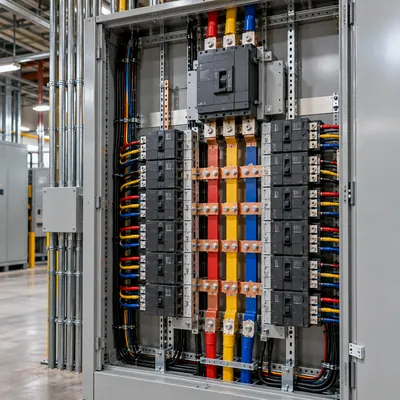
A finished panel schedule is the most efficient way to brief a switchgear manufacturer. It already contains the bus rating, main device, fault level and every outgoing breaker. For main distribution boards and sub-distribution switchboards, add:
- Required standard (IEC 61439, UL 891 or UL 67) and frequency
- Form of internal separation, IP or NEMA rating and ambient conditions
- Fixed or withdrawable functional units for each feeder
- Metering, surge protection and communication requirements
- Cable entry direction and room dimensions
MARS manufactures IEC 61439 LV switchboards in GGD, GCS and MNS designs, KYN28 MV switchgear and SF6 ring main units, and the distribution transformers and compact substations that supply them. Residential load centers are outside the MARS range. Review breaker selection in the electrical breakers guide, browse HV and LV switchgear, and send your schedules and single-line diagram through the quote request page.
Frequently asked questions
What is a panel schedule in electrical drawings?
A panel schedule is a table on electrical drawings that defines one panelboard: its voltage, phase, bus rating, main device and short-circuit rating, and every circuit with number, description, breaker size and poles, wire size and load in VA on each phase. It totals load per phase to verify capacity and balance.
How do you calculate load on a panel schedule?
Enter each circuit's connected load in VA under the phase or phases its breaker connects to, splitting multi-pole loads equally. Sum each phase column. Divide each phase total by line-to-neutral voltage for phase current. For a balanced three-phase total, divide total VA by √3 times line-to-line voltage, then apply NEC Article 220 demand factors.
What is the difference between a spare and a space on a panel schedule?
A spare is a position with a breaker installed but no circuit connected, ready for future use. A space is an empty position with no breaker, closed by a filler plate, where a breaker can be added later. Both should be listed so future capacity is clear.
How are circuits numbered in a three phase panel schedule?
Odd numbers run down the left side and even numbers down the right. Each horizontal pair shares a phase, rotating A, B, C: circuits 1 and 2 on phase A, 3 and 4 on B, 5 and 6 on C, then 7 and 8 back on A. A three-pole breaker at 1-3-5 connects to all three phases.
Is a panel schedule required by code?
The NEC requires a circuit directory under 408.4(A), with every circuit legibly identified by specific purpose and spares marked, on the panel door or face. Full load-calculation schedules are normally required by permit authorities and project specifications for commercial work rather than by a specific NEC clause.
What should a residential panel schedule include?
At minimum, each circuit number, its breaker rating and a specific description such as kitchen counter receptacles east wall. Adding the protection type, such as AFCI or GFCI, and approximate load in VA helps when planning EV chargers, heat pumps or battery storage, because it shows how much capacity each leg has left.
Written and reviewed by the MARS application engineering team in Shanghai, who specify and test transformers, switchgear, substations and battery storage for projects in 40+ countries. Last updated .
Tags: panel schedule electrical panel schedule electrical panel schedule template 3 phase panel schedule sample electrical panel schedule