Key takeaways
- A sub panel is protected by its feeder breaker in the upstream panel, so a main lug only panel is acceptable when that breaker does not exceed the sub panel's bus rating.
- Neutral and equipment ground must be isolated at every sub panel; the neutral-to-ground bond exists only at the service equipment under NEC 250.24 and 250.142.
- A 100 A sub panel feeder typically uses 3 AWG copper or 1 AWG aluminum at 75 °C with an 8 AWG copper equipment grounding conductor from NEC Table 250.122.
- A sub panel in a detached building needs a disconnecting means at the building under NEC Article 225 and a grounding electrode system under NEC 250.32.
- Outdoor electrical panels should be at least NEMA 3R for rain and sleet, with NEMA 4X or stainless enclosures preferred in coastal, washdown or corrosive locations.
Quick answer: A sub panel is a downstream panelboard fed from a breaker in the main panel that adds circuit spaces closer to the loads, such as in a garage, workshop or addition. It needs a feeder sized to its breaker, separate neutral and ground bars with no bonding, and, in a detached building, its own disconnect and grounding electrode. Outdoor sub panels need a NEMA 3R or better enclosure.
Most homes and small businesses eventually need more circuits than the main panel can hold, or need circuits far from it. Running every new circuit back to the main panel wastes copper and adds voltage drop. A sub panel solves both: one feeder carries power to a new panel, and short branch circuits run from there.
This guide is for homeowners planning a garage, shop or addition, facility staff extending a building, and designers who want a clear explanation of panels and sub panels. It covers when a sub panel makes sense, MLO versus main breaker types, feeder and grounding sizing with a worked example, detached-building rules and outdoor panel boxes. Work on service and feeder equipment must follow local code and be done by a licensed electrician.
What Is a Sub Panel and When Do You Need One?
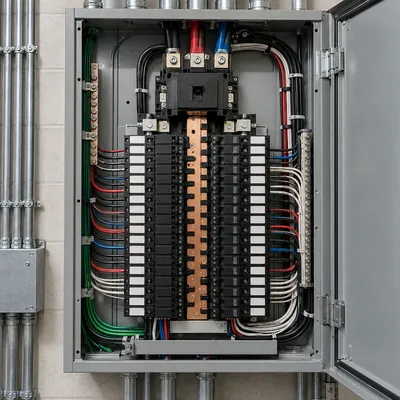
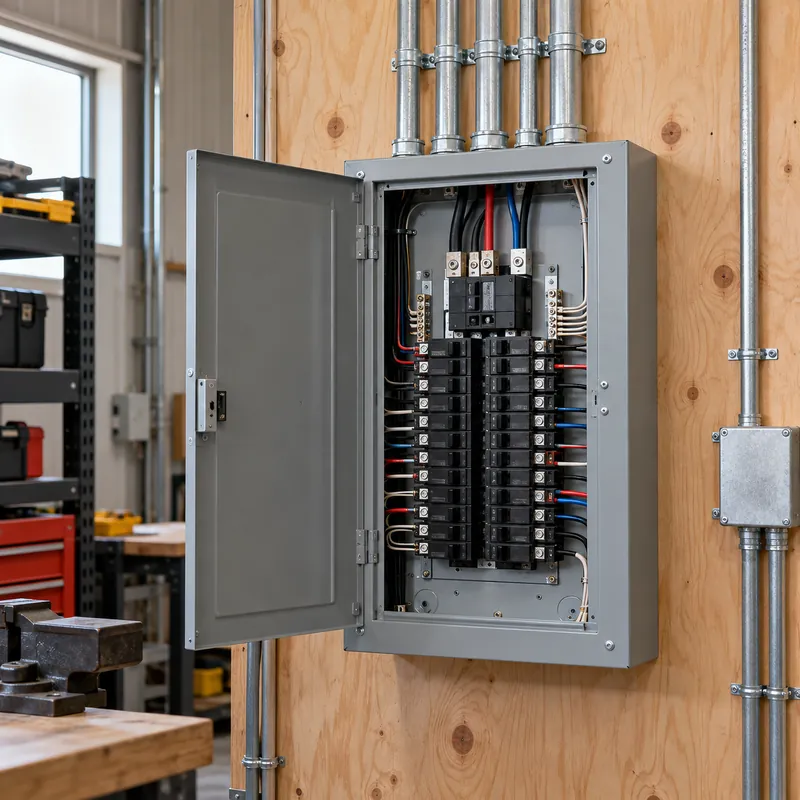
A sub panel (subpanel, or subpanel eléctrico in Spanish-language references) is a panelboard supplied by a feeder from another panel rather than directly from the utility service. Electrically it is a branch of the main panel with its own busbars and breakers.
Common reasons to add one:
- Main panel is full but the service has capacity left.
- Distance: a garage, workshop, barn, pool equipment or addition far from the main panel.
- Load grouping: a kitchen or HVAC sub panel, or a critical-load panel fed through a transfer switch for generator or battery backup.
- Separate building: detached garages and outbuildings need a disconnect at the building anyway.
- Commercial tenant spaces fed from a main distribution board.
A sub panel does not add capacity to the service. If the load calculation shows the existing service is near its limit, a service upgrade or load management is needed first; see electrical panel sizes for the calculation method.
Small electrical panels with 4 to 12 spaces are typical for sheds and garages; a 4 breaker box can serve lighting, a couple of receptacle circuits and one 240 V tool circuit. Larger shops and additions usually take a 100 A panel with 20 to 30 spaces, leaving room to grow. How a panel works internally, including the busbars and breakers, is explained in the electrical panel guide.
Main Panel vs Sub Panel: What Is Different?
Main panels and sub panels can be the same model of electrical load center. A load center is a panelboard designed for residential and light commercial use with plug-on breakers. What changes is how it is connected.
| Feature | Main (service) panel | Sub panel |
|---|---|---|
| Supply | Utility service conductors via meter | Feeder from a breaker in another panel |
| Main disconnect | Required (service disconnect) | Not required in the same building; required at a separate building |
| Neutral-to-ground bond | Yes, main bonding jumper installed | No; bonding screw or strap removed |
| Neutral bar | Bonded to enclosure | Isolated from enclosure |
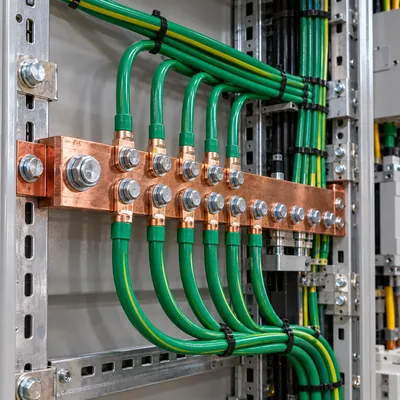
| Ground bar | Bonded to enclosure and grounding electrode | Bonded to enclosure, connected to the feeder EGC |
| Feeder conductors | Service entrance, 3 wires plus GEC | 4 wires: two hots, neutral, equipment ground |
| Grounding electrode | Required | Only if in a separate building or structure |
The key rule is that neutral current must return only on the neutral. If the neutral and ground were bonded in a sub panel, normal neutral current would split onto the ground wire, conduit and metal water pipes, energizing metal parts and defeating GFCI and fault-clearing assumptions. NEC 250.142(B) generally prohibits using the grounded conductor for grounding equipment on the load side of the service disconnect.
Equipment grounding conductor sizing for the feeder follows NEC Table 250.122; see equipment grounding conductor sizing.
MLO Panel vs Sub Panel With Main Breaker
A main lug only (MLO) panel is a panelboard whose supply conductors terminate on lugs connected directly to the busbars, without a main breaker. The panel is protected by the overcurrent device feeding it. So, contrary to a common misunderstanding, an MLO panelboard does not have a main circuit breaker; that is the meaning of the term.
An MLO sub panel is acceptable when the feeder breaker in the upstream panel does not exceed the sub panel's bus rating (NEC 408.36) and the sub panel is in the same building. A sub panel with a main breaker is useful when:
- the panel is in a separate building and the main breaker serves as the required building disconnect;
- the feeder breaker is larger than the bus rating, for example a 125 A bus panel fed from a 150 A breaker, where the main breaker protects the bus;
- a local shut-off is wanted in a workshop for convenience and maintenance;
- a main breaker panel is cheaper or more available than the MLO version, which is often the case.
Using a main breaker panel as a sub panel is common and permitted. The main breaker simply becomes a disconnect in series with the feeder breaker; coordination is not a concern at residential scale.
Panels used as building disconnects must be suitable for that use; the role of disconnecting means is covered in the electrical disconnect switch guide.
How Do You Size a Sub Panel Feeder? Worked Example
Sub panel sizing has four parts: panel rating, feeder breaker, conductors and voltage drop.
- Calculate the sub panel load using NEC Article 220.
- Select the feeder breaker at or above the calculated load (125% for continuous loads) and not above the bus rating unless a main breaker is fitted.
- Size conductors from NEC Table 310.16 at the termination temperature, usually 75 °C.
- Size the EGC from NEC Table 250.122 based on the feeder breaker.
- Check voltage drop, targeting 3% or less on the feeder.
| Feeder breaker | Copper (75 °C) | Aluminum (75 °C) | EGC copper (Table 250.122) |
|---|---|---|---|
| 30 A | 10 AWG | 8 AWG | 10 AWG |
| 60 A | 6 AWG | 4 AWG | 10 AWG |
| 100 A | 3 AWG | 1 AWG | 8 AWG |
| 125 A | 1 AWG | 2/0 AWG | 6 AWG |
| 150 A | 1/0 AWG | 3/0 AWG | 6 AWG |
| 200 A | 3/0 AWG | 250 kcmil | 6 AWG |
Worked example: a 100 A sub panel in a detached garage 150 ft from the main panel, 240 V, calculated load 80 A. Copper 3 AWG (52,620 circular mils, K = 12.9):
VD = 2 × K × I × L / CM = 2 × 12.9 × 80 × 150 / 52,620 ≈ 5.9 V, which is 5.9 / 240 ≈ 2.5%. Acceptable.
At 250 ft the drop rises to about 4.1%, so 1 AWG copper (about 2.6%) or an equivalent aluminum size would be chosen. Full method in the wire size calculator guide. Values assume NEC Table 310.16 with 75 °C terminations and no ambient or bundling correction.
Sub Panels in Detached Buildings
A sub panel in a separate structure such as a detached garage, barn or workshop has extra requirements beyond one in the same building:
- Disconnecting means: NEC Article 225 Part II requires a disconnect at the building, located at a readily accessible point nearest the point of entrance of the conductors, either outside or inside. A main breaker sub panel or a separate disconnect switch provides it.
- Four-wire feeder: two ungrounded conductors, a neutral and an equipment grounding conductor. Three-wire feeders with the neutral bonded at the outbuilding remain only under the NEC 250.32 exception for existing installations.
- Grounding electrode system: NEC 250.32 requires a grounding electrode at the building, typically two ground rods or a concrete-encased electrode, connected to the ground bar.
- Neutral isolated: the neutral stays isolated from the enclosure and ground bar, as with any sub panel.
- Wiring method: underground conductors in conduit or direct-burial cable at the cover depths of NEC Table 300.5; overhead spans per Article 225 clearances.
- Surge protection: long feeders to outbuildings benefit from a surge protective device at the sub panel.
Detached-building sub panels are often outdoors or in unconditioned spaces, which leads to enclosure selection.
Outdoor Panels: Choosing an Exterior Electrical Panel Box
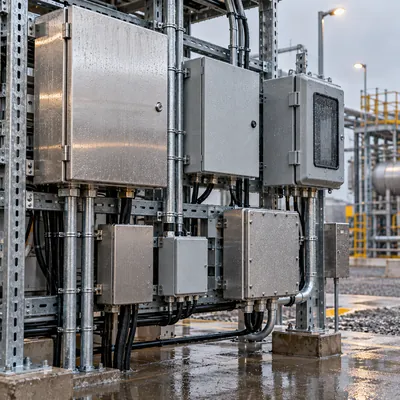
An outdoor electrical panel, sometimes called an exterior sub panel or outside breaker panel, must exclude rain and resist corrosion. Enclosure ratings follow NEMA 250 in North America and IEC 60529 IP codes elsewhere.
| Rating | Protection | Typical use |
|---|---|---|
| NEMA 1 | Indoor, protection against contact and falling dirt | Indoor sub panel, utility rooms |
| NEMA 3R | Outdoor, rain, sleet, snow, external ice formation | Most outdoor circuit breaker panels and meter-mains |
| NEMA 4 | Outdoor, hose-directed water, windblown dust | Washdown areas, exposed industrial sites |
| NEMA 4X | As NEMA 4 plus corrosion resistance | Coastal, pool, agricultural, chemical areas |
| IP54 / IP55 / IP65 | IEC dust and water protection levels | IEC-market outdoor boards |
NEMA and IP ratings do not convert exactly; see NEMA vs IP rating and the full NEMA enclosure ratings guide.
Practical points for an outdoor main breaker panel or outdoor sub panel:
- Enter conduits from the bottom or sides with listed hubs; top entries need watertight hubs to keep a 3R rating.
- Seal conduits that run from warm interiors to prevent condensation.
- Avoid direct afternoon sun on panels with heavy loads; heat derates breakers.
- Provide the same 30 in by 36 in working space outdoors as indoors.
- Gray or white electrical panel finishes are common; white or light finishes run slightly cooler in sun.
Outdoor circuit breaker panel replacement is often driven by rust at the bottom of 3R enclosures, which can reach busbars.
Next Steps: Specifying and Sourcing Distribution Boards
MARS does not manufacture residential load centers or small sub panels. For commercial, industrial and infrastructure sites, the equivalent of a sub panel is a distribution board or sub-distribution switchboard fed from a main LV switchboard, and that equipment MARS does build: IEC 61439 GGD, GCS and MNS boards, outdoor kiosks and compact substations combining transformer, MV switchgear and LV distribution in one enclosure.
For a sub-distribution board or outdoor kiosk RFQ, provide:
- Supply voltage, phases and earthing system (TN-S, TN-C-S, TT)
- Incoming feeder rating and prospective fault current
- Outgoing circuit list with breaker types and ratings
- IP or NEMA rating, ambient range, corrosion environment
- Metering, surge protection and remote monitoring needs
For three-phase commercial sub-distribution, read the 3 phase panel guide. Browse the HV and LV switchgear range or transformer substations for outdoor packaged solutions, and send requirements through the quote request page.
Frequently asked questions
Does a sub panel need a main breaker?
Not in the same building, provided the feeder breaker upstream does not exceed the sub panel's bus rating. A main lug only panel is acceptable there. In a detached building, a disconnect is required at the building, and a main breaker in the sub panel commonly provides it. Many installers use main breaker panels anyway for convenience.
Why are neutral and ground separated in a sub panel?
The neutral-to-ground bond is made only at the service equipment. If neutral and ground were bonded again in a sub panel, normal neutral current would flow on ground wires, conduit and metal piping, energizing metal surfaces and creating shock and fire risk. Separating them keeps ground conductors carrying current only during faults.
What size wire do I need for a 100 amp sub panel?
Using NEC Table 310.16 at 75 degrees C, a 100 A feeder typically uses 3 AWG copper or 1 AWG aluminum for the hots and neutral, with an 8 AWG copper or 6 AWG aluminum equipment grounding conductor from Table 250.122. Long runs may need larger conductors to keep voltage drop near 3 percent.
What does MLO mean on a panel?
MLO means main lug only. The panel's supply conductors connect to lugs on the busbars and there is no main breaker inside. The panel relies on an upstream breaker for overcurrent protection and disconnection. MLO panels are commonly used as sub panels and in commercial multi-panel installations.
Can a sub panel be installed outside?
Yes, if the enclosure is rated for the location, at least NEMA 3R for rain and sleet, and installed with watertight conduit entries, proper working clearance and protection from physical damage. NEMA 4X or stainless enclosures suit coastal or corrosive locations. Installation must follow local code and be done by a licensed electrician.
How far can a sub panel be from the main panel?
There is no fixed maximum distance. The limit is practical: voltage drop and cost. Feeders are commonly sized to keep drop near 3 percent, so longer runs need larger conductors. For example, a 100 A feeder carrying 80 A at 240 V with 3 AWG copper reaches about 2.5 percent drop at 150 feet.
Written and reviewed by the MARS application engineering team in Shanghai, who specify and test transformers, switchgear, substations and battery storage for projects in 40+ countries. Last updated .
Tags: sub panel sub panel with main breaker outdoor electrical panel electrical load center panel mlo