Key takeaways
- NEMA 250 defines enclosure types by tested performance against dust, rain, hose-directed water, ice, corrosion, oil and submersion; UL 50E and CSA C22.2 No. 94 certify the same types.
- A general purpose NEMA enclosure is Type 1, intended for indoor use where only contact with live parts and falling dirt must be prevented.
- Type 3R keeps out rain, sleet and snow but not windblown dust, which makes it the default for outdoor switchgear and service equipment in mild climates.
- Type 4X equals Type 4 hosedown protection plus corrosion resistance, typically achieved with 304 or 316 stainless steel, fiberglass or polycarbonate.
- Sealed Type 4 or 12 enclosures cannot use filtered fans, so heat-producing equipment above roughly 100 W often needs a heat exchanger or enclosure air conditioner.
Quick answer: NEMA enclosure ratings are type numbers defined in NEMA 250 that state which environmental conditions an electrical enclosure withstands. Type 1 is general-purpose indoor; Type 12 adds indoor dust and drip protection; Type 3R is outdoor rain-resistant; Type 4 resists hose-directed water; Type 4X adds corrosion resistance; Types 6 and 6P resist submersion. Types 7, 8, 9 and 10 cover hazardous locations.
Choosing an enclosure type is a low-cost decision with a high cost of getting it wrong. A Type 1 cabinet in a washdown area corrodes and trips in months; a stainless Type 4X box in a clean electrical room wastes money and traps heat. The NEMA type number is the shorthand that buyers, inspectors and manufacturers use to agree on what the enclosure must survive.
This guide is for panel builders, plant engineers and specifiers working with North American projects or ANSI-variant equipment. It gives a NEMA rating chart, explains the most specified types (1, 3R, 4, 4X, 6P and 12), shows how to select by location and how to check heat rise. For conversions between systems, see our companion article on NEMA vs IP rating.
What Does NEMA Stand For in Electrical Enclosures?
NEMA stands for the National Electrical Manufacturers Association, the US trade association that publishes product standards for electrical equipment. In the enclosure context, NEMA meaning is almost always shorthand for NEMA 250, Enclosures for Electrical Equipment (1000 Volts Maximum).
A NEMA enclosure rating is a type designation that certifies an enclosure protects people from hazardous parts and protects equipment inside from specified external conditions, verified by defined tests. The type is a performance claim, not a dimension or a material.
What items are normally found in a NEMA standard such as NEMA 250:
- Definitions of each enclosure type and the conditions it addresses.
- Construction requirements: gasketing, door latching, drain and vent provisions, knockouts and mounting.
- Test methods: rod entry, drip, rain, dust, hosedown, external icing, corrosion (salt spray), oil exclusion and submersion.
- Marking requirements so installers and inspectors can verify the type.
In practice, certification comes from UL 50 and UL 50E in the US and CSA C22.2 No. 94.1 and 94.2 in Canada, which are harmonized with NEMA 250 type definitions. A listed product carries the label "Type 4X" rather than "NEMA 4X", but the industry uses both. NEMA ratings for electrical enclosures apply up to 1,000 V; medium-voltage switchgear uses IEEE C37.20 series construction requirements instead.
NEMA Rating Chart: Enclosure Types at a Glance
The NEMA enclosure ratings chart below summarizes NEMA 250 types for non-hazardous locations. A check mark means the type is tested for that condition.
| Type | Location | Falling dirt | Dripping water | Rain, sleet, snow | Windblown dust | Hosedown | Corrosion | Submersion | Oil, coolant |
|---|---|---|---|---|---|---|---|---|---|
| 1 | Indoor | ✓ | – | – | – | – | – | – | – |
| 2 | Indoor | ✓ | ✓ | – | – | – | – | – | – |
| 3R | Indoor/outdoor | ✓ | ✓ | ✓ | – | – | – | – | – |
| 3 / 3S | Indoor/outdoor | ✓ | ✓ | ✓ | ✓ | – | – | – | – |
| 3X / 3RX / 3SX | Indoor/outdoor | ✓ | ✓ | ✓ | as base type | – | ✓ | – | – |
| 4 | Indoor/outdoor | ✓ | ✓ | ✓ | ✓ | ✓ | – | – | – |
| 4X | Indoor/outdoor | ✓ | ✓ | ✓ | ✓ | ✓ | ✓ | – | – |
| 5 | Indoor | ✓ | ✓ | – | settling dust | – | – | – | – |
| 6 | Indoor/outdoor | ✓ | ✓ | ✓ | ✓ | ✓ | – | temporary | – |
| 6P | Indoor/outdoor | ✓ | ✓ | ✓ | ✓ | ✓ | ✓ | prolonged | – |
| 12 / 12K | Indoor | ✓ | ✓ | – | circulating dust | – | – | – | seepage |
| 13 | Indoor | ✓ | ✓ | – | circulating dust | – | – | – | spraying |
Types 3, 3R, 3S, 4, 4X, 6 and 6P must also remain undamaged by external ice formation; Type 3S additionally keeps external operating mechanisms usable when ice-laden. Types 7, 8, 9 and 10 are for hazardous (classified) locations and are covered in our NEMA vs IP and Class I Division 2 guide.
Indoor Enclosures: NEMA 1, 2, 5, 12 and 13
NEMA 1 enclosure. A Type 1 electrical enclosure is a general-purpose indoor box that prevents contact with live parts and keeps out falling dirt. It may have ventilation louvers and open knockouts. This is the answer to "a general purpose NEMA enclosure is type ___": Type 1. Typical uses: panelboards, lighting contactors and switchboards in dry electrical rooms.
NEMA 2 enclosure. Type 2 adds a drip shield or drip-tight top for locations with occasional condensation or dripping, such as basements or under pipework.
NEMA 5 enclosure. Type 5 is gasketed against settling airborne dust and light dripping water, without knockouts that would admit dust.
NEMA 12 enclosure. The NEMA 12 rating is the industrial indoor workhorse. A Type 12 enclosure is built without knockouts and gasketed to exclude circulating dust, lint, fibers and flyings, dripping and light splashing water, and seepage of oil and noncorrosive coolant. Type 12K is the same with factory knockouts. A NEMA 12 box or NEMA 12 cabinet suits machine control panels, motor control centers and VFD enclosures in factories, warehouses and textile mills, but not washdown areas or outdoors.
NEMA 13 enclosure. Type 13 resists spraying, splashing and seepage of water, oil and coolant, often specified for machine-tool control stations where cutting fluid is sprayed.
Indoor equipment covered elsewhere on our blog, such as electrical control panels and motor control centers, is usually specified as Type 1 or Type 12.
What Does NEMA 3R Mean? Outdoor Types 3, 3R and 3S
A Type 3R enclosure is intended for indoor or outdoor use and protects against falling dirt, rain, sleet and snow, and remains undamaged by external ice formation. It does not claim protection against windblown dust. Because it may include drain holes and screened ventilation, a NEMA 3R enclosure suits heat-producing equipment such as outdoor switchboards, meter centers, service disconnects and transfer switches.
NEMA 3R enclosure specifications to confirm on a datasheet:
- Rain test compliance per UL 50E, with a drip-shielded top or sloped roof.
- Gasketed or overlapping door with padlockable latch.
- Bottom drain and, if fitted, louvers with insect screens.
- Finish: galvanized or galvannealed steel with polyester powder coat, or aluminum.
- Conduit entry: knockouts are typically allowed only below the lowest live part, or with hubs listed for wet locations on the top.
Type 3 adds windblown dust protection and Type 3S further requires that external mechanisms such as disconnect handles remain operable when covered with ice. The X suffix (3X, 3RX, 3SX) adds corrosion resistance.
NEMA 3R junction box sizes and NEMA 4 enclosure dimensions are not set by NEMA 250. Common catalog sizes run from 6 × 6 × 4 in up to 36 × 30 × 12 in and larger; box fill must satisfy NEC 314.16 and 314.28. For outdoor terminal boxes on substations and transformers, see our outdoor terminal box guide.
NEMA 4 vs NEMA 4X Enclosure: What Is the Difference?
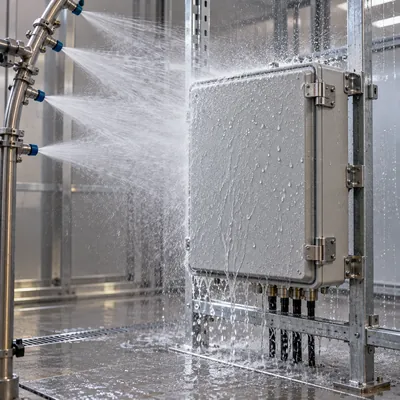
A Type 4 enclosure protects against falling dirt, rain, sleet, snow, windblown dust, splashing water and hose-directed water, and remains undamaged by external ice. The NEMA 4 enclosure definition is centered on the hosedown test, in which a 1-inch nozzle delivering about 65 gallons per minute is played over every seam from a short distance without water entering.
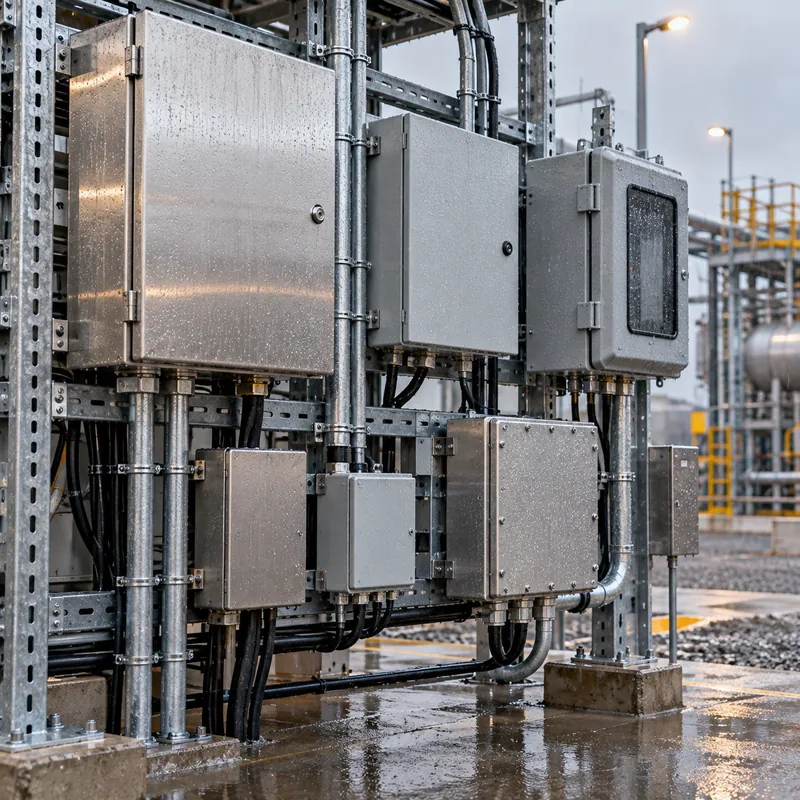
A Type 4X enclosure meets every Type 4 requirement and adds protection against corrosion, verified by an extended salt-spray test. What does NEMA 4X mean in practice? Stainless steel, fiberglass-reinforced polyester or polycarbonate construction, used where washdown chemicals, salt air or process fumes would attack painted steel.
| Attribute | NEMA 4 | NEMA 4X |
|---|---|---|
| Hose-directed water | Yes | Yes |
| Windblown dust, rain, ice | Yes | Yes |
| Corrosion resistance | Not tested | Tested |
| Typical materials | Painted carbon steel | 304 or 316 stainless, fiberglass, polycarbonate |
| Typical uses | Outdoor panels, car washes, dusty yards | Food and beverage, wastewater, coastal, chemical |
| Minimum IP equivalent (NEMA 250 comparison) | IP56 (often also tested to IP66) | IP56 (often also tested to IP66) |
Choose 316 over 304 stainless for chloride exposure such as marine sites, swimming pools and wastewater chlorination. A NEMA 4X panel needs listed watertight conduit hubs and sealed operators; one unsealed pushbutton defeats the rating. There is no NEMA 4R type; searches for it usually mean 3R or 4X.
NEMA 6 and 6P Enclosures for Submersion
A Type 6 enclosure protects against hose-directed water and the entry of water during occasional temporary submersion at a limited depth, and against damage from external ice. A Type 6P enclosure adds protection during prolonged submersion at a limited depth and adds corrosion resistance. The NEMA 6P rating is therefore the most demanding non-hazardous water rating in NEMA 250.
NEMA 250 tests Type 6 by submersion at about 6 ft (1.8 m) for 30 minutes and Type 6P by submersion for 24 hours, or by equivalent air-pressure tests. That makes Type 6P roughly comparable to IP68 for a declared depth and time, though IP68 conditions are agreed between manufacturer and user and are not fixed.
Typical applications for a NEMA 6 box or NEMA type 6 enclosure:
- Flood-prone vaults and pits, including underground distribution vaults.
- Lift stations and wet wells in water and wastewater plants.
- Instrument and junction boxes on quays, docks and bridges.
- Below-grade cable splice and terminal enclosures.
Submersible enclosures cannot dissipate much heat and cannot breathe, so they suit passive equipment, terminals and low-loss instruments rather than drives or transformers. Equipment that must operate in flooded vaults, such as submersible network transformers and underground switchgear, follows dedicated IEEE standards; see our underground switchgear guide.
How to Choose a NEMA Rated Enclosure
Follow these steps to choose among NEMA rated enclosures:
- Classify the location. Hazardous vapors or dust require Types 7, 8, 9 or 10 or another hazardous-location method before anything else.
- Indoor or outdoor. Outdoor means Type 3R minimum; add dust (3), ice-operable mechanisms (3S) or hosedown (4) as conditions demand.
- Water exposure. Dripping (2, 12), hosedown or washdown (4, 4X), submersion (6, 6P).
- Contaminants. Circulating dust and oil seepage (12), sprayed coolant (13), corrosive agents (X suffix).
- Heat. Calculate internal losses and check temperature rise.
- Accessories. Confirm every hub, window, fan and operator carries the same type rating.
Heat-rise example. A VFD and control gear dissipate 300 W in a sealed Type 12 wall-mounted enclosure of 600 × 600 × 250 mm. Exposed area, excluding the back: front 0.36 m², top 0.15 m², two sides 0.30 m², total 0.81 m². With a heat transfer coefficient of about 5.5 W/m²K for painted steel: ΔT = P / (k × A) = 300 / (5.5 × 0.81) = 67 K. Far too high. A vented Type 1 version could use a fan sized by V (m³/h) ≈ 3.1 × P / ΔT = 3.1 × 300 / 10 = 93 m³/h, but a filtered fan voids the Type 12 rating. To keep Type 12 or 4, specify an air-to-air heat exchanger or closed-loop enclosure air conditioner rated for the type. Our electrical enclosures engineering guide covers thermal design in more depth.
Next Steps: Specifying and Sourcing NEMA Enclosures
On equipment schedules and RFQs, state the required type by number (for example "Type 4X, 316 stainless"), the ambient range, the heat dissipation, and whether the rating must be certified by UL 50E or CSA C22.2 No. 94 or can be manufacturer-declared. Ask for rating continuity across hubs, windows and operators.
For larger power equipment the enclosure is part of the product design:
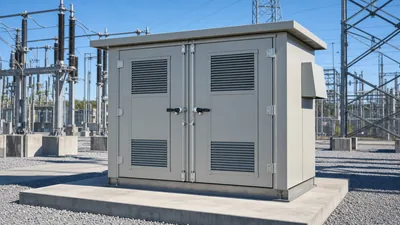
- Outdoor LV switchboards and distribution boards: Type 3R or IP54/IP55 with drip roofs, anti-condensation heaters and sun shields.
- Pad-mounted transformers: tamper-resistant construction per IEEE C57.12.28, with stainless or coastal-grade finishes per IEEE C57.12.29 where corrosion is severe; see our 3-phase pad-mounted transformer guide.
- Compact substations and BESS containers: weatherproof housings with ventilation or HVAC sized to losses.
MARS builds LV switchgear, ring main units, pad-mounted transformers and compact substations in ANSI/IEEE and IEC variants, with enclosure ratings and finishes chosen to suit the site, and routine tests on every unit. Lead times are typically 25 to 45 days. Explore the HV and LV switchgear range or pad-mounted transformers, and send your environment and enclosure requirements through the quote form.
Frequently asked questions
What is the difference between NEMA 3R and NEMA 4?
NEMA 3R protects against rain, sleet, snow and external ice but not windblown dust or hose-directed water, and may have drain holes and vents. NEMA 4 adds protection against windblown dust, splashing water and hose-directed water, so it is gasketed and sealed. Type 4 is required where equipment is washed down.
What does NEMA 12 rating mean?
A NEMA 12 rating means the enclosure is for indoor use and protects against circulating dust, lint, fibers and flyings, dripping and light splashing water, and seepage of oil and noncorrosive coolants. Type 12 enclosures have no knockouts; Type 12K is the same design with factory knockouts.
Is NEMA 4X waterproof?
NEMA 4X is watertight against rain and hose-directed water and resists corrosion, but it is not rated for submersion. For occasional temporary submersion choose Type 6, and for prolonged submersion choose Type 6P. The NEMA 250 comparison maps NEMA 4X to at least IP56 when converting from NEMA to IP; IP66 applies only where the enclosure is separately tested to IEC 60529.
Can a NEMA 12 enclosure be used outdoors?
No. Type 12 is tested only for indoor conditions and does not cover rain, sleet, snow or ice. Outdoors, use Type 3R as a minimum, Type 3 where windblown dust is present, Type 4 where hosedown or driven rain occurs, and Type 4X in corrosive or coastal locations.
What is a NEMA 6P enclosure used for?
A NEMA 6P enclosure is used where equipment may be submerged for prolonged periods at limited depth, such as flood-prone vaults, lift stations, pits and dockside junction boxes. It also adds corrosion protection. Because it cannot vent, it suits terminals and instruments rather than heat-producing equipment.
What does NEMA stand for in electrical?
NEMA stands for the National Electrical Manufacturers Association, a US trade association that publishes product standards. In enclosure specifications, a NEMA rating refers to the type designations in NEMA 250, such as Type 1, 3R, 4X or 12, which define tested environmental protection.
Written and reviewed by the MARS application engineering team in Shanghai, who specify and test transformers, switchgear, substations and battery storage for projects in 40+ countries. Last updated .
Tags: nema enclosure ratings nema ratings nema 3r enclosure nema 4x enclosure nema 12 enclosure