Key takeaways
- IEC 60529 IP codes use two digits: solids from 0 to 6 and water from 0 to 9, with IP6X meaning dust-tight and IPX7 meaning temporary immersion.
- NEMA 250 includes tests for corrosion, external icing and oil that IEC 60529 does not, so conversion is valid only from NEMA to IP.
- The NEMA Type 4 hosedown uses about 65 gal/min (246 L/min), versus 100 L/min for IPX6 and 12.5 L/min for IPX5, so IP65 is not equivalent to NEMA 4X.
- In Class I, Division 2 areas, NEC Article 501 allows general-purpose enclosures for non-arcing equipment, but arcing contacts need explosionproof, sealed, nonincendive or purged protection.
- When qualifying electrical enclosure manufacturers, ask for UL 50E or CSA listings, third-party IP test reports, gasket and finish specifications, and salt-spray test data.
Quick answer: NEMA vs IP rating: IP codes from IEC 60529 rate only protection against solids and water, while NEMA 250 types also cover corrosion, ice, oil and construction. A NEMA type can therefore be mapped to a minimum IP code, for example NEMA 4X to at least IP56 (IP66 where separately tested), but an IP code cannot be converted to a NEMA type. Hazardous locations need separate Class/Division or Zone ratings.
Global projects collide with two enclosure rating systems. A European motor drive arrives marked IP54, the US specification calls for NEMA 12, and the inspector wants a listing label. Or a buyer asks a supplier for "IP65, which is the same as NEMA 4X", and receives a box that rusts within a year near the coast. These problems come from treating IP and NEMA as interchangeable.
This guide is for engineers and buyers working across IEC and North American markets. It explains how the systems differ, gives a NEMA to IP equivalence chart, clarifies common comparisons such as IP65 vs NEMA 4X and IP54 to NEMA, covers hazardous-location enclosures for Class I Division 2, and lists what to check when choosing an electrical enclosure supplier. For the full NEMA type chart, see our NEMA enclosure ratings guide.
How Do IP Ratings Work Under IEC 60529?
An IP code (Ingress Protection) is a classification defined by IEC 60529 that states how well an enclosure prevents access to hazardous parts and the entry of solid objects and water. It consists of the letters IP followed by two digits and optional letters.
| Digit | First digit: solids | Second digit: water |
|---|---|---|
| 0 | No protection | No protection |
| 1 | Objects ≥ 50 mm | Vertically dripping water |
| 2 | Objects ≥ 12.5 mm (finger) | Dripping water, enclosure tilted 15° |
| 3 | Objects ≥ 2.5 mm (tool) | Spraying water up to 60° from vertical |
| 4 | Objects ≥ 1.0 mm (wire) | Splashing water from any direction |
| 5 | Dust-protected | Water jets, 6.3 mm nozzle, 12.5 L/min |
| 6 | Dust-tight | Powerful jets, 12.5 mm nozzle, 100 L/min |
| 7 | – | Temporary immersion, 1 m for 30 min |
| 8 | – | Continuous immersion, conditions agreed |
| 9 | – | High-pressure, high-temperature jets |
An X replaces a digit that is not tested; IPX4, for example, makes no claim about solids. Optional letters A to D indicate protection of persons against access with a hand, finger, tool or wire, and supplementary letters such as W indicate tested weather conditions. IP ratings are widely used in IEC markets for switchgear, transformers and battery systems; for battery housings see our battery enclosure engineering guide.
NEMA vs IP Rating: What Are the Key Differences?
Both systems test ingress, but they answer different questions. NEMA 250 asks "will this enclosure survive this environment?" IEC 60529 asks "how well does this enclosure exclude solids and water?"
- Scope. NEMA types include corrosion resistance (X suffix, 4X, 6P), external icing (3, 3R, 3S, 4, 6), oil and coolant exclusion (12, 13) and hazardous locations (7 to 10). IP codes cover none of these.
- Construction. NEMA 250 and UL 50E set requirements for gaskets, latches, hinges, knockouts and drain holes. IEC 60529 is a test classification only.
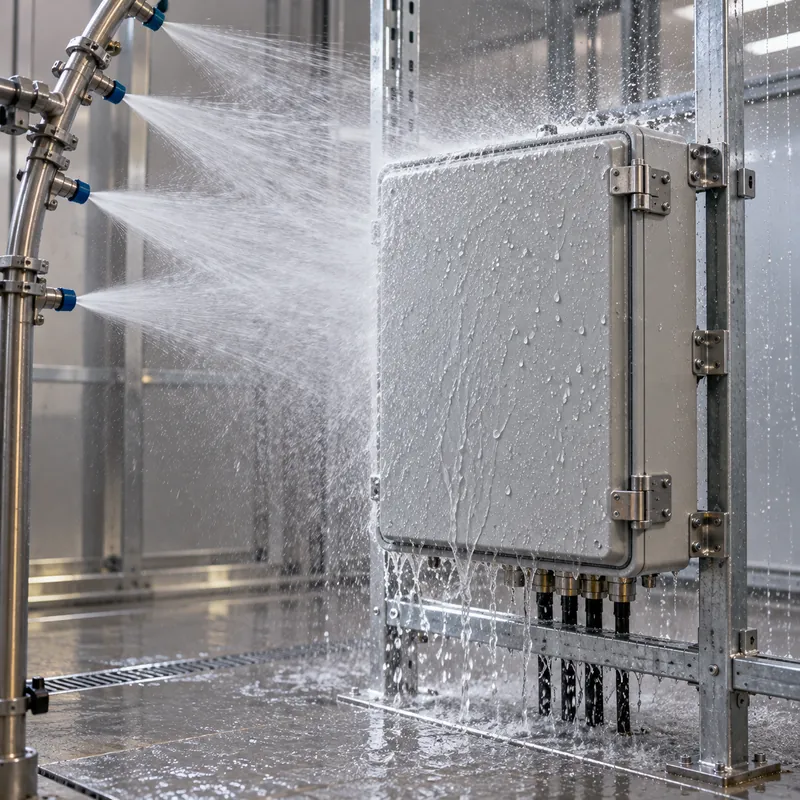
- Test severity. NEMA's Type 4 hosedown applies about 65 gal/min, or 246 L/min, through a 1-inch nozzle. IPX6 applies 100 L/min through a 12.5 mm nozzle; IPX5 applies 12.5 L/min through a 6.3 mm nozzle. The NEMA test delivers roughly 2.5 times the IPX6 flow and 20 times the IPX5 flow.
- Certification. NEMA types are listed by third parties under UL 50E or CSA C22.2 No. 94.2 and marked as Type numbers. IP codes are often self-declared, sometimes backed by third-party test reports.
- Acceptance. North American inspectors look for listed Type ratings under the NEC and CEC. IEC markets accept IP codes, frequently with additional IK impact ratings per IEC 62262.
The practical rule follows: because NEMA covers everything IP does and more, a NEMA type implies a minimum IP code, but an IP code never proves a NEMA type.
NEMA to IP Conversion Chart
NEMA 250 includes an informative comparison that maps each type to the IP code it meets or exceeds for solids and water. Use it only in that direction.
| NEMA type | Minimum IP equivalent | What the IP code does not cover |
|---|---|---|
| 1 | IP10 | Construction requirements |
| 2 | IP11 | Construction requirements |
| 3 | IP54 | External icing, rain test, corrosion |
| 3R | IP14 | External icing, rain test |
| 3S | IP54 | Operation of mechanisms when ice-laden |
| 4 | IP56 | Icing, higher hosedown flow |
| 4X | IP56 | Corrosion, icing, higher hosedown flow |
| 5 | IP52 | Construction requirements |
| 6 | IP67 | Icing, hosedown |
| 6P | IP67 | Prolonged submersion, corrosion |
| 12, 12K | IP52 | Oil and coolant seepage |
| 13 | IP54 | Oil and coolant spraying |
Two surprises in the chart deserve attention. First, Type 3R maps only to IP14 because it is not tested for dust and can have drain holes and vents. Second, Type 12 maps only to IP52, not IP54, because its dust test differs from IEC's. Many Type 4 and 4X products are also tested to IP66, which must be shown by a separate IEC 60529 report. Some manufacturers declare a Type 6P enclosure as IP68 with a stated depth and time; check the declared conditions.
IP65 vs NEMA 4X and IP54 to NEMA: Common Comparisons
IP65 vs NEMA 4X. IP65 is dust-tight and resists 12.5 L/min jets. NEMA 4X excludes windblown dust, resists a hosedown about 20 times heavier, survives external icing and passes a corrosion test. An IP65 polycarbonate box may be perfectly good for a covered outdoor sensor, but it cannot be called NEMA 4X unless it is tested and listed as Type 4X. If someone asks for the IP65 NEMA equivalent, the honest answer is that there is none; the NEMA types whose minimum IP equivalent covers IP65 are 6 and 6P, and Types 4 and 4X qualify only when also tested to IP65 or IP66.
IP54 to NEMA. IP54 is dust-protected and splash-resistant. In NEMA terms it sits between Types 12 and 13 indoors and Type 3 outdoors, but an IP54 product carries no icing, rain or oil test. For an indoor plant floor, an IP54 board is usually acceptable where the specification says Type 12, provided the authority having jurisdiction accepts a manufacturer's declaration. Outdoors, require Type 3R or 3 explicitly.
A practical approach when a project mixes systems:
- Write the specification in the system the inspector enforces: NEMA types for NEC jurisdictions, IP codes for IEC jurisdictions.
- Where equipment comes from the other market, require both markings or a third-party test report against the required standard.
- Add the conditions neither code covers: ambient temperature, UV exposure, impact rating (IK code), and corrosivity category.
MV switchgear adds its own rules: IEC 62271-200 uses IP codes plus internal arc classification, while North American metal-clad gear follows IEEE C37.20.2. See our metal-clad switchgear guide.
Class I Division 2 Enclosure Requirements
Neither IP codes nor ordinary NEMA types make an enclosure suitable for a hazardous location. In the US, NEC Article 500 classifies areas by material (Class I gases and vapors, Class II combustible dusts, Class III fibers) and likelihood (Division 1 under normal conditions, Division 2 only under abnormal conditions). Article 505 and 506 offer the IEC-style Zone system as an alternative.
A Class I, Division 2 location is one where flammable gases or vapors are handled but normally confined in closed systems, so an ignitable atmosphere exists only after a leak or equipment failure. NEC Article 501 sets the rules for equipment there:
- Non-arcing equipment, such as terminal blocks, transformers without make-and-break contacts and motors without brushes, may be installed in general-purpose enclosures.
- Arcing contacts, such as switches, breakers, relays and motor starters, need an explosionproof (Type 7) enclosure or an alternative: hermetically sealed or nonincendive contacts, oil-immersed contacts, or purged and pressurized enclosures per NFPA 496 (Type Z reduces a Division 2 area to unclassified inside the enclosure).
- Surface temperature must stay below the autoignition temperature of the gas, marked as a T-code.
- Conduit seals are required at specified boundaries and enclosure entries.
For Class II, Division 2 dust locations, NEC Article 502 generally requires dusttight enclosures for arcing equipment; Type 9 enclosures serve Division 1. The Zone equivalents use IEC 60079 protection concepts such as Ex d, Ex e, Ex p and Ex t. Mining applications add further rules, outlined in our underground mining electrical equipment guide.
How to Evaluate Electrical Enclosure Manufacturers
A rating on a datasheet is only as good as the manufacturer's process. When comparing electrical enclosure manufacturers, electrical cabinet manufacturers or a custom enclosure manufacturer, ask for evidence on these points:
| Check | What good looks like |
|---|---|
| Listings | UL 50E or CSA C22.2 No. 94.2 listing for each claimed Type, with file number |
| IP evidence | Third-party IEC 60529 test report naming the tested size and configuration |
| Gasket system | Foamed-in-place polyurethane or EPDM, with stated temperature range |
| Material and finish | Steel grade, thickness, coating system and salt-spray hours per ASTM B117 |
| Custom modifications | Procedure for keeping the rating after cutouts, windows and hubs are added |
| Thermal data | Heat dissipation curves or calculations for the enclosure size |
| Quality system | ISO 9001 certification and documented routine inspection |
Custom industrial enclosures are where ratings are most often lost. Every cutout for an HMI, meter or fan must use a component rated at least as high as the enclosure, installed per instructions. A UL 508A panel shop can maintain the Type rating of a listed enclosure if it follows these rules. Searching for enclosure manufacturers in the USA or abroad matters less than this evidence; offshore suppliers can hold UL and CSA listings too. Our switchgear manufacturer sourcing guide applies the same audit approach to complete assemblies, and electrical enclosures engineering covers material choice.
Next Steps: Specifying and Sourcing Rated Enclosures
Write enclosure requirements in a form both systems understand:
- State the governing system and rating, for example "NEMA Type 4X per UL 50E" or "IP66 per IEC 60529, IK10 per IEC 62262".
- Add environment data that ratings omit: ambient range, solar exposure, altitude, corrosivity category per ISO 12944 and seismic zone.
- For hazardous areas, state class, division or zone, gas group and temperature class, and require certification for that location.
- Ask for test reports and listing files, not just catalog claims.
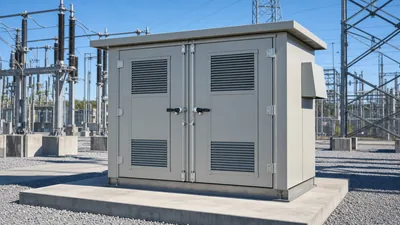
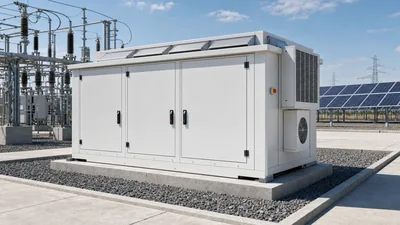
MARS does not sell empty enclosures. We design enclosures as part of complete power equipment: LV switchboards and ring main units with IP and NEMA-equivalent ratings, outdoor compact substations and containerised substations with weatherproof housings, and BESS containers with controlled thermal environments. Each design is built for the IEC or ANSI/IEEE variant the project requires and routine-tested before shipment. See our containerized substation guide, explore HV and LV switchgear and transformer substations, and send your site conditions through the quote form.
Frequently asked questions
What IP rating is equivalent to NEMA 4X?
The NEMA 250 comparison maps NEMA 4X to at least IP56, and many 4X enclosures are also tested to IP66. The conversion only works one way: an IP66 enclosure does not automatically qualify as NEMA 4X because IEC 60529 has no corrosion or icing tests and a lighter water-jet test. Require a Type 4X listing where 4X is specified.
Is IP65 the same as NEMA 4?
No. IP65 resists water jets of 12.5 L/min, while the NEMA Type 4 hosedown uses about 246 L/min, and NEMA 4 also includes external icing and construction requirements. A NEMA 4 enclosure exceeds IP65 for water, but an IP65 enclosure may fail a NEMA 4 test.
What NEMA rating is IP54?
IP54 has no exact NEMA equivalent. For solids and water it sits near NEMA 12 or 13 indoors and Type 3 outdoors, but IP54 includes no rain, icing or oil tests. Specify the NEMA type directly when equipment will be installed under the NEC.
What enclosure is required for Class 1 Div 2?
In Class I, Division 2, NEC Article 501 allows general-purpose enclosures for non-arcing equipment. Arcing devices such as switches, relays and starters need explosionproof Type 7 enclosures, hermetically sealed or nonincendive contacts, or purged and pressurized enclosures per NFPA 496. Temperature class must suit the gas.
What is a Class 2 Div 2 enclosure?
A Class II, Division 2 enclosure is used where combustible dust may be present only under abnormal conditions. NEC Article 502 generally requires dusttight enclosures for arcing equipment there, and surface temperatures limited to prevent dust ignition. Type 9 enclosures are designed for Class II, Division 1 locations.
Why can't IP ratings be converted to NEMA types?
NEMA 250 types include requirements and tests, such as corrosion, external icing, oil exclusion and construction details, that IEC 60529 does not address. An IP code proves only solids and water protection, so it cannot demonstrate the additional NEMA conditions. Conversion is valid only from NEMA to IP.
Written and reviewed by the MARS application engineering team in Shanghai, who specify and test transformers, switchgear, substations and battery storage for projects in 40+ countries. Last updated .
Tags: nema vs ip rating nema ip ratings ip65 vs nema 4x class 1 div 2 electrical enclosures electrical enclosure manufacturers