Key takeaways
- Vetting switchgear manufacturers requires verifying type-test certificates from accredited third-party laboratories according to IEC 62271-200 for medium voltage and IEC 61439-2 for low voltage.
- Factory acceptance testing (FAT) must witness power-frequency withstand voltage, primary injection, and mechanical interlocking sequence checks across 100% of manufactured panels.
- Specifying Loss of Service Continuity categories, such as LSC2B-PM over LSC1, determines whether maintenance can proceed without de-energising neighbouring functional compartments.
- Short-circuit withstand ratings must be verified for both thermal withstand duration (typically 1 to 3 seconds) and dynamic peak current under IEEE C37.20.2 or IEC standards.
- Direct technical procurement from specialized manufacturing plants reduces lead times compared to standard switchgear distributors while enabling custom relay and protection configurations.
Quick answer: Qualified switchgear manufacturers build medium-voltage and low-voltage electrical assemblies compliant with IEC 62271-200 or IEEE C37.20.2 standards, backed by third-party type tests verifying short-circuit withstand, internal arc classification (IAC), and dielectric insulation ratings. Selecting the right manufacturer requires auditing factory routine test protocols, busbar metallurgy, compartment isolation, and protection relay integration capability.
Procuring assemblies for critical infrastructure demands strict technical due diligence. Whether working with regional switchgear suppliers or international factory partners, design engineers and EPC contractors must evaluate construction topologies, fabrication tolerances, and witness test capabilities. For broader network architecture, consult our foundational electrical switchgear guide to align upstream distribution topologies with downstream equipment ratings.
Core Standards Governing Switchgear Manufacturers
Switchgear manufacturing companies operate under dual global frameworks: the International Electrotechnical Commission (IEC) system and the North American IEEE/NEMA consensus standards. Sourcing medium-voltage equipment mandates compliance with IEC 62271-200 clause 6 for type tests, which dictates dielectric verification, temperature-rise limits, and peak withstand currents. In North America, IEEE C37.20.2 governs metal-clad switchgear construction, requiring grounded metal barriers between all operational sections.
Low-voltage power distribution equipment requires strict alignment with IEC 61439-2 clause 8, eliminating the outdated concept of type-tested assemblies (TTA) in favour of verified design rules. If you are configuring LV assemblies, refer to our comprehensive IEC 61439 engineering guide for detailed design verification rules covering temperature rise and clearance distances. Reputable electrical switchgear manufacturers maintain test documentation issued by independent testing bodies such as KEMA, CESI, or ASTA, validating that sheet-steel enclosures and busbar supports endure electrodynamic repulsion forces during severe network faults.
Technical Comparison: MV Switchgear Enclosure Topologies
Selecting medium voltage switchgear manufacturers requires establishing the enclosure architecture that matches your operational availability requirements. The Loss of Service Continuity (LSC) classification under IEC 62271-200 dictates whether adjacent bays or cable terminations remain live during compartment maintenance.
| Parameter | LSC1 Design | LSC2A-PI Design | LSC2B-PM Design | IEEE C37.20.2 Metal-Clad |
|---|---|---|---|---|
| Busbar Compartment Isolation | None (shared) | Metallic / Insulating Partition | Metallic Partition (PM) | Full earthed metal barriers |
| Cable Compartment Access | Outage on entire bus | Live busbar permissible | Live busbar permissible | Live busbar permissible |
| Partition Material Class | N/A | PI (Non-metallic) | PM (Metallic grounded) | Continuous metallic sheet |
| Internal Arc Classification | Rarely certified | IAC A-FL up to 25 kA / 1 s | IAC A-FLR up to 40 kA / 1 s | Arc-resistant Type 2B |
| Circuit Breaker Mounting | Fixed type | Withdrawable or fixed | Cassette withdrawable | Drawout vacuum or SF6 |
| Typical Applications | Secondary ring main | Light industrial plants | Heavy industry, utilities | Substations, data centres |
For applications where unplanned downtime incurs severe financial penalties, utility engineers specify LSC2B-PM construction. This layout ensures that opening the cable termination compartment or withdrawing the circuit breaker does not require isolating the main busbars. Detailed rating metrics and enclosure sizing considerations are covered in our MV switchgear engineering guide.
Evaluation Criteria for Electrical Switchgear Suppliers
Evaluating electrical switchgear suppliers involves auditing both structural manufacturing precision and factory quality management systems. Switchgear companies must demonstrate automated computer numerical control (CNC) punching and bending processes that maintain enclosure tolerances within 0.5 mm, ensuring proper mechanical interlocking and drawout truck alignment. When sourcing from switchgear manufacturers in USA or overseas production facilities, verify that the vendor builds their structures with hot-dip galvanized or Aluzinc steel sheets to prevent galvanic corrosion over a 30-year operational life.
Reviewing busbar fabrication reveals manufacturing maturity. Busbars must use high-conductivity electrolytic copper (minimum 99.9% Cu-ETP grade conforming to EN 13601), rounded at the edges to minimise dielectric stress concentrations. Insulating busbar sleeves must feature heat-shrink cross-linked polyolefin or cast epoxy resin tested for non-hygroscopic performance. Electrical switchgear companies that rely on bare, uninsulated copper in compact compartments risk flashovers induced by ambient condensation or particulate ingress.
Factory Acceptance Testing: Step-by-Step Verification
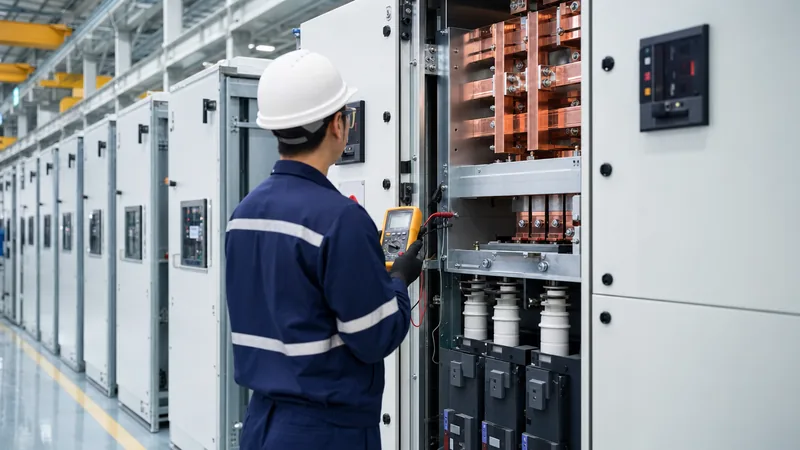
Factory Acceptance Testing (FAT) performed by a switchgear supplier ensures that each completed lineup meets approved drawings and single-line diagrams before transport. Engineers must witness the following sequence at the factory floor:
- Perform mechanical operation tests on all circuit breakers, disconnectors, and earthing switches across 5 manual and 5 electrical racking cycles, confirming that anti-pumping circuits and mechanical interlocks prevent racking under closed load conditions per IEC 62271-102.
- Conduct power-frequency withstand voltage tests on primary circuits at levels prescribed by IEC 62271-200 Table 1A (e.g., 28 kV dry withstand for 1 minute on a 12 kV nominal rated system).
- Verify secondary wiring insulation resistance using a 1,000 V megohmmeter, verifying that all control, trip, and instrument transformer circuits exhibit greater than 100 megohms to ground.
- Perform primary current injection across all phases from busbar to outgoing cable terminals to verify current transformer (CT) ratios, polarities, and secondary saturation curves.
- Perform contact resistance measurement on primary conductors using a 100 A DC micro-ohmmeter, confirming values do not exceed 120% of the manufacturer type-tested reference values.
Skilled mv switchgear manufacturers provide dedicated testing bays fitted with calibrated test sets, allowing client inspectors to record primary injection data and review secondary trip-curve timing directly from the protection relays.
Busbar Sizing and Thermal Rise Calculations
Switchgear manufacturing companies must size main and distribution busbars to carry continuous rated currents without exceeding the maximum permissible temperature limits defined in IEC 62271-1 clause 6.5. For silver-plated copper connections in air, the maximum allowable total temperature is 105 °C against a standard 40 °C ambient (a 65 K thermal rise limit).
Consider an engineer reviewing a switchgear supplier submittal for a 2,000 A medium-voltage incomer. The calculation to verify busbar cross-section proceeds as follows:
Given design parameters:
Nominal current (In) = 2,000 A
Allowable current density for ventilated enclosures (J) = 1.6 A/mm²
Minimum required cross-sectional area (A):
A = In / J = 2,000 A / 1.6 A/mm² = 1,250 mm² per phase
The manufacturer selects two copper bars per phase, each measuring 80 mm × 10 mm (individual area = 800 mm²; total area = 1,600 mm²). Accounting for skin effect and proximity effect via an AC derating factor of 0.88 for parallel rectangular conductors:
Aeff = 1,600 mm² × 0.88 = 1,408 mm²
Recalculated operating current density:
Jop = 2,000 A / 1,408 mm² = 1.42 A/mm²
Because 1.42 A/mm² falls below the design limit of 1.6 A/mm², the configuration prevents thermal runaway and ensures compliance with IEC temperature rise thresholds under full-load operation. Learn more about metal-enclosed structural partitioning in our metal clad switchgear guide.
Procurement Specification Checklist for RFQs
Submitting a thorough specification to switch gear manufacturers prevents project variations, delivery delays, and unexpected redesign fees. Engineers must integrate this checklist directly into procurement requests:
- System Ratings: Nominal operating voltage, maximum design voltage (e.g., 12 kV, 17.5 kV, 24 kV), system frequency (50/60 Hz), and basic impulse insulation level (BIL, e.g., 75 kV or 95 kV peak).
- Fault Levels: Rated short-time withstand current (Icw, e.g., 25 kA, 31.5 kA, or 40 kA) along with the required short-circuit duration (1 second or 3 seconds).
- Internal Arc Classification (IAC): Accessibility type (A for authorised personnel, B for public), accessible sides (F = front, L = lateral, R = rear), arc current level, and test duration (e.g., IAC A-FLR 31.5 kA 1 s per IEC 62271-200 Annex A).
- Enclosure Protection: IP rating per IEC 60529 (e.g., IP4X external, IP2X between internal compartments) or NEMA enclosure classification (e.g., NEMA 1, 3R, or 4X).
- Circuit Breaker Mechanism: Spring-charged stored-energy or magnetic actuator mechanism with specified open-close-open (O-0.3s-CO-15s-CO) duty cycle.
- Secondary Integration: Brand-agnostic microprocessor protection relay compatibility, optical arc flash detection sensors in breaker and busbar chambers, and Modbus/IEC 61850 communication ports.
Working with Switchgear Distributors vs Direct Factories
Sourcing power distribution infrastructure requires deciding between regional switchgear distributors and direct original equipment manufacturers. Local distributors maintain stock of standardized low-voltage distribution boards and standard rating motor control centres. However, large infrastructure projects requiring specialized engineering, custom physical layouts, or complex relay logic benefit from contracting directly with factory manufacturing teams.
Direct engagement with electrical switchgear companies provides full transparency over raw materials, custom sheet-metal fabrication, and witnessed FAT procedures. Direct factory collaboration also eliminates distributor margin stacking, reducing capital equipment expenditure on multi-panel lineups by 15% to 25% while streamlining direct technical coordination between engineering consultants and factory design teams.
Next steps: specifying and sourcing
To source custom medium-voltage or low-voltage switchgear for your next industrial, utility, or infrastructure project, assemble your system parameters including single-line diagrams, short-circuit calculations, and protection philosophy. Our manufacturing facilities design and build fully tested HV and LV switchgear, integrated compact transformer substations, and complete distribution packages tested to IEC and IEEE standards. Contact our engineering team for technical bid evaluations, dimensional layouts, or factory cost proposals at our contact page or submit your single-line diagram directly through our quote request form.
Frequently asked questions
What is the difference between switchgear manufacturers and switchgear distributors?
Switchgear manufacturers directly design, fabricate sheet steel, assemble copper busbars, and conduct factory acceptance tests on primary power assemblies. Switchgear distributors act as commercial intermediaries who inventory standard modular panels or components without operating heavy fabrication or high-voltage testing lines.
What standards do medium voltage switchgear manufacturers follow?
Medium voltage switchgear manufacturers design and build equipment primarily in accordance with IEC 62271-200 in international markets or IEEE C37.20.2 in North America. These standards specify mandatory design rules, mechanical endurance, dielectric insulation, temperature rise limits, and internal arc fault safety.
How do you verify the short-circuit rating of switchgear suppliers?
Engineers verify ratings by reviewing official type-test certificates issued by independent accredited test laboratories such as KEMA, CESI, or UL. The documentation must demonstrate compliance with both the short-time withstand current (thermal rating over 1 to 3 seconds) and peak withstand current (dynamic mechanical rating).
What is an Internal Arc Classification (IAC) for switchgear?
Internal Arc Classification (IAC) verifies that a switchgear enclosure protects operators against internal arc faults by safely venting explosive gases upward and away from personnel. A designation such as IAC A-FLR indicates protection for authorised personnel across the front, lateral, and rear sides of the cubicle.
Can electrical switchgear companies provide custom protection relays?
Yes, direct switchgear manufacturers routinely engineer low-voltage control compartments to accommodate customer-specified protection relays from various international instrument vendors. The factory wires, tests, and validates these units against designated trip schemes and SCADA communication protocols prior to dispatch.
Tags: switchgear manufacturers electrical switchgear suppliers mv switchgear manufacturers switchgear companies electrical switchgear manufacturers