Key takeaways
- NEC 430.102 requires a motor disconnect within sight of the controller and the motor, meaning visible and no more than 50 ft away.
- A motor disconnect must have an ampere rating of at least 115 percent of motor full-load current under NEC 430.110, or a matching horsepower rating.
- Since the 2020 NEC, one- and two-family dwellings need an outdoor emergency disconnect under NEC 230.85 for use by first responders.
- Enclosed safety switches are listed to UL 98 and built as general-duty or heavy-duty per NEMA KS 1; IEC switch-disconnectors follow IEC 60947-3.
- Medium-voltage disconnectors under IEC 62271-102 isolate without load, whereas load-break switches under IEC 62271-103 can interrupt normal load current.
Quick answer: An electrical disconnect is a switch that isolates equipment or an entire service from its power source so it can be worked on safely or shut off in an emergency. Common types are fused and non-fused safety switches, pull-out disconnects for air conditioners and rotary switch-disconnectors. The NEC requires disconnects for services, motors, air-conditioning equipment and many appliances, usually within sight of the equipment.
A disconnect is the most-operated piece of safety equipment in any electrical system. Maintenance technicians open one before every repair, firefighters look for one when a building burns, and inspectors check one on almost every permit. Its job is simple: provide a reliable, visible, lockable break between the source and the equipment.
This guide is for electrical designers, contractors and facility engineers selecting a disconnect switch box for motors, HVAC, services and medium-voltage equipment. It covers the types, the NEC rules that dictate where disconnects go, sizing examples, the lockout procedure and how MV disconnectors and load-break switches differ. Work on service equipment must follow local code and be done by a licensed electrician.
What Is an Electrical Disconnect?
An electrical disconnect (disconnecting means) is a device by which the conductors of a circuit can be disconnected from their source of supply. That is the NEC Article 100 definition, and it covers everything from a pull-out block on an air conditioner to a 4,000 A main breaker. An electric disconnect box, power disconnect box or electrical shut off box is the enclosed version: a switch mechanism in a NEMA-rated enclosure with an external handle.
A good disconnect provides four things:
- Isolation: a contact gap that withstands the system voltage and transients when open.
- Indication: a handle position, or for MV equipment a visible break or reliable position indicator, that clearly shows open or closed.
- Lockability: provisions to padlock the handle in the open position, so the equipment cannot be re-energized during work.
- Load switching, if rated: the ability to open while current flows. Not every disconnect can do this.
A disconnect is not the same as overcurrent protection. A non-fused switch isolates but does not protect; a circuit breaker does both and can serve as the disconnect when it is lockable and suitably located. In panelboards, each breaker is the disconnect for its branch circuit, as covered in our electrical panel guide. For high-voltage equivalents, see the high-voltage switch engineering guide.
Types of Disconnect Switches
The type depends on voltage, current, whether the switch must protect the circuit and the environment.
| Type | Typical rating | Protection | Standards | Typical use |
|---|---|---|---|---|
| Non-fused safety switch | 30–1,200 A, 240–600 V | None | UL 98, NEMA KS 1 | Local motor or equipment isolation |
| Fused safety switch | 30–1,200 A, 240–600 V | Fuses | UL 98, NEMA KS 1 | Equipment needing local overcurrent protection |
| Pull-out disconnect | 30–60 A, 240 V | Optional fuses | UL 98 | Residential AC condensers, heat pumps |
| Rotary switch-disconnector | 16–3,150 A, to 1,000 V | Optional fuses | IEC 60947-3 | Machine main switches, IEC panels |
| Molded-case switch | 100–2,500 A | Instantaneous self-protection only | UL 489 | Disconnect in switchboards |
| Circuit breaker as disconnect | Any | Overload and short circuit | UL 489, IEC 60947-2 | Service and feeder disconnects |
| MV disconnector and load-break switch | 12–40.5 kV | With fuses or breaker | IEC 62271-102, -103 | Ring main units, substations |
General-duty vs heavy-duty. General-duty safety switches suit residential and light commercial use at 240 V. Heavy-duty switches are rated to 600 V, carry horsepower ratings, have visible blade designs and higher short-circuit ratings with suitable fuses, and are the norm in industrial plants. In IEC terms, utilization categories AC-21A (resistive), AC-22A (mixed) and AC-23A (motor loads) under IEC 60947-3 state what load a switch can make and break. Choose an enclosure type from our NEMA enclosure ratings guide.
Where Does the NEC Require a Disconnect?
Disconnect requirements are spread through the NEC by equipment type. The most common:
| Equipment | NEC reference | Key requirement |
|---|---|---|
| Service | 230.70, 230.71 | Readily accessible, nearest the point of entrance; limited number of disconnects |
| Dwelling emergency disconnect | 230.85 | Outdoor, readily accessible, marked for emergency use |
| Feeders to separate buildings | 225.31 | Disconnect at each building |
| Motors and controllers | 430.102 | Within sight of controller and motor, with exceptions |
| Air-conditioning equipment | 440.14 | Within sight and readily accessible from the unit |
| Appliances | 422.31 | Lockable breaker or local switch, depending on rating |
| PV systems | 690.13 | Disconnect for PV system conductors |
| Energy storage systems | 706.15 | Disconnect for ESS, lockable |
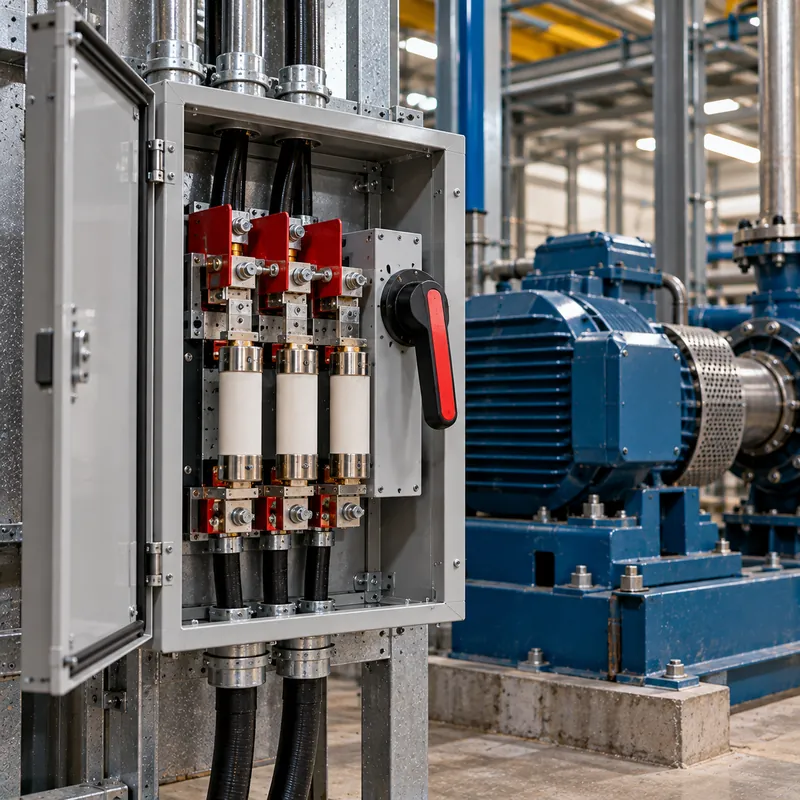
Within sight means visible from the equipment and not more than 50 ft (15 m) away. Where a motor disconnect cannot be within sight, NEC 430.102 exceptions allow the controller disconnect to serve instead if it is lockable in the open position, with the locking provision remaining in place with or without the lock installed, under defined conditions such as industrial installations with written safety procedures.
Where disconnects for many motors are grouped, they often sit in a motor control center, with a local lockable stop or isolator at each motor if within-sight rules are not met.
Main Disconnect Panel and Service Disconnects
The service disconnect is the device that disconnects all conductors in a building from the utility supply. In most buildings it is the main breaker in the main panel or main switchboard. A main disconnect panel, sometimes called a disconnect panel, may also be a separate enclosure with only a main breaker or fused switch, feeding a main-lug panel downstream.
Key rules for service disconnects:
- Location at a readily accessible point nearest the point of entrance of the service conductors, inside or outside the building, per NEC 230.70.
- A limited number of disconnects per service (NEC 230.71), grouped and marked.
- Suitable for use as service equipment, with a short-circuit rating at least equal to the available fault current.
- Ground-fault protection of equipment for solidly grounded wye services of 1,000 A or more operating above 150 V to ground, per NEC 230.95.
The 2020 NEC added NEC 230.85: one- and two-family dwellings must have an emergency disconnect at a readily accessible outdoor location, marked "EMERGENCY DISCONNECT, SERVICE DISCONNECT" or similar. It can be a meter-main combination, a separate disconnect switch or other listed equipment, and it lets firefighters de-energize a house without entering it.
When adding loads to a service, a smart panel or load management can avoid an upgrade, as shown in our smart electrical panel guide. On construction sites, temporary disconnects follow the rules in our temporary power distribution guide.
Sizing a Disconnect: Motor and AC Worked Examples
Example 1: three-phase motor. A 25 hp, 460 V, 3-phase motor. NEC Table 430.250 gives a full-load current of 34 A.
- Minimum disconnect rating under NEC 430.110:
1.15 × 34 = 39.1 A, and the switch must be horsepower-rated for at least 25 hp at 480 V (or be a listed motor circuit switch, molded-case switch or breaker as permitted by 430.109). - A 30 A switch is too small; select a 60 A heavy-duty switch with a 25 hp or greater rating at 480 V.
- If the switch is fused for branch-circuit short-circuit protection with dual-element time-delay fuses, NEC Table 430.52 allows up to 175 percent:
1.75 × 34 = 59.5 A, so 60 A fuses fit a 60 A switch.
Example 2: air-conditioning condenser. Nameplate: minimum circuit ampacity (MCA) 28 A, maximum overcurrent protection (MOCP) 45 A, 240 V single-phase.
- Under NEC 440.12, the disconnect ampere rating must be at least 115 percent of the rated-load current or branch-circuit selection current. With an RLA of about 22 A:
1.15 × 22 = 25.3 A. - A 30 A non-fused pull-out disconnect satisfies the current rating, but if the nameplate requires fuses ("maximum fuse size"), use a 60 A fused disconnect with 45 A time-delay fuses, because 45 A fuses do not fit a 30 A fuse holder.
- Install it within sight of and readily accessible from the condenser per NEC 440.14, not behind the unit.
| Load | Rule | Calculated minimum | Typical selection |
|---|---|---|---|
| 25 hp, 460 V motor | 115% FLC + hp rating | 39.1 A, 25 hp | 60 A heavy-duty, fused 60 A |
| AC condenser, MOCP 45 A fuse | 115% RLA, fuse fit | 25.3 A | 60 A fused, 45 A fuses |
Lockout/Tagout: Using a Disconnect Safely
A disconnect only protects workers if it is used within an energy control procedure. OSHA 29 CFR 1910.147 requires a written lockout/tagout program, and NFPA 70E requires an electrically safe work condition before work on conductors. The standard sequence for qualified persons:
- Plan: identify every source, including generators, batteries, PV and back-feeds, using current drawings.
- Notify affected people and stop the equipment through its normal controls.
- Open the disconnect while standing to the side of the enclosure, using the external handle. Opening under load is acceptable only if the switch is load-break rated.
- Verify the visible break or handle position where the design allows.
- Apply locks and tags: one personal lock per worker.
- Release stored energy: capacitors, springs and pressurized systems.
- Test for absence of voltage on every conductor with a properly rated, pre-checked tester, wearing PPE selected from the arc-flash assessment.
- Apply temporary protective grounds where induced voltage or re-energization is possible, especially on MV equipment.
Disconnect handles and door interlocks prevent opening the enclosure while the switch is on, but defeat mechanisms exist for qualified troubleshooting, so procedures matter more than hardware. Our what is arc flash guide explains why opening a switch under fault conditions is the highest-risk moment.
Medium-Voltage Disconnectors and Load-Break Switches
At medium voltage, disconnecting functions are split into separate devices with different abilities:
- Disconnector (isolator), IEC 62271-102: provides a safe isolating distance in the open position. It can open or close only negligible current, so it is operated after the circuit breaker has opened.
- Switch (load-break switch), IEC 62271-103: makes and breaks normal load current and can close onto a fault, but cannot interrupt a short circuit. Combined with fuses, it protects distribution transformers in ring main units.
- Switch-disconnector: a load-break switch that also meets isolating-distance requirements.
- Earthing switch: grounds the cable or busbar once isolated, often with short-circuit making capability.
- Withdrawable circuit breaker: in metal-clad switchgear, racking the breaker to the test or disconnected position provides isolation.
Interlocks enforce the sequence: the breaker must be open before the disconnector operates, and the disconnector must be open before the earthing switch closes. For transformer protection with switch-fuse combinations, see our transformer fuse sizing guide, and for the choice between RMUs and breaker-based gear, our comparison of ring main unit vs metal-clad switchgear.
Next Steps: Specifying and Sourcing Disconnects
For low-voltage disconnects, specify voltage, ampere and horsepower ratings, fused or non-fused, fuse class and size, short-circuit rating with fuses or upstream breaker, enclosure type, auxiliary contacts and lockable handle. Check the NEC location rules (within sight, readily accessible) at the layout stage, not after equipment is set. Add the disconnect to the arc-flash study and label it, because a fused switch close to a large transformer can have high incident energy at its line terminals.
For medium-voltage isolation, the RFQ should state rated voltage, rated current, short-time withstand, whether load-break capability is needed, earthing switch requirements, interlocking scheme and whether visible isolation is required by the utility.
MARS manufactures SF6 ring main units with load-break switches, switch-fuse combinations and earthing switches, KYN28 metal-clad switchgear with withdrawable vacuum breakers, and IEC 61439 LV switchboards with switch-disconnectors and breakers, all with mechanical interlocks and routine tests on every unit. Typical lead time is 25 to 45 days. See our HV and LV switchgear and transformer substations, then send your single-line diagram via the quote form.
Frequently asked questions
What is the difference between a fused and non-fused disconnect?
A non-fused disconnect only isolates the circuit and relies on an upstream breaker for overcurrent protection. A fused disconnect contains fuses that protect the downstream conductors and equipment. Use a fused disconnect when equipment nameplates specify a maximum fuse size or when local short-circuit protection is needed.
How far can a disconnect be from a motor?
NEC 430.102 requires the disconnect to be within sight of the motor and its controller, which the NEC defines as visible and not more than 50 ft away. Exceptions allow a lockable disconnect at the controller in some industrial and impracticable situations, under specific conditions.
Does an AC unit need a disconnect?
Yes. NEC 440.14 requires a disconnecting means within sight of and readily accessible from air-conditioning and refrigeration equipment. It is usually a pull-out or fused disconnect box mounted near the outdoor condenser, rated at least 115 percent of the rated-load current.
What size disconnect do I need for a 25 hp motor?
A 25 hp, 460 V three-phase motor has a full-load current of 34 A. NEC 430.110 requires at least 115 percent, or 39.1 A, plus a horsepower rating of at least 25 hp, so a 60 A heavy-duty switch is typical. Fused with dual-element fuses, 60 A fuses are permitted.
What is an emergency disconnect for a house?
Since the 2020 NEC, section 230.85 requires one- and two-family dwellings to have an outdoor, readily accessible emergency disconnect, marked for emergency use. It allows firefighters to de-energize the house without entering. A meter-main combination or separate service disconnect outdoors can meet the requirement.
Can a disconnector break load current?
A medium-voltage disconnector to IEC 62271-102 cannot interrupt load current; it only provides isolation after a breaker opens the circuit. A load-break switch to IEC 62271-103 can make and break normal load current. Low-voltage switches show their capability in their utilization category or horsepower rating.
Written and reviewed by the MARS application engineering team in Shanghai, who specify and test transformers, switchgear, substations and battery storage for projects in 40+ countries. Last updated .
Tags: electrical disconnect electric disconnect box disconnect panel main disconnect panel disconnect switch box