Key takeaways
- NEC Article 590 allows temporary wiring only for construction, remodeling, emergencies, tests and up to 90 days of holiday lighting, with removal required on completion.
- Every 125 V, single-phase, 15, 20 and 30 A receptacle on temporary power needs GFCI protection for personnel under NEC 590.6 and OSHA 1926.404.
- Portable power distribution equipment is listed to UL 1640, while IEC 61439-4 covers assemblies for construction sites in IEC markets.
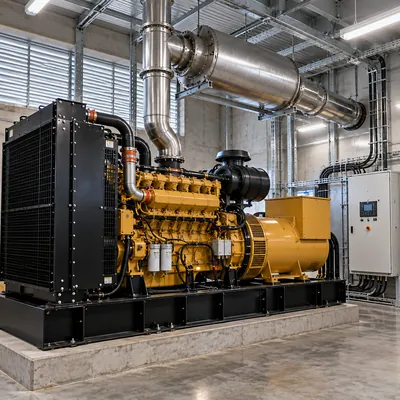
- A 150 kVA, 480 V generator delivers I = 150,000 / (1.732 × 480) = 180 A, so a 200 A distro box input is the matching choice.
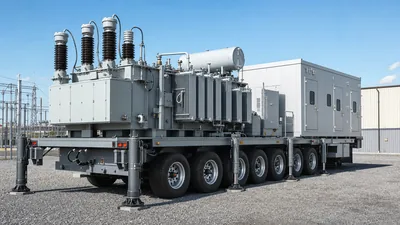
- Large or long-duration sites often use a temporary power skid: MV switch, transformer and LV switchboard pre-wired on one base, energized from the utility feeder.
Quick answer: A temporary power panel is a listed panelboard or portable distribution unit that supplies construction, event or emergency loads for a limited time, fed from a utility temp service or a generator. In the US it must follow NEC Article 590 and OSHA 1926 Subpart K, including GFCI protection on 125 V receptacles, and be removed when the work ends.
Temporary power is the electrical system nobody designs carefully until it fails: a tripped spider box stopping a concrete pour, a generator overloaded by tower crane starts, or a GFCI-less receptacle cited by an inspector. Because temporary installations move and get abused, they need stricter protection than permanent wiring, not looser.
This guide is for site electrical leads, event production engineers, rental fleet managers and EPC planners. It covers what a temporary electrical panel is, the codes that govern it, how to size generator distribution and feeder cords, and when to move from portable distro boxes to a skid-mounted substation. Connection to utility service equipment must follow local code and be done by a licensed electrician.
What Is a Temporary Power Panel?
A temporary power panel is a distribution assembly installed for a defined period to supply loads that will not remain once a project, event or emergency is over. Temp power panel, temporary panel and temporary electrical panel all refer to the same idea, though the hardware varies widely:
- Temp service pole: a meter base, main breaker and small panel with GFCI receptacles on a post or plywood stand, fed by the utility during house or small building construction.
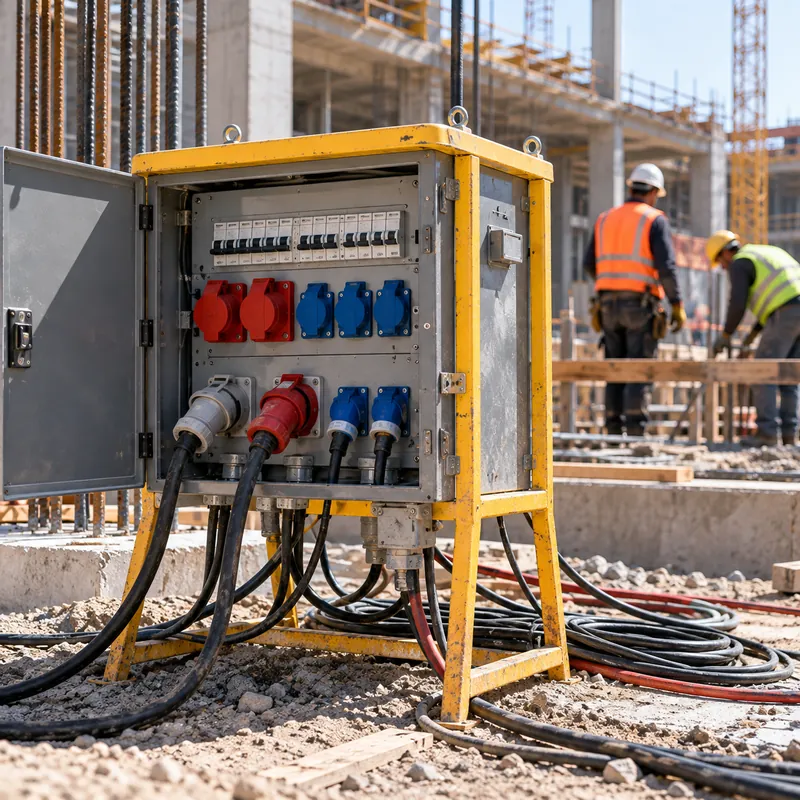
- Portable power distribution panel: a wheeled or skid-mounted steel cabinet with a main breaker, single-pole cam-type or twist-lock inputs and multiple breaker-protected outputs, often called a distro.
- Spider box: a compact rubber or steel electrical distribution box with 120 V GFCI duplex receptacles and 240 V twist-lock outlets, plugged into a larger distro.
- Temporary power skid: a pre-wired MV/LV package with transformer and switchboard on a common base for large sites.
The defining feature is not the hardware but the installation rules. Temporary distribution is portable, frequently reconfigured and exposed to weather, so codes compensate with mandatory ground-fault protection, robust enclosures and strict time limits. For the permanent equivalent of this equipment, see our power distribution board guide.
Which Codes Apply to Temporary Electrical Power Distribution?
In the US, temporary electrical power distribution is governed by NEC Article 590 and OSHA 29 CFR 1926 Subpart K. In IEC markets, IEC 60364-7-704 sets installation rules for construction and demolition sites and IEC 61439-4 covers the assemblies themselves (ACS).
| Requirement | US reference | IEC reference |
|---|---|---|
| Permitted uses and time limits | NEC 590.3 | IEC 60364-7-704 |
| Ground-fault protection for personnel | NEC 590.6, OSHA 1926.404(b)(1) | 30 mA RCD per IEC 60364-7-704 |
| Assembly construction and listing | UL 1640, UL 67 | IEC 61439-4 |
| Equipment grounding | NEC 590.4, 250.34 for portable generators | IEC 60364-5-54 |
| Cord types and protection | NEC 590.4(B), Article 400 | IEC 60245 rubber cables |
| Single-pole separable connectors | NEC Article 406, UL 1691 | IEC 60309 industrial plugs |
Key points from Article 590:
- Temporary wiring is allowed during construction, remodeling, maintenance, repair or demolition; for emergencies and tests; and for up to 90 days for holiday decorative lighting.
- It must be removed immediately on completion of the purpose.
- All 125 V, single-phase, 15, 20 and 30 A receptacles require GFCI protection. Other receptacles need GFCI protection or, where the adopted code edition permits, an assured equipment grounding conductor program.
- Receptacles must be grounding type and branch circuits must include an equipment grounding conductor; see our EGC sizing guide.
Portable Power Distribution Equipment: Types and Ratings
Portable power distribution equipment comes in standard frame sizes. The table below shows typical configurations in North American rental fleets; IEC equivalents use 400/230 V and IEC 60309 connectors.
| Unit | Typical input | Typical outputs | Common use |
|---|---|---|---|
| Spider box | 50 A, 120/240 V or 208Y/120 V twist-lock | 6 to 8 GFCI duplexes, 1 to 2 twist-lock 30 A | Hand tools, lighting at work face |
| Small distro | 100 A, 208Y/120 V single-pole cam-type | 2 to 4 50 A outputs, GFCI duplexes | Floor-level distribution, events |
| Power distribution center | 200–400 A, 480 V or 208 V single-pole cam-type | Mixed 3-phase 60–100 A and single-phase outputs | Site main distribution |
| Transformer distro | 480 V, 3-phase | 208Y/120 V panel with GFCI outputs | Stepping 480 V generator to tool voltage |
| Temporary power skid | MV utility feeder, e.g., 13.8 kV | 480 V switchboard feeders 400–3,000 A | Large construction, data center build-out |
A portable power distribution center sits between the source and the spider boxes. Look for main breaker with shunt trip or emergency stop, ground-fault protection on 480 V feeders, a NEMA Type 3R or Type 4 enclosure rating (explained in our NEMA enclosure ratings guide), and connectors that cannot be mated in the wrong order. With single-pole single-pole cam-types, connect the equipment ground first, then neutral, then phases, and disconnect in reverse order.
Sizing a Power Distribution Box for a Generator
A power distribution box for a generator should match the generator's rated current and the voltages the loads need. Work from the generator nameplate, not the load list alone, because the main breaker on the distro must protect its own bus and cords.
Given: a 150 kVA, 480Y/277 V, 3-phase generator feeding a site with tower crane, welders, pumps and a 208Y/120 V tool load estimated at 35 kVA.
- Generator full-load current:
I = S / (√3 × V) = 150,000 / (1.732 × 480) = 180 A. Select a 200 A input distro with a 200 A main breaker; cords rated for at least 180 A. - Tool load transformer: choose 45 kVA for margin. Secondary current:
I = 45,000 / (1.732 × 208) = 125 A. Feed a 150 A, 208Y/120 V panel. - Primary current of that transformer:
45,000 / (1.732 × 480) = 54 A; protect with a 60 A breaker on the distro. - Spider boxes: three 50 A units on the 208Y/120 V panel give 150 A nameplate; with typical tool diversity, real demand stays below the 125 A transformer rating.
- Check motor starting: the crane's largest motor starting kVA should not exceed about 30 to 35 percent of generator kVA for acceptable voltage dip. Use the method in our generator sizing guide.
For quick nameplate conversions, the generator kVA to amps calculator covers 208, 240, 400 and 480 V.
Feeder Cords, Voltage Drop and Grounding on Site
Temporary feeders often run 50 to 150 m across a site, so voltage drop decides cord size as often as ampacity does. For a 3-phase feeder:
Vd = √3 × I × R × L, where R is conductor resistance in ohms per km and L is the one-way length in km.
Example: a 60 A, 480 V feeder over 100 m. With 6 AWG copper (about 1.61 Ω/km): Vd = 1.732 × 60 × 1.61 × 0.1 = 16.7 V, or 3.5 percent. With 4 AWG (about 1.01 Ω/km): Vd = 10.5 V, or 2.2 percent. Choose 4 AWG to keep total drop, including the downstream spider box cords, near 5 percent.
Grounding rules that prevent most site shocks:
- A portable generator supplying only cord-and-plug equipment through receptacles on the generator, with frame bonded to the EGC, does not need a grounding electrode under NEC 250.34; a generator feeding a distribution system that is a separately derived system does need one per 250.30.
- Bond neutral to ground at one point only, normally the generator or the transformer secondary of the transformer distro.
- Use extra-hard-usage cords (types such as SOOW) and protect them from vehicle traffic with cable ramps.
- Test GFCIs at the start of every shift and record the test.
Where a generator runs at low load for long periods, consider a hybrid set as described in our hybrid generator battery systems guide.
When Does a Temporary Power Skid Make Sense?
Generators and portable distro boxes suit small and short jobs. Once a site needs more than about 500 kVA for many months, a temporary power skid fed from the utility MV network usually costs less to run and is quieter and cleaner. A temporary power skid is a factory-assembled package of MV switching, a distribution transformer and an LV switchboard on a common steel base or in a container, designed to be set, connected and relocated as one unit.
Typical skid contents:
- MV load-break switch or ring main unit with fuse or breaker protection for the transformer.
- Oil-immersed or dry-type transformer, e.g., 1,000 to 2,500 kVA, 13.8 kV to 480Y/277 V or 11 kV to 400/230 V.
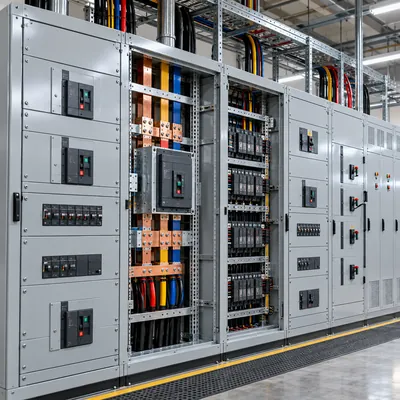
- LV switchboard with incomer ACB and MCCB feeders to site distribution centers.
- Lifting lugs, forklift pockets and grounding pads.
Skids appear on large construction sites, mining expansions, data center build-outs where permanent substations are not yet energized, and as utility contingency equipment. They overlap with the mobile substations utilities keep for emergency restoration, and with compact box-type substations. Plan the MV connection with the utility early: protection settings, metering and the grounding grid for the skid all need approval before energization.
Next Steps: Specifying and Sourcing Temporary Power
For portable distro equipment, specify input voltage and current, output configuration, connector types, enclosure rating and listing (UL 1640 in the US, IEC 61439-4 elsewhere). Always require GFCI or 30 mA RCD protection on tool circuits and an emergency-stop or shunt-trip main on larger centers.
For temporary power skids and site substations, the RFQ should state:
- Utility supply voltage, fault level and grounding.
- Transformer kVA, vector group, impedance and cooling.
- LV switchboard incomer and feeder schedule.
- Skid or container dimensions, transport limits and relocation frequency.
- Expected duration and whether the equipment will become permanent later.
That last point matters: a skid specified to permanent-installation standards, with full routine test reports and a proper grounding interface, can be re-commissioned as the site's permanent substation and avoid a second purchase.
MARS does not rent or manufacture portable spider boxes, but supplies the larger equipment behind them: compact and containerised substations, pad-mounted and oil-immersed transformers, ring main units and IEC 61439 LV switchboards that can be built on skids for temporary and relocatable service, with lead times typically 25 to 45 days. See our transformer substation range and HV and LV switchgear, then send your load schedule via the quote form.
Frequently asked questions
What is a temp power panel used for?
A temp power panel supplies electricity during construction, remodeling, demolition, events or emergencies before permanent service exists or while it is unavailable. It is fed from a utility temporary service or a generator and must be removed when the purpose ends, as required by NEC Article 590.
Do temporary power panels need GFCI protection?
Yes. NEC 590.6 and OSHA 1926.404 require GFCI protection for all 125 V, single-phase, 15, 20 and 30 A receptacles on construction sites. Other receptacles need GFCI protection or, where the adopted code permits, an assured equipment grounding conductor program with documented testing.
How long can temporary power stay in place?
NEC 590.3 limits temporary wiring to the duration of construction, remodeling, maintenance, repair, demolition, emergencies or tests, plus up to 90 days for holiday decorative lighting. Wiring must be removed immediately once the work or purpose is complete. Local authorities may impose their own permit durations.
What are electrical distro boxes?
Electrical distro boxes are portable distribution units that take a large input, usually through single-pole cam-type or twist-lock connectors, and split it into breaker-protected outputs for tools, lighting and equipment. They range from 50 A spider boxes with GFCI receptacles to 400 A power distribution centers for whole sites.
What size distribution box do I need for a 100 kVA generator?
At 480 V three-phase a 100 kVA generator delivers I = 100,000 / (1.732 × 480) = 120 A, so a 125 A or 150 A input distro fits. At 208 V the current is 278 A, needing a 300 A or 400 A unit. Always match the distro main breaker to the generator output rating.
What is a temporary power skid?
A temporary power skid is a factory-built package of medium-voltage switching, a distribution transformer and a low-voltage switchboard mounted on one steel base. It connects to a utility MV feeder to power large construction or industrial sites for months, then can be relocated to the next project.
Written and reviewed by the MARS application engineering team in Shanghai, who specify and test transformers, switchgear, substations and battery storage for projects in 40+ countries. Last updated .
Tags: temporary power panel temporary power distribution electrical distro boxes portable power distribution temporary power skid