Key takeaways
- A smart panel combines a UL 67 panelboard with per-circuit current sensing, controllable relays and a Wi-Fi or Ethernet gateway for monitoring and load control.
- NEC 220.87 lets designers size added load from 12 months of measured peak demand multiplied by 125 percent instead of a full calculated load.
- An energy management system under NEC Article 750 and 625.42 can cap EV charging so a 200 amp service accepts loads that would otherwise exceed it.
- Three architectures exist: full smart panels, smart breakers in a conventional panel, and clamp-on CT monitors that measure but cannot switch circuits.
- Commercial buildings get the same functions from IEC 61439 switchboards with multifunction meters, motorized breakers and Modbus or IEC 61850 communication.
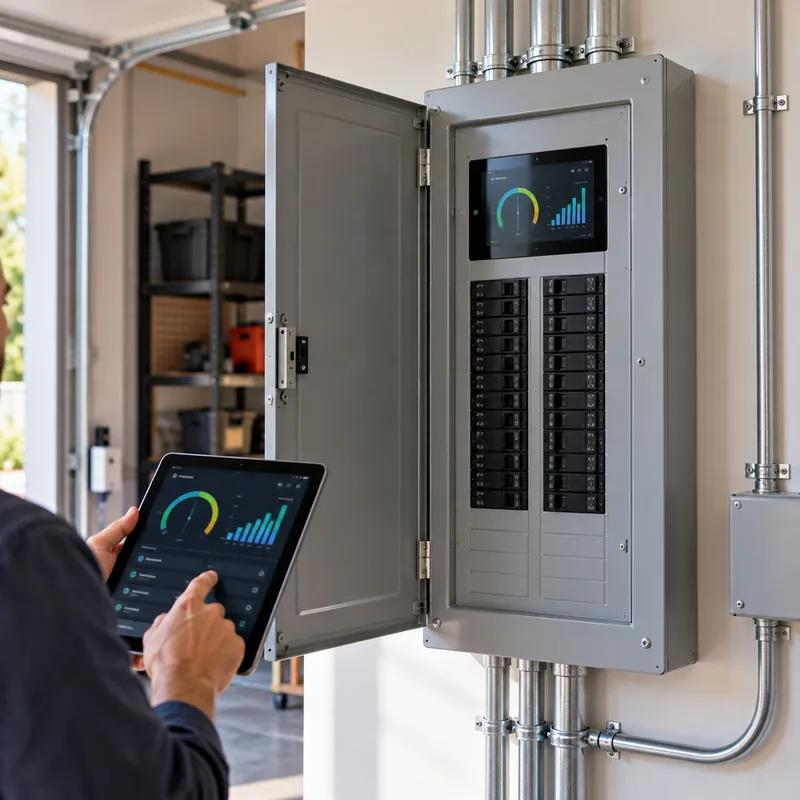
Quick answer: A smart electrical panel is a load center that measures current on every branch circuit and can switch selected circuits remotely through relays or motorized breakers. It lets owners see real-time energy use, shed loads during outages, and add EV chargers or heat pumps to a 200 amp service, often without an upgrade, using NEC Article 750 energy management rules.
Homes are being asked to carry loads their panels were never sized for: a 48 A EV charger, a heat pump, an induction range and often a battery or backup generator. A smart electrical panel answers that pressure with data and control rather than copper, by measuring what each circuit actually draws and switching non-essential loads when the service approaches its limit.
This guide is for electrical designers, contractors and facility owners who want to understand how smart breaker panels work, how to size a 200 amp smart panel against the NEC, what installation involves, and where the same concepts scale up into commercial switchboards. Work on service equipment must follow local code and be done by a licensed electrician.
What Is a Smart Electrical Panel?
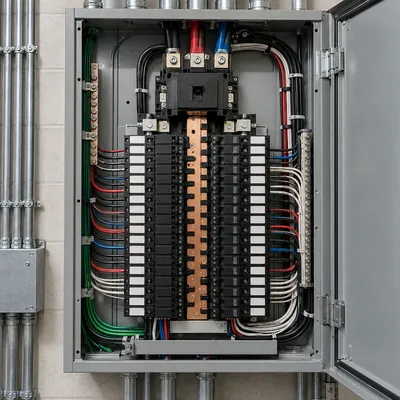
A smart electrical panel is a residential or light-commercial load center in which each branch circuit is metered and some or all circuits can be opened or closed by an electronic controller. A conventional panel only protects circuits; a smart panel also reports on them and acts on them.
Typical building blocks of a smart circuit breaker panel are:
- Panelboard and bus listed to UL 67, usually 200 A main with 30 to 42 circuit spaces.
- Overcurrent devices listed to UL 489 (or UL 489 plus integrated relay), still providing the code-required protection.
- Current sensing on every circuit, either Hall-effect sensors or small current transformers, plus voltage sensing on each leg.
- Switching elements: latching relays in series with breakers, or motor-operated breakers that can be tripped and reset remotely.
- Gateway: a Wi-Fi, Ethernet or cellular module feeding an app, with local control logic that keeps working if the internet drops.
The term "smart home electrical panel" is often stretched to cover any panel with an app. Ask whether the product can actually switch loads, because measurement alone cannot help with service sizing. For background on conventional load centers, see our electrical panel guide and the comparison of circuit breaker types.
Smart Panel vs Smart Breakers vs Energy Monitors
Smart electric panels come in three architectures, and they differ in cost, retrofit effort and what they can control. A smart breaker is a UL 489 breaker with built-in metering and a radio, installed in a compatible conventional panel. A CT energy monitor clamps current transformers onto conductors inside an existing panel and only measures.
| Approach | Measures per circuit | Switches loads | Retrofit effort | Best fit |
|---|---|---|---|---|
| Full smart panel | Yes, all circuits | Yes, most circuits | Replace panel interior or whole panel | Service upgrades, electrification, battery backup |
| Smart breakers | Yes, on smart positions | Yes, on smart positions | Swap breakers in compatible panel | Targeted control of a few large loads |
| CT energy monitor | Yes, on clamped circuits | No | Clamp-on, no panel change | Energy auditing, 220.87 data logging |
| Dedicated load manager | Service and one load | One or two loads | Small add-on enclosure | Single EV charger on tight service |
When people ask for the best smart electrical panel for home use, the honest answer depends on the goal. If the goal is avoiding a utility service upgrade, the product must be listed for load management and recognized by the authority having jurisdiction as an energy management system. If the goal is visibility, a monitor is cheaper and less disruptive. If the goal is backup with a generator or battery, check that the panel integrates with the transfer equipment described in our transfer switch sizing guide.
How Does a Smart Breaker Panel Manage Load?
Load management is the feature that changes how a service is sized. The controller samples service current continuously and compares it with a setpoint below the main breaker rating, usually 80 to 90 percent. When demand crosses the setpoint, it sheds loads in a priority order the owner sets, then restores them when demand falls.
The NEC recognizes this through Article 750 (Energy Management Systems), which allows an EMS to limit the load used in service and feeder calculations, and through 625.42, which permits EV supply equipment fed through a load management system to be sized at the managed maximum rather than the charger nameplate. Rules to respect:
- Never shed life-safety or medical loads; Article 750 prohibits load management from interfering with emergency and legally required systems.
- Use a fail-safe default: if the controller loses power or communication, controlled loads should stay off or at a capped value, not revert to unlimited.
- Program a priority list, for example EV charger first, then water heater, then second HVAC stage.
- Document the setpoint and the managed load on the panel label so inspectors and future electricians can see it.
During outages the same logic lets a 10 kW generator or a small battery run the critical circuits without manual breaker juggling. For sizing backup sources against those circuits, see the generator sizing guide and our residential energy storage guide.
Sizing a 200 Amp Smart Panel: Worked Example
Most smart electrical panel 200 amp products are installed to add load to an existing service. NEC 220.87 lets the designer use measured data: take the highest demand over 12 months (or a 30-day logged period where the AHJ accepts it), multiply by 125 percent, then add the new load.
Given: a 120/240 V, 200 A dwelling service. Utility interval data shows a 12-month peak of 30 kW. The owner wants a 48 A (11.5 kW) EV charger.
- Existing demand current:
I = P / V = 30,000 / 240 = 125 A. - Apply 220.87 factor:
125 A × 1.25 = 156 A. - Add EV charger at nameplate:
156 A + 48 A = 204 A, which exceeds the 200 A service. - With an EMS capping the charger at 32 A under 625.42:
156 A + 32 A = 188 A, which fits under 200 A. - Check the branch circuit: the charger remains a continuous load, so its own conductors and breaker are sized at
48 A × 1.25 = 60 Aif the hardware can deliver 48 A.
The result: either a service upgrade (new meter base, larger conductors and often a larger utility transformer) or a 200 amp smart panel configured as an energy management system. The second option keeps the existing utility service, while the controller dynamically raises charging current whenever household demand is lower than the peak. If a service upgrade is chosen, the utility side is the transformer: our residential transformer sizing guide explains how utilities size the pole or pad unit serving the home.
What Does Smart Electrical Panel Installation Involve?
Smart electrical panel installation is a service-equipment job, so it needs a permit, an inspection and, in most areas, a utility disconnect and reconnect. Treat it as a panel replacement with extra commissioning. The sequence a licensed electrician typically follows:
- Survey the existing service: meter panel box type, main breaker rating, conductor size, grounding electrode system and available fault current from the utility.
- Confirm listings: the smart panel must be UL 67 listed with a short-circuit current rating (SCCR) at least equal to the available fault current, commonly 10 kA or 22 kA for dwellings.
- Plan circuits: map each existing circuit to a controllable or non-controllable position and decide shed priorities.
- Coordinate the outage with the utility to pull the meter or open the service disconnect.
- Install the panel, terminate conductors to the specified torque, and verify AFCI and GFCI protection required by NEC 210.8 and 210.12 is preserved.
- Commission: connect the gateway, verify each circuit reads correctly under a known load, set the EMS setpoint and test shedding.
- Label the panel schedule and the EMS settings, then pass inspection.
A meter-main combination (meter panel box with integral main breaker) is common on newer homes; some smart panels can mount downstream of it as the distribution section. Our panel schedule guide covers how to document circuits clearly, which matters more on a panel the owner will be reading in an app.
Best Electrical Panel Features to Compare
Searches for the best electrical panel or best smart breaker panel usually end in feature lists. A modern electrical panel, smart or not, should be compared on engineering parameters first and app features second.
| Parameter | Typical residential value | Why it matters |
|---|---|---|
| Main rating | 100, 150, 200 or 225 A | Sets maximum service capacity |
| Bus rating | Equal to or above main | Allows future main upgrade |
| SCCR | 10 kA to 22 kA | Must meet utility fault current |
| Circuit spaces | 30 to 42 | Electrification adds 4 to 8 double-pole circuits |
| Controllable circuits | Varies, check count | Limits how much load can be shed |
| Metering accuracy | About 1 to 2 percent | Determines usefulness for billing and 220.87 |
| Local control | Required | Load shedding must work offline |
| Backup integration | Generator or battery input | Enables automatic critical-load selection |
A wifi electrical panel without local logic is a monitoring device, not a protective or management system. Also check how the panel handles firmware updates and whether the relay default on power loss is open or closed. Smart power panel pricing is not covered here because it varies widely by market, retail channel and installation scope.
From House Smart Panels to Commercial Intelligent Switchboards
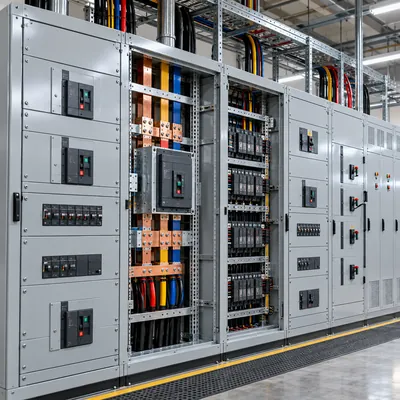
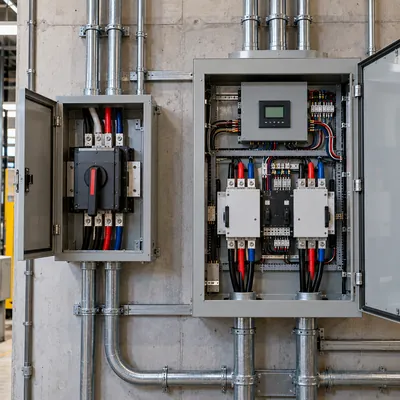
The functions homeowners now buy as a smart main panel have existed in commercial and industrial switchboards for decades, at larger scale. In a factory or building, the equivalent of a smart panel is an intelligent LV switchboard: an IEC 61439-2 assembly with electronic-trip air circuit breakers, multifunction power meters on each feeder, motor-operated breakers for remote control, and Modbus, Profibus or IEC 61850 communication to a building management or SCADA system.
Key differences from residential smart panels:
- Ratings: 400 V to 690 V, 630 A to 6,300 A busbars, with rated short-time withstand (Icw) of 50 kA or more.
- Metering: Class 0.5S or Class 1 energy accuracy, harmonics and power quality logging.
- Load management: demand control, generator load shedding and coordination with battery energy storage for peak shaving.
- Verification: design verification and routine verification under IEC 61439, not just component listing.
MARS does not manufacture residential breaker panels. We build GGD, GCS and MNS low-voltage switchboards with these monitoring and control functions, plus the distribution transformers and C&I battery cabinets that feed them. For the commercial side of panel design, read our power distribution board guide and LV switchboard engineering guide.
Next Steps: Specifying and Sourcing Smart Distribution
For a dwelling, the specification is short: a listed smart panel with adequate SCCR, enough controllable circuits for the loads you plan to manage, local control logic, and an installer who will file the EMS settings with the permit. Get 12 months of utility interval data before deciding whether a service upgrade is necessary.
For commercial, multi-family or industrial projects, a smarter path is to specify monitoring and control at the switchboard level. Include in the RFQ:
- System voltage, frequency and earthing (TN-S, TN-C-S or solidly grounded wye).
- Incomer rating, busbar rating, Icw and form of separation.
- Feeder list with breaker types, metering class and which feeders need remote control.
- Communication protocol and points list for the BMS or SCADA.
- Any battery storage or generator integration for load shedding.
MARS supplies IEC 61439 low-voltage switchboards and metal-clad MV switchgear with routine tests on every unit, FAT available, and typical lead times of 25 to 45 days. Review our HV and LV switchgear range, pair it with a liquid-cooled C&I battery cabinet for peak shaving, and send your single-line diagram through the quote request form.
Frequently asked questions
What is a smart panel in a house?
A house smart panel is a load center that meters every branch circuit and can remotely switch selected circuits through relays or motorized breakers. It shows real-time energy use in an app, sheds loads when the service nears its limit, and can prioritize critical circuits during a generator or battery backup outage.
Is a 200 amp smart panel enough for an EV charger?
Often yes. Using NEC 220.87, take the 12-month peak demand times 125 percent and add the charger. If the total exceeds 200 A, a smart panel acting as an energy management system under Article 750 and 625.42 can cap charging current so the existing 200 amp service remains adequate.
Do smart breaker panels replace circuit breakers?
No. A smart breaker panel still uses UL 489 overcurrent protection on every circuit. The smart functions, metering and switching, are added through sensors, relays or motor-operated breakers. Protection against overload and short circuit continues to come from the breakers, independent of the app or network.
Can I install a smart electrical panel myself?
Replacing a panel is service equipment work that requires a permit, utility coordination and inspection. It must follow local code and be done by a licensed electrician. Owners can safely do the app setup and circuit naming after the electrician has installed, tested and commissioned the panel.
Does a smart panel work without Wi-Fi?
A well-designed smart panel keeps local control logic, so load shedding and protection continue without internet. Remote monitoring and app control stop until the connection returns. Check the product documentation for offline behavior and the default relay state on power loss before relying on it for load management.
What is the commercial equivalent of a smart electrical panel?
In commercial and industrial buildings the equivalent is an intelligent low-voltage switchboard built to IEC 61439 or UL 891, with electronic-trip breakers, feeder power meters, motor-operated breakers and Modbus or IEC 61850 communication to a building management system for monitoring, demand control and load shedding.
Written and reviewed by the MARS application engineering team in Shanghai, who specify and test transformers, switchgear, substations and battery storage for projects in 40+ countries. Last updated .
Tags: smart electrical panel smart panel smart breaker panel 200 amp smart panel smart electrical panel installation