Key takeaways
- A drawout circuit breaker has three standard positions, connected, test and disconnected, plus a fully withdrawn position for removal from its cradle or cubicle.
- Mechanical interlocks prevent racking while the breaker is closed and prevent closing unless it is fully in the connected or test position.
- Low-voltage drawout air circuit breakers are covered by IEC 60947-2, or by UL 1066 and IEEE C37.13 for North American LV power circuit breakers.
- In MV metal-clad switchgear to IEC 62271-200, withdrawable breakers with metal partitions (class PM) between compartments typically achieve loss of service continuity category LSC2B.
- A 2,000 kVA, 400 V transformer draws 2,887 A, so a 3,200 A drawout frame derated by 10 percent at high ambient falls short and needs a 4,000 A frame.
Quick answer: A draw out breaker is a circuit breaker mounted on a racking mechanism or truck so it can be moved between connected, test and disconnected positions, or removed entirely, without unbolting cables or busbars. It provides a visible isolation gap, quick replacement and safer maintenance. Drawout designs are standard in LV power circuit breakers above about 800 A and in MV metal-clad switchgear.
In critical facilities, the time it takes to replace a failed breaker matters as much as its rating. A fixed breaker bolted to busbars can take hours to remove, with the board de-energized throughout. A draw out circuit breaker can be racked out, swapped with a spare and racked back in, often in under an hour, while adjacent feeders stay in service.
This guide is for engineers and facility managers specifying LV switchboards or MV switchgear, and for maintenance teams responsible for racking. It explains drawout construction, the positions and interlocks, fixed vs plug-in vs drawout comparisons, a sizing example with derating, safe racking practice and the maintenance points unique to drawout breakers. For breaker technology in general, see our guide to low voltage circuit breaker selection.
What Is a Drawout Circuit Breaker?
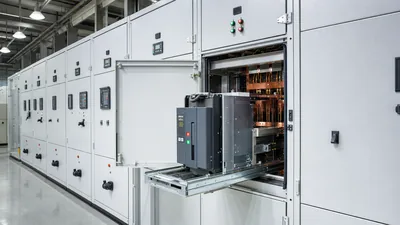
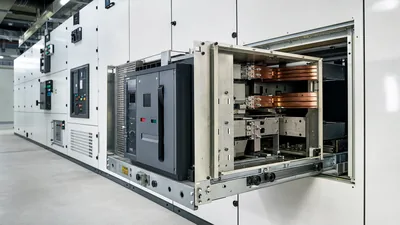
A drawout circuit breaker is a breaker whose main and control connections are made through disconnecting contacts, so the breaker element can be racked away from the energized bus without disturbing the fixed wiring. The terms draw out breaker, drawout breaker, withdrawable breaker and, in MV switchgear, breaker truck all describe the same principle.
A drawout assembly has two parts:
- The fixed part (cradle, chassis or cubicle): mounted in the switchboard, carrying the line and load primary disconnects, secondary (control) disconnects, racking screw, shutters and position indicators.
- The moving part: the breaker itself, with matching primary finger clusters, secondary plugs, trip unit and accessories.
When racked in, the breaker's finger clusters grip the stabs of the fixed part under spring pressure, carrying full rated and short-circuit current. When racked out, automatic shutters close over the live stabs. The visible separation of contacts is one reason many safety programs prefer drawout gear for isolation.
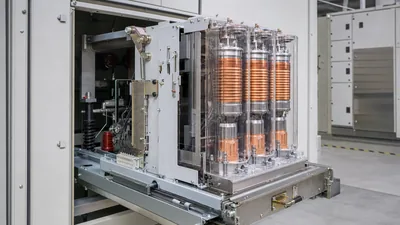
At low voltage, drawout construction is typical for air circuit breakers from about 800 A to 6,300 A, and is optional for larger molded-case breakers. At medium voltage, a withdrawable vacuum breaker on a truck is the defining feature of metal-clad switchgear; see our metal-clad switchgear engineering guide.
Drawout Breaker Positions: Connected, Test and Disconnected
Every drawout breaker has defined positions, each with a clear indicator on the front panel.
| Position | Primary contacts | Secondary (control) contacts | Use |
|---|---|---|---|
| Connected (service) | Engaged | Engaged | Normal operation |
| Test | Disconnected; shutters closed | Engaged | Operate the breaker electrically, test trip unit and control wiring without energizing the load |
| Disconnected (isolated) | Disconnected | Disconnected | Isolation for work downstream; breaker stays in the cubicle |
| Withdrawn (removed) | Out of cradle | Out | Maintenance, exchange or storage; breaker lifted or rolled out |
In MV switchgear such as KYN28, the truck moves horizontally between test/disconnected and service positions inside the breaker compartment, with the door closed, using a racking handle through a small opening. In LV air circuit breaker cradles, the racking handle drives a screw mechanism that moves the breaker through the same positions, also normally with the door closed.
The test position is particularly useful during commissioning and maintenance. Control power is available, so you can close and trip the breaker, check undervoltage releases, shunt trips and motor charging, and verify interlocks with the protective relay, all without exposing the load to voltage. For how these positions appear on drawings, see our switchgear diagram engineering guide.
Interlocks That Make Drawout Breakers Safe
Racking a closed breaker onto or off live stabs would draw an arc at the primary disconnects, one of the most dangerous switching faults possible. Drawout designs therefore include a set of mechanical and electrical interlocks, required in principle by IEC 62271-200 for MV switchgear and by the product standards for LV breakers.
- Racking interlock: the breaker cannot be racked in or out unless it is open. Usually the racking access is blocked or the breaker is held tripped during movement.
- Position interlock: the breaker cannot close except in the connected or test position. Between positions it is held trip-free.
- Earthing switch interlock (MV): the earthing switch cannot close while the truck is in service position, and the truck cannot be racked in while the earthing switch is closed.
- Door interlock (MV): the breaker compartment door cannot open with the truck in service position, depending on design.
- Rating interlock (coding): mechanical coding pins prevent inserting a breaker of the wrong frame or rating into a cradle.
- Padlocking: provision to lock the breaker in disconnected position for lockout/tagout.
- Stored energy discharge: on some designs, closing springs discharge automatically when the breaker is withdrawn.
Interlocks reduce risk but do not remove it. Racking still changes the configuration of energized equipment and must be covered by the site's arc flash risk assessment; our arc flash study guide explains how racking tasks are evaluated.
Fixed vs Plug-In vs Draw Out Circuit Breakers
Choosing a mounting style is a balance of cost, space and how quickly you need to restore service after a breaker problem.
| Feature | Fixed | Plug-in | Drawout |
|---|---|---|---|
| Connection | Bolted to bus and cables | Plugs onto a base; base wired permanently | Racks in a cradle or truck |
| Replacement time | Hours, board shut down | Shorter, usually requires feeder de-energized | Minutes to an hour, often adjacent feeders stay live |
| Test position | No | No | Yes |
| Visible isolation | No (needs separate disconnect) | Partial | Yes, with shutters |
| Cost and space | Lowest | Moderate | Highest, deeper cubicles |
| Typical use | Panelboards, small feeders | MCCB feeders in LV boards | Incomers, ties, large feeders, critical loads |
A common compromise in IEC 61439 boards is drawout air circuit breakers for incomers, bus couplers and large feeders, with fixed or plug-in MCCBs for smaller outgoing circuits. MNS and GCS withdrawable boards extend the drawout idea down to small feeders and motor starters, using withdrawable functional units. Where only a few feeders are critical, a mixed board keeps cost down while protecting the outages that matter most. For a deeper view of LV board forms, see our low voltage switchgear guide.
Worked Example: Sizing a Drawout ACB with Derating
A drawout breaker's rated current is stated for a reference ambient, commonly 40 °C around the switchboard, and drawout construction usually runs warmer than fixed because of the extra disconnecting contacts. Manufacturers publish derating tables for ambient temperature, enclosure ventilation and altitude.
Problem. Select an incomer for a 2,000 kVA, 11 kV/400 V transformer in a switchroom with a design ambient of 50 °C.
- Full-load current:
I = S / (√3 × V) = 2,000,000 / (1.732 × 400) = 2,887 A. - Try a 3,200 A drawout frame. Assume the supplier's table gives a derating factor of 0.90 at 50 °C for this frame in a drawout cradle (illustrative; actual values vary by design).
- Derated capacity:
3,200 × 0.90 = 2,880 A, which is just below 2,887 A. - Select 4,000 A frame:
4,000 × 0.90 = 3,600 A, comfortably above full load. Set the long-time pickup on the electronic trip unit to about 0.75 × 4,000 = 3,000 A. - Check breaking capacity: with 6% transformer impedance and a stiff source,
Isc ≈ 2,887 / 0.06 = 48 kA; choose a breaker with Icu and Ics at least 50 kA, and ideally Icw for 1 s if selectivity with downstream breakers is required.
Altitude above 2,000 m adds further current and voltage derating. Busbars, cradle terminals and incoming cable or busway must be checked against the same ambient. The transformer breaker size chart gives quick starting values for common transformer ratings.
How to Rack a Drawout Breaker Safely
Racking should be done only by qualified persons trained on the specific equipment, under the site's electrical safety program and lockout/tagout rules. The general sequence from connected to disconnected is:
- Plan the task. Review the arc flash label, required PPE and the switching order. Use remote racking devices where available, so the operator stands outside the arc flash boundary.
- Open the breaker using the local or remote trip, and confirm open indication and that the load is de-energized as expected.
- Insert the racking handle or connect the remote racking motor. The interlock should only allow this with the breaker open.
- Rack to test position and confirm the position indicator, then to disconnected if isolation is required.
- Lock out the breaker in disconnected position with a padlock and tag; on MV switchgear, close the earthing switch only after verifying absence of voltage on the cable side.
- Withdraw the breaker using the lifting truck or rails, if removal is required, and check that shutters have closed.
Reverse the sequence to return to service, checking that the earthing switch is open and the breaker is open before racking in. Never force a racking mechanism that binds; that usually indicates misalignment or an interlock doing its job.
Maintenance Points Specific to Drawout Breakers
Beyond normal breaker servicing, the disconnecting interface needs attention, because a poor connection at the finger clusters is a common origin of overheating and arcing faults.
- Primary finger clusters: inspect for discoloration, pitting and loss of spring pressure; clean and apply the manufacturer's specified contact lubricant.
- Stab alignment: check engagement depth in the connected position against the manufacturer's dimension.
- Infrared thermography: compare phase-to-phase temperatures at cubicle rear while loaded; a rise of several kelvin over the other phases warrants investigation.
- Contact resistance: measure from line to load stabs with a micro-ohmmeter, including the disconnects.
- Shutters and interlocks: operate through all positions and verify each interlock function.
- Secondary disconnects: inspect pins for wear and confirm control circuits in the test position.
- Racking mechanism: lubricate the screw and check for smooth movement.
Keeping one spare breaker per frame size lets a site exchange a breaker for workshop service without a long outage, which is the real economic benefit of drawout construction. Servicing intervals follow NFPA 70B guidance and the manufacturer's manual. For selection across breaker families, see our industrial circuit breakers selection guide and, at MV, the vacuum circuit breaker guide.
Next Steps: Specifying and Sourcing Drawout Switchgear
MARS manufactures switchgear with withdrawable breakers at both voltage levels: KYN28 metal-clad switchgear with truck-mounted vacuum circuit breakers for medium-voltage distribution, and GCS and MNS withdrawable LV switchboards to IEC 61439, alongside GGD fixed boards where drawout is not required.
When requesting a quote, specify:
- Which positions need drawout construction: incomers, bus couplers, large feeders or all feeders.
- Rated current, ambient temperature, altitude and required derating basis.
- Breaking capacity (Icu/Ics) and short-time withstand (Icw) at LV; Isc and IAC classification at MV.
- Interlock requirements, padlocking, trapped-key interlocks if used, and remote racking provisions.
- Number of spare breakers and lifting truck or handling accessories.
- Standard set (IEC 62271-200, IEC 61439, IEC 60947-2, or ANSI/IEEE C37 and UL 1066), 50 or 60 Hz.
Ask the supplier to demonstrate every interlock function during FAT and to provide racking instructions and spare finger clusters with the delivery. Browse our HV and LV switchgear and request a quote with your single-line diagram. Typical switchgear lead time is 25–45 days, and FAT including racking and interlock checks can be witnessed. For gas-insulated alternatives at HV, see our SF6 circuit breaker guide.
Frequently asked questions
What is the difference between a fixed and a drawout breaker?
A fixed breaker is bolted directly to busbars and cables, so replacing it requires shutting down and unbolting connections. A drawout breaker connects through disconnecting contacts in a cradle or truck, so it can be racked to test or disconnected positions and exchanged quickly while the board remains energized.
What does the test position on a drawout breaker do?
In the test position, the primary contacts are disconnected and shutters are closed, but the secondary control contacts remain connected. You can close and trip the breaker electrically, test protection and control wiring, and check accessories without energizing the load or exposing it to voltage.
Can you rack out a breaker while it is closed?
No. Interlocks prevent racking unless the breaker is open, because moving closed contacts off live stabs would draw a dangerous arc. If a racking mechanism will not move, do not force it; it usually means the breaker is closed, misaligned or another interlock is active.
What standards cover drawout circuit breakers?
LV drawout air circuit breakers follow IEC 60947-2 internationally and UL 1066 with IEEE C37.13 in North America, installed in assemblies to IEC 61439 or UL 1558. MV withdrawable breakers are rated to IEC 62271-100 and installed in switchgear to IEC 62271-200 or IEEE C37.20.2.
Is a drawout breaker safer than a fixed breaker?
It offers safety advantages such as visible isolation, shutters over live stabs and the ability to rack remotely with the door closed. However, racking is itself a task with arc flash risk, so it must be covered by the arc flash risk assessment and done by qualified persons with appropriate PPE.
When should I specify drawout breakers?
Specify drawout breakers for incomers, bus couplers, large feeders and critical loads where fast replacement and testing without outage matter, such as hospitals, data centers and continuous process plants. For small, non-critical feeders, fixed or plug-in breakers usually give better value.
Written and reviewed by the MARS application engineering team in Shanghai, who specify and test transformers, switchgear, substations and battery storage for projects in 40+ countries. Last updated .
Tags: draw out breaker drawout circuit breaker drawout breaker draw out circuit breaker withdrawable circuit breaker