Key takeaways
- SF6 has roughly 2.5 to 3 times the dielectric strength of air at the same pressure and is strongly electronegative, capturing free electrons after current zero.
- Most HV SF6 breakers operate at about 0.5–0.7 MPa absolute filling pressure, with density monitors giving alarm and lockout stages.
- SF6 has a 100-year global warming potential of about 23,500 times CO2 (IPCC AR5), so a 0.5 percent annual leak from 10 kg equals about 1.2 t CO2e.
- High-voltage AC circuit breakers are rated and type-tested to IEC 62271-100 or IEEE C37.04, C37.06 and C37.09, including breaking current and TRV.
- EU Regulation 2024/573 phases out SF6 in new medium-voltage switchgear in stages from 2026, with later dates for higher voltage classes.
Quick answer: An SF6 circuit breaker is a gas circuit breaker that interrupts current by blasting sulfur hexafluoride across the arc as the contacts separate. SF6's high dielectric strength and electronegativity let it extinguish the arc at current zero and withstand the recovery voltage. It dominates breakers above 72.5 kV, while vacuum breakers lead below 40.5 kV and SF6 use faces tightening F-gas rules.
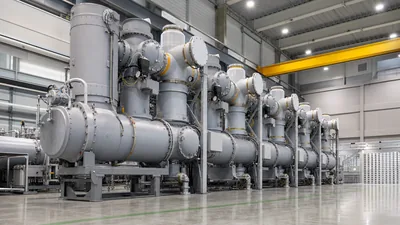
Sulfur hexafluoride transformed high-voltage switching from the 1960s onward. It allowed compact live-tank and dead-tank breakers at 72.5 kV to 800 kV and made gas-insulated switchgear possible. At distribution voltages it competes with vacuum technology, and its very high global warming potential has pushed regulators and utilities toward alternatives.
This article is for substation engineers, utility planners and EPC buyers. It explains SF6 breaker operation in detail, the ratings to check on a data sheet, gas handling and monitoring, how SF6 compares with vacuum and other gas circuit breaker technologies, and what current regulations mean for new purchases. For SF6 as an insulating medium in complete switchgear, see our SF6 gas switchgear engineering guide.
What Is an SF6 Circuit Breaker?
An SF6 circuit breaker is a switching device whose contacts open inside a sealed chamber of pressurized sulfur hexafluoride gas, which cools and de-ionizes the arc so that current is interrupted at a natural current zero. The abbreviation SF6 ckt breaker appears on many single-line diagrams and nameplates, and "gas circuit breaker" (GCB) is the general category name.
SF6 is used because of three properties:
- Dielectric strength: about 2.5 to 3 times that of air at the same pressure, rising further with pressure. That allows short contact gaps and compact interrupters.
- Electronegativity: SF6 molecules capture free electrons, forming heavy negative ions with low mobility. After current zero the arc channel loses conductivity in microseconds.
- Thermal behavior: SF6 conducts heat well at arc temperatures and recombines into SF6 after the arc, so most of the gas is restored after interruption.
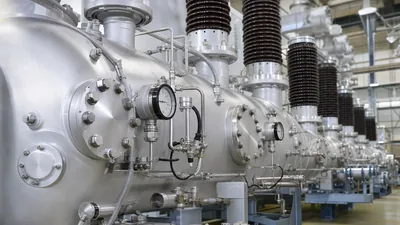
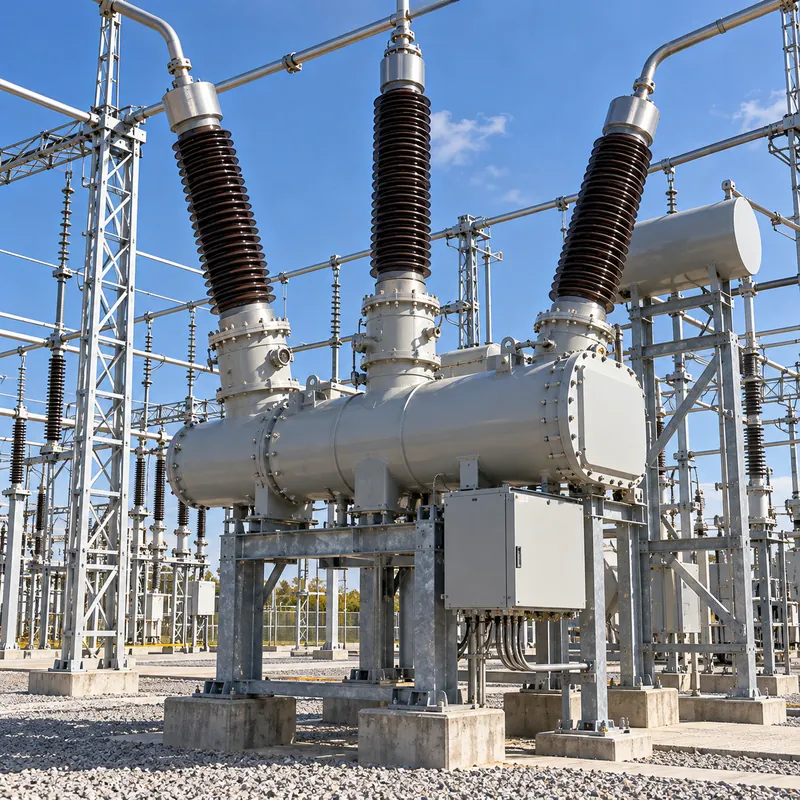
A breaker has three main assemblies: the interrupter (contacts, nozzle and puffer or expansion volume), the insulating structure (porcelain or composite for live tank, a grounded metal tank for dead tank or GIS), and the operating mechanism (spring, hydraulic or spring-hydraulic) that stores energy for close and open operations. Typical rated operating sequence is O–0.3 s–CO–3 min–CO, which supports auto-reclosing on overhead lines.
SF6 Breaker Operation: Puffer, Self-Blast and Double Motion
All SF6 breaker operation follows the same sequence: the arcing contacts separate after the main contacts, an arc forms between them, gas is forced through a nozzle across the arc, and at current zero the arc is quenched. The designs differ in how they produce gas flow.
| Design | How gas flow is created | Mechanism energy | Typical application |
|---|---|---|---|
| Puffer | The moving contact drives a piston that compresses gas, which then blasts through the nozzle | High, as the mechanism does the compression | Earlier HV breakers, still common at high breaking currents |
| Self-blast (thermal assist) | Arc heat raises pressure in a thermal volume; this stored gas blasts the arc at current zero; a small puffer handles low currents | Lower, allowing spring mechanisms | Most modern 72.5–245 kV breakers |
| Double motion | Both contacts move in opposite directions, increasing separation speed | Lower again for a given speed | Compact designs at high voltages |
| Rotating arc | Magnetic field from a coil spins the arc through gas | Very low | Some MV breakers and contactors |
What happens at current zero
As AC current approaches zero, arc temperature and conductivity fall. The gas blast removes hot ionized gas, and SF6 captures electrons. Immediately after zero, a transient recovery voltage (TRV) appears across the contacts. Interruption succeeds if the dielectric strength of the gap recovers faster than the TRV rises. Short-line faults, capacitive switching and out-of-phase switching each produce different TRV shapes, which is why they are separate type tests.
Which SF6 Circuit Breaker Ratings Matter?
SF6 circuit breakers are specified to IEC 62271-100 (with IEC 62271-1 common clauses) or to IEEE C37.04, C37.06 and C37.09 in North America. The key data sheet values are below.
| Rating | Symbol | Typical values |
|---|---|---|
| Rated voltage | Ur | 40.5, 72.5, 126, 145, 252, 420 kV |
| Lightning impulse withstand | Up | For example 550 kV or 650 kV at 145 kV class (depends on insulation coordination) |
| Rated normal current | Ir | 1,250–5,000 A |
| Rated short-circuit breaking current | Isc | 25, 31.5, 40, 50, 63 kA |
| Rated short-time withstand and duration | Ik, tk | Equal to Isc, 1 s or 3 s |
| Making current (peak) | Ip | 2.5 × Isc at 50 Hz, 2.6 × Isc at 60 Hz |
| DC time constant | τ | 45 ms standard; special values for generator or high X/R locations |
| Operating sequence | - | O–0.3 s–CO–3 min–CO |
| Mechanical endurance class | M1/M2 | 2,000 or 10,000 operations |
| Rated filling pressure (abs) | pre | Typically 0.5–0.7 MPa at 20 °C |
Worked example. A 110 kV substation has a calculated maximum three-phase fault level of 5,800 MVA. Fault current is I = S / (√3 × V) = 5,800 / (1.732 × 110) = 30.4 kA. Selecting a 126 kV breaker with Isc = 31.5 kA leaves only 3.6% margin, so planners expecting system growth would choose 40 kA. The required peak making current at 50 Hz is 2.5 × 40 = 100 kA. Breaker duty also depends on X/R; see our circuit breaker ratings guide for substations.
Gas Pressure, Density Monitoring and Leakage
An SF6 breaker can only interrupt its rated current if the gas density is correct. Because pressure varies with temperature, breakers use a temperature-compensated density monitor (density relay) rather than a plain pressure gauge.
Typical stages, expressed as absolute pressure at 20 °C:
- Rated filling pressure, for example 0.60 MPa.
- Alarm pressure, for example 0.52 MPa: refill required soon.
- Minimum functional pressure (lockout), for example 0.50 MPa: the control circuit blocks operation, or trips and blocks, depending on the utility's philosophy.
Values vary by design, so always use the nameplate. IEC 62271-1 treats SF6 breakers as closed pressure systems and the industry norm for sealed HV equipment is a relative leakage rate not exceeding 0.5% per year; many modern designs specify lower.
Worked example: leakage in CO2 equivalent
A 145 kV dead-tank breaker holds 10 kg of SF6. At 0.5% per year: leak = 10 × 0.005 = 0.05 kg/yr. Using a GWP of 23,500 (IPCC AR5): 0.05 × 23,500 = 1,175 kg CO2e per year, roughly the annual emissions of driving a passenger car several thousand kilometers. Across a utility fleet of hundreds of breakers this becomes material, which is why SF6 inventories and leak reporting are now routine.
Gas handling follows IEC 62271-4: recover gas with a dedicated gas cart before opening any compartment, test it for moisture, purity and decomposition products, and reuse it if it meets IEC 60480, or send it for reclamation. New gas must meet IEC 60376. Arced SF6 contains toxic byproducts such as SOF2 and metal fluoride powders, so personnel must use appropriate PPE and ventilation.
SF6 vs Vacuum vs Other Gas Circuit Breakers
The choice of interrupting medium depends mainly on voltage, switching duty and environmental policy.
| Feature | SF6 | Vacuum | Air-blast / air magnetic | Alternative gases (fluoronitrile or fluoroketone mixtures, clean air) |
|---|---|---|---|---|
| Voltage range in practice | 12–800 kV | Mainly up to 40.5 kV, emerging at 72.5–145 kV | Legacy HV, LV air breakers today | 12–420 kV, growing |
| Maintenance | Gas monitoring, periodic mechanism service | Very low; sealed interrupter | High | Similar to SF6 |
| Electrical endurance | High | Very high (E2 class common) | Moderate | Under development per design |
| Environmental impact | Very high GWP | None from gas | None | Much lower GWP |
| Capacitive switching | Very good, low restrike probability | Good, C2 class available | Moderate | Design-dependent |
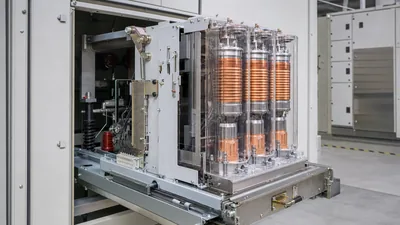
In distribution switchgear, vacuum has largely displaced SF6 as the breaking medium; MARS KYN28 metal-clad panels, for example, use withdrawable vacuum breakers, as described in our vacuum circuit breaker guide. SF6 is still widely used as insulation in ring main units and in gas-insulated switchgear, often with vacuum interrupters inside. Above 72.5 kV, SF6 remains the installed-base standard, while alternative-gas and vacuum designs are being introduced. For a side-by-side of distribution options, see ring main unit vs metal-clad switchgear.
SF6 Regulations: What the F-Gas Rules Mean for New Projects
SF6 is a fluorinated greenhouse gas covered by climate regulations in many jurisdictions. The most far-reaching is the EU F-gas Regulation (EU) 2024/573, which bans placing new SF6-containing switchgear on the market in stages: medium voltage up to 24 kV from 2026, 24–52 kV from 2030, and high voltage above 52 kV from 2028 and 2032 depending on voltage, with exemptions where no suitable alternative is available. Exact scope and exemptions should be checked against the current text before a procurement decision.
Other regions use reporting and leak-reduction rules rather than bans, and some utilities have adopted internal SF6-free targets. Practical implications for buyers:
- Check the project's regulatory jurisdiction and the delivery date, not the order date.
- Ask for gas mass per breaker and guaranteed leakage rate on the data sheet, and include them in evaluation.
- Require a gas handling plan covering filling on site, top-up, end-of-life recovery and documentation.
- Evaluate alternatives such as vacuum at MV and alternative-gas designs at HV where available at your rating.
- Keep an SF6 inventory with serial numbers, mass, top-up records and recovery certificates.
Existing SF6 equipment can generally remain in service and be maintained, but servicing increasingly requires certified personnel and reclaimed or recycled gas.
Maintenance and Testing of SF6 Circuit Breakers
SF6 circuit breakers need little interrupter maintenance, but the mechanism and gas system require routine checks. A typical program includes:
- Visual and density checks: monthly or with each substation inspection; record density monitor readings against temperature.
- Gas quality: dew point (moisture), SF6 purity and SO2 or decomposition products, especially after heavy fault interruption.
- Timing test: opening and closing times, pole discrepancy and contact travel curves compared with factory values.
- Static and dynamic contact resistance: micro-ohm measurement at 100 A DC or more to detect contact wear.
- Mechanism checks: spring charging motor current and time, hydraulic pressure, lubrication per manufacturer intervals.
- Insulation tests: insulation resistance of control circuits; power-frequency withstand only after major work.
Major overhaul is usually triggered by a cumulative interrupted-current count (for example a sum of I² or I values against a limit curve), the number of mechanical operations, or an abnormal test trend. For an overview of how these tests fit into commissioning, read our substation testing engineering guide. Partial discharge measurement on GIS enclosures, covered in our partial discharge testing guide, is a useful complementary check on insulation condition.
Next Steps: Specifying and Sourcing SF6 and SF6-Free Switchgear
MARS supplies SF6-insulated ring main units, KYN28 metal-clad switchgear with vacuum breakers, compact substations and power transformers up to 110 kV class, and can coordinate primary equipment for transformer substation projects. Whether you need SF6 or an SF6-free design depends on jurisdiction and rating, so state it clearly at the RFQ stage.
Include in your specification:
- Rated voltage, insulation level, normal current and short-circuit breaking current with DC time constant.
- Installation: indoor or outdoor, altitude, minimum ambient temperature (low temperatures can require heaters or gas mixtures), seismic level.
- Gas requirements: SF6 permitted or not, maximum gas mass, guaranteed leakage rate and density monitor contacts.
- Mechanism type, auxiliary voltage, operating sequence and auto-reclose requirements.
- Applicable standards: IEC 62271-100 or IEEE C37 series, 50 or 60 Hz.
- Routine and type test reports, and FAT witness points.
For ring main units, also specify whether SF6 is acceptable for insulation only, and ask for gas mass and leakage data per unit for your inventory. Explore our HV and LV switchgear, and request a quote with your single-line diagram. For withdrawable MV breakers, see also our drawout circuit breaker guide.
Frequently asked questions
How does an SF6 circuit breaker extinguish the arc?
When the contacts separate, an arc forms in SF6 gas. A puffer piston or arc-heated pressure volume blasts gas through a nozzle across the arc. At the natural current zero, SF6 cools the channel and captures free electrons, so the gap regains dielectric strength faster than the recovery voltage rises.
What pressure is SF6 in a circuit breaker?
High-voltage SF6 breakers are typically filled to about 0.5–0.7 MPa absolute at 20 °C. A temperature-compensated density monitor gives an alarm when density drops a set amount and blocks operation at the minimum functional pressure. Exact values are on each breaker's nameplate.
Is SF6 gas dangerous?
Pure SF6 is non-toxic and inert but heavier than air, so it can displace oxygen in pits and low spaces. Arced SF6 contains toxic decomposition products such as SOF2 and HF-forming compounds. Handling must follow IEC 62271-4 with recovery equipment, ventilation and appropriate PPE.
What is the difference between an SF6 and a vacuum circuit breaker?
An SF6 breaker interrupts in pressurized gas and is used up to 800 kV. A vacuum breaker interrupts in a sealed vacuum bottle, needs very little maintenance and dominates medium voltage up to about 40.5 kV. Vacuum has no greenhouse gas impact, while SF6 has a very high global warming potential.
Is SF6 being banned?
In the EU, Regulation 2024/573 phases out SF6 in new switchgear in stages, starting with medium voltage up to 24 kV from 2026 and extending to higher voltages by 2032, with some exemptions. Other regions rely on reporting and leak limits. Existing equipment can generally stay in service.
How long does an SF6 circuit breaker last?
Service life is commonly 30–40 years with proper maintenance. Mechanical endurance class M2 allows 10,000 operations, and interrupter overhaul is driven by cumulative interrupted current. Gas leakage, mechanism wear and timing drift are the usual reasons for refurbishment or replacement.
Written and reviewed by the MARS application engineering team in Shanghai, who specify and test transformers, switchgear, substations and battery storage for projects in 40+ countries. Last updated .
Tags: sf6 circuit breaker sf6 breaker operation gas circuit breaker sf6 circuit breakers sf6 ckt breaker