Key takeaways
- A split-phase transformer has one secondary winding with a grounded center tap, giving 120 V from each end to neutral and 240 V across the full winding.
- Split-phase 120/240 V is single-phase: both legs come from one winding, so they are 180 degrees apart relative to neutral, not 90 or 120 degrees.
- Neutral current on a split-phase service equals the difference between the two leg currents, so 50 A and 30 A legs leave 20 A on the neutral.
- Since the 1996 NEC, new range and dryer circuits must use four wires, two hots, a neutral and a separate equipment grounding conductor, under NEC 250.140.
- A 50 kVA pole-mounted transformer at 240 V delivers 208 A of secondary current and typically serves four to ten homes, depending on load.
Quick answer: 240V single phase in North America comes from a split-phase transformer whose secondary winding is center-tapped. The two ends give 240 V between them, and each end gives 120 V to the grounded center tap. A pure 240 V load uses two hots and a ground; a 120/240 V load such as a dryer adds a neutral, making a four-wire circuit.
Every North American house runs on 240 V single phase, but few documents explain exactly how the utility transformer produces it, why the same service also gives 120 V, and how this differs from the 230 V single-phase used across Europe and Asia. Getting these details right matters for wiring three-wire 240 V circuits, sizing neutrals and choosing distribution transformers for rural and residential feeders.
This guide covers split-phase transformer construction, 240 V wiring practice, neutral behavior, naming conventions such as 220 V, and practical sizing of pole-mounted transformers. It is for contractors, utility and EPC engineers and equipment buyers serving 60 Hz residential markets.
What Is 240V Single Phase and How Is It Produced?
240 V single phase is a single-phase AC supply of 240 V nominal between two ungrounded conductors. In North America it is almost always delivered as part of a 120/240 V split-phase service, a three-wire single-phase system with a grounded neutral at the midpoint.
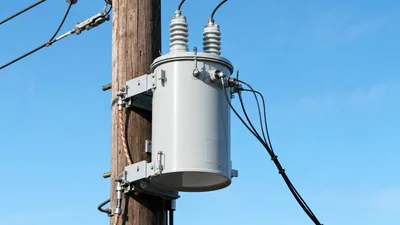
A split-phase transformer is a single-phase distribution transformer whose secondary is a single winding, or two series-connected sections, with a center tap brought out as the neutral. On a typical unit the terminals are marked:
- H1, H2: primary, often H1 to a 7,200 V phase conductor and H2 to the grounded system neutral on a 12,470Y/7,200 V feeder.
- X1, X3: secondary line terminals, 240 V between them.
- X2: center tap, bonded to ground at the service as the neutral, 120 V to each of X1 and X3.
IEEE C57.12.00 specifies additive polarity for single-phase distribution transformers up to 200 kVA with primary voltage up to 8,660 V, and subtractive polarity above those limits. Polarity matters when banking units or paralleling.
Turns ratio for a 7,200 V to 240 V unit is 7,200 / 240 = 30:1. Each 120 V half-winding is 60:1 relative to the primary. Taps on the primary (commonly ±2 × 2.5 percent) adjust the secondary voltage to keep customers within the ANSI C84.1 range. Pole-mounted wiring details appear in the single-phase pole-mounted transformer wiring diagram.
Split Phase vs Single Phase: Are They Different?
Split-phase is a form of single-phase, not a separate system. The distinction is about how many conductors and voltages are available.
| Feature | Split-phase 120/240 V (North America) | Single-phase 230 V (IEC countries) |
|---|---|---|
| Source | Center-tapped single-phase transformer | One phase of a 400/230 V three-phase wye |
| Conductors | L1, L2, N (plus ground) | L, N (plus PE) |
| Voltages | 120 V L-N, 240 V L-L | 230 V L-N |
| Voltage to ground on hot conductors | 120 V | 230 V |
| Neutral current, balanced load | Zero | Equal to line current |
| Frequency | 60 Hz | 50 Hz (mostly) |
The main advantage of split-phase is that it gives a high voltage for heavy loads while keeping only 120 V to ground at outlets. The main disadvantage is that two-pole breakers and a three-wire service are needed for 240 V appliances.
IEC-style single-phase 230 V, explained in the 230V single-phase power guide, takes a single hot conductor from one phase of a three-phase LV network. Calling split-phase two-phase is a common mistake; the reasons are covered in what 2 phase power really is.
3-Wire 240 Volt Wiring: Two Hots and a Ground
A 240 V load with no 120 V components, such as a water heater, baseboard heater, well pump or air-conditioning condenser, needs only two hot conductors and an equipment grounding conductor. This is the familiar 3 wire 240 volt circuit.
- Two-pole breaker: occupies two adjacent spaces in the panel so that one pole is on L1 and the other on L2, with a common trip so both lines open together.
- Two ungrounded conductors: typically black and red, or black and a white conductor re-identified with tape where cable is used, as NEC 200.7(C) permits.
- Equipment grounding conductor: green or bare, sized from NEC Table 250.122 according to the breaker rating, for example 10 AWG copper for 60 A, 12 AWG for 20 A.
- No neutral: the load is connected only between L1 and L2, so no current returns on a neutral.
A 240V wiring diagram for this 3-wire case shows L1 and L2 from the breaker to the load terminals and the ground from the panel ground bar to the equipment frame. The ground carries current only during a fault.
Worked example: a 4,500 W, 240 V water heater draws 4,500 / 240 = 18.75 A. Water heaters are continuous loads under NEC 422.13, so the circuit needs 18.75 × 1.25 = 23.4 A. A 25 A or 30 A two-pole breaker with 10 AWG copper conductors is standard. For EGC rules in depth, see equipment grounding conductor sizing.
Note: residential service and branch-circuit work must follow local code and be done by a licensed electrician.
When Do 240V Circuits Need a Neutral? 4-Wire 120/240 V
Electric ranges, clothes dryers and some combination appliances have 240 V heating elements and 120 V timers, lights, controls or motors. They need both voltages, and therefore a neutral as well as the two hots.
Older installations used a three-wire 120/240 V circuit where the neutral also bonded the appliance frame. Since the 1996 NEC, new range and dryer circuits must be four-wire: two hots, an insulated neutral and a separate equipment grounding conductor, as required by NEC 250.140. Existing three-wire circuits may remain only under the conditions listed in that section.
| Circuit type | Conductors | Typical receptacle | Example loads |
|---|---|---|---|
| 240 V, 3-wire | L1, L2, EGC | NEMA 6-series | Water heater, welder, compressor |
| 120/240 V, 4-wire | L1, L2, N, EGC | NEMA 14-30, 14-50 | Dryer, range, RV supply, EV charger |
| 120/240 V, 3-wire (legacy) | L1, L2, N (frame bonded to N) | NEMA 10-30, 10-50 | Existing dryers and ranges only |
The separate ground matters because an open neutral on a legacy three-wire circuit could leave the appliance frame energized. The voltage between neutral and ground is a useful diagnostic for neutral integrity, explained in neutral to ground voltage.
Neutral Current and Balance in Split-Phase Services
In a split-phase system, 120 V loads on leg L1 and leg L2 draw currents that are 180 degrees apart in the neutral. The neutral therefore carries only the difference:
IN = |IL1 − IL2| (for loads of similar power factor)
Example: a home has 50 A of 120 V load on L1 and 30 A on L2, plus a 20 A 240 V heater. L1 carries 70 A, L2 carries 50 A, and the neutral carries |50 − 30| = 20 A. The 240 V load adds equally to both legs and nothing to the neutral.
This is the great advantage of split-phase: a well-balanced service has little neutral current and therefore low neutral voltage drop and losses. Compare 120/208 V three-wire service, where the neutral carries current equal to the phase current even when balanced, explained in the 208V single-phase guide.
The open-neutral hazard
If the service neutral opens, 120 V loads on L1 and L2 end up in series across 240 V. The leg with less load sees higher voltage, up to nearly 240 V across 120 V equipment, causing damage. Symptoms include lights brightening on one side of the house as loads on the other side switch on. A loose or corroded neutral connection at the transformer or meter is the usual cause and requires utility attention.
Voltage drop advantage
A 2.4 kW load on 10 AWG copper 100 ft away (0.248 Ω round trip) draws 20 A at 120 V and drops 20 × 0.248 = 4.96 V, or 4.1 percent. At 240 V it draws 10 A and drops 2.48 V, just 1.0 percent. Doubling voltage cuts percentage drop by four.
220V Single Phase vs 240V: Naming and International Equivalents
Single phase 220 volt, 230 V and 240 V all appear in catalogs, sometimes for the same thing and sometimes not.
- North America: 240 V is the ANSI C84.1 nominal for the line-to-line voltage of split-phase service. 220 V and 230 V are older or utilization-voltage names; motor nameplates show 230 V for use on 240 V systems.
- IEC countries: 230 V is the line-to-neutral nominal under IEC 60038, harmonized from earlier 220 V (continental Europe) and 240 V (UK, Australia).
- China and some other markets: 220 V line-to-neutral remains the nominal.
The physical difference is important. A 220V 1 phase supply in China has one conductor at 220 V to ground and one neutral. A 240 V circuit in the US has two conductors each at 120 V to ground. A device designed for one hot and one neutral normally works on either, because it sees only the voltage across its terminals, but a device that switches only one pole may leave the second conductor live on a US circuit. Equipment imported for US 240 V use should therefore have double-pole switching and protection where required.
Frequency is the other check: 60 Hz in North America, 50 Hz in most IEC countries. A 50 Hz transformer or motor on 60 Hz at the same voltage generally runs cooler magnetically; the reverse can overheat. For portable equipment, see the 120 to 240 transformer guide when the site lacks a 240 V circuit.
How to Size a Pole-Mounted Split-Phase Transformer
Utility and private-network designers select split-phase transformer kVA from the diversified demand of the homes or buildings it serves.
| Transformer kVA | Secondary current at 240 V | Typical application |
|---|---|---|
| 25 kVA | 104 A | 1 to 4 homes, rural service |
| 37.5 kVA | 156 A | 3 to 6 homes |
| 50 kVA | 208 A | 4 to 10 homes |
| 75 kVA | 313 A | Large homes, small farms, shops |
| 100 kVA | 417 A | Farm or small commercial service |
| 167 kVA | 696 A | Large single-phase commercial |
Worked example: six all-electric homes each have a calculated demand of about 12 kVA under NEC Article 220 methods, but their coincident peak is lower because they do not all peak together. Applying a utility diversity factor of 0.5 gives 6 × 12 × 0.5 = 36 kVA. A 37.5 kVA transformer would be fully loaded at peak; a 50 kVA unit leaves room for EV chargers and heat pumps. Distribution transformers tolerate short peaks above nameplate under IEEE C57.91 loading guidance, but sustained overload shortens insulation life.
Also check motor starting: a 5 hp, 240 V well pump with locked-rotor current near 150 A causes a voltage dip of several percent on a 25 kVA unit. Construction and mounting options are reviewed in the single-phase pole-mounted transformer guide.
Next Steps: Specifying and Sourcing Split-Phase Transformers
For a residential feeder, farm or small commercial project, include these items in the transformer specification:
- kVA rating and primary voltage, for example 7,200 V or 7,620 V line-to-neutral, or 14,400 V or 19,920 V on 25 kV and 34.5 kV class systems.
- Secondary 120/240 V, three-wire, center-tapped, 60 Hz, with additive or subtractive polarity stated.
- Primary taps, BIL, impedance and loss requirements, plus any national efficiency rule.
- Mounting (pole bracket or pad), bushing arrangement, surge arresters and fuse cutout coordination.
- Governing standard, normally IEEE C57.12.00 and C57.12.20 for overhead units.
MARS manufactures single-phase pole-mounted transformers and pad-mounted transformers with 120/240 V secondaries to ANSI/IEEE variants, routine tested on every unit with FAT available and typical lead times of 25 to 45 days. Send quantities and ratings through the quote request.
Frequently asked questions
Is 240V single-phase or split-phase?
Both. North American 240 V is single-phase power delivered through a split-phase arrangement: one transformer winding with a grounded center tap. The full winding provides 240 V, and each half provides 120 V to neutral. Because there is only one winding and one phase angle, the system is single-phase.
What is a 3-wire 240 volt circuit?
A 3-wire 240 V circuit has two hot conductors from a two-pole breaker and one equipment grounding conductor, with no neutral. It serves loads that operate only at 240 V, such as water heaters and well pumps. Loads with 120 V parts need a fourth conductor, the neutral.
Is 220V the same as 240V single phase?
In North America, 220 V is an old name for the 240 V split-phase circuit, and the equipment is the same. Internationally, 220 V or 230 V single-phase usually means one hot conductor and a neutral from a three-phase network, which has a different voltage to ground than US 240 V.
What is a split-phase transformer?
A split-phase transformer is a single-phase distribution transformer whose secondary winding is center-tapped. The center tap is grounded as the neutral, giving 120 V from each end to neutral and 240 V across the ends. It is the standard pole-mounted or pad-mounted transformer serving North American homes.
How much current flows in the neutral on a 240V service?
On a split-phase 120/240 V service the neutral carries the difference between the 120 V load currents on the two legs. If L1 has 40 A and L2 has 25 A of 120 V load, the neutral carries 15 A. Loads connected at 240 V add nothing to the neutral.
What size transformer is needed for a house?
Utilities usually serve one to four average homes from a 25 kVA transformer and four to ten from a 50 kVA unit, based on diversified demand. A single large all-electric house with EV charging may justify its own 37.5 or 50 kVA unit. Actual sizing depends on the utility's load data.
Written and reviewed by the MARS application engineering team in Shanghai, who specify and test transformers, switchgear, substations and battery storage for projects in 40+ countries. Last updated .
Tags: 240v single phase split phase vs single phase split phase transformer 3 wire 240 volt wiring 220v single phase