Key takeaways
- Single-phase 208 V is taken line-to-line from a 208Y/120 V three-phase wye, where each line is 120 V to neutral and 120 degrees from its neighbors.
- A 208 V single-phase branch circuit needs two ungrounded conductors on a two-pole common-trip breaker plus an equipment grounding conductor sized per NEC Table 250.122.
- On 120/208 V three-wire service, balanced 120 V loads make the neutral carry the full phase current, unlike 120/240 V split-phase where it carries zero.
- A 240 V resistive heater on 208 V produces only 75 percent of its rated power, because heater output varies with the square of voltage.
- Three equal 208 V single-phase loads connected A-B, B-C and C-A balance the panel, with line current equal to 1.732 times each load current.
Quick answer: 208V single phase is the voltage between any two hot lines of a 208Y/120 V three-phase wye system. Because the lines are 120 degrees apart, 120 × √3 = 208 V. A 208 V single-phase circuit uses two ungrounded conductors on a two-pole breaker plus an equipment ground; a neutral is added only when the equipment also needs 120 V.
208 V single phase is everywhere in North American apartment buildings, offices, schools and retail units, yet it is often misunderstood. Electricians see two hot legs and a two-pole breaker, just as on a 240 V home circuit, and assume the same rules apply. They do not: the phase angle is different, the neutral behaves differently, and 240 V equipment loses capacity on 208 V.
This guide explains where 208 V single-phase comes from, how to wire it, how the neutral carries current in 120/208 V services and how to size loads correctly. It is written for electrical contractors, building engineers and equipment suppliers working in 208Y/120 V buildings.
What Is 208V Single Phase and Where Does It Come From?
208 V single-phase is a single-phase supply derived from two lines of a three-phase, four-wire 208Y/120 V system. The utility transformer, usually a three-phase pad-mounted unit or a bank of three single-phase units, has a wye-connected secondary with a grounded neutral at the star point. Each phase winding produces 120 V, and the phases are displaced 120 degrees.
The voltage between any two lines is the phasor difference of two 120 V vectors 120 degrees apart:
VLL = 2 × VLN × sin(60°) = √3 × VLN = 1.732 × 120 = 207.8 V
So a 120/208 single-phase load is not on a different system; it is the same three-phase source used line-to-line. A building panel fed at 208Y/120 V offers three different 208 V pairs (A-B, B-C, C-A) and three 120 V circuits (A-N, B-N, C-N).
| Connection | Voltage | Breaker | Typical loads |
|---|---|---|---|
| One line to neutral | 120 V | 1-pole | Receptacles, lighting, small appliances |
| Two lines | 208 V single-phase | 2-pole | Water heaters, ranges, PTAC units, EV chargers |
| Two lines plus neutral | 120/208 V | 2-pole | Ranges and dryers with 120 V controls |
| Three lines | 208 V three-phase | 3-pole | Rooftop units, elevators, kitchen equipment |
The three-phase side of this system is covered in the 208V 3-phase power guide, and the wye connection itself in the 3-phase 4-wire system guide.
How to Wire 208V Single Phase
A 208 volt single phase circuit is wired much like a 240 V circuit, with differences in conductor identification and neutral use. The steps below describe the design layout; installation must follow the NEC and local code and be carried out by a licensed electrician with the circuit de-energized.
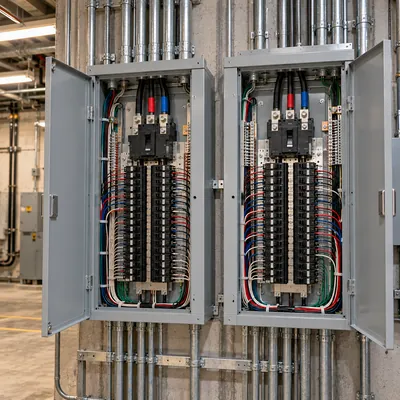
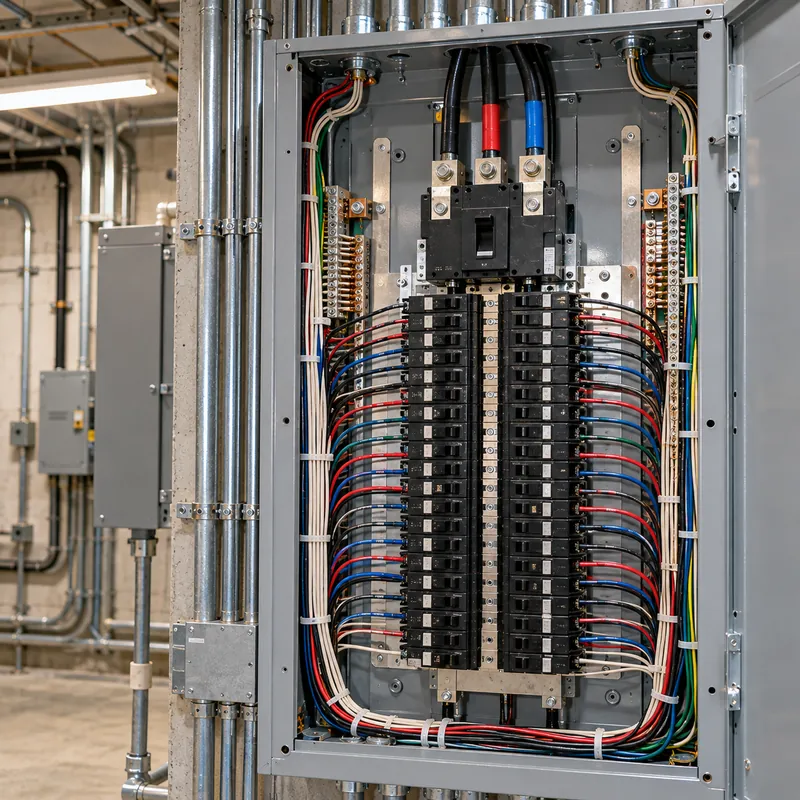
- Select the breaker: a two-pole, common-trip breaker occupying two adjacent phase positions (A-B, B-C or C-A) in a three-phase panelboard.
- Size the conductors: from load current with the 125 percent continuous factor where applicable, using NEC Table 310.16 at the terminal temperature rating.
- Run two ungrounded conductors: in 208Y/120 V systems, common practice is black, red and blue for phases A, B and C; NEC 210.5(C) requires the identification scheme to be posted at the panel.
- Run an equipment grounding conductor: green, bare or green-yellow, sized from the overcurrent device rating using NEC Table 250.122, for example 10 AWG copper for a 60 A circuit.
- Add a neutral only if needed: if the equipment requires 120 V for controls or lights, run a white or grey grounded conductor, making it a 120/208 V three-wire-plus-ground circuit.
- Verify at the equipment: measure 208 V line-to-line and about 120 V each line to ground before energizing the load.
A single phase 208V wiring diagram therefore shows two phase conductors from a two-pole breaker to the load terminals L1 and L2, a ground conductor from the panel ground bar to the equipment frame, and optionally a neutral from the neutral bar. For the EGC rules in detail, see equipment grounding conductor sizing; conductor colors are covered in color code for 3-phase power.
120/208 V Single-Phase Service: Why the Neutral Carries Current
Many apartment buildings fed from a 208Y/120 V network give each unit a 120/208 V single-phase three-wire service: two phase conductors plus neutral. It looks identical to a 120/240 V home service, but the neutral behaves differently.
In a 120/240 V split-phase service, the two 120 V legs are 180 degrees apart. Equal loads on each leg produce currents that cancel in the neutral, so a balanced service has zero neutral current.
In a 120/208 V service, the two legs are 120 degrees apart. The neutral carries the phasor sum of the two leg currents:
IN = √(IA² + IB² − IA × IB) (for in-phase loads on legs 120 degrees apart)
Worked example: a unit has 40 A of 120 V resistive load on leg A and 40 A on leg B. Neutral current is √(1,600 + 1,600 − 1,600) = 40 A, equal to the phase current. With 50 A on A and 20 A on B: √(2,500 + 400 − 1,000) = 43.6 A.
| Leg loads (A / B) | Neutral on 120/240 V | Neutral on 120/208 V |
|---|---|---|
| 40 A / 40 A | 0 A | 40 A |
| 50 A / 20 A | 30 A | 43.6 A |
| 60 A / 0 A | 60 A | 60 A |
This is why the NEC neutral ampacity rules in 310.15 treat the neutral of a three-wire circuit from a 208Y/120 V system as a current-carrying conductor for ampacity adjustment, and why the neutral should be full size. Comparison with split-phase service is in 240V single-phase and split-phase.
Running 240V Equipment on 208V Single Phase
Much residential equipment in North America is designed for 240 V, and a lot of it ends up on 208 V circuits in multi-family buildings. The result depends on the load type.
Resistive heaters
Power varies with voltage squared: P208 = P240 × (208 / 240)² = 0.751 × P240.
Example: a 5,000 W, 240 V water heater element has resistance R = 240² / 5,000 = 11.52 Ω. On 208 V it draws 208 / 11.52 = 18.1 A and produces 208² / 11.52 = 3,756 W, a 25 percent loss of heating capacity and slower recovery. Many manufacturers offer 208 V elements to restore full output.
Motors and compressors
Equipment rated 208-230 V is designed for both. A motor rated only 230 V running at 208 V is 9.6 percent below nameplate, at the edge of the ±10 percent NEMA MG 1 tolerance, and any further voltage drop pushes it outside. Torque falls roughly with voltage squared, and current rises.
Electronic loads and EV chargers
Switch-mode supplies usually accept 208 to 240 V. A charger limited to 32 A delivers 208 × 32 = 6.66 kW instead of 7.68 kW at 240 V.
| Load | Rated at 240 V | On 208 V |
|---|---|---|
| Resistive heater | 100 percent output | 75 percent output |
| Induction motor rated 230 V | Within tolerance | Marginal, check nameplate |
| EV charger at 32 A | 7.68 kW | 6.66 kW |
| Dual-rated 208-230 V equipment | Rated | Rated |
Where full 240 V output is essential, a buck-boost transformer raises 208 V to about 236 V; see buck and boost transformer 208 to 240.
How to Get 208 Volts Single Phase
There are four practical ways to obtain a 208 volt 1 phase supply, depending on what is already available.
- From an existing 208Y/120 V panel: install a two-pole breaker across any two phases. This is the normal case in commercial buildings.
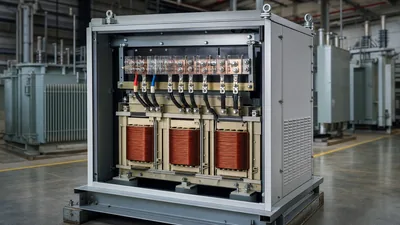
- From a 480Y/277 V building: install a three-phase dry-type step-down transformer, typically 480 V delta primary to 208Y/120 V secondary, then a 208Y/120 V panelboard. Sizing and connections are covered in the 480 to 208 transformer wiring diagram.
- From 240 V single-phase: use a buck-boost transformer in buck configuration to lower 240 V by about 32 V, or a single-phase isolation transformer with a 208 V secondary.
- From the utility: request 120/208 V network service, available where the local distribution is 208Y/120 V.
A single-phase transformer with a 208 V secondary is less common because most equipment designed for 208 V tolerates 240 V or is dual rated. The step-down from three-phase is the usual route for tenant fit-outs in high-rise buildings fed at 480Y/277 V.
For a new building, the decision between 208Y/120 V and 480Y/277 V service affects every feeder; the trade-offs are explained in 208 vs 240 volts.
Balancing 208V Single-Phase Loads on a Three-Phase Panel
Each 208 V single-phase load draws current from two of the three phases. Good practice is to distribute these loads across A-B, B-C and C-A so that phase currents stay within about 10 percent of each other.
Worked example: a laundry room has three 10 kW, 208 V single-phase dryers. Each draws 10,000 / 208 = 48.1 A. Connected one per phase pair (A-B, B-C, C-A), the three loads form a balanced delta, and each line current is 48.1 × √3 = 83.3 A. Check: 30,000 / (1.732 × 208) = 83.3 A.
If all three were connected to A-B, line A and line B would each carry 3 × 48.1 = 144 A while line C carried nothing. The feeder and transformer would see a severe imbalance, and the transformer's most loaded winding would set its effective capacity.
| Connection | Line A | Line B | Line C |
|---|---|---|---|
| One dryer each on A-B, B-C, C-A | 83.3 A | 83.3 A | 83.3 A |
| Two on A-B, one on B-C | 96.2 A | 127 A | 48.1 A |
| All three on A-B | 144 A | 144 A | 0 A |
For mixed 120 V and 208 V loads, compute each line current as a phasor sum, or use the per-phase VA method of NEC Article 220. The transformer must be sized for the most heavily loaded phase times three, not simply the total kVA.
Transformer and Service Sizing for 120/208 V Buildings
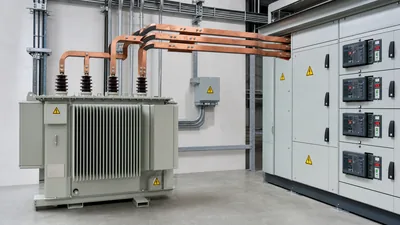
A building supplied at 208Y/120 V typically has a dedicated three-phase pad-mounted transformer outside, or a network vault in dense urban areas. Its secondary current is high for its kVA because the voltage is low.
- 150 kVA at 208 V:
150,000 / (1.732 × 208) = 416 A - 300 kVA at 208 V: 833 A
- 500 kVA at 208 V: 1,388 A
- 750 kVA at 208 V: 2,082 A
Beyond about 750 kVA, 208 V service becomes awkward because of the busway and parallel conductor sets required. That is the point where designers move to 480Y/277 V service with local dry-type transformers for 208Y/120 V loads.
When specifying the supply transformer, list the expected single-phase load distribution, the share of non-linear loads (which add triplen harmonic current to the neutral) and any large motor starting. Pad-mounted transformer options are described in the 3-phase pad-mounted transformer guide.
Next Steps: Specifying and Sourcing for 208V Single-Phase Loads
Whether the requirement is a new building service or a step-down for a tenant fit-out, write the specification so the voltage system is unambiguous:
- State secondary as 208Y/120 V, three-phase, four-wire, 60 Hz, solidly grounded.
- Give kVA, impedance, primary voltage and taps, and the standard (IEEE C57.12.00 and C57.12.34 for pad-mounts).
- Specify a full-size or oversized neutral where 120/208 V three-wire circuits and non-linear loads dominate.
- For equipment rated 240 V, decide early whether to buy 208 V versions or add buck-boost transformers.
MARS supplies three-phase pad-mounted transformers with 208Y/120 V secondaries and dry-type transformers for 480 V to 208Y/120 V step-down, built to ANSI/IEEE variants with routine tests on every unit. Send your load schedule through the quote request for a matched proposal.
Frequently asked questions
Is 208V single-phase or three-phase?
208 V can be either. Between any two lines of a 208Y/120 V system, 208 V is single-phase and feeds two-pole circuits. Using all three lines, 208 V is three-phase and feeds three-pole circuits for motors and HVAC. Both come from the same three-phase wye transformer secondary.
How do you wire 208V single phase?
A 208 V single-phase circuit uses two ungrounded conductors from a two-pole common-trip breaker on two different phases, plus an equipment grounding conductor sized from NEC Table 250.122. A neutral is added only if the equipment needs 120 V. Work must follow local code and be done by a licensed electrician.
Does 208V single phase need a neutral?
No, a pure 208 V load needs only the two line conductors and an equipment ground. A neutral is required only when the equipment also has 120 V components, such as controls, timers or lights, which are fed from one line to neutral. The neutral must never be used as the equipment ground.
Can I run a 240V appliance on 208V single phase?
Often yes, with reduced performance. Resistive heaters lose about 25 percent of their output on 208 V. Motors rated only 230 V run near the edge of their tolerance and may overheat if voltage drops further. Equipment marked 208-230 V is designed for both. Check the nameplate before connecting.
Why does the neutral carry current on 120/208 service?
On 120/208 V three-wire service the two legs are 120 degrees apart, not 180 degrees, so their currents do not cancel in the neutral. With equal 120 V loads on each leg, the neutral carries the same current as each phase. The neutral must therefore be full size and counted as current-carrying.
How do you get 208 volts single phase?
Connect a two-pole breaker across any two phases of a 208Y/120 V panel. In a 480Y/277 V building, install a 480 V to 208Y/120 V dry-type step-down transformer first. From a 240 V single-phase supply, a buck-boost transformer in buck mode or an isolation transformer with a 208 V secondary can be used.
Written and reviewed by the MARS application engineering team in Shanghai, who specify and test transformers, switchgear, substations and battery storage for projects in 40+ countries. Last updated .
Tags: 208v single phase 208 single phase wiring 120 208 single phase 208v 1 phase wiring how to get 208 volts single phase