Key takeaways
- 208 V equals 120 V times 1.732 and is the line-to-line voltage of a 208Y/120 V four-wire wye system used in offices, retail and apartments.
- 240 V three-phase is supplied by delta systems, either three-wire ungrounded or corner-grounded, or four-wire high-leg delta with a 208 V wild leg to neutral.
- For the same 75 kVA load, current is 208 A at 208 V three-phase and 180 A at 240 V three-phase, a 15 percent difference in conductor duty.
- NEMA MG 1 allows motors to operate at plus or minus 10 percent of nameplate, so a 230 V motor at 208 V sits right at the lower limit of 207 V.
- A buck-boost transformer rated at roughly 12 to 15 percent of load kVA can raise 208 V to about 236 V or lower 240 V to about 211 V.
Quick answer: 208 vs 240 volts: 208 V is the line-to-line voltage of a 208Y/120 V three-phase wye, standard in North American commercial buildings. 240 V comes from split-phase residential service or a 240 V delta three-phase system. 208 V is 13 percent lower, so 240 V-only equipment on 208 V loses about 25 percent of heater output and roughly 18 to 25 percent of motor torque.
The choice between 208 V and 240 V shows up at two scales. For a building, it is the choice of service: a 120/208 V wye or a 240 V delta. For an individual machine, it is whether a nameplate that says 230 V will be happy on the 208 V circuit the building actually has. Both scales produce costly mistakes when the difference is ignored.
This guide compares the two systems electrically, shows how each is wired and supplied, quantifies the effect on equipment, and lists the conversion options. It is aimed at MEP engineers, contractors, equipment vendors and facility owners in 60 Hz North American markets.
What Is 208 Volts and Where Does 240 V Come From?
208 V is the voltage between any two phase conductors of a three-phase wye system with 120 V from each phase to neutral: 120 × √3 = 207.8 V. The system is designated 208Y/120 V and is the standard service for light commercial and multi-family buildings in the US and Canada.
240 V comes from two different sources:
- Split-phase single-phase: a center-tapped single-phase transformer giving 120/240 V, the normal residential supply. See 240V single-phase and split-phase.
- Three-phase delta: a delta-connected secondary with 240 V between each pair of lines. It may be ungrounded, corner-grounded, or center-tapped on one winding to provide 120 V (the 120/240 V four-wire high-leg delta).
| Parameter | 208Y/120 V wye | 240 V delta (3-wire) | 240/120 V high-leg delta |
|---|---|---|---|
| Line-to-line | 208 V | 240 V | 240 V |
| Line-to-neutral | 120 V on all phases | None | 120 V on A and C, 208 V on B (high leg) |
| Wires | 4 (A, B, C, N) | 3 | 4 |
| Grounding | Neutral solidly grounded | Ungrounded or corner-grounded | Center tap grounded |
| Typical use | Offices, retail, apartments | Older industrial, motor loads | Older shops, light industrial |
The 208Y/120 V system dominates new construction because every phase supplies 120 V receptacles and lighting equally, and the grounded neutral simplifies ground-fault detection. The 3-phase arrangement itself is detailed in the 208V 3-phase power guide.
208 Volts vs 240 Volts: Electrical Comparison
The two voltages differ by 32 V, or 13.3 percent relative to 240 V. That modest difference has three consequences.
Current for the same power
For a three-phase load, I = kVA × 1,000 / (√3 × V). A 75 kVA load draws 75,000 / (1.732 × 208) = 208 A at 208 V but 75,000 / (1.732 × 240) = 180 A at 240 V. The 208 V system needs larger conductors, breakers and busbars for the same kVA. The figures for common 75 kVA transformers are tabulated in 75 kVA transformer amps.
Fixed-impedance load output
Resistive heaters and incandescent lamps follow P ∝ V², so a 240 V-rated device on 208 V delivers (208 / 240)² = 75 percent of rated power.
Motor torque and current
Induction motor torque varies approximately with voltage squared. A motor wound for 230 V and run on 208 V develops about (208 / 230)² = 82 percent of its rated torque at a given slip, so it slips more and draws more current to carry the same load. NEMA MG 1 permits operation at ±10 percent of rated voltage, which for a 230 V motor is 207 to 253 V. Supplied at a nominal 208 V with any voltage drop, the motor is outside tolerance.
| Effect | 240 V device on 208 V | 208 V device on 240 V |
|---|---|---|
| Resistive heater output | 75 percent | 133 percent (overloaded) |
| Motor torque (approximate) | 75 to 82 percent | Higher, with more magnetizing current |
| Motor current at same load | Higher | Lower at load, higher no-load current |
| Lamp and ballast life | Dimmer, longer life | Brighter, shorter life |
For dual-rated 208-230 V equipment, either supply is acceptable within the stated range.
120/208 V Three-Phase Wiring and Service
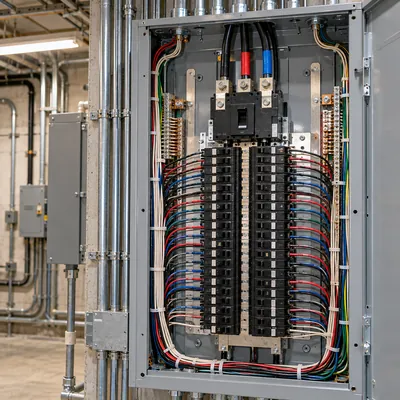
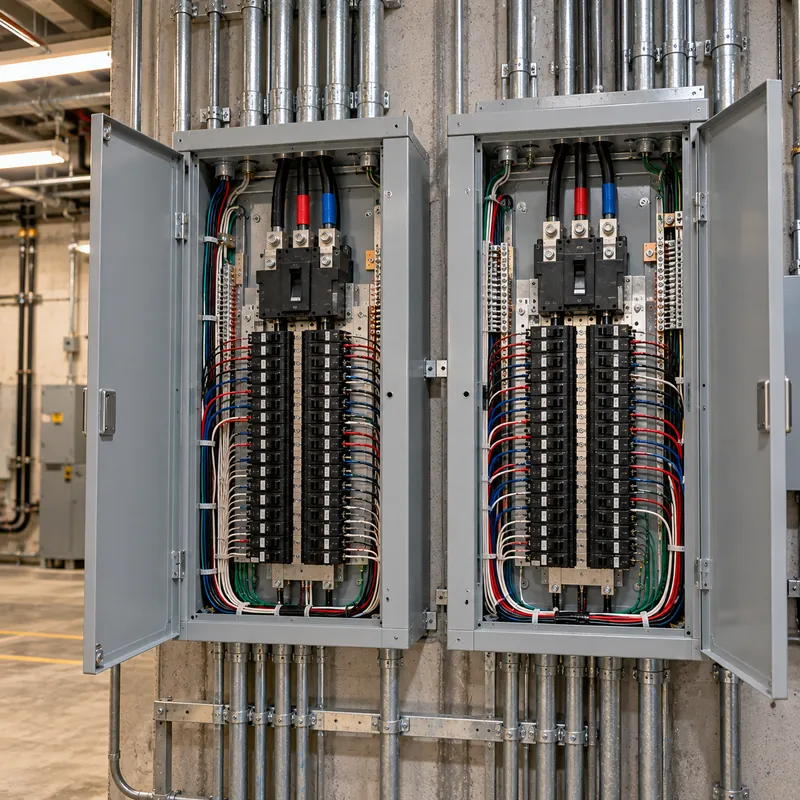
A 120/208 V three-phase service is a four-wire service: three phase conductors and a grounded neutral, plus an equipment grounding path. It supplies three types of load from one panel.
- 120 V single-pole circuits from any phase to neutral.
- 208 V two-pole circuits between any two phases.
- 208 V three-pole circuits for three-phase motors, rooftop units and elevators.
208 three phase wiring in the US typically identifies phases A, B and C as black, red and blue, the neutral as white or grey and the ground as green or bare. NEC 210.5(C) requires the scheme to be posted at each panelboard. A 208V 3 phase wiring layout from a pad-mounted transformer runs the service lateral to a main switchboard, which feeds panelboards and three-phase loads; the neutral is bonded to ground only at the service disconnect, per NEC 250.24.
Worked example: a retail unit has 40 kVA of 120 V lighting and receptacle load evenly spread, plus a 25 kVA three-phase rooftop unit. Total is 65 kVA at 208 V three-phase: 65,000 / (1.732 × 208) = 180 A per phase. A 200 A, 120/208 V service is sufficient after NEC Article 220 demand factors; under the 125 percent continuous rule, the continuous portion should be checked carefully before finalizing.
The phase color conventions and their variants by jurisdiction are explained in color code for 3-phase power.
Note: service equipment work must follow local code and be carried out by licensed electricians.
208 3-Phase vs 240 3-Phase: Which System Should a Building Use?
For a new building with a mix of lighting, receptacles and modest motor load, 208Y/120 V is almost always the right answer. For a motor-dominated building with little 120 V load, 240 V delta has been used historically, but most such facilities now choose 480Y/277 V instead.
| Criterion | 208Y/120 V | 240 V delta / high-leg delta |
|---|---|---|
| 120 V availability | All three phases | Only two phases (high-leg) or none |
| Phase balance for 120 V loads | Easy | Difficult; lighting loads land on one transformer |
| Motor voltage | 200 V nameplate | 230 V nameplate |
| Ground-fault detection | Simple with grounded neutral | Needs ground detectors on ungrounded systems |
| Hazard labelling | Standard | High leg must be orange per NEC 110.15 and on B phase in panels per NEC 408.3(E) |
| Utility availability | Standard everywhere | Increasingly restricted for new services |
The high-leg delta remains in service in many older shops and farms where a single large transformer supplies both 120 V lighting and three-phase motors. Its 208 V wild leg to neutral must never be used for 120 V loads. The construction and hazards are explained in the 3-phase high-leg delta transformer guide.
Where a building has 208 V service but tenants bring 240 V three-phase equipment, the practical options are buying 208 V versions, using boost transformers, or supplying a dedicated 240 V delta transformer from the 480 V system.
Equipment Nameplates: 200 V, 208 V, 230 V and 208-230 V Ratings
Nameplates show utilization voltage, which is deliberately below system nominal to allow for voltage drop inside the building. Matching nameplate to system is the simplest way to avoid trouble.
| System nominal | Motor nameplate | Acceptable range (±10 percent) | Notes |
|---|---|---|---|
| 208 V | 200 V | 180 to 220 V | Correct match for 208Y/120 V |
| 240 V | 230 V | 207 to 253 V | Correct match for 240 V delta or split-phase |
| 208 or 240 V | 208-230 V | Typically 187 to 253 V | Dual-rated, check the stated tolerance |
| 208 or 240 V | 230/460 V dual winding | 207 to 253 V on low connection | Not designed for 208 V |
A typical failure pattern: an imported compressor rated 230 V is installed on a 208 V circuit at the end of a long feeder. Service voltage is 205 V at peak, 11 percent below nameplate. The motor runs hot, trips on overload in summer, and eventually fails early. The fix is either a 200 V motor or boosting the voltage.
For HVAC equipment, many manufacturers list 208/230 V and require a transformer tap change for 208 V supply. Always set the control transformer tap to match the measured voltage at commissioning.
How to Convert Between 208 V and 240 V
When equipment and supply do not match, choose the conversion method by the load type and kVA.
- Buck-boost transformer: a low-voltage isolation transformer connected as an autotransformer. A 208 V to 236 V boost needs a buck-boost unit rated only around 12 to 14 percent of the load kVA. Three-phase boost is done with two or three units in open-delta or wye. See the buck-boost transformer guide.
- Isolation transformer: a full-rated three-phase dry-type transformer, for example 208 V delta to 240 V delta, used where isolation, a new grounding point or a delta secondary is needed. Design details are in 208 step-up to 240 delta.
- Step-down from 480 V: in buildings with 480 V service, supply 240 V loads from a 480 V to 240 V transformer rather than boosting 208 V.
- Replace the equipment element: for heaters, use 208 V elements to restore full output without any transformer.
Sizing example: a 30 kVA three-phase 240 V machine on a 208 V supply. A wye-connected boost uses three single-phase buck-boost transformers, each adding 16 V to its 120 V phase: 120 + 16 = 136 V line-to-neutral, or 136 × 1.732 = 236 V line-to-line. Load current is 30,000 / (1.732 × 240) = 72 A, so each unit handles 16 × 72 = 1.15 kVA. Three 1.5 kVA units suffice, about 15 percent of the load kVA in total installed rating and a fraction of a full isolation transformer's cost and size.
The opposite direction, lowering 240 V to 208 V, is covered in 240V to 208V transformer.
Supply Transformers for 120/208 V and 240 V Services
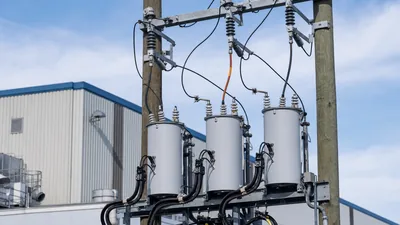
The service voltage is fixed by the utility transformer, usually a three-phase pad-mounted unit for underground commercial service or a bank of pole-mounted units overhead.
- 208Y/120 V: three-phase pad-mount with delta or grounded-wye primary and grounded-wye secondary, common sizes 75 to 1,000 kVA. Delta-wye units provide a 30-degree phase shift and block zero-sequence currents from the primary.
- 240 V delta: three-phase pad-mount with delta secondary, or three single-phase units in closed delta.
- 240/120 V high-leg delta: typically two or three pole-mounted single-phase units, one larger lighting transformer with center tap and smaller power transformers, sometimes in open delta.
Pad-mounted units are built to IEEE C57.12.34 and come in radial or loop-feed configurations with dead-front or live-front bushings. The 3-phase pad-mounted transformer guide covers configuration choices and protection.
For a large building, the decision often shifts from 208 vs 240 to 208 vs 480. Above roughly 500 to 750 kVA, 480Y/277 V service with local step-down transformers reduces feeder cost substantially.
Next Steps: Specifying and Sourcing 208 V and 240 V Supply Equipment
Before specifying transformers or switchgear, collect the equipment nameplate voltages and decide which system serves them best.
- For 208Y/120 V service, state kVA, primary voltage, grounded-wye secondary, impedance and 60 Hz, plus neutral sizing for non-linear loads.
- For 240 V delta, state whether the secondary is ungrounded, corner-grounded or center-tapped high-leg.
- Where 240 V equipment sits on 208 V, list loads and kVA so buck-boost or isolation units can be sized correctly.
- Specify IEEE C57.12.00 and C57.12.34 for pad-mounted units and NEMA ST 20 or IEEE C57.12.01 for dry-type LV units.
MARS supplies three-phase pad-mounted transformers with 208Y/120 V and 240 V secondaries, plus dry-type units for step-up and step-down applications, routine tested with FAT available and typical lead times of 25 to 45 days. Send your requirement through the quote request.
Frequently asked questions
What is the difference between 208 and 240 volts?
208 V is the line-to-line voltage of a 208Y/120 V three-phase wye system, while 240 V comes from split-phase residential service or a 240 V delta three-phase system. 208 V is about 13 percent lower, so equipment rated only for 240 V produces less heat or torque and may draw more current on 208 V.
Can I use a 240V appliance on 208V?
Many appliances rated 208-240 V or 208/230 V work on either. Appliances rated only 240 V or 230 V may run with reduced output, about 75 percent for heaters, and motors may overheat because 208 V is at or below their minus 10 percent tolerance. Check the nameplate or use a buck-boost transformer.
What is 120/208 three-phase service?
120/208 three-phase service is a four-wire wye supply with three phase conductors and a grounded neutral. It provides 120 V from each phase to neutral for lighting and receptacles, and 208 V between phases for single-phase and three-phase equipment. It is the standard service for light commercial and multi-family buildings.
Is 208 three-phase the same as 240 three-phase?
No. 208 V three-phase comes from a wye system with a grounded neutral and 120 V to ground on each phase, while 240 V three-phase comes from a delta system. Motors should match: 200 V nameplate for 208 V systems and 230 V nameplate for 240 V systems.
Why do commercial buildings use 208V instead of 240V?
A 208Y/120 V wye system supplies 120 V equally from all three phases, so lighting and receptacle loads balance easily across one three-phase transformer. It also has a grounded neutral for simple ground-fault protection. A 240 V delta system cannot supply 120 V from every phase without a high-leg arrangement.
How do you convert 208V to 240V?
The most economical method is a buck-boost transformer connected to boost by about 13 percent, raising 208 V to roughly 236 V. Its rating is only a fraction of the load kVA. Where isolation or a delta secondary is needed, a full-rated 208 V to 240 V dry-type isolation transformer is used.
Written and reviewed by the MARS application engineering team in Shanghai, who specify and test transformers, switchgear, substations and battery storage for projects in 40+ countries. Last updated .
Tags: 208 vs 240 volts 120 208v 3 phase 120 208 service 208 3 phase vs 240 3 phase what is 208 volts