Key takeaways
- US homes receive 120/240 V single-phase, three-wire service at 60 Hz from a center-tapped utility transformer, giving 120 V outlets and 240 V appliance circuits.
- ANSI C84.1 Range A limits service voltage to plus or minus 5 percent of nominal, which is 114 to 126 V on a 120 V circuit.
- The common US three-phase systems are 208Y/120 V for light commercial buildings and 480Y/277 V for large commercial and industrial facilities.
- Equipment nameplates use utilization voltages of 115, 200, 230 and 460 V, which are deliberately set below the 120, 208, 240 and 480 V system nominals.
- US utility primary distribution is usually 12.47 kV, 13.2 kV or 13.8 kV, with 4.16 kV, 24.9 kV and 34.5 kV also in service.
Quick answer: The voltage in the US is 120 V for ordinary outlets and 240 V for large appliances, both at 60 Hz, supplied as 120/240 V single-phase split-phase service. Commercial and industrial buildings use 208Y/120 V or 480Y/277 V three-phase. ANSI C84.1 holds 120 V service within 114 to 126 V under normal conditions.
The United States does not have a single electrical voltage. It has a family of standard nominal systems, each matched to a class of customer, and they all run at 60 Hz. The answer to what voltage is used in the US depends on whether you are plugging in a laptop, wiring a dryer, fitting out a strip mall or supplying a factory.
This guide sets out the US voltage standard for residential, commercial and industrial service, explains why people still say 110 or 220, and shows how the utility transformer determines which voltages a building gets. It is aimed at overseas equipment suppliers, project engineers and importers who must match equipment to American electricity.
What Voltage Is Used in the US?
United States electrical voltage is standardized by ANSI C84.1, which lists the preferred nominal system voltages and their allowed ranges. The National Electrical Code (NFPA 70) then governs how those systems are wired inside buildings.
| System | Phases / wires | Typical users | Voltages available |
|---|---|---|---|
| 120/240 V | Single-phase, 3-wire | Homes, small shops, farms | 120 V line-to-neutral, 240 V line-to-line |
| 208Y/120 V | Three-phase, 4-wire wye | Apartments, offices, retail | 120 V L-N, 208 V L-L |
| 240/120 V delta (high leg) | Three-phase, 4-wire delta | Older shops, small industry | 120 V, 240 V, 208 V high leg to neutral |
| 480Y/277 V | Three-phase, 4-wire wye | Large commercial, industrial, hospitals | 277 V L-N, 480 V L-L |
| 480 V delta | Three-phase, 3-wire | Motor-heavy industrial plants | 480 V L-L only |
All of these run at 60 Hz. Unlike Japan, the US has no 50 Hz regions; the reasons and consequences of the two frequencies are covered in our 50 Hz vs 60 Hz guide.
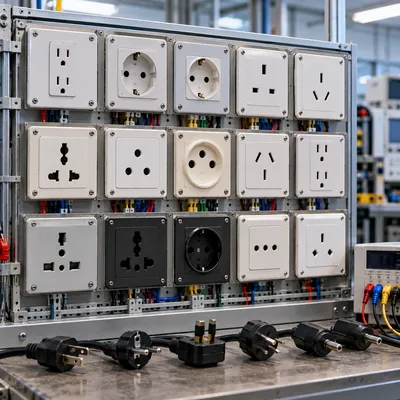
A US voltage standard of 120 V at the outlet is low by world standards. Most of Europe, Asia and Africa use 230 V. The lower outlet voltage was historically chosen for lamp filament life and shock safety, and the split-phase arrangement adds 240 V for heavier loads without a second service.
What Is Standard Household Voltage in the US?
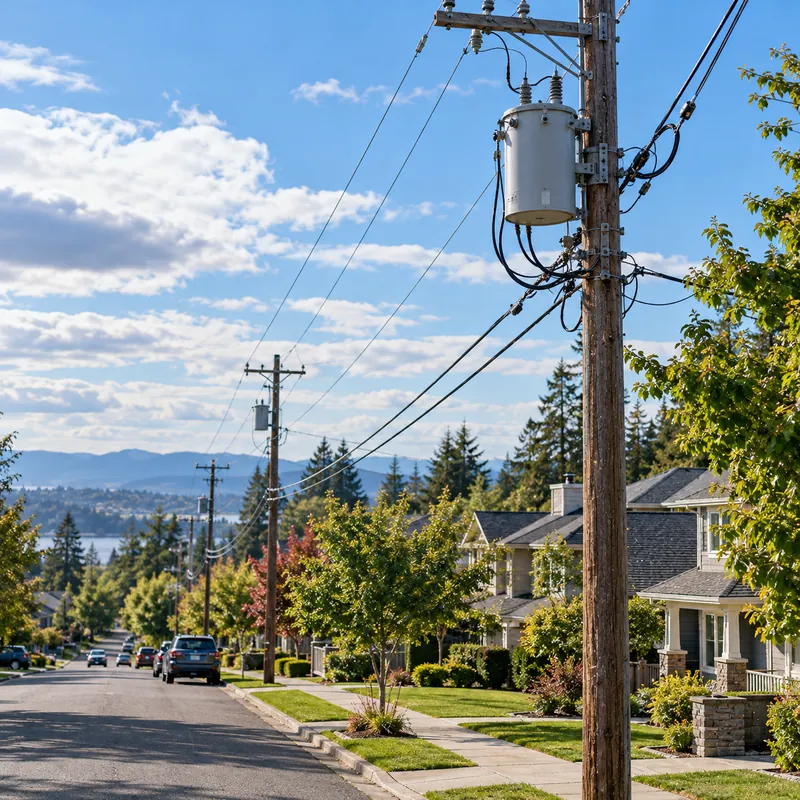
Standard home voltage in America is 120/240 V split-phase. The utility pole-mounted or pad-mounted transformer has a secondary winding with a grounded center tap. Each end of the winding is a hot leg at 120 V to the neutral; across both ends is 240 V.
- 120 V circuits feed receptacles, lighting and small appliances through NEMA 5-15 and 5-20 outlets.
- 240 V circuits feed water heaters, ranges, dryers, heat pumps, well pumps and EV chargers through two-pole breakers.
- 120/240 V circuits (two hots plus neutral) feed ranges and dryers that need 240 V for heating elements and 120 V for controls.
Typical residential services are 100 A, 150 A, 200 A or 400 A at 120/240 V. A 200 A service can supply 200 × 240 = 48,000 VA at full rating, though NEC Article 220 load calculations and demand factors normally size the service well below connected load.
So is household plug voltage 110 V, 115 V or 120 V? The nominal system voltage is 120 V. Older documents say 110 V or 115 V, and appliance nameplates often show 115 V or 120 V. They all refer to the same supply. The detailed wiring of split-phase service, including three-wire 240 V circuits, is covered in the 240V single-phase and split-phase guide.
Note: work on residential service equipment must follow local code and be done by a licensed electrician.
US Voltage: 220 or 240? Why the Names Vary
Americans use 110, 115, 117 and 120 V interchangeably, and 220, 230 and 240 V for the higher voltage. The confusion comes from history and from the difference between system and utilization voltage.
- History: early DC and AC systems ran around 110 V. Over the 20th century utilities raised nominal voltage in steps to 115 V, then 117 V, and finally 120 V, which ANSI C84.1 has used for decades.
- System vs utilization: the system nominal is the utility voltage (120, 240, 208, 480). Utilization voltage is what equipment is designed for after voltage drop in the building (115, 230, 200, 460).
- Line-to-line vs line-to-neutral: 208 V is the line-to-line voltage of a 120 V wye. Some people call it 220 V, which is wrong and causes misapplied equipment.
So what is 230 voltage in a US context? A 230 V motor nameplate means the motor is intended for a 240 V system. It is not the same as European single-phase 230 V, which is line-to-neutral at 50 Hz. Single phase 230 in Europe has one hot and one neutral; US 240 V has two hots and no neutral is needed for the load.
The answer to US voltage 220 or 240 is therefore: 240 V is the correct nominal; 220 V is an outdated name that persists in everyday speech. If a device is labelled 220-240 V 50/60 Hz, it will run on US 240 V. Equipment rated 220 V only should be checked, because 240 V is 9 percent above its rating.
ANSI C84.1 Voltage Ranges: What Is Normal Voltage in a House?
Normal voltage in a house is not exactly 120 V. ANSI C84.1 defines two ranges around each nominal.
| Nominal | Range A service (normal) | Range B service (infrequent) |
|---|---|---|
| 120 V | 114 to 126 V | 110 to 127 V |
| 240 V | 228 to 252 V | 220 to 254 V |
| 208 V | 197 to 218 V | 191 to 220 V |
| 480 V | 456 to 504 V | 440 to 508 V |
Range A is the band the utility designs to hold under normal conditions. Range B allows short excursions that should be corrected but are tolerable. Below Range B, equipment may malfunction or overheat.
The average voltage in a house measured at a receptacle is therefore anywhere from about 116 to 124 V most of the time. Voltages are lower at the end of long branch circuits, at the end of a rural feeder, and during peak demand. Utilities adjust using transformer tap changers, line voltage regulators and capacitor banks on 12.47 kV or 13.2 kV feeders.
Worked example: a 120 V receptacle reads 117 V at no load and 112 V with a 1,500 W heater running. The 5 V drop on a 12.5 A load implies circuit resistance of 5 / 12.5 = 0.4 Ω, which is consistent with a long 14 AWG run. The service itself is within Range A; the branch circuit is the cause. Our wire size calculator guide shows how to keep drop under 3 percent.
American Three-Phase Voltage: 208Y/120, 240 Delta and 480Y/277
Commercial and industrial customers receive three-phase service from a pad-mounted transformer, a pole-mounted bank or a customer-owned substation. American three-phase voltage is selected by load size and type.
208Y/120 V
The standard for apartment buildings, offices, schools and retail. It provides 120 V receptacles directly from each phase to neutral and 208 V for HVAC and kitchen equipment. Compare it in detail against 240 V in 208 vs 240 volts.
240/120 V four-wire delta
A legacy system where one transformer winding is center-tapped to provide 120 V. The third phase, the high leg, measures 208 V to neutral and must be marked orange under NEC 110.15. Still common in older rural and light-industrial services.
480Y/277 V
The workhorse for large buildings. Motors and chillers run at 480 V, fluorescent and LED lighting runs at 277 V, and dry-type transformers step down to 208Y/120 V for receptacles. Details are in the 277/480V 3-phase system guide.
Higher LV and MV utilization
600 V systems are rare in the US but standard in Canada (347/600 V). Large plants take service at 4.16 kV, 12.47 kV or 13.8 kV and own their substations. Motors above roughly 250 hp often run at 4,000 V nameplate on 4.16 kV systems.
Every three-phase system above is 60 Hz with phase voltages displaced 120 degrees. Line-to-line voltage equals line-to-neutral voltage times √3, so 120 × 1.732 = 208 V and 277 × 1.732 = 480 V.
How Does Electricity Reach a US House? From Feeder to Outlet
The path from generator to outlet passes through several transformations. Knowing them clarifies why American electricity voltage looks the way it does.
- Generation at 13.8 kV to 25 kV, stepped up by generator step-up transformers to 115 kV, 230 kV, 345 kV or 500 kV for transmission.
- Transmission substations step down to subtransmission levels such as 69 kV or 115 kV.
- Distribution substations step down to primary distribution, most commonly 12.47Y/7.2 kV or 13.2Y/7.62 kV, with 24.94 kV and 34.5 kV used in growing suburban areas.
- Distribution transformers convert primary voltage to the customer service voltage. For homes, a single-phase pole-mounted or pad-mounted unit is connected line-to-neutral at 7.2 kV and supplies 120/240 V.
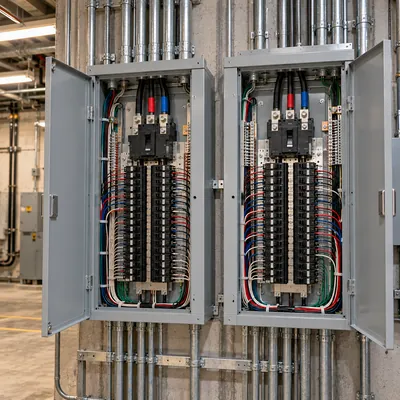
- Service entrance brings the conductors through the meter to the main breaker panel.
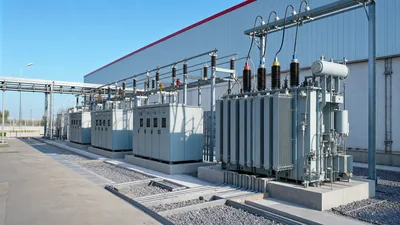
A typical neighborhood transformer is 25, 37.5, 50 or 75 kVA and serves 4 to 12 homes. A 50 kVA unit at 240 V delivers 50,000 / 240 = 208 A of secondary current. Three-phase commercial pad-mounts range from 75 kVA to 2,500 kVA and higher; their primary voltage classes and configurations are explained in power distribution voltages.
Pad-mounted transformers built to IEEE C57.12.34 dominate underground residential developments and commercial sites because they are tamper-resistant and sit at grade on a concrete pad.
How Does US Voltage Compare with India, the UK and Europe?
Overseas suppliers frequently ask whether their 230 V 50 Hz equipment can be used in America. The table compares US electricity voltage with common export markets.
| Country / region | Outlet voltage | Three-phase LV | Frequency |
|---|---|---|---|
| United States | 120 V (240 V split-phase) | 208Y/120, 480Y/277 V | 60 Hz |
| Canada | 120 V (240 V split-phase) | 208Y/120, 600Y/347 V | 60 Hz |
| European Union | 230 V | 400Y/230 V | 50 Hz |
| United Kingdom | 230 V | 400Y/230 V | 50 Hz |
| India | 230 V | 415Y/240 V (400 V) | 50 Hz |
Is India 50 Hz or 60 Hz? India is 50 Hz throughout. So are the UK and the EU. A 50 Hz motor run on 60 Hz spins about 20 percent faster; a 50 Hz transformer on 60 Hz at the same voltage runs with lower flux, which is generally acceptable, but a 60 Hz transformer on 50 Hz at full voltage can over-flux and overheat. More country data is in the voltage by country guide.
For industrial equipment, the practical solution is not adapters but specifying the right transformer: a 480 V to 400 V isolation unit, or a pad-mounted transformer with a 400Y/230 V secondary where an imported production line needs it.
Next Steps: Specifying and Sourcing US-Voltage Transformers
When procuring distribution equipment for a US project, define the voltage system completely so the transformer, switchgear and loads match.
- State primary voltage and connection, for example 12,470GrdY/7,200 V, and whether the unit is radial or loop feed.
- State secondary voltage exactly: 120/240 V single-phase, 208Y/120 V or 480Y/277 V.
- Specify 60 Hz, kVA rating, impedance, BIL, primary taps (commonly ±2 × 2.5 percent) and the governing standard, typically IEEE C57.12.00 and C57.12.34 for pad-mounts.
- Confirm the utility's requirements for metering, bushings and enclosure security before ordering.
MARS supplies single-phase and three-phase pad-mounted transformers and pole-mounted transformers in ANSI/IEEE variants for 60 Hz service, with routine tests on every unit and FAT welcome. Lead time is typically 25 to 45 days. Send your single-line diagram and voltage data through the quote request for a configured proposal.
Frequently asked questions
What is the voltage in the United States?
The United States uses 120 V for standard outlets and 240 V for large appliances, both at 60 Hz, delivered as 120/240 V single-phase split-phase service. Commercial and industrial buildings use 208Y/120 V or 480Y/277 V three-phase systems. ANSI C84.1 sets the nominal values and the allowable tolerance bands.
Is US voltage 110 or 120?
The correct nominal is 120 V. The 110 V figure dates from early 20th-century systems and is still used informally. Appliance nameplates may read 115 V or 120 V because they are rated at utilization voltage, slightly below the system nominal. All of these describe the same standard US outlet supply.
How many volts does it take to power a house in the US?
A US house is powered by 120/240 V single-phase service. Two hot conductors each provide 120 V to the neutral for lights and outlets, and 240 V between them for ranges, dryers, water heaters and heat pumps. Service size is typically 100 to 200 A, with 400 A for large homes.
Is India 50 Hz or 60 Hz?
India operates at 50 Hz, with 230 V single-phase and 400 to 415 V three-phase low-voltage supply. The United States uses 60 Hz. Equipment moving between the two must be checked for frequency, because motor speed, transformer flux and some timing circuits depend on it, not only on voltage.
What is the standard three-phase voltage in America?
The two standard American three-phase voltages are 208Y/120 V for light commercial and multi-family buildings and 480Y/277 V for large commercial and industrial sites. Older facilities may have 240 V delta or 240/120 V high-leg delta. All run at 60 Hz with phases 120 degrees apart.
What voltage range is normal at a US outlet?
Under ANSI C84.1 Range A, service voltage on a 120 V system should stay between 114 and 126 V. Range B, 110 to 127 V, is permitted occasionally. Readings at an outlet can be a few volts lower than at the panel because of branch-circuit voltage drop under load.
Written and reviewed by the MARS application engineering team in Shanghai, who specify and test transformers, switchgear, substations and battery storage for projects in 40+ countries. Last updated .
Tags: what is the voltage in the us us voltage standard household voltage american three phase voltage us voltage 220 or 240