Key takeaways
- Hertz counts AC cycles per second; a 60 Hz supply reverses direction 120 times per second and a 50 Hz supply 100 times per second.
- Synchronous motor speed is n = 120 × f / p, so a 4-pole motor runs at 1,800 rpm synchronous on 60 Hz and 1,500 rpm on 50 Hz.
- Transformer flux density varies with V/f; running a 60 Hz design at 50 Hz and full voltage raises flux by 20% and risks saturation.
- Inductive reactance X_L = 2πfL is 20% higher at 60 Hz, so a reactor or coil draws about 17% less current than at 50 Hz on the same voltage.
- Capacitor kvar is proportional to frequency; a bank rated at 60 Hz delivers only five sixths of its rating when operated at 50 Hz.
Quick answer: 50Hz vs 60Hz describes the two standard power frequencies: the number of AC cycles per second. North America and parts of South America and Asia use 60 Hz; Europe, China, India, Africa and Australia use 50 Hz. Frequency does not convert to amps or volts, but it changes motor speed, reactance and transformer flux, so equipment must be designed or derated for its grid.
Grid frequency is usually invisible until equipment crosses a border. A transformer, motor or capacitor bank designed for one frequency can run hot, saturate, change speed or fall short on output when installed on the other. Exporters and EPC contractors working between 50 Hz and 60 Hz markets meet this question on almost every project.
This guide is for engineers, buyers and project managers who need the practical consequences. It defines what Hz means in electricity, explains why searches for hz to amps or volts to hz have no direct conversion, then works through the physics that do link frequency to current, voltage, speed and losses, with transformer-focused worked examples and a specification checklist.
What Is Hz in Electricity?
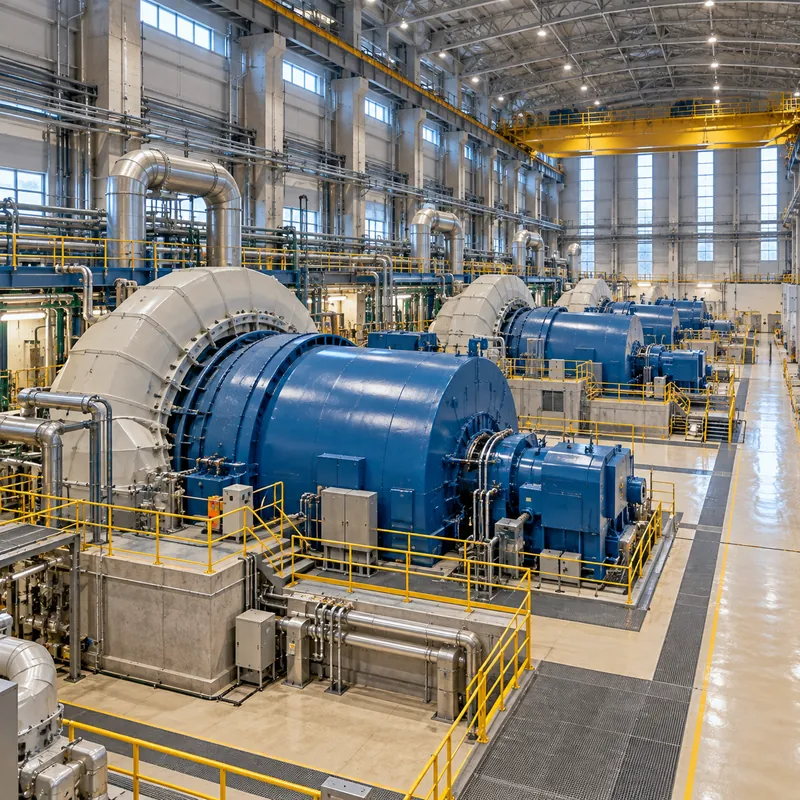
Hertz (Hz) is the unit of frequency, one cycle per second. In an AC power system, power frequency is the number of complete voltage cycles the generators produce each second, fixed by the rotational speed of synchronous generators: f = p × n / 120, where p is the number of poles and n the speed in rpm. A 2-pole turbine generator turns at 3,600 rpm for 60 Hz and 3,000 rpm for 50 Hz.
Each cycle contains a positive and a negative half, so current reverses direction twice per cycle: 120 times per second on 60 Hz electricity and 100 times on 50 Hz. The period is T = 1 / f, 16.7 ms at 60 Hz and 20 ms at 50 Hz, which is why protection clearing times are often expressed in cycles.
The AC voltage and frequency together define a supply. A nameplate reading 230 V 50 Hz states the RMS voltage and the frequency; both must match the grid for correct operation. IEC 60196 lists 50 Hz and 60 Hz as the standard power frequencies, and grids hold them within a narrow band, typically fractions of a hertz under normal operation, by balancing generation and load.
Frequency is a system-wide quantity: every point on a synchronized grid runs at the same frequency at any instant, while voltage varies from place to place with load and impedance. That difference underlies most of the confusion addressed in the next section. For the waveform itself, see the 3 phase waveform guide.
Hz to Amps and Volts to Hz: Why There Is No Direct Conversion
Searches such as hz to amps, amps to hertz, hz to voltage or a 50 hertz to amps converter assume a fixed relationship between frequency and current or voltage. There is none. Frequency, voltage and current are independent quantities: a 120 V outlet at 60 Hz can deliver 0.1 A to a phone charger or 15 A to a heater. Current is set by the load through Ohm's law and the power equation, explained in how to calculate voltage.
Frequency does influence current indirectly, through reactance:
- Inductive reactance:
X_L = 2πfL. Higher frequency, higher reactance, lower current through an inductor. - Capacitive reactance:
X_C = 1 / (2πfC). Higher frequency, lower reactance, higher current through a capacitor. - Resistance: essentially independent of frequency at power frequencies, apart from skin effect in large conductors.
Worked example: the same coil on 50 and 60 Hz
A 0.1 H reactor on 230 V: at 50 Hz, X_L = 2π × 50 × 0.1 = 31.4 Ω and I = 230 / 31.4 = 7.3 A. At 60 Hz, X_L = 37.7 Ω and I = 6.1 A. Same voltage, about 17% less current at 60 Hz.
Similarly, volts to hz has no meaning on its own, but the ratio volts per hertz (V/f) is very meaningful for magnetic equipment: it sets the flux in transformer and motor cores. That ratio is the real link between hertz and voltage, and it drives the design rules below.
50Hz vs 60Hz: Which Countries Use Which Frequency?
American electricity frequency is 60 Hz, inherited from early North American alternating-current systems; much of Europe standardized on 50 Hz, and the two standards spread through trade and colonial ties. Neither is technically superior; each involves trade-offs in equipment size, losses and transmission reactance.
| Frequency | Examples | Typical LV supply |
|---|---|---|
| 60 Hz | United States, Canada, Mexico, Brazil, South Korea, Taiwan, Philippines, Saudi Arabia | 120/240 V, 208Y/120 V, 480Y/277 V; 220 V in some |
| 50 Hz | European Union, United Kingdom, China, India, Australia, most of Africa, Russia | 230/400 V |
| Both | Japan (east 50 Hz, west 60 Hz) | 100/200 V |
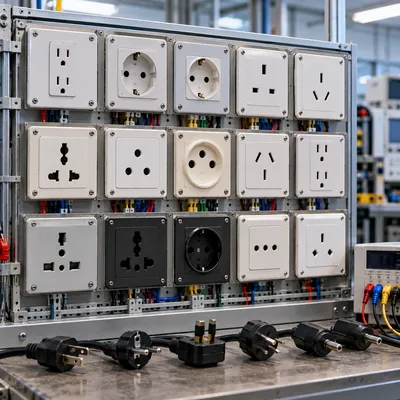
A handful of countries have mixed or regional practices, and remote industrial sites may run island grids at either frequency, so always confirm with the utility or site data rather than assuming from the country. Detailed voltage and frequency data by market is collected in the voltage by country guide, and North American voltage classes in US voltage standards.
Engineering trade-offs
- 60 Hz equipment can be smaller for the same voltage because the core needs less area for the same flux, per
E = 4.44 f N A B. - 50 Hz lines have lower series reactance per kilometre, slightly improving long-distance transfer capability.
- Iron and stray losses rise with frequency, partly offsetting the size advantage.
How Frequency Affects Transformer Design and Operation
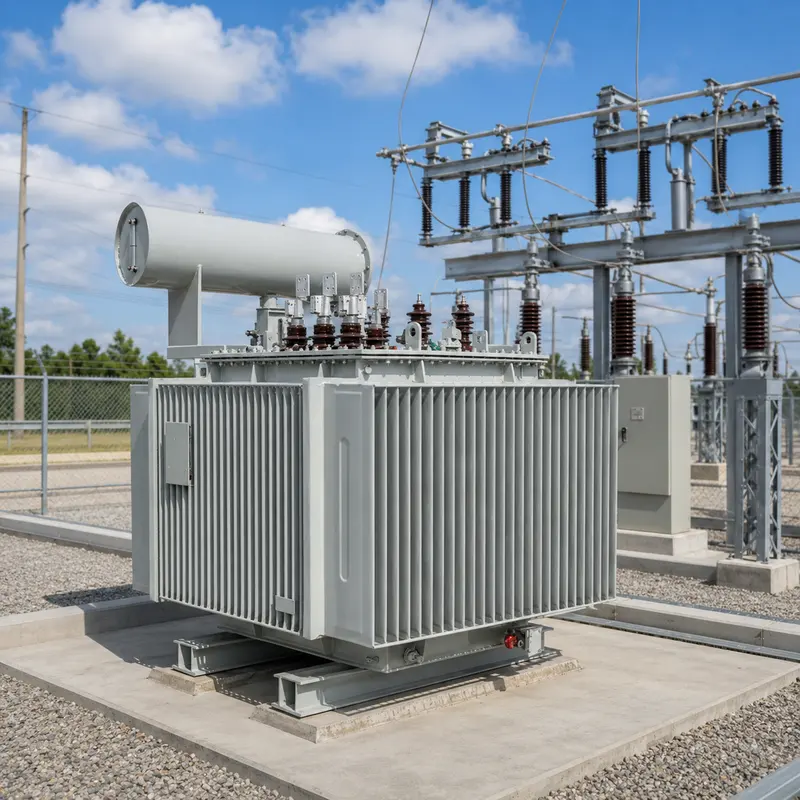
The transformer EMF equation, E = 4.44 × f × N × A × B_max, means that at fixed turns and core area, peak flux density is proportional to V/f. Designers choose B_max close to the economic limit of the core steel, commonly in the 1.5–1.75 T range for grain-oriented silicon steel, leaving margin below saturation.
Worked example: 60 Hz transformer on a 50 Hz grid
A unit designed at 60 Hz for 1.65 T is connected to a 50 Hz supply at the same rated voltage. New flux density: 1.65 × 60 / 50 = 1.98 T. That is above the saturation knee of grain-oriented steel, so magnetizing current rises by many times, no-load loss climbs sharply and noise increases. The unit is unsuitable at rated voltage.
To keep flux constant the voltage must fall with frequency: V_50 = V_60 × 50 / 60. A 480 V, 60 Hz winding could be applied at 400 V, 50 Hz with the same flux. Load current capacity is unchanged, so kVA falls to about five sixths of the 60 Hz rating.
50 Hz transformer on a 60 Hz grid
The reverse is generally acceptable at rated voltage because flux falls by one sixth. However:
- Impedance rises about 20% since leakage reactance is proportional to f, increasing regulation and reducing fault current.
- Eddy-current losses in windings and structural parts rise with frequency, so load losses increase.
- Nameplate, test certificates and losses data no longer describe the operating point.
The honest answer is that a transformer should be designed and tested for its operating frequency. For the losses part of the equation, see transformer losses and total cost of ownership.
Frequency Effects on Motors, Capacitors and Other Equipment
Beyond transformers, frequency changes the behavior of most power equipment.
| Equipment | 60 Hz design on 50 Hz | 50 Hz design on 60 Hz |
|---|---|---|
| Induction motor | Speed falls 17%; at same voltage flux rises 20% and it overheats; acceptable only at 5/6 voltage | Speed rises 20%; pump and fan load rises roughly with speed cubed, risking overload |
| Transformer | Saturation at rated voltage; derate voltage to 5/6 | Usually acceptable; higher impedance and stray loss |
| Capacitor bank | kvar falls to 5/6 of rating | kvar rises 20%; check current and harmonic resonance |
| Reactors and coils | Current rises 20% at same voltage | Current falls about 17% |
| Contactor coils, solenoids | Higher coil current; may overheat | Lower pull-in force |
| Synchronous clocks, timers | Run slow by 17% | Run fast by 20% |
| Switch-mode power supplies | Usually tolerant (often rated 50/60 Hz) | Usually tolerant |
Motor speed example
Synchronous speed n_s = 120 × f / p. A 4-pole motor: 1,800 rpm at 60 Hz, 1,500 rpm at 50 Hz. With 3% slip, actual speeds are about 1,746 and 1,455 rpm. A centrifugal pump designed around 1,750 rpm loses about 17% flow and 31% head at 50 Hz, by the affinity laws. More on motor operating characteristics is in the three-phase electric motor guide.
Many motors are dual-rated, for example 460 V 60 Hz and 380 V 50 Hz, which preserves V/f within a few percent. Capacitor kvar follows Q = V² × 2πfC, which affects power factor correction designs covered in power factor explained.
Can You Convert 50 Hz to 60 Hz?
A transformer cannot change frequency. It changes voltage and current magnitude only; the output frequency always equals the input. Converting frequency requires a machine or power electronics.
- Static frequency converters. A rectifier creates a DC link, then an inverter synthesizes the new frequency. Used for shore power at ports, aircraft ground power at 400 Hz and test bays. Sized in kVA with an output transformer for voltage matching and isolation.
- Variable frequency drives. Per-motor converters that run a 60 Hz motor from a 50 Hz grid or vice versa, while maintaining V/f.
- Motor-generator sets. A motor at one frequency drives a generator at the other; robust but less efficient.
- Battery energy storage with grid-forming inverters. On island grids, the inverter sets frequency directly, and a BESS can provide frequency regulation on interconnected grids.
For most industrial imports, the cost-effective approach is not conversion but specifying equipment built for the site frequency. Where conversion is unavoidable, the converter's output harmonic content and short-circuit capability must be checked against the downstream protection.
For backup and island systems, the generator governs frequency; frequency stability during large motor starts is part of generator sizing, discussed in the generator sizing guide.
Specifying Transformers for 50 Hz and 60 Hz Projects
Projects that source equipment internationally should make frequency an explicit line in every datasheet, and check that the design and test standards align with it.
- Design standard. IEC 60076-1 covers both frequencies; IEEE C57.12.00 is written around 60 Hz systems. A 60 Hz IEC transformer and a 60 Hz IEEE transformer differ in ratings, test levels and terminal markings, not just in frequency.
- Voltage and BIL. State nominal voltage, highest equipment voltage and lightning impulse level per the target market's insulation coordination.
- Losses. Guaranteed no-load and load losses must be quoted at the operating frequency. Losses measured at 50 Hz do not apply to 60 Hz operation.
- Impedance. Specify percent impedance at the operating frequency to keep short-circuit levels and regulation within design.
- Dual-frequency units. Possible, but the core must be designed for 50 Hz flux at the rated voltage, making the unit larger than a pure 60 Hz design. Test reports should cover both frequencies where required.
Sound level, cooling and accessories such as fans, pumps and control transformers also depend on frequency. Make sure auxiliary supply frequency is stated, because a 50 Hz fan motor on a 60 Hz auxiliary supply runs faster and draws more power. For cooling fans in particular, see the transformer fan cooling guide.
Next Steps: Specifying and Sourcing
Include the following in a transformer or substation RFQ for a cross-frequency project:
- Grid frequency and tolerance band at the site, plus auxiliary supply frequency.
- Primary and secondary voltages, kVA, vector group and tap range.
- Design and test standard: IEC 60076, IEEE C57.12.00, GB or GOST.
- Guaranteed losses and impedance at the stated frequency, with loss capitalization values if used.
- Any dual-frequency requirement, with the voltage applicable at each frequency.
MARS designs oil-immersed transformers, power transformers and switchgear for both 50 Hz and 60 Hz grids, in IEC, ANSI/IEEE, GB and GOST variants, with routine tests at rated frequency. Send your project data through the quote page to receive a design matched to your network.
Frequently asked questions
What is the difference between 50Hz and 60Hz?
50 Hz supplies complete 50 AC cycles per second and 60 Hz supplies 60. The difference affects motor speed by 20%, transformer flux at a given voltage, reactance of coils and capacitor output. Equipment must be designed for the grid frequency or derated; voltage and current are not determined by frequency.
How do you convert Hz to amps?
You cannot. Hertz measures how often AC alternates, and amperes measure how much charge flows. Current is set by voltage and load. Frequency only affects current through reactance: an inductive load draws less current at a higher frequency and a capacitive load draws more, at the same voltage.
Can I use a 60Hz transformer on 50Hz?
Only at reduced voltage. At 50 Hz and full rated voltage, core flux rises 20% and a 60 Hz design will normally saturate, overheating and drawing high magnetizing current. Operating at five sixths of rated voltage keeps flux constant, but the kVA rating falls by the same ratio.
Can a 50Hz transformer be used on 60Hz?
Generally yes at rated voltage, because flux decreases. Impedance increases about 20%, load losses rise somewhat due to eddy currents, and nameplate and test data no longer match operation. For new projects, specify the actual frequency so losses and impedance are guaranteed at that point.
Does the United States use 50 or 60 Hz?
The United States uses 60 Hz throughout its interconnected grids, as do Canada and Mexico. Common building voltages are 120/240 V single phase and 208Y/120 V or 480Y/277 V three phase. Imported 50 Hz equipment must be checked for speed, flux and output before connection.
Does frequency affect voltage?
On a grid, frequency and voltage are regulated separately, so changing one does not directly change the other. Inside magnetic equipment, however, flux depends on the ratio of volts to hertz. That is why motor drives keep V/f constant and why transformers must not run at full voltage on a lower frequency than designed.
Written and reviewed by the MARS application engineering team in Shanghai, who specify and test transformers, switchgear, substations and battery storage for projects in 40+ countries. Last updated .
Tags: 50hz vs 60hz power frequency what is hz in electricity hz to amps 60 hz electricity