Key takeaways
- Most kits fall into three groups: 12 V portable or RV kits under 1 kWh, 24-48 V off-grid all-in-one kits, and grid-tie kits with battery backup.
- Cold-weather open-circuit voltage of each string must stay below the controller's maximum PV input, or the controller can be permanently damaged.
- Inverter DC draw equals watts divided by battery voltage times efficiency; a 3.6 kW inverter on 25.6 V pulls about 153 A from the battery.
- A battery's BMS continuous discharge rating must exceed the inverter's full-load DC current, or the BMS will trip under heavy loads.
- Kits frequently omit DC fuses, disconnects, grounding hardware and permits, which can add a significant share to the delivered system cost.
Quick answer: A solar panel kit with battery and inverter is a bundled system of PV modules, a charge controller, a battery and an inverter, often with cables and mounts, sold as one package. Good kits are pre-matched, but always verify four limits: string voltage against controller input, charge current against battery rating, inverter draw against battery discharge current, and battery capacity against your daily energy use.
Bundled solar kits have made small and mid-size systems far easier to buy. A single order can bring panels, an all-in-one inverter, a lithium battery and the cables to connect them. The catch is that "complete" means different things to different sellers, and a mismatch between components is easy to miss on a product page.
This guide is for homeowners, cabin and RV owners, and small businesses comparing solar power kits with batteries. It explains the main kit types, what should be in the box, and how to check compatibility with a worked example that uncovers a common hidden mismatch. It finishes with installation and scaling advice, including when a kit should give way to an engineered system.
What Is in a Solar Panel Kit With Battery and Inverter?
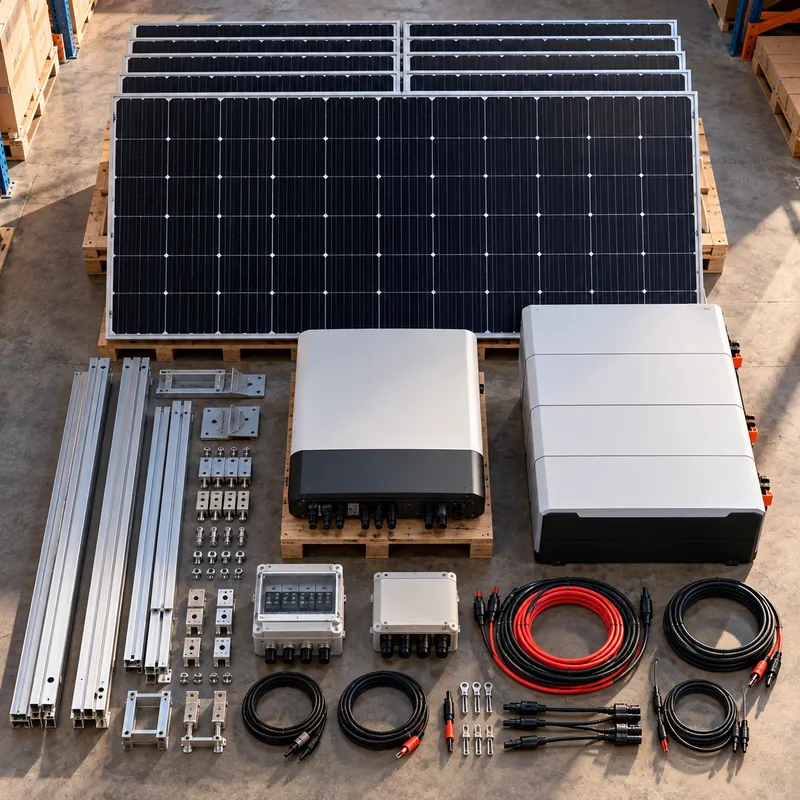
A solar kit is a pre-selected set of components sold together so that they work as a system. A complete solar panel and battery kit should include:
- PV modules, rated in watts at standard test conditions, with open-circuit voltage (Voc) and short-circuit current (Isc) on the datasheet.
- Charge controller, ideally MPPT, either separate or built into an all-in-one inverter.
- Battery, usually LiFePO4 with an internal battery management system (BMS), rated in Ah at a nominal voltage, and with a continuous discharge current limit.
- Inverter, pure sine wave, rated in continuous and surge watts, at 120 V, 230 V or 120/240 V.
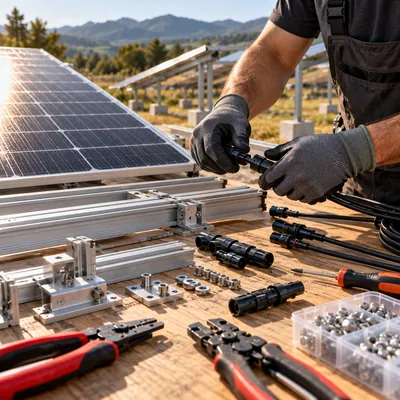
- Balance of system: PV cables and connectors, battery cables, fuses or breakers, a PV disconnect, mounting hardware and grounding parts.
Many listings that look complete leave out the balance-of-system items, racking or the battery-to-inverter fuse, which is often the most safety-critical part. Ask for a full packing list.
An all-in-one solar power system integrates the controller, inverter, charger and sometimes the battery into one enclosure. Modular solar power systems instead stack battery modules beneath an inverter head, allowing capacity to grow. For a closer look at the electronics inside, see our off-grid inverter guide and hybrid solar inverter guide.
Types of Solar Kits With Battery
| Kit type | Typical array | Battery | Inverter | Best for |
|---|---|---|---|---|
| 12 V solar power kit | 100-400 W | 0.5-1.5 kWh, 12.8 V | 300-1,500 W | RVs, boats, sheds, small solar panel with battery for lighting |
| 24 V off-grid kit | 0.8-2 kW | 2.5-5 kWh, 25.6 V | 2-3.6 kW all-in-one | Cabins, tiny houses, workshops |
| 48 V off-grid kit | 2-8 kW | 5-30 kWh, 51.2 V | 3-12 kW, some split-phase | Full-time off-grid homes, farms |
| Grid-tie kit with battery backup | 4-15 kW | 10-30 kWh, LV or HV | Hybrid inverter 5-15 kW | Grid-connected homes wanting outage protection |
| 220 V / 230 V kits | 1-10 kW | 5-20 kWh | 230 V single-phase | Markets outside North America, 50 Hz sites |
A 12 V solar panel kit is the right choice only for small loads: at 12 V, a 1,500 W inverter already draws more than 130 A. Above about 1.5 kW, step up to 24 V, and above about 3 kW, to 48 V; our 12 V vs 24 V vs 48 V guide explains why.
A whole home solar system kit is almost always a grid-tie hybrid with 10 kWh or more of storage, or a 48 V off-grid kit of 8 kW or more. For homes using around 15-20 kWh per day, our 5 kW solar system guide shows the scale of array that typically pairs with that load. Mobile and manufactured homes have their own roof and mounting constraints, covered in our guide to solar panels for mobile homes.
Worked Example: Checking a Kit for Compatibility
Consider a 24 V off-grid kit with these datasheet values:
- 4 × 450 W panels: Voc 49.5 V, Isc 11.5 A, temperature coefficient of Voc −0.28%/°C
- All-in-one inverter: 3.6 kW continuous, MPPT max 145 Vdc, max charge current 80 A
- One LiFePO4 battery: 25.6 V, 200 Ah (5.12 kWh), BMS continuous discharge 100 A
Check 1: string voltage. At a site minimum of −10 °C: Voc_cold = 49.5 × [1 + 0.0028 × (25 − (−10))] = 49.5 × 1.098 ≈ 54.4 V. Four in series gives 217 V, above the 145 V limit. Two in series, two strings in parallel (2S2P), gives 109 V: acceptable.
Check 2: PV input current. 2S2P gives 2 × 11.5 = 23 A. Confirm against the controller's maximum PV input current.
Check 3: charge current. 1,800 W / 25.6 V ≈ 70 A, below the 80 A controller limit and within the battery's 0.5C (100 A) charge rating.
Check 4: discharge current. At full inverter output and 92% efficiency: 3,600 / (25.6 × 0.92) ≈ 153 A. The single battery's BMS allows only 100 A, so it would trip whenever load exceeds about 100 × 25.6 × 0.92 ≈ 2.35 kW.
Result: the kit is only usable as sold if loads stay under 2.35 kW. The fix is a second battery in parallel (200 A combined BMS capacity, 10.24 kWh) or a 48 V version of the kit. This discharge mismatch is the most common hidden fault in bundled kits.
Sizing the Kit to Your Energy Use
A compatible kit can still be the wrong size. Check it against your loads with two quick calculations.
Daily solar production: E_solar = P_array × PSH × 0.75. The 1.8 kW array above in a location with 4 peak sun hours produces about 1.8 × 4 × 0.75 = 5.4 kWh/day.
Battery coverage: usable energy is about 5.12 kWh × 0.9 × 0.92 ≈ 4.2 kWh per battery delivered as AC. That covers one night of a 4 kWh daily load, but not a cloudy day.
| Daily load | Suggested array (4 PSH) | Suggested battery (1.5 days) | Kit class |
|---|---|---|---|
| 1 kWh | 350-400 W | 2 kWh | 12 V |
| 3 kWh | 1.0 kW | 5-6 kWh | 24 V |
| 6 kWh | 2.0 kW | 10-12 kWh | 48 V |
| 12 kWh | 4.0 kW | 20-24 kWh | 48 V or hybrid |
The array column uses E_daily / (4 × 0.75); the battery column uses E_daily × 1.5 / (0.9 × 0.92), rounded up. Use your own location's worst-month sun hours and required autonomy; the full design method is in our off-grid solar system guide. For grid-tied homes where the battery is for backup only, size battery kWh on the critical loads for the expected outage length instead.
Solar Battery System Installation: What a Kit Install Involves
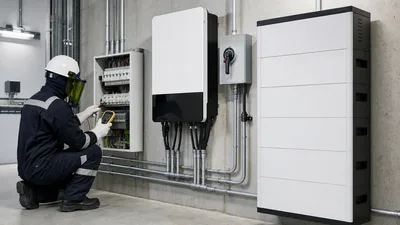
Small 12 V RV and shed kits are designed for owner installation. Permanent home systems connect to building wiring and service equipment: that work must follow local code and be done by a licensed electrician, with permits and, for grid-tied kits, utility approval before energizing. A typical installation sequence is:
- Site survey: roof or ground area, shading, structure, and the location for the battery and inverter within cable reach.
- Permits and design: single-line diagram, equipment listings (UL 1741 inverters, UL 9540 or UL 1973 batteries in the US) and placement rules under NFPA 855 and the residential code.
- Mounting: racking attached to rafters or a ground frame, with flashing on roofs.
- Equipment mounting: inverter and battery on a non-combustible surface with clearances specified by the manufacturer.
- DC wiring: PV strings to a disconnect and controller; battery to inverter through a correctly rated fuse.
- AC wiring: inverter output to a dedicated loads panel or, for hybrids, through backup and grid connections.
- Grounding and bonding: module frames, racking and enclosures bonded, single neutral-ground bond.
- Commissioning: battery profile set, BMS communications checked, rapid shutdown tested, inspection passed.
Our solar battery installation guide covers placement and ventilation details, and the sub panel guide explains a dedicated backup loads panel.
How to Compare the Best Solar Panel Kits
When comparing listings, ignore headline wattage and compare these specifications line by line:
- Usable battery kWh and cycle rating to 80% capacity, typically 3,000-6,000 cycles for LiFePO4.
- BMS continuous discharge and charge current versus the inverter's DC draw and the controller's output.
- Inverter continuous and surge watts, output voltage and whether 120/240 V split-phase is available.
- MPPT maximum PV voltage, input current and number of trackers.
- Expandability: can batteries be paralleled, and can inverters be stacked?
- Certifications: UL 1741, UL 9540 or UL 1973 for North America; IEC 62109 and IEC 62619 elsewhere; UN 38.3 for battery shipping.
- Balance of system: fuses, disconnects, cables and racking included or not.
- Warranty and support: terms for each component, and who handles claims.
- Low-temperature behavior: self-heating battery or charge cut-off below 0 °C.
The cheapest solar panel kits often save money on the battery's BMS current rating and the inverter's surge capability, which are exactly the specifications that decide whether the system starts a pump or a refrigerator. Beginner solar kits are best chosen with spare capacity, because loads tend to grow once the system is in service.
When a Kit Is Not Enough: Commercial and Larger Systems
Kits are designed for repeatable residential and small off-grid needs. They are not suited to sites that need:
- Three-phase power at 208, 400 or 480 V for motors, compressors and production equipment.
- Storage above roughly 50-100 kWh, or daily cycling for peak shaving or demand-charge reduction.
- Integration with an existing switchboard, generator and building management system.
- Engineered fire protection, thermal management and remote monitoring required by insurers and authorities.
At that point the system is designed rather than bought as a bundle: PV inverters sized for the array, a battery energy storage system with its own power conversion system and BMS, switchgear and, often, a transformer to match site voltage. MARS manufactures that commercial tier: liquid-cooled LFP cabinets from 93 to 372 kWh, containerized BESS from 500 kWh to 10 MWh, and the LV switchboards and transformers that connect them. Our DIY solar kits guide covers the opposite end, where owners assemble small systems themselves.
Next Steps: Specifying and Sourcing
Before ordering any kit, prepare a short specification:
- Daily energy and peak load: kWh/day and the largest simultaneous load, including motor surge.
- Grid status: off-grid, grid-tied with backup, or grid-tied self-consumption.
- Output voltage: 120 V, 120/240 V split-phase, 230 V, at 50 or 60 Hz.
- Site data: worst-month peak sun hours, minimum temperature for string voltage, mounting surface.
- Compatibility checks: the four limits from the worked example: string voltage, PV current, charge current and discharge current.
- Compliance: listings required locally, and who will install and inspect.
For homes and cabins, buy a kit that passes all four checks with margin and have permanent wiring installed by a licensed electrician. For commercial and industrial projects, MARS supplies energy storage systems with PCS, BMS, EMS and fire suppression integrated, routine-tested before shipment. Send your load profile through the quote request form.
Frequently asked questions
What size solar panel kit with battery and inverter do I need?
Divide your daily kWh by local peak sun hours times 0.75 to size the array, then size the battery for the hours or days of autonomy you need, divided by about 0.83 for usable depth and inverter losses. The inverter must cover your largest simultaneous load and motor surges.
Can a solar panel kit power a whole house?
Large kits can, typically a 48 V or hybrid kit with 8 kW or more of inverter, 6 to 12 kW of panels and 20 kWh or more of battery. Smaller kits power selected circuits only. Whole-house kits connect to service equipment and must be installed by a licensed electrician with permits.
Are all-in-one solar power systems good?
All-in-one systems combine the controller, inverter and charger in one unit, reducing wiring and simplifying setup, which suits cabins and small homes. The trade-off is a single point of failure: if the unit fails, both solar charging and AC output stop. Larger or critical sites often prefer separate components.
What is the difference between a 12V and 48V solar kit?
Battery voltage sets DC current for a given power. A 12 V kit suits loads under about 1.5 kW, such as RVs and sheds. A 48 V kit carries a quarter of the current for the same power, allowing larger inverters, thinner cables and lower losses, and is standard for homes and full-time off-grid use.
Can I install a solar kit with battery myself?
Small plug-and-play and 12 V RV kits are designed for owner installation. Permanent systems wired into a home's electrical panel require permits and must follow local code; work on service equipment should be done by a licensed electrician, and grid-tied kits also need utility approval before operation.
What do solar kits usually leave out?
Many kits omit the battery-to-inverter fuse, DC disconnects, grounding hardware, conduit, roof racking, permits and labor. Some exclude the battery or include only a small one. Always ask for a complete packing list and check that every DC circuit has a correctly rated overcurrent device.
Written and reviewed by the MARS application engineering team in Shanghai, who specify and test transformers, switchgear, substations and battery storage for projects in 40+ countries. Last updated .
Tags: solar panel kit with battery and inverter solar panel system solar battery kit solar panel and battery kit whole home solar system