Key takeaways
- Off-grid arrays are sized for the worst month, using array kW = daily kWh / (peak sun hours × 0.75), not for annual average sunshine.
- Battery banks commonly provide 2-5 days of autonomy; LiFePO4 allows 80-90% usable depth of discharge versus about 50% for lead-acid.
- MPPT controller current is array watts divided by battery voltage, plus a 25% margin, so 2.8 kW at 51.2 V needs at least a 70 A controller.
- In the US, stand-alone systems follow NEC Article 710 alongside Article 690 for PV and Article 706 for energy storage.
- A backup generator sized for the loads plus full charger input, about 6-7 kW for a 20 kWh 48 V bank, avoids oversizing batteries for rare storms.
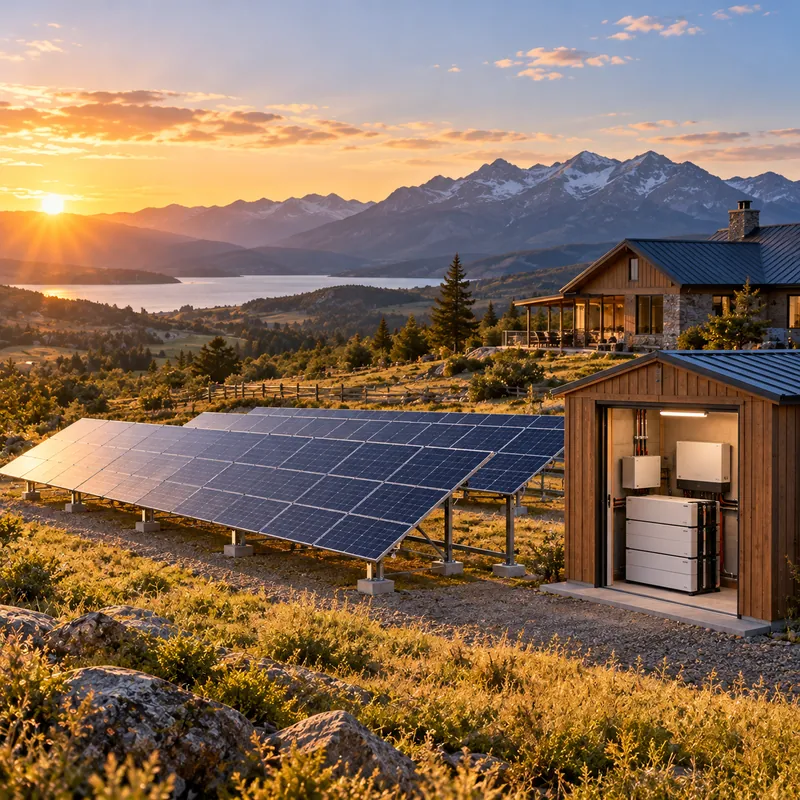
Quick answer: An off grid solar system is a stand-alone power system that generates electricity with solar panels, stores it in a battery bank and supplies AC loads through an inverter, with no utility connection. Design it from the load: measure daily kWh, size the array for the worst month's sun, size batteries for two to five days of autonomy, and add a generator for long cloudy spells.
Off-grid solar works when it is designed from the load upward and for the darkest weeks of the year. Systems that disappoint usually share the same faults: an array sized on summer sun, a battery bank sized on optimism, and no plan for a week of overcast weather. The engineering is not complicated, but every step depends on the one before.
This guide is for cabin and homestead owners, rural businesses, and installers designing stand alone power systems. It walks through a complete off grid solar system design with worked numbers, shows how the components connect, compares kits with custom systems, explains cost drivers and shows when the same principles scale up to commercial off-grid microgrids.
What Is an Off Grid Solar System?
A stand-alone solar system, or off grid solar power system, is a PV installation that is not connected to the utility and must supply all of the site's energy from its own generation and storage. NEC Article 710 calls these stand-alone systems, and they differ from grid-tied designs in three ways:
- The battery is mandatory. Without the grid as a buffer, every kilowatt-hour used at night or in cloudy weather must come from storage.
- The inverter is grid-forming. It creates the AC supply itself; see our off grid inverter guide.
- Sizing targets reliability, not payback. The question is how many days the system can carry the load without sun, not how many kWh it exports.
The main alternatives are on-grid (grid-tied, no battery) and hybrid (grid-tied with battery). Buyers searching for an "off grid on grid solar system" are usually describing a hybrid that can island during outages. If a utility line is available at reasonable cost, grid-tied or hybrid systems are generally cheaper per kWh; our explainer on how an on-grid solar system works compares them. Off-grid makes sense where the line extension is costly, the supply is unreliable, or independence is the goal; the wider strategic choice is discussed in our off-grid power solutions guide.
Step 1: Do a Load Audit
Everything else is sized from daily energy (kWh/day) and peak power (kW). List every load, its wattage, hours of use per day and whether it can run at the same time as others.
| Load (example cabin) | Watts | Hours/day | Wh/day |
|---|---|---|---|
| Refrigerator, efficient | 90 avg | 24 | 2,160 |
| LED lighting | 80 | 5 | 400 |
| Water pump | 600 | 1 | 600 |
| Laptop, router, phones | 70 | 8 | 560 |
| Washing machine (cold wash) | 500 | 0.5 | 250 |
| Inverter idle draw | 25 | 24 | 600 |
| Microwave, small tools | 1,200 | 0.35 | 430 |
| Total | 5,000 |
Use measured values where possible: a plug-in energy meter for a week reveals the real consumption of refrigerators and electronics. Then make efficiency choices before buying hardware. Every watt-hour removed from the daily load saves panels, batteries and generator fuel. Typical off-grid savings come from propane or wood for heating and cooking, efficient DC refrigeration, LED lighting and eliminating phantom loads with switched outlets.
Avoid resistive electric heating, electric water heating and electric ranges unless the system is very large; a single 3 kW heater running four hours uses more than twice this cabin's entire daily budget.
Step 2: Size the Solar Array for the Worst Month
Array output depends on peak sun hours (PSH), the daily irradiation on the panel expressed as equivalent hours at 1 kW/m². Use the lowest monthly PSH in the months the site is occupied, at the tilt you will install.
P_array (kW) = E_daily / (PSH_min × derate)
The derate factor, typically 0.70-0.80, combines temperature losses, soiling, wiring, controller efficiency and battery charge efficiency.
Worked example. The cabin needs 5.0 kWh/day and the worst occupied month averages 2.5 PSH at a steep winter tilt:
P_array = 5.0 / (2.5 × 0.75) = 2.67 kW
Seven 400 W modules give 2.8 kW. In summer, at perhaps 6 PSH, the same array produces about 2.8 × 6 × 0.75 = 12.6 kWh/day, far more than needed; surplus is simply curtailed, or used for discretionary loads such as water pumping.
If the worst-month array is impractically large, accept generator support for those weeks rather than doubling the array. For seasonal cabins used mainly in summer, size on the summer months instead and the system becomes much smaller. Ground mounts allow steeper winter tilts and easy snow clearing, which often justifies them in northern locations. For small outbuildings, see the scaled-down approach in our solar power for sheds guide.
Step 3: Size the Off Grid Battery Bank
The battery bank must carry the load through nights and cloudy days. Days of autonomy is the number of days the battery alone can supply the load without solar input.
E_battery (kWh) = (E_daily × N_autonomy) / (DoD × η_inverter)
Worked example. The cabin with 5.0 kWh/day, three days autonomy, LiFePO4 at 80% planned DoD and 92% inverter efficiency:
E_battery = (5.0 × 3) / (0.80 × 0.92) ≈ 20.4 kWh
At 51.2 V nominal: 20,400 / 51.2 ≈ 398 Ah, for example a 16-cell string of 400 Ah cells, or four 100 Ah 48 V modules in parallel.
| Design choice | Lead-acid (AGM/flooded) | LiFePO4 |
|---|---|---|
| Planned DoD | 50% | 80-90% |
| Nominal kWh for this cabin | about 32.6 kWh | about 20.4 kWh |
| Round-trip efficiency | 75-85% | 92-96% |
| Maintenance | Watering (flooded), equalization | None; BMS monitors cells |
| Cold-weather charging | Allowed, reduced acceptance | Needs heating below 0 °C |
Two to three days of autonomy plus a generator is the usual economic optimum; five or more days without a generator makes the battery very large for an event that may occur once a year. Bank architecture, paralleling and BMS integration are covered in our lithium battery bank guide.
Step 4: Select the Charge Controller and Inverter
Charge controller. An MPPT controller converts high-voltage array DC to battery charging current. Its output current rating sets the limit:
I_controller = (P_array / V_battery) × 1.25 = (2,800 / 51.2) × 1.25 ≈ 68 A
A 70-80 A MPPT controller suits this array. Check that the cold-weather open-circuit voltage of each string stays under the controller's maximum PV voltage: with 41 V modules and a −20 °C design low, about 46 V each, so strings of up to three modules fit a 150 V controller, and seven modules in one string fit a 500 V unit. Higher input voltage means fewer, thinner PV cables.
Inverter. Size for simultaneous load and surge. The cabin's largest coincident load is the microwave, pump and refrigerator: 1,200 + 600 + 90 ≈ 1,900 W; with 1.25 margin, 2.4 kW, and the pump's starting surge pushes peak demand near 4 kW. A 3-4 kW pure sine inverter-charger with strong surge rating fits. An all-in-one unit combining controller, inverter and charger is the simplest option at this scale and is what most off grid solar kits include.
Generator. Choose a generator large enough to run the loads and the charger at full rate; for a 400 Ah 48 V bank charging at 80 A, about 80 × 56 ≈ 4.5 kW plus loads, so a 6-7 kW unit. Auto-start on low state of charge keeps the battery healthy.
Off Grid Solar Wiring Diagram: How the Components Connect
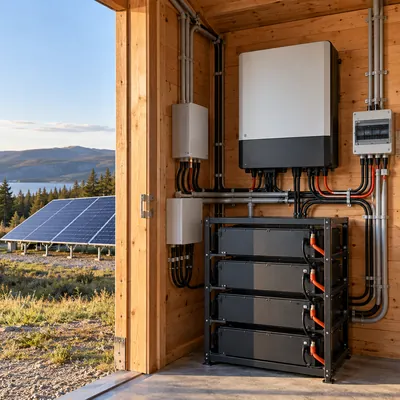
A typical off grid solar wiring diagram follows this power path, with protection at each stage:
- PV array wired in strings; where three or more strings are paralleled, each gets a fuse in a combiner box.
- PV disconnect rated for DC voltage, ahead of the controller.
- MPPT charge controller, or the PV input of an all-in-one inverter.
- Battery protection: a high-interrupting-capacity fuse or DC breaker close to the battery positive terminal, plus a battery disconnect.
- DC busbars and a shunt for state-of-charge monitoring.
- Inverter-charger connected to the busbars with short, heavy conductors.
- AC distribution panel feeding branch circuits with overcurrent protection.
- Generator wired to the inverter-charger's AC input through its own breaker.
Equipment grounding and system bonding are frequently done wrong off-grid. The neutral-to-ground bond must exist in exactly one place, usually in the inverter or the main AC panel, and PV frames, racking and enclosures must be bonded per NEC 690 and Article 250. Our equipment grounding conductor sizing guide covers conductor selection. Rooftop arrays on buildings still need rapid shutdown under NEC 690.12 even when the system is off-grid.
Permanent off-grid systems are building wiring: installation must follow local code and be carried out or inspected by a licensed electrician.
Off Grid Solar Kits vs Custom Systems, and What They Cost
An off grid solar kit bundles panels, an all-in-one inverter, batteries and sometimes racking and cables. Kits suit cabins, tiny homes and sheds because the components are pre-matched. Custom designs suit larger homes, mixed loads, three-phase power and harsh climates. Kit compatibility checks are explained in our solar panel kit with battery and inverter guide.
| Application | Typical daily load | Array | Battery | Inverter |
|---|---|---|---|---|
| Shed or workshop lights | 0.3-1 kWh | 200-600 W | 1-3 kWh, 12-24 V | 0.5-1.5 kW |
| Weekend cabin or tiny house | 2-5 kWh | 1-3 kW | 5-20 kWh, 48 V | 2-4 kW |
| Full-time off grid home | 8-20 kWh | 4-12 kW | 20-60 kWh | 6-15 kW, split-phase |
| Remote business or village microgrid | 100 kWh+ | 50 kW+ | 200 kWh+ BESS | Three-phase PCS |
Indicative cost drivers. Off grid solar system cost is driven mainly by battery kWh, inverter kW, array size, mounting and labor, and generator. As a rough indication only, small cabin systems can start in the low thousands of US dollars, while full-time home systems commonly reach tens of thousands. Prices vary by market, chemistry and date; obtain current quotes. Commercial-scale remote systems are covered in our remote solar power system guide.
Next Steps: Specifying and Sourcing
Use this sequence before buying any equipment:
- Complete a measured load audit and cut avoidable loads.
- Find worst-month peak sun hours for your location and tilt.
- Size the array, battery autonomy, controller and inverter using the formulas above.
- Decide on generator support and auto-start strategy.
- Draw a single-line diagram with every fuse, disconnect and grounding point, and check it against NEC 690, 706 and 710 or the local equivalent.
- Obtain permits and have the installation completed or inspected by a licensed electrician.
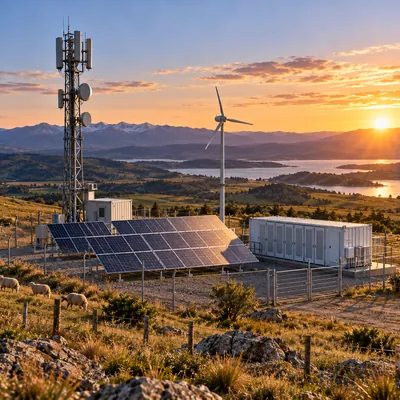
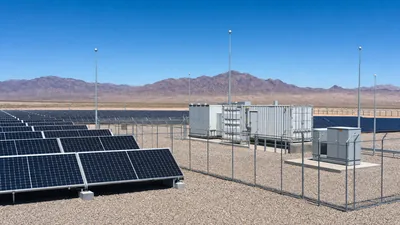
For homes and cabins, a well-matched kit or local installer is the practical route. For remote industrial sites, mines, farms, island grids and village microgrids with loads from tens of kilowatts upward, MARS supplies LFP battery energy storage from 93 kWh liquid-cooled cabinets to 10 MWh containers with grid-forming PCS, BMS, EMS and fire suppression, plus the transformers and switchgear for the distribution network. Explore our energy storage systems and send your load profile and site data through the quote request form.
Frequently asked questions
What is needed for an off grid solar system?
An off grid solar system needs solar panels, mounting, a charge controller, a battery bank, an inverter or inverter-charger, DC and AC protection such as fuses, breakers and disconnects, a grounding system and, ideally, a backup generator. All-in-one inverters combine the controller, inverter and charger in one unit to simplify wiring.
How many solar panels do I need to go off grid?
Divide daily energy use in kWh by worst-month peak sun hours times about 0.75, then divide by the panel rating. A home using 5 kWh per day with 2.5 winter sun hours needs about 2.7 kW, or seven 400 W panels. Summer-only cabins need far less.
How big a battery bank do I need for off grid solar?
Multiply daily kWh by the days of autonomy you want, usually two to three, and divide by usable depth of discharge times inverter efficiency. For 5 kWh per day, three days, LiFePO4 at 80% and 92% efficiency, the bank should be about 20 kWh nominal.
How much does an off grid solar system cost?
Cost depends mainly on battery capacity, inverter size, array size, mounting, labor and whether a generator is included. As a rough indication, small cabin systems may start in the low thousands of US dollars and full-time home systems often reach tens of thousands. Prices vary by market and date.
Can I run a whole house on off grid solar?
Yes, but the system must be sized for the home's daily kWh and peak load, which usually means 6 to 15 kW of inverter, 4 to 12 kW of panels and 20 to 60 kWh of batteries, plus a generator. Using gas or wood for heating and cooking makes whole-house off-grid solar far more affordable.
Do off grid solar systems need a generator?
Not strictly, but most benefit from one. Without a generator, the battery and array must be oversized to survive the longest cloudy spell. A generator that covers rare long storms lets the designer use two to three days of battery autonomy instead of five or more, reducing total cost.
Written and reviewed by the MARS application engineering team in Shanghai, who specify and test transformers, switchgear, substations and battery storage for projects in 40+ countries. Last updated .
Tags: off grid solar system off grid solar power systems off grid solar kit off grid battery bank off grid solar system cost