Key takeaways
- Lights-only sheds typically need a 30–50 W panel and a 20–30 Ah battery, while workshop sheds need 200–400 W and 100–200 Ah at 12 V.
- Each panel watt yields about PSH × 0.75 watt-hours per day, so 3.4 Wh per watt at 4.5 peak sun hours.
- At 12 V, voltage drop dominates cable choice; a 10 m run at 8 A needs about 10 mm² copper to stay under 3%.
- A shed outlet requires an inverter rated for the tool's surge, often two to three times running watts for induction motors.
- Permanent outbuilding wiring, and any connection to the house supply, must follow NEC rules and be inspected by the local authority.
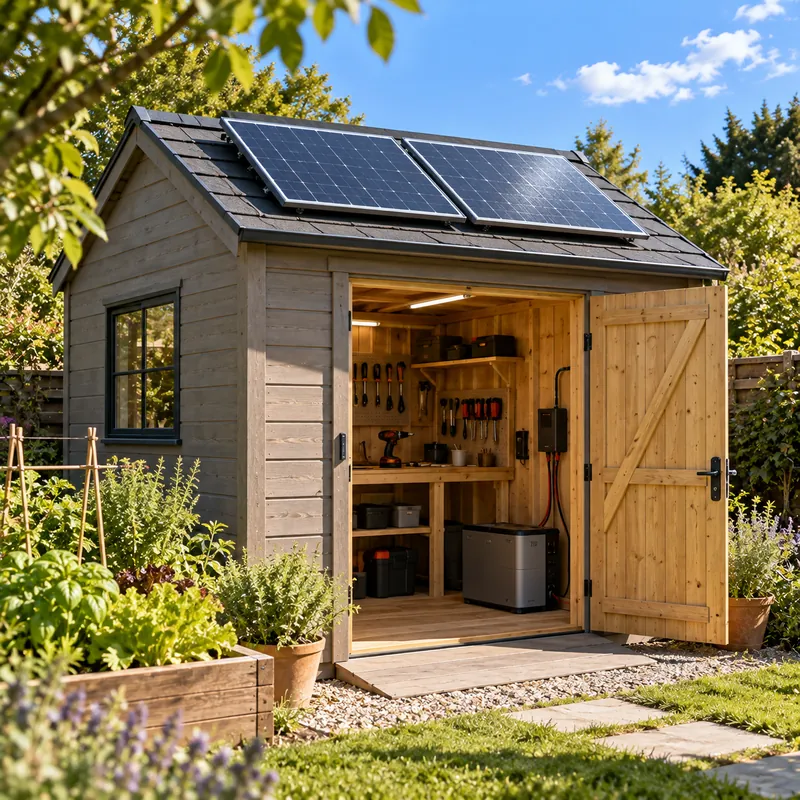
Quick answer: Solar power for a shed is usually a small 12 V off-grid system: one or two 100–200 W panels, an MPPT charge controller, a 50–200 Ah LFP battery and either DC lights or a 300–1,000 W pure sine inverter for outlets. Size it from a load audit: daily watt-hours divided by about 3.4 Wh per panel watt in temperate sun.
Running a cable from the house to a garden shed often means trenching, a sub-feed and a permit. For lights, a few sockets and battery tool charging, a self-contained solar system on the shed roof is frequently cheaper and simpler. The challenge is sizing: an undersized system leaves the battery flat by Wednesday, and an oversized one wastes money on panels the roof cannot hold.
This guide is for homeowners, allotment and smallholding users, and anyone specifying a small solar power system for outbuildings such as garden sheds, storage sheds, workshops and tiny cabins. It walks through load audit, component sizing, wiring and the practical choices that make a solar shed reliable.
How Much Solar Power Does a Shed Need?
Start with a load audit, not a kit. List each device, its power and its daily hours of use, then multiply: E_day = Σ (P × h). Add 20% for inverter and battery losses if any AC loads are present.
| Shed type | Typical loads | Daily energy | Panel | Battery (12 V LFP) |
|---|---|---|---|---|
| Storage shed | 2–4 LED lights, 2 h | 30–60 Wh | 20–50 W | 12–30 Ah |
| Garden shed | Lights, phone and radio, tool battery charger | 150–300 Wh | 100 W | 50 Ah |
| Hobby workshop | Lights, laptop, small tools, fan | 500–900 Wh | 200–300 W | 100–150 Ah |
| Garden office | Laptop, monitor, router, heater excluded | 800–1,500 Wh | 400–600 W | 200 Ah (or 24 V) |
Worked example: hobby workshop
- Loads: 4 × 10 W LED for 3 h (120 Wh), laptop 60 W for 4 h (240 Wh), tool battery charger 150 W for 1 h (150 Wh), bench fan 40 W for 3 h (120 Wh). Total 630 Wh.
- Add 20% losses:
630 × 1.2 = 756 Wh. - Panel at 4.5 PSH and derate 0.75:
756 / (4.5 × 0.75) = 224 W, so 250 W. - Battery for 1.5 days at 90% DoD:
756 × 1.5 / 0.9 = 1,260 Wh, which is1,260 / 12.8 ≈ 98 Ahat 12.8 V nominal LFP. Use 100 Ah.
Electric heating is the item that breaks small systems: a 1,500 W heater uses in one hour what the workshop above uses in two days. Our small solar battery guide covers battery options at this scale.
Choosing Small Solar Panels for a Shed
Small solar panels are PV modules from about 5 W to 200 W, built with the same cell technology as rooftop modules but in smaller frames. Mini solar panels and small solar cells below 10 W are sized for devices such as gate openers, sensors and a single light, not for a whole shed.
- Rigid framed monocrystalline modules (50–200 W) suit permanent roof mounting and last longest.
- Flexible panels suit curved or lightweight roofs, but run hotter and degrade faster.
- 12 V nominal panels have Vmp of about 18 V and charge a 12 V battery even with a PWM controller.
- Higher-voltage 60/72-cell modules (Voc 37–50 V) are cheaper per watt but require an MPPT controller.
Mounting matters as much as panel choice. A shed with a solar panel roof facing within 45° of south (northern hemisphere) at 20–40° tilt captures most of the annual energy. Low-pitch sheds benefit from tilt brackets; flat felt roofs need a ballast or bolted frame and attention to wind uplift. Shading from trees or the house is the most common cause of underperformance, since a shaded cell reduces output of its whole series group.
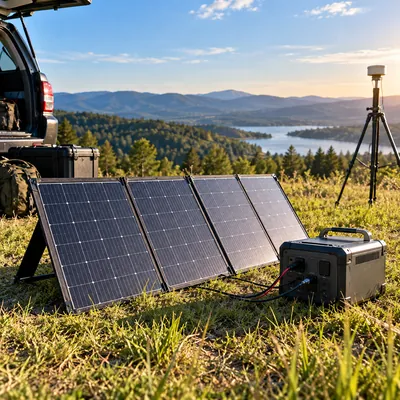
For temporary sites where nothing can be fixed to the structure, a folding unit is an alternative; see our guide to portable solar panels.
Which Battery and Charge Controller for a Solar Shed?
A charge controller is the regulator between the panel and the battery that limits charging current and voltage to protect the battery. For anything above 50 W, choose MPPT: it converts excess panel voltage into extra current and gains 15–30% over PWM in cool weather.
Controller sizing is I_out = P_panel / V_battery. A 250 W array into a 12 V battery needs at least 250 / 12 ≈ 21 A, so a 25–30 A MPPT controller. Check that the array's cold-weather Voc stays below the controller's maximum PV voltage.
| Battery type | Usable capacity | Cycle life | Shed suitability |
|---|---|---|---|
| Flooded lead-acid | 50% | 500–1,000 | Cheap, needs ventilation and watering |
| AGM / gel | 50–60% | 500–1,200 | Sealed, tolerates cold better than LFP charging |
| LiFePO4 (LFP) | 90–100% | 3,000–6,000 | Light, long life; needs low-temperature charge protection |
Unheated sheds in cold climates are an issue for lithium: LFP must not be charged below about 0 °C. Choose a battery with built-in low-temperature cut-off or self-heating, or use AGM for winter-only sites. For the voltage choice between 12, 24 and 48 V, see 12V vs 24V vs 48V solar batteries.
How Do You Wire Solar Power in a Shed?
At 12 V, currents are high and voltage drop is the main design constraint. Voltage drop for a two-wire DC run is:
V_drop = 2 × L × I × R / 1000
where L is one-way length in m, I is current in A and R is conductor resistance in Ω/km.
Worked example
Battery to light circuit: 10 m one-way, 8 A load, target under 3% (0.36 V at 12 V).
- 4 mm² copper (about 4.6 Ω/km, near 12 AWG):
2 × 10 × 8 × 4.61 / 1000 = 0.74 V, 6.1%. Too high. - 6 mm² (3.08 Ω/km, near 10 AWG): 0.49 V, 4.1%.
- 10 mm² (1.83 Ω/km, near 8 AWG): 0.29 V, 2.4%. Acceptable.
Keep battery and controller close together, and move loads to a 24 V system or AC if runs are long. Every positive conductor leaving the battery needs overcurrent protection sized to the cable, as close to the battery terminal as practical. A small DC fuse block keeps branch circuits tidy; principles are explained in our DC distribution panel guide.
Permanent outbuilding wiring falls under local electrical code; in the US, NEC Article 690 covers PV and Article 706 covers energy storage. Any connection between the shed system and the house supply, or a feed from the house, must follow local code and be done by a licensed electrician. Our sub-panel guide explains the conventional grid-fed alternative.
Solar Powered Shed Lights and Outlets
Lighting is the most efficient use of shed solar. Run 12 V LED fixtures directly from the battery through a wall switch: no inverter losses, no standby draw. A 12 V LED batten rated 10–20 W lights a 3 × 4 m shed well. Solar powered shed lights with switch sold as all-in-one units use a small panel and built-in cell; they suit storage sheds but rarely provide workshop-level brightness.
A solar powered outlet for the shed requires an inverter. Sizing rules:
- Continuous rating above the largest simultaneous load, with 25% margin.
- Surge rating at least two to three times the running watts of any motor load such as a compressor, saw or pump.
- Pure sine output for chargers, electronics and motors.
- Low idle draw (under 10 W) or a remote switch, because an idling inverter can consume 0.2–0.5 kWh per day, more than the lights.
Inverter DC current is I_DC = P_AC / (V_batt × η). A 1,000 W load on 12 V at 90% efficiency draws 1,000 / (12 × 0.9) = 93 A, which demands short, heavy cables. Above roughly 1,000–1,500 W, move to 24 V. Off-grid inverter types are compared in the off-grid inverter guide.
Shed Solar Kits vs Custom Systems
A shed solar power kit bundles panel, controller, cables and sometimes a battery and inverter. Kits, sold in German-speaking markets as a solaranlage set, save matching effort but often contain PWM controllers, thin cables and lead-acid batteries. Evaluate a solar panel kit for a shed against these points:
| Check | Good kit | Weak kit |
|---|---|---|
| Controller | MPPT, sized with 25% margin | PWM, rated exactly at panel current |
| Cable | Sized for under 3% drop, fused | Thin, unfused leads |
| Battery | LFP with BMS and low-temperature protection | Unspecified lead-acid |
| Inverter | Pure sine, low idle draw | Modified sine |
| Panel certification | IEC 61215 / IEC 61730 or UL 61730 | None stated |
Small solar panel companies and kit sellers vary widely; ask for datasheets with temperature coefficients and the battery's cycle rating at stated depth of discharge. A custom system costs a little more design time but lets each component be sized properly.
Larger outbuildings follow the same logic at higher power; see our guides to solar power for a barn and solar power for a small house.
Whichever route you take, label the battery disconnect and fuse ratings inside the shed door so anyone servicing the system later can isolate it quickly.
Next Steps: Specifying and Sourcing
Write down the shed's load audit, roof orientation and pitch, the coldest winter temperature, and whether outlets or only lights are needed. From that, specify panel watts, controller type and current, battery chemistry and Ah, inverter continuous and surge rating, and cable sizes. Keep the battery in a ventilated, dry enclosure away from combustible storage.
Plan for maintenance as well: clean panels twice a year, check terminal torque and look for corrosion on connectors annually, and record battery state of charge before winter so a low reading is noticed before it causes damage.
MARS does not manufacture small panels or shed kits; local solar retailers serve this market. Where an outbuilding is part of a larger commercial, agricultural or industrial site, such as a farm complex, a pumping station or a remote depot, the right solution scales to stationary LFP storage with a three-phase power conversion system. MARS builds liquid-cooled energy storage systems from 93 kWh cabinets to 10 MWh containers, as well as distribution transformers and switchgear for site supply. Send site details through our quote request.
Frequently asked questions
What size solar panel do I need for a shed?
For lights only, 20–50 W is usually enough. For lights plus phone and tool battery charging, around 100 W. A workshop with a laptop, fan and small tools typically needs 200–300 W. Calculate it by dividing daily watt-hours by peak sun hours times 0.75.
Can I run power tools on solar power in a shed?
Yes, with a correctly sized inverter and battery. A 1,000–2,000 W pure sine inverter with surge capacity two to three times running watts handles most hand tools. Battery current is high at 12 V, so 24 V is preferable for heavier tools, and battery capacity must cover the energy used per session.
What battery is best for a solar shed?
Lithium iron phosphate is generally best: 90% or more usable capacity, thousands of cycles and low weight. In unheated sheds in freezing climates, choose LFP with low-temperature charge protection or self-heating, or use AGM, because LFP should not be charged below about 0 degrees Celsius.
Do I need a permit for solar power in a shed?
A small standalone system with no connection to the house may not need a permit in some areas, but rules vary. Permanently installed wiring, systems connected to the house supply, and larger battery installations usually require a permit and inspection. Check local code and use a licensed electrician for any grid connection.
How long will a 100Ah battery run shed lights?
A 100 Ah 12.8 V LFP battery stores about 1,280 Wh, roughly 1,150 Wh usable. Four 10 W LED lights draw 40 W, so they would run for about 29 hours from a full charge. Real runtime falls if other loads or an idling inverter share the battery.
Written and reviewed by the MARS application engineering team in Shanghai, who specify and test transformers, switchgear, substations and battery storage for projects in 40+ countries. Last updated .
Tags: solar power for shed solar panel for shed small solar panels solar kit for shed small solar power system