Key takeaways
- A portable panel's watt rating is measured at STC (1,000 W/m², 25 °C cell temperature); real field output is usually 70–80% of nameplate.
- Daily energy can be estimated with E = P × PSH × 0.75, so a 200 W panel in 4.5 peak sun hours gives about 0.68 kWh.
- A panel's open-circuit voltage must stay below the power station's maximum PV input voltage, including the cold-weather rise of roughly 0.3% per °C.
- Plug-in solar that feeds a wall outlet back-energizes the circuit and is not permitted under NEC 705 in most US jurisdictions without an approved interconnection.
- Once loads exceed a few kilowatt-hours per day or need three-phase power, a fixed C&I battery cabinet rated to UL 9540 is the sensible next step.
Quick answer: Portable solar panels are folding or lightweight PV modules, typically 50–400 W, that charge a battery pack or portable power station through a DC charge controller. They have no AC outlet themselves; the outlet comes from the battery's inverter. Expect about 70–80% of the rated watts in good sun, so a 200 W panel yields roughly 0.6–0.8 kWh per clear day.
Portable solar is the entry point for most people's first contact with photovoltaics: a folding panel, a battery pack with sockets, and a cable between them. The products are simple, but the marketing is not. Terms such as solar energy station, solar powered AC outlet, plug and play solar and solar generator are used loosely, and wattage claims rarely match what a panel delivers on a real afternoon.
This guide is written for engineers, facility teams and technically minded buyers who want to size a portable solar power system correctly, understand where the AC outlet actually comes from, avoid voltage and connector mistakes, and recognize the point where a portable kit should give way to a stationary battery energy storage system.
What Are Portable Solar Panels and How Do They Work?
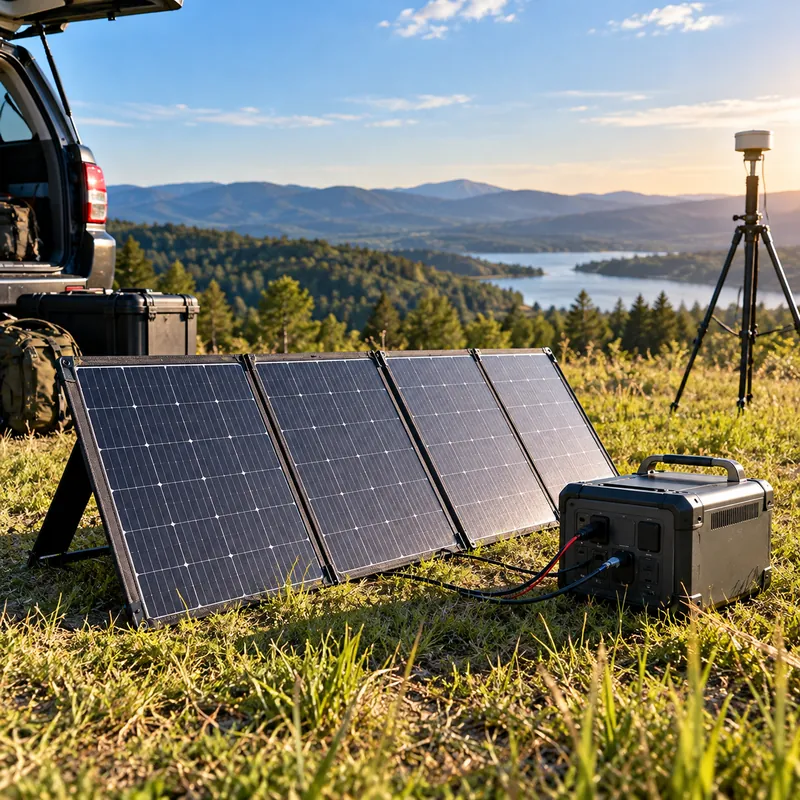
A portable solar panel is a photovoltaic module built for repeated deployment: folding fabric-backed arrays, briefcase-style rigid panels, or thin flexible laminates. Each one converts sunlight into direct current; it does not store energy and it does not produce household AC.
The panel connects to a charge controller, which regulates current into a battery. In most modern kits the controller is built into the power station or battery pack and uses maximum power point tracking (MPPT), which continuously adjusts the operating voltage to extract the most power from the panel as light and temperature change. Older and cheaper kits use PWM controllers, which effectively clamp the panel to battery voltage and waste 15–30% of available power with a high-voltage panel.
Common portable panel formats
| Format | Typical rating | Weight per 100 W | Best use |
|---|---|---|---|
| Folding fabric (packable) | 60–220 W | 2–2.5 kg | Travel, camping, lightweight portable solar panels |
| Briefcase rigid glass | 100–200 W | 5–6 kg | Vehicle-based use, longer life |
| Flexible laminate | 50–200 W | 1.5–2 kg | Curved surfaces, boats, van roofs |
| Rigid framed module on stand | 300–450 W | 5–6 kg | Semi-permanent portable solar array |
Monocrystalline cells dominate all four formats. Folding units trade durability and cooling for weight; fabric-backed panels run hotter and lose more output in summer than framed glass modules. For more background on cell-level storage options that pair with these panels, see our guide to lightweight solar batteries.
How Much Power Do Portable Solar Panels Really Produce?
Panel ratings are measured at Standard Test Conditions: 1,000 W/m² irradiance, 25 °C cell temperature and air mass 1.5. In the field, cells run 20–35 °C hotter than ambient, panels are rarely perfectly aimed, and cables and controllers add losses. A realistic derate for portable use is 0.70–0.80.
The useful planning formula is:
E_day (Wh) = P_rated × PSH × k
where PSH is peak sun hours (kWh/m²/day for the site and month) and k is the system derate.
Worked example: charging a 1 kWh power station
- Panel: 200 W folding unit. Site: 4.5 peak sun hours. Derate k = 0.75.
- Daily harvest:
200 × 4.5 × 0.75 = 675 Wh. - Battery: 1,024 Wh usable, charge efficiency about 0.92, so energy needed from the panel =
1,024 / 0.92 ≈ 1,113 Wh. - Days to full from empty:
1,113 / 675 ≈ 1.65 days. Two 200 W panels in parallel bring this under one day.
Peak watts are a poor guide to energy. A panel that briefly reads 185 W at noon may average under 120 W across the day. When comparing portable solar products, ask for the temperature coefficient of power (typically −0.30 to −0.40%/°C) and the cell efficiency, not just the headline wattage. Our explainer on what size solar system you need applies the same energy method to fixed installations.
Choosing Solar Panels for a Portable Power Station
A portable power station is a self-contained lithium battery with an inverter, MPPT controller and outlets in one case. Matching panels to it is mainly a voltage and current exercise.
- Check the PV input window. Every unit lists a voltage range (for example 12–60 V or 32–150 V) and a maximum input current or wattage.
- Correct Voc for cold. Open-circuit voltage rises as cells cool. Use
Voc_cold = Voc_STC × [1 + β × (T_min − 25)], with β around −0.0029/°C. Two 22.5 V panels in series at −10 °C give45 × [1 + 0.0029 × 35] ≈ 49.6 V, safely inside a 60 V limit. - Series or parallel. Series raises voltage, helps MPPT start earlier in the day and reduces cable current. Parallel keeps voltage low and tolerates partial shading better.
- Confirm the connector. MC4, Anderson-style and 8 mm barrel connectors are all common; adapters add resistance and should be rated for the current.
- Do not oversize current. Most controllers clip excess power safely, but exceeding the stated input current or voltage can damage them and voids warranty.
| Power station capacity | Suggested panel watts | Approx. clear-day recharge |
|---|---|---|
| 250–500 Wh | 100–200 W | One day |
| 1–2 kWh | 400–800 W | One day |
| 3–5 kWh | 1,000–1,600 W | One to two days |
Units with 3 kWh or more usually accept an outdoor solar panel 1000W array or larger. For a broader comparison of these packaged units, see our solar generator guide.
Solar Panel With Outlet: Where Does the AC Socket Come From?
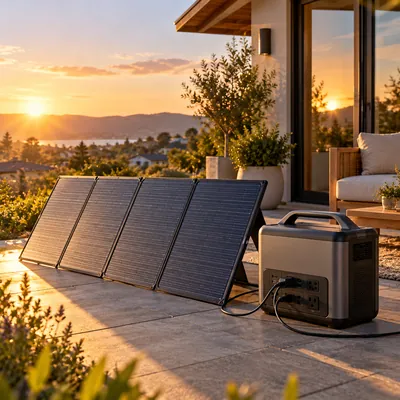
Searches for a solar panel with outlet, solar powered AC outlet or solar panel with plug socket all describe the same arrangement: a panel feeding a battery that contains an inverter. A bare PV module cannot power a 120 V or 230 V appliance directly; its output varies with every passing cloud and it is DC.
The chain is panel → MPPT controller → battery → inverter → outlet. The outlet's capability depends on the inverter, so check three numbers:
- Continuous rating in watts, which must exceed the running load.
- Surge rating, typically 1.5–2× continuous for a few seconds, needed for compressors and pumps.
- Waveform: pure sine wave output is required for motors, chargers with active PFC and most electronics. Modified sine units cause heating and noise.
A solar powered 110V outlet on a small battery bank will run a laptop for hours but a 1,500 W kettle for minutes. Runtime is roughly t (h) = E_battery × η_inverter / P_load; a 1,000 Wh pack at 90% inverter efficiency runs a 300 W load for about 3 hours. The same logic applies to solar powered battery banks and solar charger battery banks for phones, which use USB outputs rather than an inverter and are covered in our article on the solar power bank.
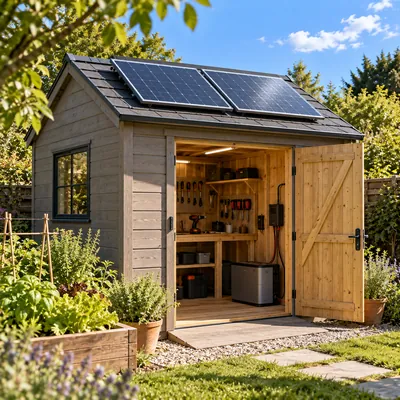
When the requirement is a permanent solar electrical outlet in an outbuilding, a fixed small system is usually better than a portable pack; the design steps are in our guide to solar power for a shed.
Plug and Play Solar: Can You Plug Solar Panels Into a Wall Outlet?
Plug-in solar (also called balcony solar or plug and play solar) is a small PV array with a microinverter that connects to a building's wiring through an ordinary socket. Several European countries permit this within defined limits, commonly a few hundred watts per household, using inverters that disconnect when the grid is lost.
In the United States the situation is different. Feeding power into a branch circuit through a receptacle creates a backfeed source that the circuit was not designed for, and the male plug pins can be energized when unplugged. The National Electrical Code treats any parallel source under Article 705, which requires a proper point of connection, overcurrent protection and a utility-listed inverter meeting UL 1741 and IEEE 1547. A few states have started to legislate small plug-in systems, so rules are changing, but in most jurisdictions a solar panel plugged into a wall outlet is not code-compliant without a permit and interconnection approval.
| Option | Grid connection | Typical approval |
|---|---|---|
| Portable panel + power station | None (isolated) | None needed |
| Plug-in solar kit with microinverter | Through a receptacle | Varies; not permitted in most US areas |
| Permitted grid-tied system | Dedicated breaker or supply-side tap | Permit plus utility interconnection |
Work on service equipment and any connection to building wiring must follow local code and be carried out by a licensed electrician. For a correctly interconnected system, see how an on-grid solar system works.
Portable Solar Power for Home Backup: Realistic Limits
A portable solar power system for home use can keep a refrigerator, router, lights and phone charging running through an outage, which is valuable. It cannot replace a whole-house system. Consider a modest home that uses 25 kWh per day. A 2 kWh power station with 800 W of panels harvesting 800 × 4.5 × 0.75 = 2.7 kWh per day covers roughly a tenth of that, and only on sunny days.
Practical load prioritization
- Refrigerator: 1–2 kWh/day, with a start surge of 3–6× running watts.
- Network equipment and lighting: 0.3–0.8 kWh/day.
- Medical devices: size separately with margin, and check waveform compatibility.
- Well pumps, HVAC, electric cooking: generally beyond portable kits.
Lithium iron phosphate (LFP) chemistry has become standard in portable units of 1 kWh and above because it tolerates thousands of cycles and is thermally more stable than nickel-based cells. Lithium battery generator and lithium solar generator are marketing names for the same product class. Voltage choice inside larger home systems is explained in 12V vs 24V vs 48V solar batteries.
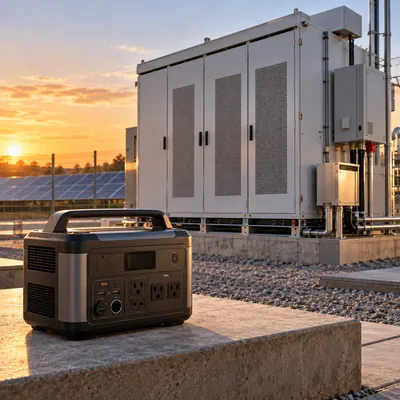
If your backup goal is a whole building, see our comparison of portable power stations versus BESS, which sets out the capacity, power and code thresholds where a stationary system becomes necessary.
When Should a Project Move From Portable Kits to a Fixed BESS?
Portable kits are designed for convenience, not for continuous duty. Several engineering signals indicate that a site has outgrown them:
- Energy: daily demand above roughly 5–10 kWh, or a need for multi-day autonomy.
- Power: continuous loads above 3–5 kW, motor starting, or three-phase equipment.
- Duty: daily cycling for peak shaving, solar self-consumption or demand-charge control.
- Compliance: commercial sites typically require a system listed to UL 9540 with cells tested to UL 9540A and installation per NFPA 855 or the local fire code.
| Attribute | Portable power station | C&I battery cabinet |
|---|---|---|
| Energy | 0.3–5 kWh | 93–372 kWh per cabinet |
| Output | Single-phase sockets | Three-phase PCS, grid-forming options |
| Thermal management | Fans | Liquid cooling |
| Controls | App | BMS plus site EMS |
| Fire protection | None | Detection and suppression integrated |
MARS does not make portable panels or consumer power stations. We manufacture stationary LFP energy storage systems: liquid-cooled C&I cabinets from 93 to 372 kWh and containerized systems from 500 kWh to 10 MWh with PCS, BMS/EMS and fire suppression. For off-grid sites in that range, our off-grid solar system guide covers architecture.
Next Steps: Specifying and Sourcing
For a portable kit, write a one-page requirement before buying: list each load with running and surge watts, hours per day, the minimum winter peak sun hours for the site, and the voltage and current window of the chosen power station. Specify MPPT control, pure sine inverter output, LFP chemistry, cold-corrected Voc margin of at least 10% and weather rating (IEC 60529 IP65 or better for panels left outdoors).
For a commercial or industrial site, the specification should instead cover:
- Load profile in 15-minute intervals and the use case (backup, peak shaving, PV self-consumption).
- Usable energy at end of warranty, power rating and C-rate.
- Grid voltage, frequency (50 or 60 Hz) and interconnection standard, such as IEEE 1547 or the local grid code.
- Certification set: UL 9540, UL 9540A, IEC 62619, UL 1741 for the PCS.
- Factory acceptance testing and commissioning scope.
MARS supplies liquid-cooled C&I and containerized battery storage with routine tests on every unit and FAT welcome; typical BESS lead time is 60–90 days. Send your load data through our quotation form for a sized proposal.
Frequently asked questions
What size portable solar panel do I need for a power station?
Divide the power station's capacity by the energy one watt of panel delivers per day. With 4.5 peak sun hours and a 0.75 derate, each panel watt gives about 3.4 Wh daily, so a 1,000 Wh station needs roughly 300–400 W of panels to recharge in one sunny day, within its input voltage limit.
Can a solar panel power an AC outlet directly?
No. A solar panel produces variable DC. To get a usable AC outlet you need a charge controller, a battery to buffer the variation, and an inverter. Portable power stations package all three. Grid-tied microinverters also make AC, but they only operate when connected to a live, approved grid circuit.
Are plug-in solar panels legal in the US?
In most US jurisdictions, plugging a solar inverter into a household receptacle is not permitted without a permit and utility interconnection, because NEC Article 705 requires a defined point of connection and listed equipment. A few states are introducing rules for small plug-in systems, so check current local regulations and use a licensed electrician.
How long do portable solar panels last?
Framed glass modules commonly carry 25-year power warranties. Folding fabric-backed portable panels see more flexing, ultraviolet exposure on the textile and heat buildup, so a service life of 5–10 years is more typical. Store them dry, avoid sharp folds against the cells, and inspect connectors and cables regularly.
Is a portable solar power system enough to run a house?
Usually not. An average home may use 20–30 kWh per day, while portable power stations hold 0.3–5 kWh. They are well suited to essential-load backup such as a refrigerator, lights, router and medical devices. Whole-house backup needs a permanently installed battery system with a properly rated inverter and transfer equipment.
What is the best solar battery bank chemistry?
For battery banks above about 500 Wh, lithium iron phosphate is generally preferred: it delivers 3,000 or more cycles, has a flat discharge voltage and is more thermally stable than NMC. Small phone-sized solar power banks still mostly use NMC or lithium polymer cells for compactness, at the cost of shorter cycle life.
Written and reviewed by the MARS application engineering team in Shanghai, who specify and test transformers, switchgear, substations and battery storage for projects in 40+ countries. Last updated .
Tags: portable solar panels solar panels for portable power station solar panel with outlet plug and play solar portable solar power system