Key takeaways
- A solar generator stores energy in a battery, typically LiFePO4, and only produces AC through its inverter; it creates no energy without sunlight or another charging source.
- Runtime in hours equals usable watt-hours multiplied by about 0.85 conversion efficiency, divided by the average load in watts.
- A 400 W solar panel in a location with 5 peak sun hours delivers roughly 1.5 kWh per day after typical 25% system losses.
- Connecting any backup source to house wiring requires a listed transfer switch or interlock under NEC Article 702 to prevent backfeeding the utility.
- Whole-house backup usually needs 10-30 kWh of fixed storage and 7-12 kW of inverter capacity, beyond what portable solar generators provide.
Quick answer: A solar power generator is not a generator in the combustion sense; it is a battery, inverter and solar charge controller in one enclosure, recharged by solar panels. Capacity in watt-hours sets how long it runs, and inverter watts set what it can start. Portable units suit essential loads for hours; backing up a whole house needs a fixed battery system of 10-30 kWh or more with a transfer switch.
Solar generators are marketed as silent, fume-free replacements for gas generators. Some deliver exactly that for camping, small outages and essential loads; others are sold with whole-house claims that the physics cannot support. The difference comes down to two numbers on the label and one honest look at how much energy a home actually uses.
This guide is for homeowners weighing a solar generator for the house, facility managers planning emergency power and anyone comparing solar against fuel-based standby generators. It explains what is inside, how to size capacity and solar input with worked numbers, how to connect safely and when to step up to a fixed home or commercial battery system.
What Is a Solar Powered Generator?
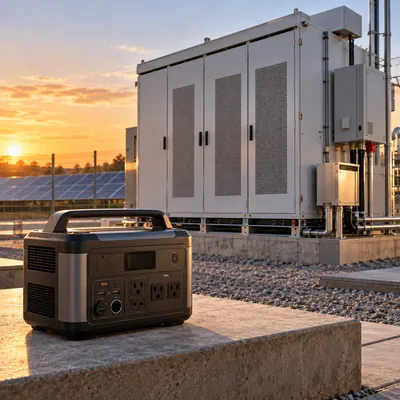
A solar powered generator is a self-contained battery energy storage unit with an integrated inverter and solar charge controller, designed to be recharged from photovoltaic panels. The name is a marketing term: it stores energy rather than generating it, and the panels are the actual source.
Inside a typical unit:
- Battery pack. Usually lithium iron phosphate (LiFePO4) for cycle life and safety, sometimes NMC in lighter models. Rated in watt-hours (Wh) or kilowatt-hours (kWh).
- MPPT charge controller. Converts panel DC to battery charging current. Its maximum input voltage and watts limit how many panels you can connect.
- Inverter. Converts battery DC to 120 V or 230 V AC; larger units offer 120/240 V split-phase, the "220 V" output buyers look for to run well pumps and dryers.
- AC charger and pass-through. Charges from a wall outlet or fuel generator and can power loads while charging.
- BMS and outputs. A battery management system protects cells; outlets include AC, USB and 12 V DC.
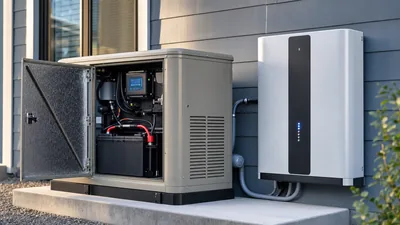
Units under about 3 kWh are portable power stations; above that, many become wheeled or modular systems. The comparison with stationary commercial storage is covered in the portable power station vs BESS guide. Fixed home batteries perform the same function without the portability and are the more common choice for whole-home backup.
Watt-Hours vs Watts: Reading the Specifications
Two ratings decide whether a solar generator for the home will do the job:
- Capacity (Wh or kWh) is energy, the size of the fuel tank. It determines runtime.
- Continuous output (W) is power, the size of the engine. It determines what can run at once. A separate surge rating covers motor starting.
| Class | Capacity | Continuous output | Realistic use |
|---|---|---|---|
| Small portable | 250-1,000 Wh | 300-1,000 W | Phones, laptops, CPAP, lights, router |
| Mid portable | 1-3 kWh | 1.5-3 kW | Refrigerator, sump pump, lights during short outages |
| Expandable home unit | 3-15 kWh with add-on batteries | 3-7 kW, some 120/240 V | Critical-load circuits via transfer switch |
| Fixed home battery | 10-30+ kWh | 5-12 kW | Whole-home or large partial backup |
| C&I cabinet or container | 93 kWh to 10 MWh | 50 kW to several MW | Commercial backup, peak shaving |
Also check the solar input limit, charge rate from AC, cycle rating to 80% capacity, operating temperature range and listing. UL 2743 covers portable power packs, while fixed systems are listed to UL 9540. For battery fundamentals, our 10 kWh battery guide works through a typical home-scale unit.
How Long Will a Solar Generator Run? Runtime Calculation
Runtime depends on usable capacity, conversion losses and average load:
Runtime (h) = (Capacity_Wh × DoD × η_inverter) / Average load_W
For LiFePO4 units the usable depth of discharge is typically 90-100% of the rated capacity, and inverter efficiency at moderate load about 85-92%. A combined factor of 0.85 is a safe planning value.
Worked example: essential loads during an outage
| Load | Average W | Hours | Wh |
|---|---|---|---|
| Refrigerator (cycling) | 60 | 24 | 1,440 |
| LED lighting | 60 | 6 | 360 |
| Router and phone charging | 25 | 24 | 600 |
| Furnace blower | 400 | 6 | 2,400 |
| Daily total | 4,800 |
Required capacity for one day without recharge: 4,800 / 0.85 ≈ 5,650 Wh. A 2 kWh portable unit would last about 2,000 × 0.85 / 200 ≈ 8.5 h at the 200 W daily average, then need recharging. A 6 kWh expandable unit covers a full day.
Inverter sizing is separate: the refrigerator compressor and furnace blower may start together, so check surge capacity against starting watts, as explained in our generator sizing guide.
How Many Solar Panels Does a Solar Generator Need?
The battery only stays useful if solar input can refill it. Daily solar harvest is:
E_solar = P_panels × PSH × derate
where PSH is peak sun hours (kWh/m² per day of irradiance on the panel) and derate covers temperature, soiling, wiring, angle and controller losses, typically 0.70-0.80.
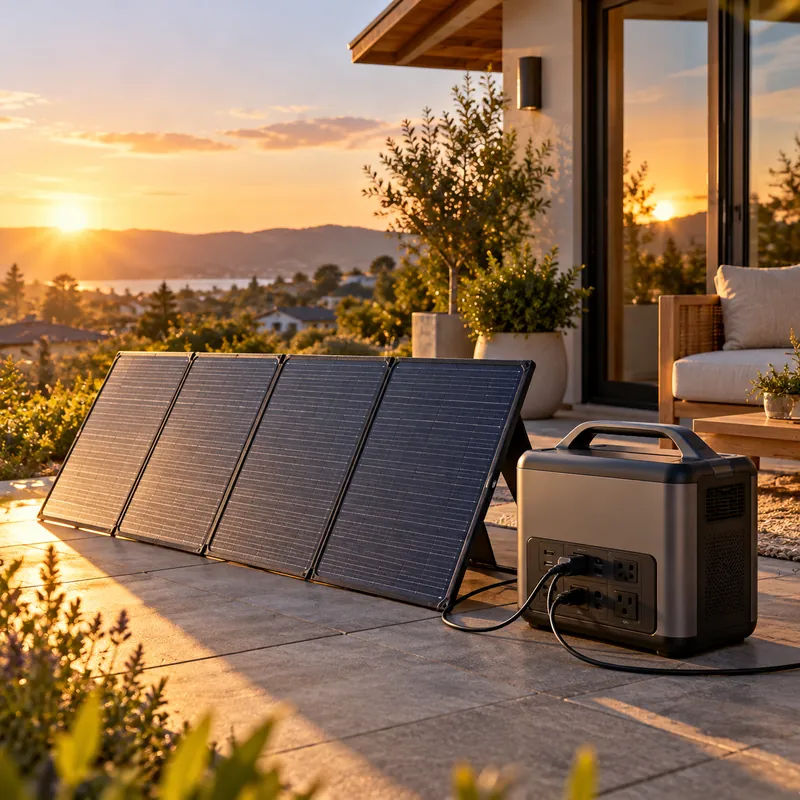
Worked example. Two 200 W portable panels in a location averaging 5 PSH: 400 × 5 × 0.75 = 1,500 Wh/day. Refilling the 5,650 Wh need from the runtime example would take almost four sunny days, so either add panels or cut loads. To recover 4.8 kWh of daily use: 4,800 / (5 × 0.75) = 1,280 W of panels, roughly three 400 W modules, and the unit's MPPT input must accept that many watts and the string's cold-weather open-circuit voltage.
Winter matters most for emergency planning. Many northern locations see 2 PSH or less in December, cutting harvest by more than half. In practice, solar emergency generators for the home are paired with a wall charger to top up before a forecast storm, and sometimes with a small fuel generator for extended outages: the "solar and gas generator" hybrid approach.
Fold-out panels are discussed in our portable solar panels guide; for permanent roof arrays, start with a load-based solar system size calculation.
Can a Solar Powered Whole House Generator Really Run a Home?
It depends on the house and on what "whole house" means. Consider a home using 30 kWh per day with a 9 kW peak from a heat pump, water heater and range.
- Battery for one day:
30 / 0.85 ≈ 35 kWh. - Inverter: at least 9 kW continuous, with surge for compressors, at 120/240 V.
- Solar to recharge daily at 4 PSH:
30 / (4 × 0.75) = 10 kWof panels.
No portable unit delivers that. A real solar whole house generator is a fixed system: a roof or ground array, one or two hybrid inverters and 20-40 kWh of wall- or floor-mounted batteries, installed with a transfer switch. Our hybrid solar inverter guide explains that architecture.
The realistic alternative is load management. Backing up a critical-loads panel of 6-12 kWh per day, while leaving electric heat, ranges and dryers off, brings battery size down to 10-15 kWh and solar to 3-5 kW. Smart circuit control can automate that shedding during an outage.
Fixed residential storage is subject to NFPA 855 and the residential code, which limit energy per unit and per location and set separation and garage-installation rules. Check these with the local authority before buying a large battery or solar standby generator.
Solar Backup Generator vs Gas Standby Generator
Battery-based and combustion generators solve different problems, and many homes and businesses benefit from both.
| Factor | Solar generator / home battery | Fuel standby generator |
|---|---|---|
| Energy source | Stored energy plus solar recharge | Natural gas, propane or diesel |
| Outage duration | Limited by kWh and sunshine | Limited only by fuel supply |
| Transfer | Often under 20 ms with integrated backup | Typically 10-30 s for start and transfer |
| Indoor use | Allowed per listing and code; no exhaust | Outdoors only, carbon monoxide hazard |
| Noise and maintenance | Silent, minimal maintenance | Noise, oil changes, exercising, fuel |
| Daily value | Can cycle for tariff savings and self-consumption | Idle except in outages |
| Surge capacity | Limited by inverter | Usually strong for motor starting |
For long rural outages, a battery that covers the first day silently plus a generator that recharges it is often the most resilient design. Combined designs are covered in our home generator battery guide.
How to Connect a Solar Generator to a House Safely
Plugging a backup source into a wall outlet with a double-male cord can backfeed the utility transformer and energize lines that crews believe are dead. Never do it. Safe options include:
- Extension cords to individual appliances. Simplest and safe for small portable units; keep cords rated for the load.
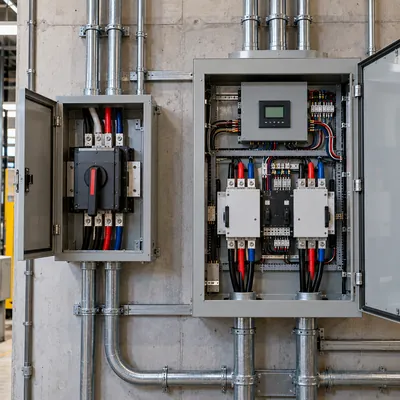
- Manual transfer switch or inlet with interlock. A listed power inlet box feeds a transfer switch or a breaker interlock kit in the main panel, so the main breaker must open before the backup breaker can close.
- Automatic transfer switch. Used with fixed batteries and hybrid inverters to switch critical loads within milliseconds to seconds.
- Hybrid inverter with backup gateway. The inverter itself isolates the house from the grid and runs the backup panel.
NEC Article 702 covers optional standby systems and requires transfer equipment that prevents inadvertent interconnection with the utility. If the unit has a bonded neutral, a switched-neutral transfer arrangement may be needed. Our guide to transfer switch types and sizing explains the choices.
Work on the service panel, inlet boxes and transfer equipment must follow local code and be done by a licensed electrician, with a permit and inspection.
Next Steps: Specifying and Sourcing
Before buying, write down the answers to five questions:
- Which loads must run, and what are their running and starting watts?
- How many hours or days of outage must be covered, and in which season?
- Will the unit be portable, or permanently connected through a transfer switch?
- How much solar can be installed, and what are the local peak sun hours in winter?
- Which listings does the local authority require: UL 2743 for portable packs, UL 9540 for fixed storage, NFPA 855 siting rules?
For homes, compare listed units on usable kWh, inverter and surge watts, solar input, 120/240 V capability, cycle life and warranty, then have an electrician design the connection.
MARS does not sell portable solar generators. For businesses, farms, campuses and remote sites whose backup needs start at tens of kilowatts, we build LFP liquid-cooled cabinets from 93 to 372 kWh and containerized systems up to 10 MWh with PCS, BMS, EMS and fire suppression. See our energy storage systems or send load data through the quote request form.
Frequently asked questions
What is a solar generator?
A solar generator is a battery pack combined with an inverter and solar charge controller in one enclosure, recharged by solar panels or a wall outlet. It supplies AC and DC power silently and without fuel, but it only stores energy; its runtime is limited by battery capacity and how much solar energy it can collect each day.
Can a solar generator power a whole house?
Most portable solar generators cannot. A typical home may need 20 to 35 kWh per day and 8 to 12 kW of peak power. Whole-house backup with solar normally uses a fixed battery system of 10 to 40 kWh, a hybrid inverter and a transfer switch, or limits backup to a critical-loads panel.
What size solar generator do I need for a refrigerator?
A typical refrigerator averages 50 to 100 W and uses 1.2 to 2 kWh per day, with a starting surge of 600 to 1,200 W. A unit with at least 1,500 Wh usable capacity and 1,500 W continuous output covers one day; add solar input or a larger battery for longer outages.
How long does it take to charge a solar generator with solar panels?
Divide the battery capacity by panel watts times peak sun hours times about 0.75. A 2,000 Wh unit with 400 W of panels at 5 peak sun hours needs about 2,000 / (400 × 5 × 0.75) = 1.3 days. Wall charging is usually faster, often a few hours.
Is a solar generator better than a gas generator?
A solar generator is quieter, can be used indoors per its listing, needs little maintenance and switches over quickly, but its energy is limited. A gas or propane generator runs as long as fuel lasts and handles large motor loads. For long outages, combining a battery with a fuel generator is often the most reliable choice.
Can I plug a solar generator into a wall outlet to power my house?
No. Backfeeding through an outlet with a double-male cord is dangerous and violates electrical code, because it can energize utility lines and overload wiring. Use extension cords to individual appliances, or have a licensed electrician install a power inlet with a transfer switch or listed interlock.
Written and reviewed by the MARS application engineering team in Shanghai, who specify and test transformers, switchgear, substations and battery storage for projects in 40+ countries. Last updated .
Tags: solar power generator solar powered generator solar generator for house solar backup generator solar powered whole house generator