Key takeaways
- Portable power stations typically store 0.25-5 kWh and deliver 300 W to about 4 kW, usually single-phase at 120 V or 230 V.
- Commercial liquid-cooled BESS cabinets start around 93-372 kWh, and containerized systems scale from 500 kWh to 10 MWh with three-phase PCS output.
- Portable lithium power packs are covered by UL 2743, while stationary systems are listed to UL 9540 and sited under NFPA 855.
- Runtime equals usable watt-hours times roughly 0.85 divided by load watts, so a 2 kWh station runs a 500 W load for about 3.4 hours.
- Lithium batteries shipped by air, sea or road must pass the UN 38.3 transport tests regardless of size.
Quick answer: A portable power station is a rechargeable lithium battery with a built-in inverter, AC outlets and USB ports, typically 0.25-5 kWh and up to about 3-4 kW output. It suits outdoor use, emergencies and small tools. Once a site needs more than roughly 10-20 kWh per day, three-phase power or continuous duty, a stationary battery energy storage system (BESS) cabinet or container is the right tool.
Battery storage now spans six orders of magnitude, from phone power banks to multi-megawatt-hour containers. The portable power station sits near the small end: a carry-handle box that has replaced many small fuel generators for camping, tailgating, emergencies and light jobsite work. The question many buyers face is not which portable unit to buy, but when portable stops making sense.
This article is for homeowners, event organizers, contractors and facility managers who need to place their requirement on that ladder. It explains what a portable power station can and cannot do, gives runtime and scaling calculations, compares safety standards and shows the thresholds where a C&I cabinet or containerized BESS takes over.
What Is a Portable Power Station?
A portable power station is a self-contained, rechargeable battery unit that integrates a lithium battery pack, battery management system, inverter, charger and output sockets in one enclosure light enough to carry or wheel. It is also sold as a battery powered generator or portable battery generator, although it generates nothing; it releases stored energy.
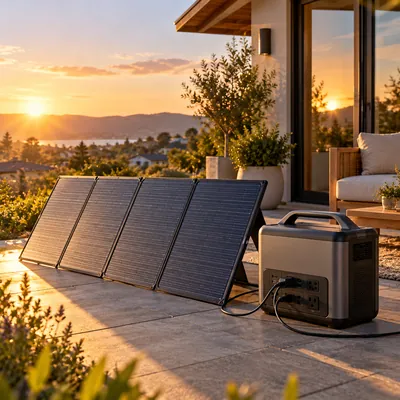
Typical features include AC outlets with a pure sine wave inverter, USB-A and USB-C ports, a 12 V car socket, wall and car charging, and a solar input with a built-in MPPT controller. When paired with folding panels, the same product is marketed as a solar generator; the solar power generator guide covers recharge sizing for that use.
Chemistry matters. Older and lighter units use NMC cells, which have higher energy density but shorter cycle life and lower thermal-runaway onset temperature. Most current models use LiFePO4, offering typically 3,000 or more cycles to 80% capacity. The trade-offs are compared in our LFP vs NMC battery guide.
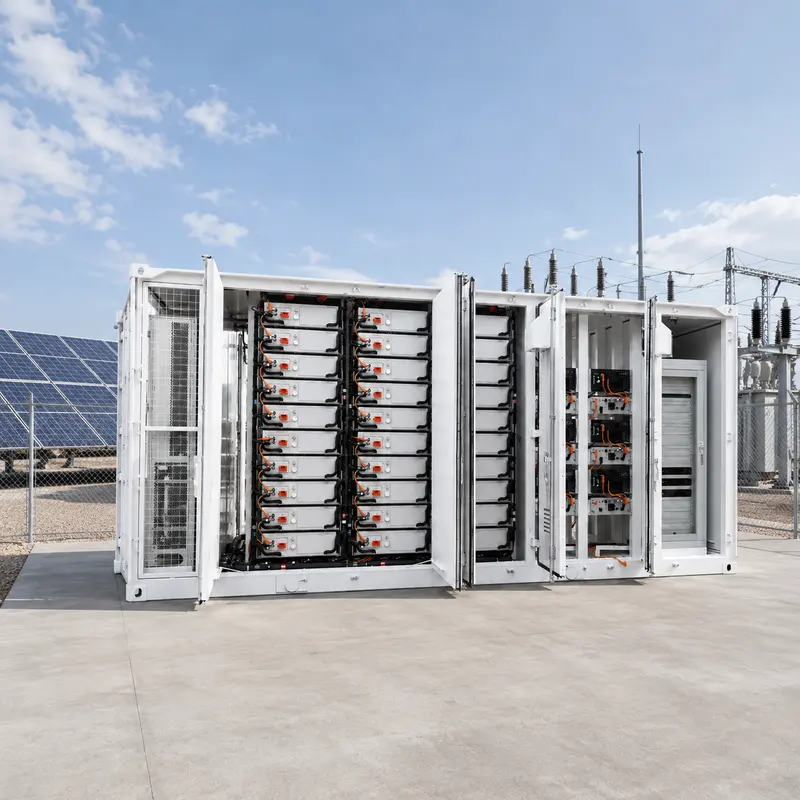
A battery energy storage system (BESS), by contrast, is a stationary installation of battery racks, power conversion system, BMS, energy management system, thermal management and fire protection, connected to a building or grid. The difference is not just size; it is duty cycle, integration and safety engineering.
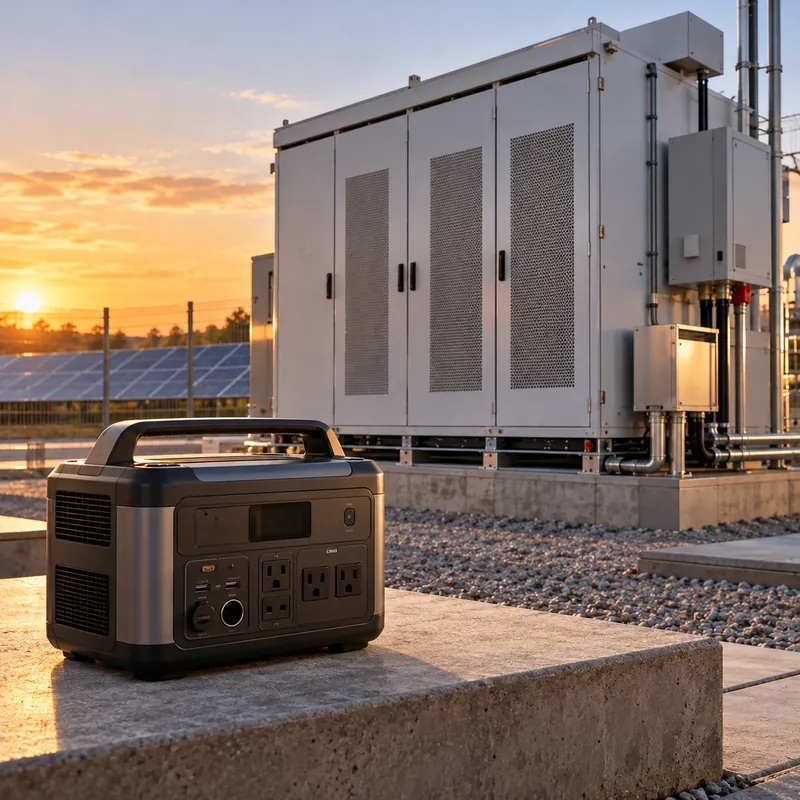
The Storage Ladder: From Power Bank to Container
Placing the requirement on the right rung avoids both underbuying and overspending.
| Class | Energy | Power | Output | Typical use |
|---|---|---|---|---|
| Power bank | 10-100 Wh | 5-100 W | USB, some with a small AC outlet | Phones, laptops |
| Small portable power station | 250-1,000 Wh | 300-1,000 W | AC, USB, 12 V | Camping, CPAP, tailgating |
| High capacity portable power station | 1-5 kWh, expandable | 1.8-4 kW | 120 V or 230 V, some 120/240 V | Home backup of essentials, light tools |
| Fixed home battery | 5-30 kWh | 5-12 kW | Single or split-phase, grid-connected | Whole-home or partial backup |
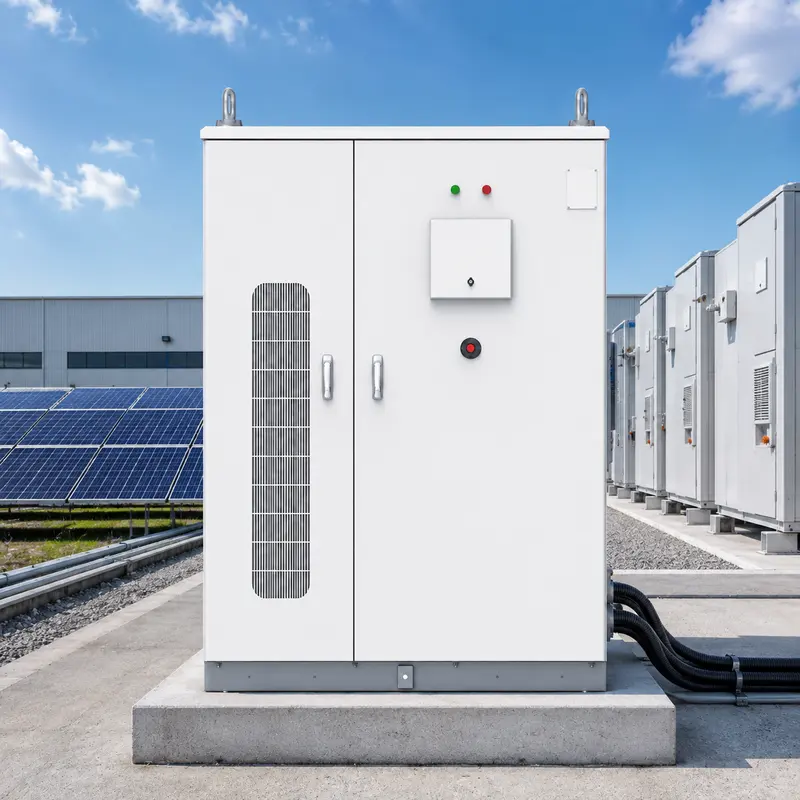
| C&I liquid-cooled cabinet | 93-372 kWh | Typically 0.5C-1C of rated kWh | Three-phase 400/480 V via PCS | Peak shaving, backup, PV self-consumption |
| Containerized BESS | 500 kWh-10 MWh | 250 kW to several MW | Three-phase LV or MV via transformer | Factories, microgrids, utility services |
An expandable or modular power station blurs the line between rows two and three by adding extra battery packs, but the inverter rating does not grow with the batteries. More capacity extends runtime; it does not let you start a larger compressor.
How Long Does a Portable Power Station Last? Runtime Math
Runtime depends on usable capacity, inverter efficiency and the load:
t (h) = (E_rated × DoD × η) / P_load
For a LiFePO4 station, assume DoD of about 0.95 and AC inverter efficiency of about 0.88-0.90, so a combined factor near 0.85.
Worked example 1: home backup. A 2,048 Wh unit runs a refrigerator averaging 80 W plus a router and lights at 40 W: t = 2,048 × 0.85 / 120 ≈ 14.5 h. That covers an overnight outage but not a multi-day storm.
Worked example 2: 2,000 W power station on a tool. A 1,500 W circular saw run continuously from a 1,000 Wh unit: t = 1,000 × 0.85 / 1,500 ≈ 0.57 h, about 34 minutes of cutting. Intermittent use stretches that across a working morning.
Remember three other limits:
- Surge. Compressors and motors need two to five times running watts at start; check the surge rating.
- Idle draw. Leaving the AC inverter on with no load can consume 10-30 W, or 240-720 Wh per day.
- Recharge time. Wall charging often takes 1-3 hours, solar charging a day or more.
For any portable charger used during a power outage, recharge planning matters as much as capacity.
Is a Portable Power Station Safe for Indoor Use?
Unlike fuel generators, battery units produce no carbon monoxide, which makes them suitable for indoor use as a battery operated generator, provided the product is listed and used as instructed. Safety still depends on cells, BMS and certification.
| Standard | Applies to | What it addresses |
|---|---|---|
| UL 2743 | Portable power packs | Electrical, mechanical and thermal safety of the complete portable unit |
| IEC 62133-2 | Portable lithium cells and batteries | Cell and battery safety for portable applications |
| UN 38.3 | All lithium batteries in transport | Altitude, thermal, vibration, shock, short-circuit and overcharge tests |
| UL 1973 / IEC 62619 | Stationary and industrial batteries | Battery module and system safety |
| UL 9540 / UL 9540A | Stationary energy storage systems | System listing and thermal-runaway propagation test method |
| NFPA 855 | Stationary ESS installations | Siting, separation, energy limits and fire protection |
Practical rules: keep units away from heat sources and direct sun, do not charge below the cell's minimum temperature (LiFePO4 is normally 0 °C), avoid charging unattended in sleeping areas, and retire any unit that swells, smells or overheats. Large stationary systems are a different category with engineered fire suppression and ventilation; see our guide to battery thermal runaway.
Portable Power for Construction Sites, Events and Outdoor Use
Contractors and event crews increasingly use batteries to cut noise and fuel, from a power bank for construction tools to trailer-mounted storage. The scaling problem appears quickly.
Worked example: site welfare cabin and tools. A site office, heaters, lighting and battery chargers average 3 kW over a 10-hour shift, with peaks of 12 kW when a compressor and heaters coincide.
- Daily energy:
3 kW × 10 h = 30 kWh. - Portable stations rated 2 kWh:
30 / (2 × 0.85) ≈ 18 units, all needing recharge every night, none able to supply 12 kW peak or three-phase loads. - Stationary alternative: a 60-100 kWh battery with a 30-50 kW three-phase inverter, recharged by a small generator running at its efficient load point, or by a grid connection where one exists.
The second option is how hybrid generator-battery sets work: the battery covers low-load hours silently and the generator runs only to recharge or meet peaks. Our hybrid generator battery guide explains the sizing, and the temporary power distribution guide covers the site panels downstream.
For truly mobile work, such as a weekend market or tailgating, a 1-2 kWh portable power station for outdoor use with weather-resistant enclosure and solar input remains the practical answer.
When to Move From Portable to a C&I Cabinet or Container
A portable battery backup is a consumer product with consumer-grade duty limits. Move to stationary commercial storage when one or more of these thresholds is crossed:
- Energy: daily requirement above about 10-20 kWh, or a need to cycle every day for years.
- Power: sustained load above 3-5 kW, or any three-phase motor load.
- Integration: the battery must connect to a switchboard, PV system or grid with automatic transfer, peak shaving or export control.
- Uptime: the loads are revenue-critical, such as cold rooms, processing lines, telecom or clinics.
- Compliance: the authority having jurisdiction requires UL 9540 listing, NFPA 855 siting and engineered fire protection.
A liquid-cooled C&I cabinet keeps cell temperatures within a few degrees of each other, which extends cycle life under daily duty; see our liquid vs air cooling comparison. For megawatt-hour needs, a containerized BESS includes PCS, BMS, EMS, HVAC and suppression in one factory-tested unit; our article on how to specify a containerized BESS walks through the specification.
Where buyers search for a "portable power substation", they usually mean a trailer- or skid-mounted transformer and switchgear unit for temporary MV connections, a different product from battery storage. MARS's compact and containerized substations belong to that transformer-and-switchgear category rather than to battery storage.
Comparing Cost: Portable Stations vs Stationary BESS
Upfront price per kWh is a misleading comparison on its own. What matters is cost per kWh actually delivered over the product's life:
Cost per delivered kWh = Capital cost / (Usable kWh × Cycles to end of life × η)
Illustrative comparison. Using placeholder values only to show the method, a 2 kWh portable unit rated for 3,000 cycles delivers at most 2 × 0.95 × 3,000 × 0.88 ≈ 5,000 kWh over its life. A 215 kWh commercial cabinet rated for 6,000 or more cycles delivers 215 × 0.9 × 6,000 × 0.9 ≈ 1,045,000 kWh. Divide each unit's purchase price by its delivered energy and the commercial system is usually far cheaper per kWh, even though its purchase price is much higher.
Portable units rarely reach their rated cycles, because they are used occasionally and age mostly by calendar time. That is fine for emergency use, but it means portable stations are a poor vehicle for daily energy cost savings.
Actual prices vary widely by market, chemistry, certification, service scope and date, so request current quotes rather than relying on published figures. Our commercial energy storage guide discusses what drives installed C&I project cost.
Next Steps: Specifying and Sourcing
Start by placing the need on the storage ladder:
- Measure the load: average and peak kW, daily kWh, single- or three-phase.
- Define duty: occasional emergency use, daily cycling, or continuous off-grid supply.
- Define integration: stand-alone outlets, transfer switch, switchboard connection, PV or generator coupling.
- Check compliance: UL 2743 for portable units; UL 9540, UL 9540A data and NFPA 855 siting for stationary systems; IEC 62619 outside North America.
For personal and household emergency use, a listed LiFePO4 portable unit is the right purchase. For commercial, industrial and site energy needs from about 100 kWh upward, MARS builds liquid-cooled ESS cabinets of 93-372 kWh and containerized energy storage systems from 500 kWh to 10 MWh, with PCS, BMS, EMS and fire suppression integrated and routine-tested before shipment. Send your load profile and site data through the quote request form; typical BESS lead time is 60-90 days.
Frequently asked questions
What is a portable power station used for?
A portable power station supplies AC and USB power where there is no outlet or during outages: camping, tailgating, remote work, CPAP machines, refrigerators, routers and light power tools. It is recharged from a wall outlet, car socket or solar panels, and it runs silently without fuel or exhaust.
Can a portable power station power a house?
Only essential loads for a limited time. A 2 to 5 kWh station can run a refrigerator, lights and internet for roughly half a day to a day, but it cannot supply whole-house loads such as central air or electric cooking. Whole-home backup needs a fixed battery system with a transfer switch.
What size portable power station do I need?
Add the watts of everything you want to run at once and pick an inverter rating at least 25% higher, checking surge for motors. Then multiply average watts by required hours and divide by 0.85 to get capacity in watt-hours. A 500 W load for 4 hours needs about 2,350 Wh.
Is it safe to use a battery generator indoors?
A listed battery power station produces no exhaust and is generally suitable indoors, unlike fuel generators. Use one certified to a recognized standard such as UL 2743, keep it ventilated and away from heat, follow charging temperature limits, and stop using any unit that swells, smells or overheats.
What is the difference between a portable power station and a BESS?
A portable power station is a small, self-contained consumer unit with outlets, typically under 5 kWh. A BESS is a stationary, engineered system of battery racks, power conversion, management software, cooling and fire protection connected to a building or grid, ranging from tens of kWh to many MWh.
How long does a portable power station battery last?
LiFePO4 portable stations are commonly rated for 3,000 or more full cycles to 80% capacity, while NMC units are often rated for 500 to 1,000 cycles. In occasional use, calendar aging dominates, so store the unit at partial charge in a cool place and top it up every few months.
Written and reviewed by the MARS application engineering team in Shanghai, who specify and test transformers, switchgear, substations and battery storage for projects in 40+ countries. Last updated .
Tags: portable power station battery powered generator portable battery generator portable power station for home backup high capacity portable power station