Key takeaways
- A hybrid inverter adds a bidirectional battery port to a grid-tie inverter, so one unit handles PV conversion, battery charging and discharge.
- DC-coupled hybrid systems typically recover 3-6 percentage points more solar energy into storage than AC-coupled retrofits because they avoid an extra conversion.
- Low-voltage batteries at 48 V carry about 100 A for 5 kW, while 400 V high-voltage stacks carry about 12.5 A for the same power.
- Backup capability depends on an isolating transfer function; integrated backup ports commonly switch in under 20 ms, external transfer equipment takes longer.
- In North America the inverter should be listed to UL 1741 SB and the complete storage system to UL 9540, installed under NEC Articles 705 and 706.
Quick answer: A hybrid solar inverter combines a grid-tied PV inverter and a bidirectional battery inverter in one unit. It converts solar DC to AC, charges a battery from surplus solar or the grid, discharges the battery to cut evening imports or peak demand, and, when equipped with a backup port, keeps selected circuits powered during a grid outage while staying grid-connected the rest of the time.
A standard grid-tie inverter does one thing: it exports solar energy and shuts off when the grid goes down. Rising evening tariffs, demand charges, export limits and outage risk have pushed many projects toward storage, and the hybrid inverter is the most common way to add it without a second conversion box.
This article is written for homeowners, installers and commercial energy managers deciding between a plain grid tie inverter, a retrofit AC-coupled battery and a full hybrid solar system. It covers architectures, operating modes, battery voltage choices, a worked backup sizing calculation and what changes when a hybrid solar power plant reaches commercial scale.
Hybrid Solar Inverter vs Solar Grid Tie Inverter
A solar grid tie inverter, also called a grid-connected or on-grid inverter, converts PV power to AC and exports it in parallel with the utility. It has no energy buffer, so its output follows the sun, and anti-islanding rules force it offline the moment the grid fails. The design is covered in our main solar inverter guide.
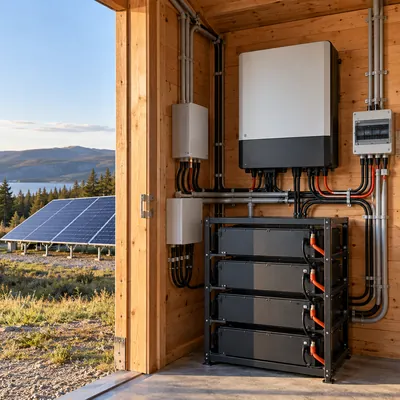
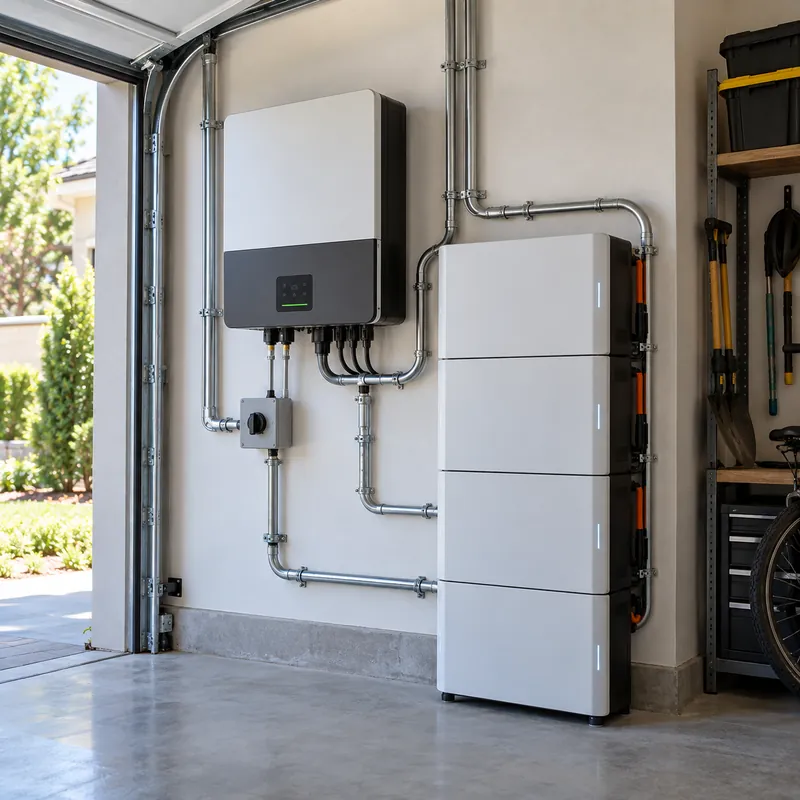
A hybrid solar power inverter keeps that function and adds a battery DC port with a bidirectional converter. In practice it behaves as three machines in one enclosure: a PV inverter, a battery charger and a battery inverter, coordinated by one controller and usually one energy meter at the service point.
| Feature | Grid-tie inverter | Hybrid inverter | Off-grid inverter-charger |
|---|---|---|---|
| Grid connection | Required | Normal, optional during outage | None or generator only |
| Battery | No | Yes, DC-coupled | Yes, essential |
| Works in outage | No | Yes, if backup port fitted | Always (grid-forming) |
| Export to grid | Yes | Yes, can be limited to zero | No |
| Typical sizing driver | Array kW | Array kW and backup load | Peak and surge load |
If the site has no grid at all, an off-grid inverter-charger is the right tool; see the off-grid inverter guide for how grid-forming units differ.
DC-Coupled vs AC-Coupled Hybrid Solar Systems
There are two ways to put solar and a battery on the same AC bus.
DC coupling means the PV array and the battery share the hybrid inverter's internal DC bus. Solar energy charges the battery through one DC-DC stage and reaches the loads through one inversion. AC coupling means an existing grid-tie inverter keeps feeding AC, and a separate battery inverter rectifies part of that AC to charge the battery, then inverts it again later.
Worked example: solar-to-battery-to-load efficiency
Using typical component efficiencies:
- DC-coupled:
η = 0.98 (MPPT) × 0.97 (battery round trip) × 0.97 (inverter) ≈ 0.92 - AC-coupled:
η = 0.97 (PV inverter) × 0.96 (charge) × 0.97 (battery) × 0.96 (discharge) ≈ 0.87
On 4,000 kWh per year cycled through storage, the 5-point gap is about 200 kWh annually. DC coupling also allows the battery to absorb energy the inverter would otherwise clip when the DC/AC ratio is high.
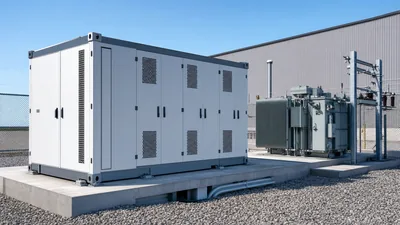
AC coupling still wins in two cases: retrofits where a working grid-tie inverter has years of warranty left, and commercial sites where storage is sized independently of PV and sits on a separate feeder. Most commercial battery cabinets, including liquid-cooled C&I units, are AC-coupled through their own power conversion system for exactly that reason.
Operating Modes of a Hybrid Solar Power System
The controller of a hybrid inverter runs one of several dispatch strategies, normally selectable at commissioning:
- Self-consumption. Surplus solar charges the battery instead of exporting; the battery discharges when load exceeds PV. Best where export tariffs are well below import tariffs.
- Time-of-use shifting. The battery charges from solar or off-peak grid energy and discharges during the expensive tariff window.
- Backup reserve. A set state of charge, often 20-40%, is held back for outages and not used for daily cycling.
- Export limiting. A current transformer at the service measures net flow and the inverter throttles PV or charges the battery to keep export at or below a utility limit, including zero export.
- Peak shaving. Common in commercial sites, the battery discharges whenever site demand crosses a kW threshold to reduce demand charges; see our peak shaving guide.
A smart solar power inverter exposes these modes through a local app or a Modbus/SunSpec interface so an external energy management system can override them. On grid-supporting firmware, the inverter also performs volt-VAR and frequency-watt functions required by IEEE 1547-2018. Mode choice matters for battery life: a battery cycled daily for self-consumption ages faster than one held at reserve, so warranty throughput limits should be checked against the intended mode.
How Does a Hybrid Solar Inverter With Battery Backup Work in an Outage?
When the grid fails, the inverter must first isolate the home from the utility, then become grid-forming, setting voltage and frequency itself. That isolation is the step that separates a true hybrid solar inverter with battery backup from a battery-only self-consumption unit.
- The inverter detects loss of grid voltage or frequency outside IEEE 1547 limits.
- An internal or external transfer relay opens the connection to the utility.
- The inverter switches from grid-following to grid-forming control and energizes the backup panel.
- PV keeps producing, charging the battery and serving loads; the inverter curtails PV if the battery is full.
- When the grid returns and stays stable for the reconnect period, the inverter resynchronizes and closes the relay.
Integrated backup ports typically transfer in under 20 ms, fast enough that most electronics ride through. Whole-home backup usually requires an external automatic transfer device rated for the service; our automatic transfer switch guide explains ratings and NEC requirements.
Many systems back up only a critical-loads panel to keep the inverter and battery affordable. Wiring a backup panel or transfer equipment involves service equipment and must follow local code and be carried out by a licensed electrician.
Sizing a Hybrid Inverter and Battery: Worked Example
Size the inverter on continuous and surge load, and the battery on energy over the backup duration.
| Critical load | Running W | Surge W | Hours/day | Wh/day |
|---|---|---|---|---|
| Refrigerator | 150 | 900 | 10 (duty) | 1,500 |
| Lighting and internet | 230 | 230 | 8 | 1,840 |
| Furnace blower | 500 | 1,200 | 8 | 4,000 |
| Well pump | 1,100 | 3,300 | 2 | 2,200 |
| Total | 1,980 | - | - | 9,540 |
Inverter continuous rating: 1,980 W × 1.25 margin ≈ 2.5 kW minimum on the backup port. Surge: the worst case is the pump starting while everything else runs: 3,300 + 150 + 230 + 500 = 4,180 W, so the inverter's 10-second surge rating must exceed about 4.2 kW.
Battery for one day without solar:
E_nominal = E_load / (DoD × η) = 9.54 / (0.90 × 0.95) ≈ 11.2 kWh
A 10-12 kWh LFP battery covers a full day; daily solar recharge extends autonomy indefinitely in fair weather. For battery voltage and chemistry trade-offs, see our guide to lithium solar batteries.
Single-Phase vs Three-Phase and Low- vs High-Voltage Batteries
A single-phase hybrid inverter suits North American 120/240 V split-phase homes and most 230 V residential services elsewhere, typically from 3 to 12 kW. Three-phase hybrids, from about 5 kW to 50 kW, serve larger homes, farms and small businesses on 400/230 V or 208/120 V and 480/277 V supplies, and avoid unbalanced loading when backing up three-phase motors.
Battery bus voltage is the second fork:
| Battery type | Nominal DC voltage | DC current at 5 kW | Notes |
|---|---|---|---|
| Low-voltage (LV) | 48-51.2 V | 5,000 / 51.2 ≈ 98 A | Parallel modules, heavy cables, simple expansion |
| High-voltage (HV) | 150-600 V | 5,000 / 400 = 12.5 A | Series stack, lighter cabling, slightly higher efficiency |
The inverter and battery must be on each other's compatibility list, because the BMS and inverter exchange charge limits over CAN or RS-485. A mismatched pair may run but will not respect current limits or report state of charge correctly. Our 12 V vs 24 V vs 48 V battery comparison explains the low-voltage side in more depth.
From Home Hybrid Kit to Hybrid Solar Power Plant
A hybrid solar system kit for a house bundles one inverter, one battery and sometimes panels. At commercial and utility scale, a hybrid solar plant uses the same idea, PV plus storage behind one point of interconnection, but the hardware separates into dedicated blocks:
- PV inverters, string or central, on the solar side.
- A battery energy storage system with its own bidirectional power conversion system, BMS, thermal management and fire suppression.
- LV or MV switchgear, step-up transformers and a plant controller that enforces export limits and ramp rates.
A factory with 500 kWp of rooftop PV, for example, might add a 215-372 kWh liquid-cooled cabinet for peak shaving, AC-coupled at the 400 V switchboard. Wider architectures that also include generators or wind are covered in the hybrid power system guide.
When evaluating a hybrid inverter supplier or storage vendor for this class of project, ask for certification documents (UL 1741 SB, UL 9540 and UL 9540A test reports, or IEC 62619 and IEC 62477 equivalents), the communication protocol between PCS and BMS, and a factory acceptance test plan. MARS supplies the storage, PCS integration, transformers and switchgear, and works with the PV inverter chosen by the project.
Next Steps: Specifying and Sourcing
Write the specification around outcomes, not just a product type. A complete request includes:
- Load data: 12 months of interval data or bills, and a list of critical loads with surge currents.
- Objective: self-consumption, backup hours, peak-shaving target in kW, or export cap.
- Electrical interface: service voltage and phases, main breaker and busbar rating, and whether coupling will be DC or AC.
- Battery requirements: usable kWh, continuous kW, chemistry (LFP preferred for stationary use), warranty throughput and cycle expectations.
- Compliance: UL 1741 SB, UL 9540, NEC 705/706 and NFPA 855 for North America, or IEC 62619, IEC 62477-1 and local grid code elsewhere.
For residential systems, a local installer will select a listed inverter-battery pair. For commercial and industrial sites, MARS builds liquid-cooled LFP cabinets from 93 to 372 kWh and containerized systems from 500 kWh to 10 MWh, with PCS, BMS, EMS and fire suppression integrated. Review our energy storage systems and send your load profile through the quote request form.
Frequently asked questions
What is a hybrid solar inverter?
A hybrid solar inverter is a single unit that converts solar DC to AC and also charges and discharges a battery. It runs connected to the grid, stores surplus solar for later use, can limit export, and, if it has a backup port, powers selected circuits during outages while isolating the home from the utility.
What is the difference between a hybrid inverter and a grid tie inverter?
A grid tie inverter only converts solar power and exports it, and it must shut down during a blackout. A hybrid inverter adds a battery port, energy management and often a backup output, so it can store energy, shift it to expensive tariff periods and keep essential loads running when the grid fails.
Can a hybrid inverter work without a battery?
Most hybrid inverters can operate as ordinary grid-tied inverters with no battery connected, exporting solar during daylight. Some models disable the backup port without a battery, and a few need the battery for startup. Installing a hybrid now and adding storage later avoids replacing the inverter when batteries become affordable.
What size hybrid inverter do I need for my house?
Match the PV side to the array with a DC/AC ratio of 1.1 to 1.3, then confirm the backup output covers the running watts of your critical loads with 25% margin and the surge rating exceeds the largest motor starting current plus other loads. A typical home needs 5 to 10 kW.
Is a single-phase hybrid inverter suitable for three-phase homes?
It can back up one phase, but it leaves three-phase motors and loads on other phases unsupported and may cause unbalanced export. Where the service is three-phase and backup or large loads matter, a three-phase hybrid inverter, or three single-phase units configured as a set, is the better choice.
How long does a hybrid solar battery last?
Stationary LFP batteries used with hybrid inverters typically offer 6,000 or more cycles to about 70-80% retained capacity under rated conditions, and warranties of around 10 years or a stated energy throughput. Actual life depends on depth of discharge, temperature and how often the battery is cycled each day.
Written and reviewed by the MARS application engineering team in Shanghai, who specify and test transformers, switchgear, substations and battery storage for projects in 40+ countries. Last updated .
Tags: hybrid solar inverter hybrid solar system solar grid tie inverter hybrid solar inverter with battery backup hybrid solar power plant