Key takeaways
- A photovoltaic inverter converts array DC to grid-synchronous AC at 50 or 60 Hz, typically at 96-99% peak efficiency for modern transformerless designs.
- Grid-tied inverters sold in North America are certified to UL 1741 and must meet IEEE 1547-2018 ride-through and anti-islanding requirements.
- Most residential arrays use a DC/AC ratio of 1.1 to 1.3, accepting a small amount of midday clipping in exchange for better morning and evening yield.
- Maximum string voltage must be checked at the coldest expected temperature, because module open-circuit voltage rises roughly 0.25-0.30% per degree Celsius below 25 °C.
- Utility-scale plants use 1,500 Vdc central or string inverters feeding medium-voltage step-up transformers, often sharing the substation with battery storage.
Quick answer: A solar inverter is the power-electronic device that converts the direct current (DC) produced by solar panels into alternating current (AC) at the voltage and frequency of the building or grid. It also tracks the array's maximum power point, synchronizes with the grid, disconnects during outages (anti-islanding) and reports production. Main types are string, micro, central, hybrid and off-grid inverters.
Every grid-connected solar array depends on one box that does far more than flip DC into AC. The solar inverter decides how much energy the panels actually deliver, whether the system passes utility inspection, and how it behaves when the grid sags or fails. Choosing the wrong topology or sizing it poorly costs yield for the 10 to 15 years the inverter stays in service.
This guide is for homeowners comparing quotes, installers checking string designs and engineers who specify inverters for commercial or utility projects. It explains how a solar power inverter works, compares the main types, walks through sizing with worked numbers, and lists the standards an inspector will ask for.
What Does a Solar Inverter Do?
A solar panel produces direct current whose voltage and current change with sunlight and temperature. Homes, factories and the utility network run on alternating current. The device converting DC to AC in solar panel systems is the inverter, and in a grid-tied system it performs five jobs at once:
- Maximum power point tracking (MPPT). MPPT is a control algorithm that continuously adjusts the operating voltage of the array so that the product of voltage and current, and therefore power, stays at its peak.
- DC-to-AC conversion. Semiconductor switches chop the DC into a sine-shaped AC waveform at 50 or 60 Hz.
- Grid synchronization. A phase-locked loop matches the inverter output to the grid's voltage, frequency and phase angle before and during export.
- Protection and anti-islanding. Anti-islanding is the function that stops the inverter from energizing the line when the utility supply is lost, protecting line workers.
- Monitoring and grid support. Modern units log production and can provide volt-VAR, frequency-watt and ride-through behavior that grid codes now require.
Without the inverter, a solar power system cannot run ordinary appliances or export energy. That is why the inverter is often called the brain of the system: panels set the ceiling on energy, but the inverter determines how much of it reaches the loads. For the full energy path from roof to meter, see our explainer on how an on-grid solar system works.
How Does a Solar Power Inverter Work?
Inside a typical single-phase string inverter, power passes through four stages.
1. DC input and MPPT stage
The array connects to one or more MPPT inputs. A boost DC-DC converter raises and regulates the array voltage to a stable DC link, typically 350-450 V for 240 V single-phase output or 650-800 V for 400/480 V three-phase output. The MPPT algorithm, commonly perturb-and-observe or incremental conductance, nudges the operating point every few milliseconds.
2. DC link
Film or electrolytic capacitors smooth the bus and buffer the double-frequency ripple that single-phase output draws from the DC side.
3. Inverter bridge
An H-bridge (single-phase) or three-phase bridge of IGBTs or MOSFETs switches at 16-50 kHz using pulse-width modulation. Varying the pulse width sinusoidally produces an average voltage that follows a sine wave.
4. Output filter and relays
An LC filter removes switching harmonics so that current total harmonic distortion stays below the 5% limit of IEEE 1547. Output relays open within two seconds of a grid loss.
Inverter efficiency is the ratio of AC output to DC input: η = P_AC / P_DC. Because inverters spend most hours at part load, buyers compare weighted figures, the CEC efficiency in North America or the European efficiency in IEC markets, rather than peak values. Transformerless designs reach 97-98.5% weighted efficiency; units with a low-frequency isolation transformer lose another 1-2% but provide galvanic isolation, which some off-grid and floating-array applications still prefer.
Types of Solar Inverters Compared
The phrase "solar panel inverter" covers several architectures. The right choice depends on roof shading, system size, battery plans and code requirements.
| Type | Typical size | Where it fits | Main trade-off |
|---|---|---|---|
| String inverter | 3-125 kW | Unshaded residential and commercial roofs | One MPPT per string; shading on one module drags the string |
| String + DC optimizers | 3-100 kW | Complex roofs, partial shade | Module-level MPPT, more rooftop electronics |
| Microinverter | 250-1,300 W per unit | Small or shaded roofs, solar module inverter on each panel | Higher cost per watt, many units to replace over life |
| Central inverter | 1-5 MW per block | Ground-mount utility plants at 1,500 Vdc | Single point of failure, needs MV skid |
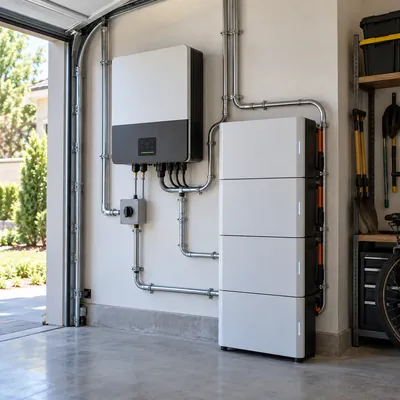
| Hybrid inverter | 3-30 kW | Grid-tied systems with batteries | Battery compatibility must be verified |
| Off-grid inverter-charger | 0.3-15 kW | Cabins, remote sites, 12/24/48 V battery banks | Grid-forming; sized for surge, not array |
A solar panel with an AC inverter attached at the factory, often called an AC module, is simply a microinverter pre-mounted on the frame. A 12 V solar inverter is almost always an off-grid battery inverter rather than a grid-tied unit, because PV strings for grid export run at hundreds of volts. Battery-ready systems are covered in our hybrid solar inverter guide, and stand-alone designs in the off-grid inverter guide.
How to Size a Solar Inverter: DC/AC Ratio and String Voltage
Inverter sizing has two separate checks: power (how many DC watts per AC watt) and voltage (how many modules per string).
Power: the DC/AC ratio
The DC/AC ratio, or inverter loading ratio, is array STC power divided by inverter AC rating. Panels rarely produce nameplate output because of heat, soiling and sun angle, so a ratio of 1.1-1.3 is normal. Above about 1.3 the inverter clips noticeably at midday.
Worked example. A house has 21 modules of 400 W: P_DC = 21 × 400 = 8.4 kW. With a 7.6 kW inverter, DC/AC = 8.4 / 7.6 = 1.11, a conservative ratio with negligible clipping. A 6.0 kW unit would give 1.40, which saves capital but loses peak-hour energy in sunny climates.
Voltage: cold-weather open-circuit check
Module open-circuit voltage rises as temperature falls. Use the datasheet temperature coefficient β (per °C):
Voc_max = Voc_STC × [1 + β × (T_min − 25)]
For a module with Voc = 41.0 V, β = −0.27%/°C and a design low of −20 °C: Voc_max = 41.0 × [1 + (−0.0027 × −45)] = 41.0 × 1.1215 = 46.0 V. Against a 600 V inverter limit, 13 modules give 598 V (acceptable) while 14 give 644 V (not permitted). NEC 690.7 requires this calculation, or the code's correction table, for every string.
Repeat the check at the hot end: the string's Vmp at maximum cell temperature must stay above the inverter's minimum MPPT voltage. Our solar system sizing guide covers the upstream step of turning annual kWh into array kW.
Which Standards Apply to a Grid-Tied Photovoltaic Inverter?
An inverter for PV is utility-interactive equipment, so certification matters as much as efficiency. Inspectors and utilities in North America and IEC markets typically ask for the following.
| Standard | Scope | Why it matters |
|---|---|---|
| UL 1741 (incl. Supplement SB) | Safety and grid-support testing of inverters in North America | Required listing for utility-interactive equipment |
| IEEE 1547-2018 / IEEE 1547.1 | Interconnection performance and test procedures | Voltage and frequency ride-through, reactive power, anti-islanding |
| NEC Article 690 | PV system wiring, string voltage, rapid shutdown (690.12) | Rooftop arrays need module-level or array-level shutdown |
| NEC Article 705 | Interconnected power sources | Busbar loading, including the 120% rule for load-side connections |
| IEC 62109-1 / -2 | Safety of power converters for PV | Baseline safety in IEC markets |
| IEC 61727 / IEC 62116 | Utility interface and anti-islanding test | Common grid-connection references outside North America |
| EN 50549-1/-2 | Generators connected to European distribution networks | Ride-through and protection settings in Europe |
National grid codes add country-specific settings, so a unit certified in one market may need a different firmware profile elsewhere. Always confirm the grid profile selected at commissioning matches the utility's interconnection agreement.
How to Choose the Best Solar Inverter for Home Use
The best solar inverter for a home is the one that matches the roof, the battery plan and the local code, not the one with the highest headline efficiency. Compare quotes on these criteria:
- Topology versus shading. A clean south-facing roof suits a string inverter; multiple orientations or chimney shade favor optimizers or microinverters.
- Number of MPPT inputs. Two or more trackers let east and west roof faces operate independently.
- Weighted efficiency. A 1% difference over 15 years on an 8 kW array in a 1,400 kWh/kWp climate is about 1,700 kWh.
- Battery readiness. If storage is likely within five years, a hybrid unit avoids a second inverter later.
- Backup capability. A standard grid-tied house solar inverter shuts down in an outage; only units with a backup port and transfer function keep circuits alive.
- Warranty and serviceability. Typical warranties run 10-12 years for string inverters and up to 25 years for microinverters. Ask who services the unit locally.
- Listing and grid profile. Confirm UL 1741 SB or the local equivalent, and rapid-shutdown compliance.
Installation of any solar power inverter for a house connects to service equipment. That work must follow local code and be carried out by a licensed electrician; permits and utility approval are required before energizing. Our solar panel installation guide outlines the permitting sequence.
Solar Inverters at Commercial and Utility Scale
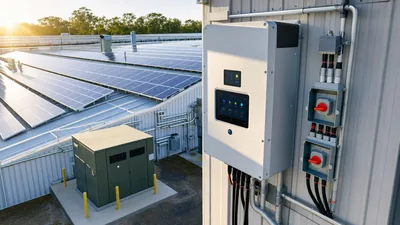
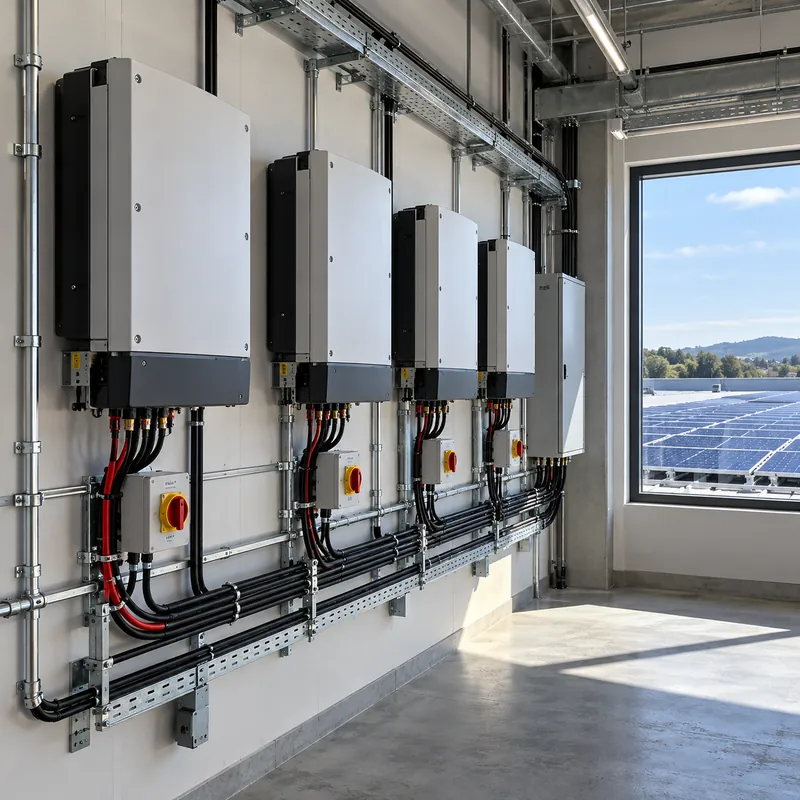
Above roughly 100 kW, inverter selection becomes part of the electrical system design rather than an equipment pick. Commercial rooftops typically use multiple 50-125 kW three-phase string inverters at 480 V or 400 V. Ground-mount plants use 1,500 Vdc arrays feeding either distributed string inverters or 2.5-5 MW central inverter blocks.
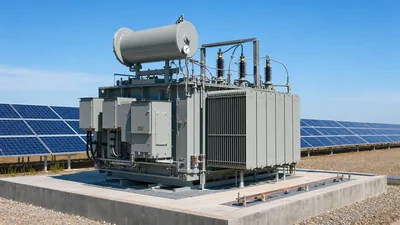
At this scale the inverter output is collected through LV switchgear and stepped up by a medium-voltage transformer, often integrated into a skid or compact substation. Key interface points include:
- Transformer winding design. Inverter-duty transformers must handle harmonic currents and, for some central inverters, dual LV windings. See our solar power transformer guide.
- Collector and point-of-interconnection substation. Covered in the solar substation design guide.
- Storage coupling. Solar-plus-storage plants add a bidirectional power conversion system (PCS) on the battery side. A PCS is an inverter that can both charge and discharge a battery; see our PCS engineering guide.
MARS does not manufacture PV inverters. We supply the equipment around them: oil-immersed and dry-type step-up transformers, compact transformer substations, MV/LV switchgear and LFP battery storage with integrated PCS, BMS and EMS, so the inverter vendor's output connects cleanly to the grid and to storage.
Next Steps: Specifying and Sourcing
A clear specification prevents mismatched equipment at the interface between inverters, transformers and storage. Before requesting quotes, assemble:
- Array data: module datasheet, string lengths, site minimum and maximum temperatures, and total kWdc.
- Inverter data: AC rating, output voltage, DC input window, grid profile and certification (UL 1741 SB, IEEE 1547 or IEC equivalents).
- Interconnection data: utility voltage, available fault current, earthing system and any export limit.
- Storage intent: whether batteries will be AC-coupled now or later, the target kWh and discharge hours.
- Site conditions: altitude, ambient range, IP or NEMA rating needed and seismic zone.
For commercial and utility projects, MARS can supply step-up transformers designed for inverter duty, compact substations and battery storage from 93 kWh liquid-cooled cabinets to 10 MWh containers. Browse our energy storage systems, then send your single-line diagram and inverter datasheet through the quote request form. Routine tests are performed on every unit and factory acceptance testing is welcome.
Frequently asked questions
What does a solar inverter do?
A solar inverter converts the DC electricity from solar panels into AC electricity that matches the voltage and frequency of the home or grid. It also runs maximum power point tracking to extract the most energy from the array, synchronizes with the utility, shuts down during outages for safety, and records production data.
How does a solar inverter work?
The inverter first regulates array voltage with an MPPT DC-DC stage, stores energy on a DC link, then switches transistors thousands of times per second using pulse-width modulation to build a sine-shaped AC waveform. An output filter removes switching noise and relays connect the unit to the grid only after it is synchronized.
What size solar inverter do I need?
Divide the array's DC rating by an inverter loading ratio of about 1.1 to 1.3. An 8.4 kW array suits a 6.5 to 7.6 kW inverter. Then confirm the string's cold-weather open-circuit voltage stays below the inverter maximum, and its hot-weather MPP voltage stays above the minimum MPPT voltage.
Does a grid-tied solar inverter work during a power outage?
No. A standard grid-tied inverter must disconnect within about two seconds of losing utility voltage, as required by IEEE 1547 and UL 1741 anti-islanding rules. To keep power during outages, you need a hybrid or backup-capable inverter with batteries and an automatic means of isolating the home from the grid.
How long do solar inverters last?
String inverters typically last 10 to 15 years, and many carry 10 to 12 year warranties with extension options. Microinverters often carry 25-year warranties. Heat is the main aging factor, so mounting the inverter in shade with good airflow and keeping vents clean extends its service life.
Can I use a 12V inverter with solar panels?
Yes, but only in an off-grid setup. A 12 V inverter draws from a battery that is charged by a solar charge controller; it cannot connect directly to panels or export to the grid. For loads above about 1.5 to 2 kW, a 24 V or 48 V battery system keeps DC currents and cable sizes manageable.
Written and reviewed by the MARS application engineering team in Shanghai, who specify and test transformers, switchgear, substations and battery storage for projects in 40+ countries. Last updated .
Tags: solar inverter photovoltaic inverter types of solar inverters solar inverter for home how does a solar power inverter work