Key takeaways
- An off-grid inverter is grid-forming: it sets 120/240 V or 230 V at 50 or 60 Hz itself, unlike grid-tied inverters that follow the utility waveform.
- Continuous rating should exceed simultaneous running load by about 25%, and the surge rating must cover motor starting currents of three to six times running current.
- DC input current equals P / (V × η), so a 4 kW inverter draws roughly 181 A from a 24 V bank but only about 91 A from 48 V.
- Idle self-consumption of 20-60 W can waste 0.5-1.4 kWh per day, a significant share of a small off-grid system's energy budget.
- Stand-alone systems in the US fall under NEC Article 710, with batteries under Articles 480 and 706 and inverters listed to UL 1741.
Quick answer: An off grid inverter is a battery-fed inverter that creates its own AC supply, setting voltage and frequency without any utility grid. Most are inverter-chargers: they convert battery DC to pure sine AC for loads, charge the battery from a generator or shore supply, and often include an MPPT solar charge controller. Size it for peak and surge watts, and size the battery for daily energy.
When there is no utility connection, the inverter stops being a converter and becomes the power plant. Every light, pump and appliance on the site depends on it holding voltage and frequency steady, starting motors without collapsing and recharging the battery from whatever source is available. Getting the inverter wrong is the most common reason off-grid systems trip, brown out or flatten their batteries.
This guide is for cabin and homestead owners, remote-site engineers and installers choosing a battery inverter, an inverter charger or an all-in-one unit. It explains the technology, gives worked sizing numbers for the inverter, cabling and LiFePO4 battery bank, and shows when a project outgrows residential equipment.
What Is an Off Grid Inverter and How Is It Different?
A battery inverter is an inverter whose DC source is a battery rather than a PV array. In off-grid service it is grid-forming, meaning it generates the reference voltage and frequency that every other device on the network synchronizes to. A grid-tied solar inverter, by contrast, is grid-following and cannot run without an external waveform; see the solar inverter guide for that design.
Off-grid units come in three common packages:
- Inverter-charger. A bidirectional unit that inverts battery DC to AC and, when a generator or grid supply is connected to its AC input, transfers loads to that source and charges the battery. This is the off grid inverter charger found in most cabins and remote sites.
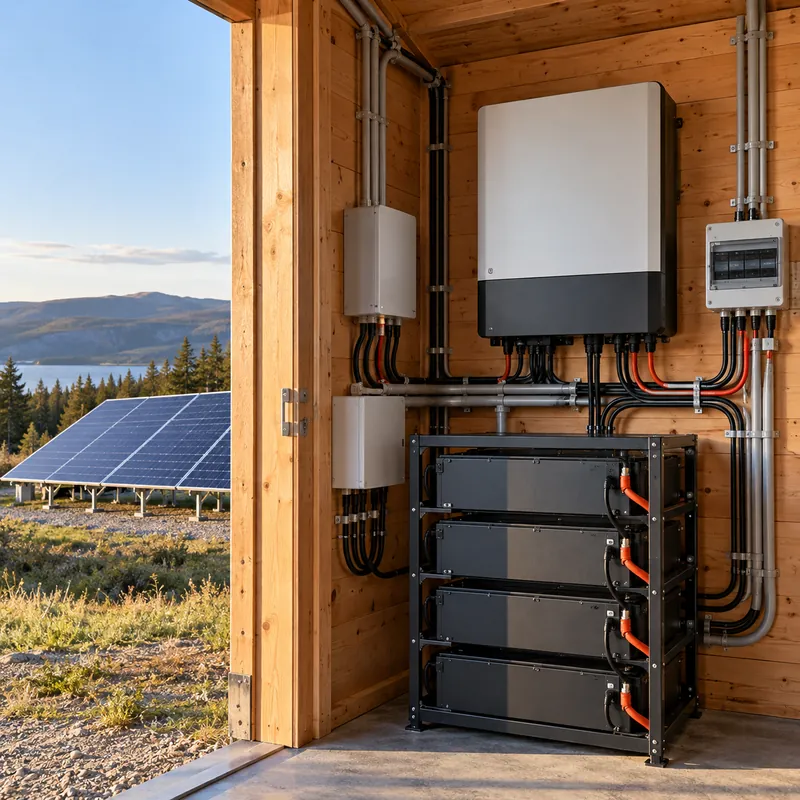
- All-in-one off grid inverter. An inverter-charger with a built-in MPPT solar charge controller, so the array connects directly. Convenient below about 8-10 kW, but a single failure takes out both solar charging and AC supply.
- Separate inverter and charge controller. A stand-alone MPPT controller charges the battery and a separate inverter supplies AC. More components, but easier to expand and repair.
A hybrid inverter can sometimes operate off-grid, but it is optimized for grid-connected self-consumption. The hybrid solar inverter guide explains where the two categories overlap.
Low-Frequency vs High-Frequency Off Grid Power Inverters
Two internal topologies dominate, and they behave very differently under motor loads.
| Characteristic | Low-frequency (transformer-based) | High-frequency (transformerless) |
|---|---|---|
| Construction | H-bridge drives a 50/60 Hz iron-core transformer | DC-DC stage at tens of kHz, small ferrite transformer |
| Surge capability | Often 200-300% for several seconds | Often 150-200% for under a second to a few seconds |
| Weight per kW | High, often 8-15 kg/kW | Low, often 2-5 kg/kW |
| Idle consumption | Higher, 30-60 W on many units | Lower, 15-40 W |
| Best for | Well pumps, compressors, workshop tools | Electronics, lighting, light appliances |
Both types should produce a pure sine wave with total harmonic distortion below about 3-5%. Modified-sine inverters are cheaper but make motors and transformers run hot, upset variable-speed drives and can damage some chargers; they have no place in a whole house inverter installation.
Look closely at the charger section too. Charge current, multi-stage algorithms and a selectable LiFePO4 profile matter as much as the inverter rating, because the charger determines how quickly a generator can refill the battery and therefore how many hours it must run each week.
How to Size an Off Grid Solar Inverter for Surge and Continuous Load
Size the inverter from the loads, never from the solar array:
- List every load that can run at the same time and add the running watts.
- Multiply the total by 1.25 to keep the inverter below 80% continuous loading.
- Identify the largest motor and estimate its starting demand: induction motors draw three to six times running current for a fraction of a second.
- Add the largest motor's surge to the running watts of everything else.
- Choose an inverter whose surge rating, at the stated duration, exceeds that figure.
Worked example. A cabin runs a 700 W well pump, a 150 W refrigerator, 300 W of lighting and electronics and a 1,200 W microwave. Simultaneous running load is 700 + 150 + 300 + 1,200 = 2,350 W; with margin, 2,350 × 1.25 ≈ 2,940 W. If the pump surges to 700 × 4 = 2,800 W, peak demand is 2,800 + 150 + 300 + 1,200 = 4,450 W.
A 3 kW high-frequency inverter with a 6 kVA surge for 100 ms may fail to start the pump if it takes 0.5 s to accelerate. A 4 kW low-frequency unit with 300% surge for 5 s, or a pump fitted with a soft starter, is the safer choice. A 240 V split-phase home with large motors typically needs a 6-8 kW inverter-charger or two stacked units; a whole home power inverter serving electric cooking and heat pumps can exceed 12 kW.
DC Current, Cabling and Protection
The DC side carries far higher current than the AC side, and that is where off-grid systems fail most often. Inverter DC input current is:
I_DC = P_AC / (V_battery × η)
Worked example. A 4,000 W load at 92% efficiency:
- 12 V bank:
4,000 / (12 × 0.92) ≈ 362 A - 24 V bank:
4,000 / (24 × 0.92) ≈ 181 A - 48 V bank:
4,000 / (48 × 0.92) ≈ 91 A
At 12 V the cable becomes impractical, and voltage drop at low state of charge trips the inverter on undervoltage. The usual rule is 12 V up to about 1-1.5 kW, 24 V up to 3 kW, and 48 V above that. Our 12 V vs 24 V vs 48 V comparison covers the trade-offs in detail.
Protect the battery conductor with a fuse or DC breaker rated for the battery's prospective short-circuit current, which for LiFePO4 banks can reach several kA. For the 48 V case, 91 A × 1.25 ≈ 114 A, so a 125 A high-interrupting-capacity fuse with conductors rated at least 125 A after correction is appropriate. Keep runs short, use fine-strand copper with crimped lugs, and include a DC disconnect. NEC Articles 480 and 706 cover battery installations; size conductors with our wire size calculator guide and group circuits in a DC distribution panel.
Designing the LiFePO4 Battery Bank Behind the Inverter
LiFePO4 (lithium iron phosphate) is now the default lithium ion inverter battery for stationary off-grid use, thanks to its thermal stability, flat voltage curve and long cycle life.
Sizing formula: E_battery = (E_daily × days of autonomy) / (DoD × η_inverter)
Worked example. The cabin above uses 6 kWh per day and needs 2 days of autonomy. With 80% usable depth of discharge and 92% inverter efficiency: E = (6 × 2) / (0.80 × 0.92) ≈ 16.3 kWh. At 51.2 V nominal that is 16,300 / 51.2 ≈ 318 Ah, for example a 16-cell string of 320 Ah prismatic cells or several parallel 100 Ah 48 V modules.
Add the inverter's idle draw to the daily budget: a unit consuming 40 W around the clock uses 40 × 24 = 960 Wh per day, 16% of this cabin's load. Use the inverter's search or power-saving mode where loads allow.
| Chemistry | Usable DoD | Typical cycle life | Cold charging |
|---|---|---|---|
| Flooded lead-acid | 50% | 800-1,500 | Yes, with temperature compensation |
| AGM / gel | 50% | 500-1,200 | Yes, at reduced current |
| LiFePO4 | 80-95% | 3,000-6,000+ | Not below 0 °C without heating |
The BMS must be able to tell the inverter-charger to reduce or stop charge current; see our LiFePO4 BMS guide.
Adding a Generator and Solar Charging
Most off-grid systems include a generator for long cloudy spells. The inverter-charger's AC input accepts the generator, passes power to the loads through an internal transfer relay and charges the battery with the remaining capacity.
Size the charger and generator together. A 318 Ah 48 V bank charged at 0.3C takes about 95 A DC, or 95 × 56 V ≈ 5.3 kW of charging power. Add the running loads and allow for generator derating at altitude; a 7-8 kW generator lets the charger work at full rate without overload. Use the charger's input-current limit so a small generator is not tripped when loads start.
On the solar side, an MPPT solar inverter battery charger or separate controller must handle array current at battery voltage: a 4 kWp array at 48 V produces up to 4,000 / 51.2 ≈ 78 A, so an 80-100 A controller fits. Check the controller's maximum PV input voltage against the cold-weather string voltage, as with any PV design.
Generator auto-start based on battery state of charge reduces run hours and fuel use. For deeper treatment of fuel-plus-battery systems, see the hybrid generator battery systems guide, and for full system design from load audit to array, the off-grid solar system guide.
When Does a Project Outgrow Residential Off-Grid Inverters?
Residential inverter-chargers, typically 1-15 kW per unit and stackable to perhaps 30-50 kW, serve homes, cabins, telecom huts and small farms well. Portable battery inverter packs and power stations serve even smaller loads; the portable power station vs BESS comparison explains that end of the range.
A project usually needs commercial-grade storage when:
- Peak load exceeds about 50 kW or includes three-phase motors of 15 kW or more.
- Daily energy exceeds roughly 150-200 kWh, making low-voltage battery banks unwieldy.
- The site is a mine camp, island grid, factory or agricultural processing plant where downtime is costly.
- Several sources, such as diesel gensets, PV and wind, must be coordinated by an energy management system.
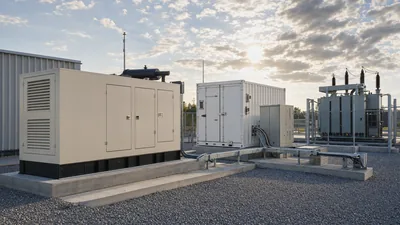
At that point the architecture shifts to high-voltage LFP racks with a grid-forming power conversion system, a transformer to the site voltage and LV switchgear. MARS supplies this class of system: liquid-cooled LFP cabinets from 93 to 372 kWh and containerized BESS from 500 kWh to 10 MWh with integrated PCS, BMS, EMS and fire suppression, plus the transformers and switchgear that tie them into the site network.
Next Steps: Specifying and Sourcing
Whether you are buying a 3 kW inverter-charger or a containerized microgrid, the same data drives a good specification:
- Load list: running watts, surge watts, operating hours and which loads run simultaneously.
- Supply voltage: 120 V, 120/240 V split-phase, 230 V single-phase or 400/230 V three-phase, at 50 or 60 Hz.
- Autonomy: days without sun, plus generator availability and size.
- Battery: chemistry, nominal voltage, usable kWh and BMS communication protocol with the inverter.
- Environment: temperature range, altitude, dust and moisture, and the required NEMA or IP rating.
- Compliance: UL 1741 and NEC 710/706 in the US, or IEC 62109 and IEC 62619 elsewhere.
Residential stand-alone systems connect to building wiring and must follow local code and be installed by a licensed electrician. For commercial, remote industrial and island systems, review MARS energy storage systems and send your load list and site data through the quote request form. Typical lead time for BESS is 60-90 days, and factory acceptance testing is welcome.
Frequently asked questions
What is the difference between an off grid inverter and a grid tie inverter?
An off grid inverter draws power from a battery and creates its own AC voltage and frequency, so it works with no utility present. A grid tie inverter takes power from solar panels and synchronizes to the utility waveform, and it must shut down when the grid fails. Off-grid units are sized for load, grid-tie units for array size.
What size off grid inverter do I need?
Add the running watts of all loads that can operate together and multiply by 1.25. Then confirm the surge rating covers the largest motor's starting demand, typically three to six times its running watts, plus everything else that is running. Most cabins need 2 to 4 kW; whole houses typically need 6 to 12 kW.
Can I use a lithium ion battery with any inverter?
Only if the inverter-charger has a charging profile matching the battery's voltage limits and, ideally, communicates with its BMS. LiFePO4 batteries need specific absorption and float voltages, no equalization, and charge blocking below 0 °C. Using a lead-acid profile can overcharge or undercharge lithium cells and void the warranty.
How long will a battery run an inverter?
Runtime in hours equals usable battery energy in watt-hours times inverter efficiency, divided by load in watts. A 10 kWh LiFePO4 bank at 90% usable depth of discharge and 92% efficiency supplies a 1,000 W load for about 10,000 × 0.9 × 0.92 / 1,000 = 8.3 hours, minus inverter idle consumption.
Is a 24V or 48V off grid inverter better?
For systems above about 3 kW, 48 V is better because it halves DC current compared with 24 V, reducing cable size, fuse rating and voltage drop. A 24 V off grid inverter remains sensible for small cabins, vans and boats with loads below 2 to 3 kW, where component availability and battery modularity matter more.
Do off grid inverters need a charge controller?
Yes, solar panels always need a charge controller between the array and the battery. All-in-one off grid inverters include an MPPT controller internally, while modular systems use a separate controller. Either way, check the maximum PV input voltage and charge current against the array design.
Written and reviewed by the MARS application engineering team in Shanghai, who specify and test transformers, switchgear, substations and battery storage for projects in 40+ countries. Last updated .
Tags: off grid inverter battery inverter off grid solar inverter solar inverter with charger whole house inverter