Key takeaways
- Array size in kW is roughly annual kWh divided by (365 × peak sun hours × 0.8), so 10,800 kWh at 4.5 PSH needs about 8.2 kW.
- Panel count equals array watts divided by module watts; a 1 kW block needs about 2.5 modules at 400 W each.
- The three main system types are grid-tied, off-grid and hybrid, differing in whether a battery and grid connection are present.
- Ground mount solar foundations are typically driven piles, helical piers or concrete piers sized for local wind, snow and frost depth.
- NEC 690.12 rapid shutdown applies to rooftop arrays on buildings, while NEC 705 governs how any PV inverter connects to the premises wiring.
Quick answer: How to install solar panels: size the array from annual kWh use, choose grid-tied, off-grid or hybrid architecture, design strings to the inverter's voltage window, install a roof or ground mount with engineered footings, then wire DC and AC circuits to NEC Article 690 and 705, pass inspection and obtain utility permission to operate. Electrical connections need a licensed electrician.
Installing solar is a construction project with an electrical core. The modules themselves are the easy part; the decisions that determine performance and safety are the system type, string design, mounting structure and point of interconnection. Getting those right on paper first is what separates a system that runs for 25 years from one that fails inspection.
This guide is for homeowners planning a project with a contractor, facility engineers scoping a site, and technicians who want a structured overview of a basic solar installation, from understanding solar fundamentals to setting up a ground-mounted array. It does not replace a stamped design or local code requirements.
What Are the 3 Types of Solar Systems?
Before any hardware is chosen, decide the architecture. A grid-tied system is a PV array whose inverter synchronizes with the utility and exports surplus energy; it shuts down during outages. An off-grid system has no utility connection and relies on batteries and often a generator. A hybrid system is grid-connected but includes battery storage and an inverter that can island essential loads.
| System type | Battery | Works in outage | Typical use | Key standards |
|---|---|---|---|---|
| Grid-tied | No | No | Lowest cost per kWh, net metering | NEC 690, 705; UL 1741; IEEE 1547 |
| Off-grid | Yes, sized for autonomy | Yes | Remote homes, cabins, telecom | NEC 690, 706, 710 |
| Hybrid | Yes | Yes, backed-up loads | Backup plus self-consumption | NEC 690, 705, 706; UL 9540 |
Different types of solar energy are sometimes confused with system types. Solar photovoltaic converts light directly to electricity; solar thermal heats water or air; concentrated solar power is a utility-scale thermal technology. This guide covers PV only. For the inverter side of each architecture, see our solar inverter guide and hybrid solar inverter guide.
Types of solar panels for home use are almost entirely monocrystalline silicon today, in 54-, 60-, 66-, 72- or 108/132-half-cell layouts, with PERC, TOPCon and heterojunction cell technologies. Bifacial modules gain extra yield on ground mounts with reflective surfaces.
How Many Solar Panels Are Needed to Power a Home?
Start from the last 12 months of utility bills. The array size is:
P_array (kW) = E_annual / (365 × PSH × PR)
where PSH is the site's average daily peak sun hours and PR is the performance ratio covering temperature, soiling, wiring and inverter losses, typically 0.75–0.85.
Worked example
- Annual consumption: 10,800 kWh. Site PSH: 4.5. PR: 0.80.
P_array = 10,800 / (365 × 4.5 × 0.80) = 10,800 / 1,314 ≈ 8.2 kW.- With 410 W modules:
8,200 / 410 = 20 panels. - Roof or ground area at about 2.0 m² per module plus spacing: roughly 45–50 m².
So how many solar panels per kilowatt? At 400 W per module, 2.5 panels make 1 kW. How many kW of solar for a house depends heavily on climate and loads: an all-electric home with a heat pump and an EV can need two to three times the array of a gas-heated home.
| Annual use | PSH 3.5 | PSH 4.5 | PSH 5.5 |
|---|---|---|---|
| 6,000 kWh | 5.9 kW | 4.6 kW | 3.7 kW |
| 10,800 kWh | 10.6 kW | 8.2 kW | 6.7 kW |
| 15,000 kWh | 14.7 kW | 11.4 kW | 9.3 kW |
Values use PR 0.80. Detailed design for the two most common sizes is in our 5kW solar system guide and 10kW solar system guide.
Roof Mount or Ground Mount Solar: Which Is Better?
Ground mount solar is an array installed on a free-standing structure anchored in the soil rather than attached to a building. It is the usual answer to the question "can I put solar panels in my backyard" and is common on rural properties, farms and commercial sites with land.
| Factor | Roof mount | Ground mount |
|---|---|---|
| Orientation and tilt | Fixed by roof | Optimized freely |
| Cooling and yield | Hotter, lower yield | Better airflow, bifacial gain |
| Structure | Rails and flashed attachments | Piles or piers plus racking |
| Rapid shutdown (NEC 690.12) | Required on buildings | Generally not, if not on a building |
| Trenching | None | Conduit to the building, NEC 300.5 burial depths |
| Maintenance access | Difficult | Easy cleaning and snow removal |
Solar panel footings and frames
Residential ground mount solar frames are usually steel or aluminum racking on one of three foundations:
- Driven piles (galvanized steel posts) for firm, rock-free soils; fast, no concrete.
- Helical piers screwed in with torque monitoring, which gives a field check of capacity.
- Concrete piers poured below frost depth; slower but suit variable soils.
Footing size depends on wind uplift and snow load per ASCE 7, soil bearing and frost depth, and should come from the racking manufacturer's engineering or a structural engineer. Free standing solar panel frames and garden ballasted systems suit only small arrays on level ground. Tilt for annual yield is roughly equal to latitude minus 0–10°.
How to Install Solar Panels Step by Step
The sequence below applies to a basic grid-tied or hybrid installation. Each step involves permits, inspections or professional work; this is an overview, not a DIY procedure for energized equipment.
- Site assessment. Measure shading across the year, confirm roof condition or soil type, and check the main service panel rating and busbar capacity.
- Design and permit. Prepare a single-line diagram, string calculations, structural attachment details and equipment datasheets; submit to the authority having jurisdiction and file the utility interconnection application.
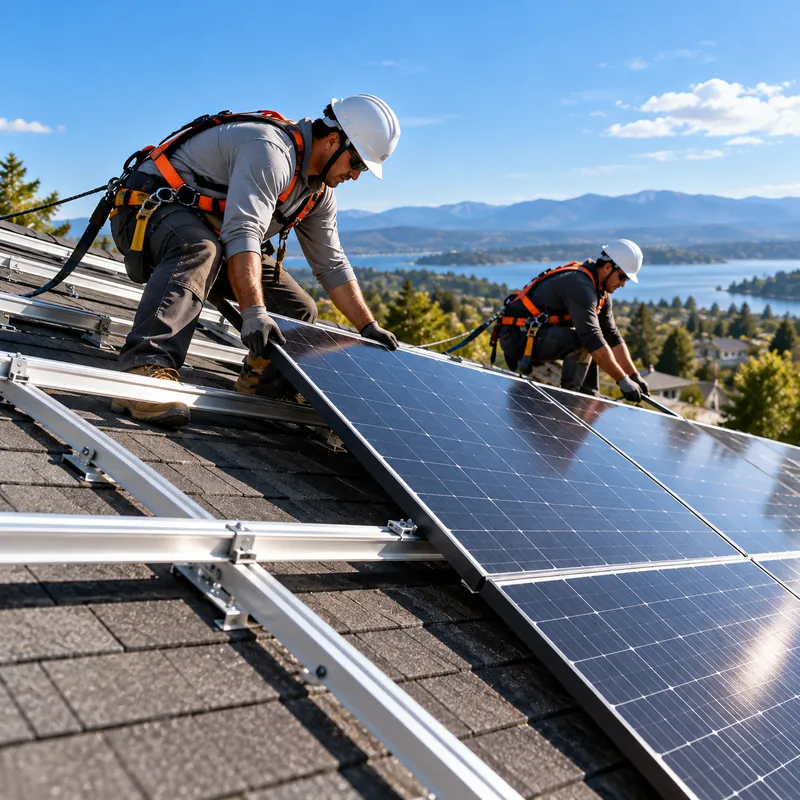
- Install the mounting structure. Flashed roof attachments into rafters, or piles and racking for a ground array, torqued to specification.
- Mount the modules. Clamp to rails per the module's approved clamping zones; bond frames with listed hardware per NEC 690.43.
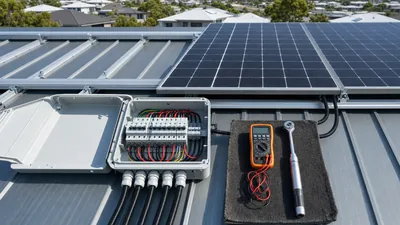
- Run DC wiring. Use PV wire, correctly crimped and same-make connectors, conductors sized at 125% × 125% of Isc per NEC 690.8, and install rapid shutdown devices on rooftop arrays.
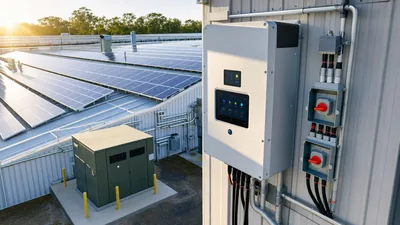
- Install inverter, disconnects and batteries. Locate per manufacturer clearances; battery systems follow NEC 706 and NFPA 855 for spacing and siting.
- Make the AC interconnection. Connect by back-fed breaker within the 120% busbar rule of NEC 705.12, or a supply-side tap, performed by a licensed electrician.
- Inspect, commission and energize. Pass the building and electrical inspections, verify string voltages and insulation resistance, then switch on after the utility grants permission to operate.
A deeper treatment of the DIY end of the market, including what owner-builders can legitimately do, is in our do-it-yourself solar system guide.
How to Hook Up Solar Panels to a House Safely
The point of interconnection decides how much solar a house can take without service upgrades. Under NEC 705.12, a load-side connection through a back-fed breaker is limited by the 120% rule: the sum of the main breaker and 125% of the inverter output current must not exceed 120% of the busbar rating, with the solar breaker at the opposite end of the bus.
Worked check
A 200 A panel with a 200 A main: 1.2 × 200 − 200 = 40 A available. 40 A / 1.25 = 32 A of continuous inverter output, which is 32 × 240 ≈ 7.7 kW. A 10 kW inverter would therefore need a main breaker derate, a supply-side connection or a panel upgrade.
Other connection points that need attention:
- A visible, lockable AC disconnect where required by the utility.
- Grounding and bonding of all metallic racking and the equipment grounding conductor sized per NEC 250.122.
- Labeling of all sources at the service equipment per NEC 705.10.
- For hybrid systems, a backed-up loads panel fed from the inverter's protected output.
Work on service equipment must follow local code and be done by a licensed electrician. If the property's service is too small, see our guide to the 200 amp solar system for busbar strategies.
Off-Grid Solar Panel Installation: What Changes?
An off-grid installation removes the utility as a backstop, so the battery and inverter become the heart of the design rather than accessories. Three things change.
- Battery sizing for autonomy. Capacity is
E_batt = E_day × days / DoD. A cabin using 6 kWh/day with 2 days of autonomy on LFP at 90% usable depth of discharge needs6 × 2 / 0.9 ≈ 13.3 kWh. - Array sizing for the worst month. Use December PSH (northern hemisphere), not the annual average, or plan generator support.
- Inverter rating for peak and surge. Off-grid inverters must start pumps and compressors without grid support, so surge capacity matters.
Battery voltage follows load size: 12 V for small cabins, 24 V for mid-size and 48 V for whole-home systems, as explained in our comparison of 12V, 24V and 48V solar batteries. Battery siting, ventilation and clearances are covered in the solar battery installation guide.
For larger off-grid sites such as farms, mines or remote facilities, the same principles scale to containerized battery storage with a power conversion system, which MARS manufactures; see the energy storage systems range.
Next Steps: Specifying and Sourcing
Whether you are commissioning a contractor or tendering a commercial project, a short written specification prevents most installation disputes. Include:
- 12 months of consumption data and, for commercial sites, interval demand data.
- System type (grid-tied, off-grid or hybrid) and backup load list.
- Mounting type, with geotechnical data for ground mount solar footings.
- Module and inverter certifications: UL 61730 or IEC 61215/61730 for modules, UL 1741 and IEEE 1547 for inverters.
- Battery system listing to UL 9540 and installation per NFPA 855.
- Interconnection method and any service upgrade.
- Warranty terms, monitoring and maintenance responsibilities.
Ask bidders to state who holds the permit, who attends inspections, and how monitoring data will be shared after handover. For ground-mounted arrays, require as-built drawings of buried conduit routes so later excavation does not damage cables.
Commercial and industrial PV projects often need more than panels and inverters: a step-up transformer, MV switchgear and battery storage for peak shaving. MARS manufactures battery energy storage systems, distribution transformers and MV/LV switchgear to IEC and ANSI/IEEE standards, with routine tests on every unit. Share your single-line diagram through our request for quotation page.
Frequently asked questions
Can I install solar panels myself?
In many jurisdictions owner-builders can install racking and modules under a permit, but connections to service equipment and the utility interconnection usually require a licensed electrician and inspection. Even where DIY is allowed, NEC 690 and 705 requirements apply in full, and the utility will not grant permission to operate without a passed inspection.
How many solar panels do I need for 1 kW?
Divide 1,000 W by the module rating. With 400 W modules you need 2.5 panels per kilowatt; with 450 W modules about 2.2. A 1 kW block produces roughly 1,100–1,600 kWh per year depending on location, tilt and shading, which is useful for scaling an estimate.
How deep do ground mount solar footings need to be?
Depth is set by frost line, soil type and wind uplift. Driven piles commonly embed 1.2–2.5 m, and concrete piers must extend below local frost depth. The racking supplier or a structural engineer should size footings to ASCE 7 wind and snow loads using site soil data.
What is the difference between on-grid and off-grid solar?
On-grid systems synchronize with the utility, export surplus and shut down during outages for line-worker safety. Off-grid systems have no utility connection and rely on batteries, sized for several days of autonomy, plus often a generator. Hybrid systems combine both: grid-connected with batteries that keep essential loads running.
How long does it take to install a solar panel system?
Physical installation of a residential system usually takes one to three days. The full process, including design, permitting, inspection and utility permission to operate, commonly takes several weeks to a few months depending on the jurisdiction and the utility's interconnection queue.
Which direction should solar panels face?
In the northern hemisphere, panels facing true south at a tilt close to latitude maximize annual energy. East and west orientations lose roughly 10–20% of annual yield but spread production across the day, which can suit time-of-use tariffs or self-consumption with batteries.
Written and reviewed by the MARS application engineering team in Shanghai, who specify and test transformers, switchgear, substations and battery storage for projects in 40+ countries. Last updated .
Tags: how to install solar panels ground mount solar solar panel setup types of solar panel systems how many solar panels needed to power a home