Key takeaways
- A 5kW solar system produces about 5 × PSH × 0.8 kWh per day, so roughly 18 kWh daily at 4.5 peak sun hours.
- Twelve to fourteen modules rated 370–450 W make up 5 kW; no single 5000W solar panel exists in standard residential formats.
- A 5000 watt solar generator describes inverter output power in kW, while its stored energy is a separate kWh figure that sets runtime.
- A 5kW off grid solar power system serving 10–12 kWh per day typically needs 20–25 kWh of LFP battery for two days of autonomy.
- On a 240 V service a 5 kW inverter draws about 21 A, needing a 30 A breaker and usually fitting within the NEC 705.12 busbar limit.
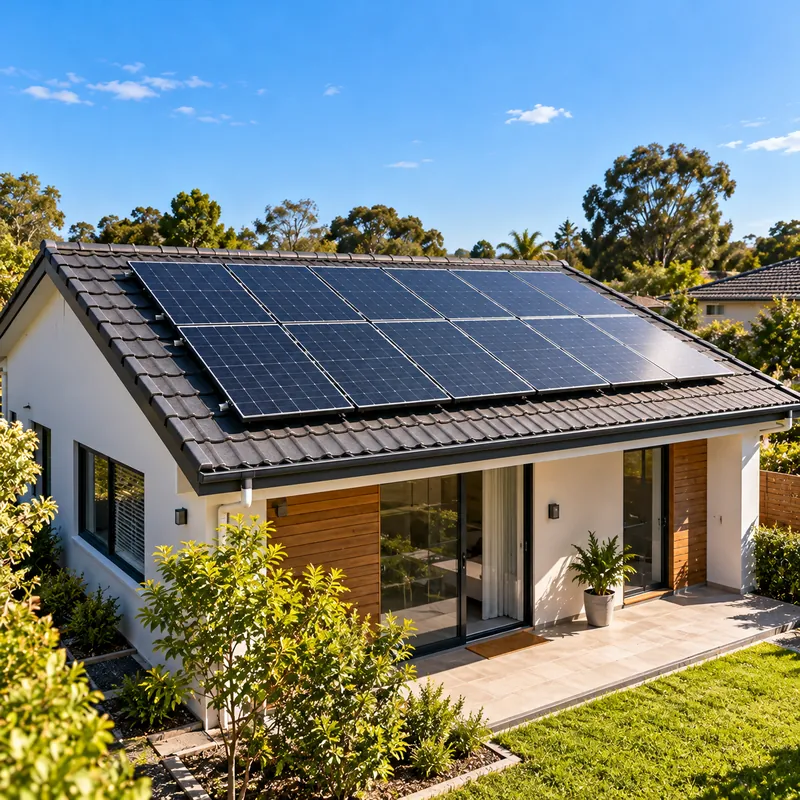
Quick answer: A 5kW solar system is a 5,000 W DC photovoltaic array, typically 12–14 panels of 370–450 W needing about 28–35 m² of roof. It generates around 12–24 kWh per day, or 4,400–8,800 kWh a year depending on sun hours, which suits a small to medium home with gas heating or an efficient all-electric apartment. A 5 kW array does not mean 5 kWh of storage.
A 5 kW array is the most common entry size for residential solar: large enough to cut a typical bill substantially, small enough to fit most roofs and service panels without upgrades. It is also the size where marketing language causes the most confusion, because 5,000 watt figures appear on panels, inverters and portable "solar generators" that do very different jobs.
This guide is aimed at homeowners and small-business owners planning a 5kW solar installation, and at technicians who need a clear way to explain what the system can and cannot run. It focuses on matching the system to loads, choosing an inverter type and sizing a battery, with worked figures throughout.
How Much Electricity Does a 5kW Solar System Generate?
Output follows the standard energy relationship E = P_DC × PSH × PR. With PR, the performance ratio, around 0.80:
| Peak sun hours | Daily output | Monthly (30 days) | Annual |
|---|---|---|---|
| 3.0 | 12 kWh | 360 kWh | 4,380 kWh |
| 4.0 | 16 kWh | 480 kWh | 5,840 kWh |
| 5.0 | 20 kWh | 600 kWh | 7,300 kWh |
| 6.0 | 24 kWh | 720 kWh | 8,760 kWh |
Peak sun hours are the number of hours per day at an equivalent irradiance of 1,000 W/m²; a location receiving 4.5 kWh/m² per day has 4.5 PSH. Annual averages hide seasonal variation, so use monthly data for systems with batteries or no grid backup.
Module degradation of about 0.4–0.6% per year means a 5kW solar power system delivers roughly 88–92% of its first-year output after 20 years. That is worth including in any payback calculation. For homes needing more, see the 10kW solar system guide; for a smaller step, the 4kW solar system guide.
Tilt and azimuth shift these numbers. A roof facing east or west typically yields 10–20% less annual energy than a south-facing roof at the same pitch, and a flat installation loses some output to soiling and lower winter yield. Use local irradiance data rather than national averages when comparing quotes.
What Can a 5kW Solar System Run?
The useful question is energy, not power. A 5 kW array making 18 kWh on an average day can supply that energy across 24 hours only if the grid or a battery buffers the difference between production and use. Here is a worked daily load audit for a small home:
| Load | Power | Hours/day | Energy |
|---|---|---|---|
| Refrigerator (average) | 60 W avg. | 24 (cycling) | 1.5 kWh |
| LED lighting | 200 W | 5 | 1.0 kWh |
| Washing machine | 500 W | 1 | 0.5 kWh |
| Mini-split heat pump | 1,200 W | 6 | 7.2 kWh |
| Induction cooking | 2,000 W | 1 | 2.0 kWh |
| Water heater (heat pump) | 500 W | 4 | 2.0 kWh |
| Electronics, network, misc. | 250 W | 10 | 2.5 kWh |
| Total | 16.7 kWh |
The method is E_load = Σ (P_i × t_i). Here the 5 kW array at 4.5 PSH (18 kWh) covers the home on an average day. Add an electric vehicle charging 8 kWh per day, or resistance heating, and the system falls short. A 5 kW array also supports simultaneous loads only up to the inverter rating; on a cloudy day the grid or battery carries the rest.
Our solar system sizing guide explains how to collect this data from utility bills and smart meters.
5kW Solar Panels: How Many Panels and Which Inverter?
Searches for a 5000W solar panel or a solar cell 5000 watt refer to the whole array, since residential modules are rated 350–450 W each. Typical layouts are 14 × 360 W, 13 × 385 W, 12 × 420 W or 11 × 450 W.
Inverter architecture options
| Architecture | How it works | Strengths | Limitations |
|---|---|---|---|
| String inverter | One or two series strings into a central inverter | Lowest cost, easy service | Shading on one module affects the string |
| String plus DC optimizers | Module-level DC/DC converters feed a string inverter | Module-level MPPT, built-in rapid shutdown | More electronics on the roof |
| Microinverters | One inverter per module or pair | Best for complex roofs and partial shade | Higher cost per watt, more rooftop devices |
| Hybrid inverter | String input plus battery port | Battery-ready, backup output | Battery must be compatible |
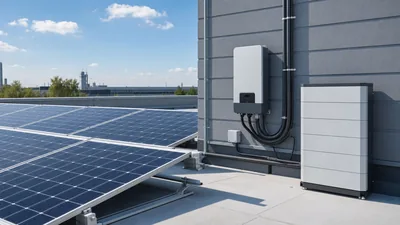
A 5 kW string fits comfortably in one string of 12–13 modules on most single-phase inverters. Rapid shutdown under NEC 690.12 applies to arrays on buildings, which optimizers and microinverters satisfy at module level. For a deeper look at hybrid units, read the hybrid solar inverter guide.
On the AC side, a 5 kW inverter at 240 V delivers about 5,000 / 240 = 20.8 A; with the 125% continuous factor that is 26 A, so a 30 A breaker. On a 200 A panel with a 200 A main, the NEC 705.12 120% rule allows 40 A of solar breaker, so no service upgrade is needed.
5kW vs 5kWh: Understanding 5000 Watt Solar Generators
Kilowatts (kW) measure power, the rate of energy flow; kilowatt-hours (kWh) measure energy, the amount delivered over time. A 5 kW array and a 5 kWh battery are different quantities that happen to share a number.
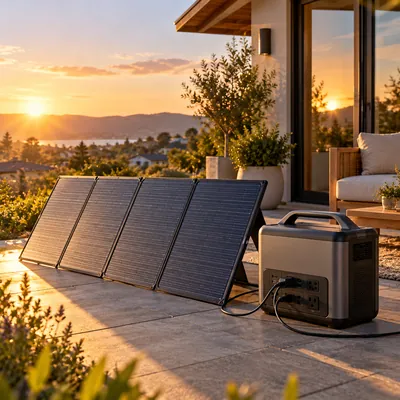
A "5000 watt solar generator" is usually a portable battery pack with a 5,000 W continuous inverter. Its stored energy might be 3, 5 or 10 kWh. Runtime is t = E_usable × η / P_load: a unit with 5 kWh usable at 90% inverter efficiency runs a 1,500 W load for 5 × 0.9 / 1.5 = 3 h, even though the inverter could deliver 5,000 W for a much shorter time.
- Inverter power (kW): sets which appliances can start and run together.
- Battery energy (kWh): sets how long they run.
- Solar input (W): sets how fast the battery refills.
5000 watt solar generator prices vary by market and date and are driven by battery capacity, chemistry (LFP versus NMC), inverter rating, split-phase output and solar input limit; compare products on cost per usable kWh and cycle warranty rather than headline wattage. These packaged units are explained in our solar generator guide, and the difference between them and stationary storage in portable power station vs BESS.
Battery Sizing for a 5kW Solar System
Most 5 kW systems pair with 5–15 kWh of storage. Size the battery to the energy you want to shift or back up:
E_nominal = E_target / (DoD × η_rt)
Worked example
The household in the load audit uses about 9 kWh between sunset and sunrise. With LFP at 95% depth of discharge and 92% round-trip efficiency: 9 / (0.95 × 0.92) = 10.3 kWh nominal. A 10 kWh battery would capture most of the surplus on a good day, since daytime use is about 7.7 kWh against 18 kWh of production, leaving about 10 kWh to store.
Power matters too: the battery's continuous discharge rating must cover the evening peak. A 10 kWh battery with a 5 kW continuous rating handles cooking plus heat pump simultaneously; a 3 kW rating would push the remainder to the grid.
Whether storage pays off depends on export tariffs, time-of-use rates and outage frequency, discussed in are solar batteries worth it. Detailed battery specs at this scale are in the 10kWh battery engineering guide.
Check warranty throughput too: one full cycle per day for ten years is about 3,650 cycles, which LFP chemistry handles comfortably but which should be confirmed against the stated warranty terms.
Designing a 5kW Off-Grid Solar Power System
Off-grid, the 5 kW array is sized against winter output and the battery against the longest expected cloudy spell. A practical method:
- Set the daily load. Off-grid homes usually reduce loads; assume 10 kWh/day with gas cooking and a wood stove.
- Check winter yield. At 2.5 PSH and PR 0.75:
5 × 2.5 × 0.75 = 9.4 kWh/day, slightly below the load. - Size autonomy storage. Two days:
10 × 2 / 0.9 = 22.2 kWhnominal LFP. - Select inverter/charger. 5–6 kW continuous with 2× surge for a well pump; 48 V DC bus.
- Plan backup generation. A 4–6 kW generator with auto-start covers the winter deficit and long overcast periods.
- Protect the DC bus. Class T or equivalent fuse at the battery, sized to the cable and inverter current; at 48 V a 5 kW inverter draws about 115 A.
The choice of 48 V over lower voltages is explained in our 12V vs 24V vs 48V battery comparison. Packaged kits that combine these components are reviewed in solar panel kits with battery and inverter.
Next Steps: Specifying and Sourcing
To get comparable 5kW solar installation quotes, give each installer the same brief: 12 months of consumption, roof photos and dimensions, main panel rating, and whether you want backup. Ask each to state module and inverter certifications (IEC 61215/61730 or UL 61730; UL 1741 and IEEE 1547), predicted annual kWh with losses listed, rapid shutdown method, battery usable kWh and continuous kW, and warranty terms.
Ask each installer to show how the array could be expanded later, for example by reserving inverter capacity or roof space, since adding panels to a 5 kW system is easier when it is planned from the start.
Residential 5 kW systems are supplied by local installers; MARS does not sell residential panels or inverters. Where a 5 kW array is part of a larger commercial site, a farm or a remote facility, the storage and grid equipment are where we help. MARS manufactures stationary LFP energy storage systems, including 93–372 kWh liquid-cooled C&I cabinets and containerized systems up to 10 MWh, along with distribution transformers and switchgear. Share your project details on the contact page or request a proposal through our quote form.
Frequently asked questions
How many kWh does a 5kW solar system produce per day?
Roughly 12–24 kWh per day depending on location, calculated as 5 kW × peak sun hours × 0.8. A temperate site averaging 4.5 peak sun hours yields about 18 kWh per day, with summer days well above that and winter days far below it.
Can a 5kW solar system run a house?
It can cover the annual consumption of a small to medium home using roughly 5,500–8,000 kWh per year, especially with gas heating and efficient appliances. To run the house at night or during outages, it needs either a grid connection with net metering or a battery bank of around 10 kWh or more.
How many panels are in a 5kW solar system?
Divide 5,000 W by the module rating: 14 panels at 360 W, 13 at 385 W, 12 at 420 W or 11 at 450 W. Total module area is about 24–27 square meters, or roughly 28–35 square meters of roof once fire code setbacks are included.
What is the difference between a 5kW solar system and a 5000 watt solar generator?
A 5 kW solar system is a fixed PV array rated at 5,000 W of generating capacity. A 5000 watt solar generator is a portable battery with a 5,000 W inverter; its energy capacity in kWh, not its wattage, determines how long it runs, and it relies on separately connected panels to recharge.
How big a battery do I need for a 5kW off-grid system?
For a home using about 10 kWh per day with two days of autonomy, plan around 22 kWh of nominal LFP storage at 90% usable depth of discharge. Colder or cloudier sites need more storage or a backup generator, because winter solar output may fall below daily demand.
Written and reviewed by the MARS application engineering team in Shanghai, who specify and test transformers, switchgear, substations and battery storage for projects in 40+ countries. Last updated .
Tags: 5kw solar system 5kw solar power system 5kw off grid solar power system 5000 watt solar generator 5kw solar installation