Key takeaways
- Going off grid means supplying all electricity on site, so every option needs storage or a dispatchable source to cover nights and low-resource periods.
- Wind power scales with the cube of wind speed, P = 0.5 × ρ × A × v³ × Cp, so a site averaging 6 m/s yields about 73% more than one at 5 m/s.
- Micro-hydro power follows P = ρ × g × Q × H × η; 10 L/s falling 30 m at 50% efficiency gives about 1.5 kW continuously.
- Solar PV is the most modular off-grid source, but its winter output at high latitudes can fall to a third or less of summer output.
- Commercial off-grid sites such as mines, islands and telecom hubs use containerized BESS with grid-forming inverters to coordinate several sources.
Quick answer: Off grid power solutions are ways of producing and storing electricity without a utility connection. The main options are solar PV with batteries, small wind turbines, micro-hydro, and fuel generators, usually combined into a hybrid system. Solar plus battery storage is the most common starting point; adding a second source with a different weather pattern, such as wind, hydro or a generator, improves year-round reliability.
Off grid is often described as a lifestyle, but for an engineer it is a precise condition: no utility connection, so generation, storage and control must all be on site. Choosing between the available off grid electricity options is a resource assessment problem first and a shopping problem second. The best off grid power source for a sunny desert cabin is different from the best one for a valley farm with a year-round creek.
This guide is for people deciding how to go off the grid, rural business owners and engineers planning remote-site power. It defines the terms, compares each energy source with real output formulas and worked examples, explains the role of storage, sets out a planning sequence and shows how the same choices play out at commercial scale.
What Does Off Grid Mean?
Off grid means operating without a connection to the public electricity network, so a building or site must generate, store and manage its own power. In everyday use, the term can also cover independence from municipal water, sewer and gas, but in electrical terms the definition is simply the absence of a utility service.
Three related terms are worth separating:
- Grid-tied: connected to the utility, exporting surplus and importing shortfall. No independence during outages unless batteries and backup equipment are added.
- Grid-tied with backup (hybrid): connected, but able to island and run from batteries when the grid fails.
- Off grid (stand-alone): no utility connection at all; NEC Article 710 refers to these as stand-alone systems.
A microgrid is a group of loads and sources that can operate either connected to or isolated from the main grid; an isolated microgrid is an off-grid system serving several buildings. Our microgrid definition guide explains the distinction.
What it means to go off the grid in practice is accepting responsibility for reliability. There is no utility to absorb a design mistake: if the battery is too small or the generator fails, the lights go out. That is why off-grid planning starts with resource data and load reduction, and why most successful systems combine more than one source.
Off Grid Electricity Options Compared
Each off-grid power source has a characteristic output pattern. Matching those patterns to the load is the heart of the design.
| Source | Output pattern | Strengths | Limitations |
|---|---|---|---|
| Solar PV | Daytime only, strongly seasonal at high latitude | Modular, silent, low maintenance, falling hardware cost | Needs storage for nights; winter deficit |
| Small wind turbine | Irregular; often stronger in winter and at night | Complements solar seasonally | Very site-sensitive; tower, noise and maintenance |
| Micro-hydro | Continuous where flow is year-round | Steady 24-hour output, small battery needed | Requires head and flow; water rights and permits |
| Fuel generator | Dispatchable on demand | Covers any shortfall; high surge capacity | Fuel cost and logistics, noise, maintenance, emissions |
| Battery storage | Stores, does not generate | Instant response, shifts energy in time | Finite kWh; must be recharged by a source |
No single source is universally best. Where a stream with head is available, micro-hydro usually delivers the most energy per dollar. In most other locations, solar with batteries is the backbone, and either wind or a generator covers the dark season. Detailed sizing of solar-based systems is in our off-grid solar system guide; combined renewables are covered in the solar wind hybrid system guide.
How Much Power Can Wind and Micro-Hydro Produce?
Both sources can be estimated from first principles before buying any hardware.
Small wind
P = 0.5 × ρ × A × v³ × Cp, where ρ is air density (about 1.225 kg/m³ at sea level), A is swept area in m², v is wind speed in m/s and Cp is the power coefficient (theoretical maximum 0.593, the Betz limit; small turbines typically achieve 0.25-0.40).
Worked example. A 3 m diameter rotor sweeps A = π × 1.5² ≈ 7.07 m². At 5 m/s with Cp = 0.35: P = 0.5 × 1.225 × 7.07 × 125 × 0.35 ≈ 190 W. At 6 m/s, v³ rises from 125 to 216 and output to about 330 W. The cube law is why a few meters of extra tower height above turbulence often matters more than the turbine itself. Use average power across the wind-speed distribution, not the nameplate rating.
Micro-hydro
P = ρ × g × Q × H × η, with water density ρ = 1,000 kg/m³, g = 9.81 m/s², Q flow in m³/s, H net head in m and η overall efficiency (typically 0.5-0.7 for small systems).
Worked example. 10 L/s (0.010 m³/s) with 30 m net head at 50% efficiency: P = 1,000 × 9.81 × 0.010 × 30 × 0.5 ≈ 1,470 W. Running continuously, that is 1.47 × 24 ≈ 35 kWh/day, enough for a well-equipped off-grid home with a modest battery buffer.
Why Storage Is the Core of Every Off Grid Power Solution
Generation and consumption never line up exactly. Storage bridges three time scales:
- Seconds: motor starting surges and load steps, handled by the inverter and battery's power rating.
- Hours: moving solar energy from midday to evening, handled by battery kWh.
- Days to weeks: riding through cloudy spells or calm periods, handled by battery autonomy plus a dispatchable source such as a generator.
Lithium iron phosphate batteries now dominate off-grid storage because they tolerate deep daily cycling, need no maintenance and are thermally stable. Lead-acid remains in use where upfront cost dominates, at the expense of shorter life and lower usable capacity.
Battery size depends on the source mix. A micro-hydro site may need only a few hours of storage, since the source runs all night. A solar-only site may need two to five days. Adding a generator or wind turbine reduces the required autonomy and therefore battery cost.
Seasonal storage, carrying summer surplus into winter, is not practical with batteries: a home needing 300 kWh of seasonal buffer would require an enormous bank cycled once a year. That role is filled by fuel, by a second renewable source, or at utility scale by long-duration technologies discussed in our long-duration energy storage guide. For the inverter that ties storage to the loads, see the off grid inverter guide.
How to Go Off the Grid: A Planning Sequence
Getting electricity off grid reliably follows the same sequence whether the site is a cabin or a farm:
- Check rules first. Some jurisdictions require occupied dwellings to have a utility connection or specific code compliance; obtain building and electrical permits, and water rights for hydro.
- Measure the load. Record daily kWh and peak kW, then reduce it: efficient appliances and non-electric heating and cooking cut system cost dramatically.
- Assess resources. Gather monthly solar irradiation, wind speed at hub height, or measured stream flow and head. A season of measurement beats any estimate.
- Choose the source mix. Pick a primary source and a complementary or dispatchable backup.
- Size storage and conversion. Battery kWh for autonomy, inverter kW for peak and surge, charge controllers for each source.
- Design protection and grounding. Fuses, disconnects, surge protection, a single neutral-ground bond, lightning protection for towers.
- Install and commission to code. Permanent systems must follow local electrical code and be installed or inspected by a licensed electrician.
- Plan maintenance. Generator servicing, turbine inspections, intake screen cleaning for hydro and battery monitoring.
Expect the first year to reveal load assumptions that were wrong. Leave space in the design to add panels or battery modules.
Off Grid Living Supplies: Equipment Checklist
Beyond the main power source, an off grid shop list for a reliable electrical system typically includes:
| Category | Items | Selection note |
|---|---|---|
| Generation | PV modules and racking, wind turbine and tower, hydro turbine and penstock | Size from resource data, not nameplate |
| Charge control | MPPT solar controllers, wind/hydro diversion controllers and dump loads | Wind and hydro need a diversion load when batteries are full |
| Storage | LiFePO4 battery modules with BMS, enclosure, heating if below 0 °C | Confirm BMS communication with inverter |
| Conversion | Inverter-charger, generator with auto-start | Pure sine; adequate surge |
| Protection | DC fuses and breakers, disconnects, surge protective devices, grounding electrodes | DC-rated for voltage and fault current |
| Monitoring | Battery shunt monitor, remote data logger | Shows real state of charge and trends |
| Efficient loads | DC or high-efficiency refrigeration, LED lighting, efficient pumps | The cheapest kWh is the one not used |
Off-grid cabin supplies should also include spares for single points of failure: fuses, a spare charge controller for remote sites, and generator service parts. Generator selection is covered in our generator sizing guide.
Commercial and Industrial Off Grid Energy Solutions
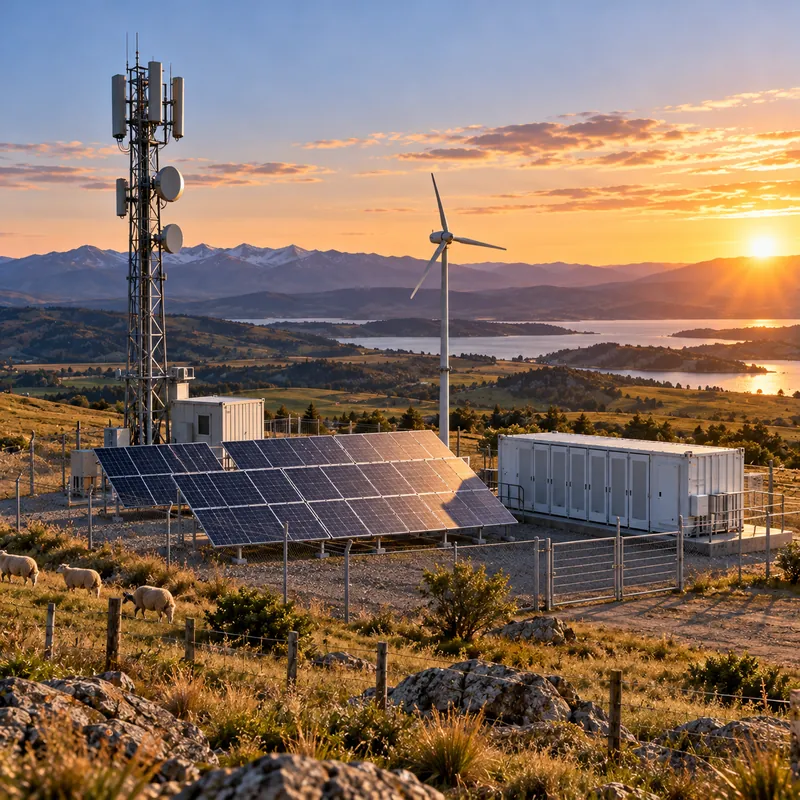
Off-grid power is not only for homes. Mines, quarries, island communities, telecom sites, agricultural processing, remote construction camps and resorts often sit far from a grid or face a weak, unreliable one. Historically they ran on diesel alone; most now add solar and battery storage to cut fuel use and generator hours.
At this scale the architecture becomes a microgrid:
- Solar PV of hundreds of kilowatts to megawatts on ground mounts or roofs.
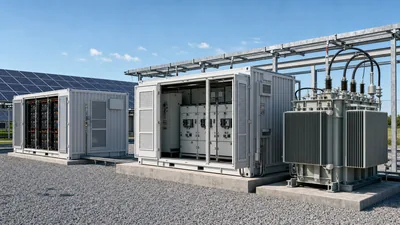
- Containerized BESS with a grid-forming power conversion system that sets voltage and frequency, allowing generators to switch off for hours.
- Diesel or gas generators retained for long low-resource periods and as backup.
- Microgrid controller and EMS that dispatch each source, manage battery state of charge and maintain spinning reserve.
- MV distribution with step-up transformers, ring main units and compact substations where loads are spread over kilometers.
Design approaches are explained in our advanced microgrid solutions guide and the hybrid power system guide.
MARS supplies the electrical backbone for these projects: LFP battery storage from 93 kWh cabinets to 10 MWh containers with PCS, BMS, EMS and fire suppression, oil-immersed and dry-type transformers, RMUs and containerized substations at 50 or 60 Hz.
Next Steps: Specifying and Sourcing
Whatever the scale, a good off-grid specification answers these questions:
- What is the daily kWh and peak kW, by season?
- What resource data exists: monthly irradiation, wind measurements, stream flow and head, fuel delivery cost?
- What reliability is required, and what happens if power is lost for an hour or a day?
- What voltage and phase configuration do the loads need: 120/240 V split-phase, 230 V, or 400/230 V three-phase?
- What environmental conditions apply: temperature range, altitude, dust, salt air, seismic zone?
- Which codes and listings will the authority require: NEC 690, 706, 710 and NFPA 855 in the US, or IEC 62619, IEC 62933 and local equivalents elsewhere?
Homeowners will typically work with a local designer and licensed installer. For commercial, industrial and community-scale off-grid systems, review MARS energy storage systems and send your load and site data through the quote request form. MOQ is one unit, and factory acceptance testing is welcome.
Frequently asked questions
What does off grid mean?
Off grid means having no connection to the public electricity network, so a home, business or site must produce, store and manage all of its own power. Typical off-grid systems combine solar panels or other renewable sources with batteries, an inverter and often a backup generator. The term sometimes also covers independent water, sewer and heating.
What is the best off grid power source?
Micro-hydro is usually the best where a year-round stream with useful head is available, because it runs day and night. Elsewhere, solar PV with lithium battery storage is the most practical primary source, supported by a generator or small wind turbine for winter and long cloudy spells. The best choice depends on measured local resources.
How do you get electricity off grid?
Generate it on site with solar panels, a wind turbine, a micro-hydro turbine or a fuel generator, store it in a battery bank, and convert it to household AC with an inverter. Size each part from your measured daily energy use and local resource data, and install it to code with proper protection.
Is it legal to live off the grid?
Living off the grid is legal in many places, but rules vary. Some jurisdictions require dwellings to meet building and electrical codes, obtain permits, or connect to available utilities, and hydro systems may need water rights. Check with the local building department and authority having jurisdiction before buying land or equipment.
How much does it cost to go off grid?
Cost depends on daily energy use, the resource mix and how many days of autonomy are needed. Reducing loads is the biggest lever. Small seasonal cabins may need only a modest kit, while full-time homes with typical appliances need much larger arrays and batteries. Prices vary by market and date, so obtain current quotes.
Can wind and solar be combined off grid?
Yes. Wind and solar often complement each other because wind is frequently stronger in winter and at night when solar output is low. A hybrid system uses separate charge controllers for each source feeding a common battery, with a diversion load to absorb excess wind energy when the battery is full.
Written and reviewed by the MARS application engineering team in Shanghai, who specify and test transformers, switchgear, substations and battery storage for projects in 40+ countries. Last updated .
Tags: off grid power solutions off grid meaning how to go off the grid off grid electricity options best off grid power source