Key takeaways
- Static phase converters only start a motor and then run it on two phases, typically delivering about two-thirds of rated motor output.
- Rotary converters use an idler motor to generate the third leg and are usually sized at 1.5 to 2 times the largest motor's horsepower for hard starts.
- A VFD fed from single phase is commonly derated to about 50% of its three-phase current rating, or chosen from a drive line rated for single-phase input.
- NEC 455.6 requires phase converter supply conductors rated at least 125% of the converter's nameplate single-phase input full-load current.
- Single-phase input current is roughly 1.7 times the three-phase line current for the same power at equal voltage, so service capacity often limits conversion.
Quick answer: A single phase to 3 phase converter creates a third voltage phase from a two-wire single-phase supply so three-phase motors and machines can run. The main types are static converters, rotary converters, digital converters and VFDs with single-phase input. A transformer alone cannot do it: it changes voltage, not the number of phases.
Three-phase power is the standard for industrial motors, compressors, welders and machine tools, but many workshops, farms, rural sites and homes only have a single-phase utility supply. The cost of bringing three-phase lines to a property can be high, so phase conversion is often the first option people look at when they ask how to get 3 phase power.
This guide explains how to change single phase to three phase in practice, compares the four main converter technologies, works through sizing and supply-current calculations, summarizes the NEC Article 455 requirements and sets out when a utility three-phase service, with a proper distribution transformer, is the better long-term answer. Installations connected to a utility service must comply with local code and be carried out by a licensed electrician.
Can You Convert Single Phase to Three Phase?
Yes, but not with a transformer alone. A single-phase supply provides one alternating voltage between two conductors. Three-phase power consists of three voltages displaced by 120°. A transformer can step a voltage up or down, but every winding on its core sees the same single-phase flux, so all outputs remain in phase. Creating a new phase requires energy storage that shifts timing: capacitors, a rotating machine or power electronics.
A phase converter is a device that produces three-phase power from a single-phase supply by generating a third voltage leg, either electrically (capacitors or an inverter) or electromechanically (a rotating idler). The original two supply lines become two of the three phases, and the converter supplies the third, sometimes called the manufactured or generated leg.
Search terms like single phase inverter to three phase or inverter 1 phase to 3 phase refer to the electronic approach: rectify the single-phase AC to DC, then invert DC to three-phase AC. That is what VFDs and digital phase converters do.
Existing guides on our site cover related angles: converting 1 phase to 3 phase in general, 220 V to 3 phase conversion for international supplies, and why a single phase to three phase transformer needs a converter in front of it. This article focuses on choosing and sizing the converter itself.
Types of Phase Converters Compared
Each single to three phase converter technology trades cost against voltage balance, starting capability and load flexibility.
| Type | How it works | Output balance | Typical uses | Limitations |
|---|---|---|---|---|
| Static converter | Capacitors start the motor, then disconnect | Poor; motor runs on two phases | Single lightly loaded motor, saws, fans | About 2/3 of rated output; one motor per unit |
| Rotary converter | Idler motor generates third leg, capacitors balance it | Fair to good (within a few % if tuned) | Workshops with several machines, compressors | Idler noise and no-load loss; leg voltage varies with load |
| Digital phase converter | Inverter generates the third leg | Good, actively regulated | CNC machines, mixed loads | Higher cost; electronics sensitive to surges |
| VFD with single-phase input | Rectifies to DC, inverts to 3-phase PWM | Excellent (motor terminals) | Single motor, variable speed | One motor per drive; derating; not for non-motor loads |
| Utility three-phase service | Utility extends three-phase line and transformer | Excellent | Growing sites, large loads | Connection cost and lead time |
For a single motor that needs speed control, a VFD phase converter is usually the neatest choice. For a shop with several machines running at different times, a rotary or digital converter feeding a small three-phase panel is common. For loads that are not motors, such as some welders, heaters or electronic equipment, check the manufacturer's acceptance of converter power: unbalanced voltage that a motor tolerates can upset control electronics. The two-phase power guide explains why the old two-phase systems are not a substitute.
How a Rotary Phase Converter Works and How to Size It
A rotary converter uses a three-phase idler motor (or purpose-built generator) with no mechanical load. Two of its terminals connect to the single-phase supply. Once spinning, its rotor field induces a voltage in the third winding that is displaced in time, producing the manufactured leg. Run capacitors connected from the generated leg to the supply legs improve balance; start capacitors or a pony motor bring the idler up to speed.
Sizing rules
- Largest motor: the idler should be at least the horsepower of the largest motor. For hard-starting loads, such as compressors starting against pressure or machines with heavy flywheels, 1.5 to 2 times is common practice.
- Total running load: rotary converters can supply several motors running at once, typically up to a total load in the range specified by the converter manufacturer, often 2 to 3 times the idler rating when motors start one at a time.
- Balance: for CNC equipment, target manufactured leg voltage within a few percent of the others; many CNC controls specify maximum supply unbalance in their installation manuals.
The manufactured leg should not be used to feed single-phase loads, and it should be identified at panels and outlets. NEC 455.9 requires that the manufactured phase not be connected to any single-phase loads, and 455.8 requires a disconnecting means in sight of the converter. Phase rotation must be checked before running motors, as explained in our phase rotation guide.
Remember that a converter cannot create more power than the single-phase service supplies. A converter feeding 20 hp of running motors draws the same total kW from the single-phase service, at higher current than an equivalent three-phase supply.
Single Phase to 3 Phase VFD: Sizing and Derating
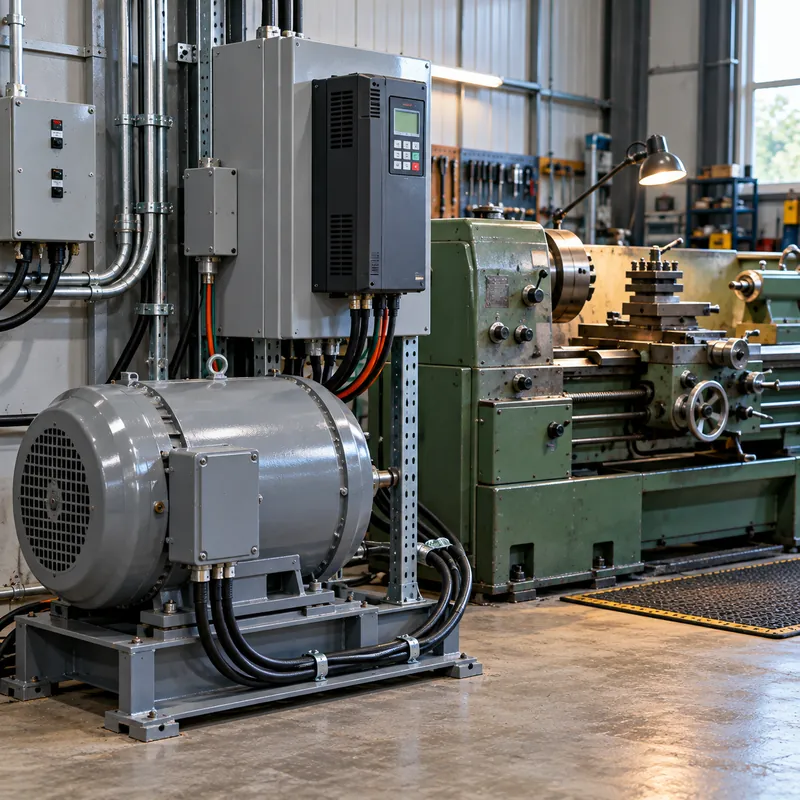
A variable frequency drive phase converter is a VFD supplied from single phase that outputs three-phase power to one motor. Internally, a rectifier converts AC to DC, capacitors smooth the DC bus, and an inverter creates three-phase PWM output at variable frequency.
When a standard three-phase-input drive is fed from single phase, only two of the six rectifier diodes conduct and the DC bus capacitors see much higher ripple current. The usual guidance is to derate the drive to around 50% of its three-phase output current, or to select a drive specifically rated for single-phase input. Always follow the drive manufacturer's derating table, since some designs require a larger reduction or forbid single-phase input entirely.
Voltage limits
A VFD's output voltage cannot exceed what its DC bus allows, and the bus is set by the input. A 240 V single-phase input therefore yields at most about 230–240 V three-phase. Dual-voltage motors (230/460 V) must be connected for the low voltage. To run a 460 V motor, add a step-up transformer: see our 240 to 480 step up transformer guide.
VFD advantages and cautions
- Soft starting reduces inrush on the single-phase service, often the deciding factor on weak rural supplies.
- Speed control and motor protection functions are built in.
- One drive per motor; it cannot supply a panel of mixed loads.
- Input current is non-sinusoidal with low true power factor; a line reactor helps reduce harmonics and protects the rectifier.
- Long motor leads may need output filters to protect motor insulation from voltage spikes.
Worked Example: Converting for a 10 hp Motor
A workshop with a 240 V single-phase, 200 A service wants to run a 10 hp, 230 V three-phase compressor.
Step 1: motor current and power
NEC Table 430.250 lists 28 A for a 10 hp, 230 V three-phase motor. With efficiency about 89%, input power is 10 × 746 / 0.89 ≈ 8.4 kW.
Step 2: single-phase current (rotary converter)
At an assumed combined power factor of 0.9 on the single-phase side: I = P / (V × PF) = 8,400 / (240 × 0.9) ≈ 39 A. Adding idler magnetizing current and converter losses, a typical 15 hp rotary converter might be nameplated around 50 A single-phase input. NEC 455.6 requires conductors rated at least 1.25 × 50 = 62.5 A, so 6 AWG copper (65 A at 75 °C) is suitable, subject to voltage drop and local code.
Step 3: VFD option
Derating a three-phase-input drive to 50% means it must be rated at least 28 / 0.5 = 56 A output, roughly a 20 hp class drive. Single-phase input current with a true power factor near 0.7 and drive efficiency of 96%: 8,400 / 0.96 / (240 × 0.7) ≈ 52 A RMS.
Step 4: compare with the service
Either option adds roughly 40–55 A of single-phase load. On a 200 A service that is feasible if existing load allows, but a second 10 hp machine would push most homes and small shops to their limit.
| Option | Single-phase input (approx.) | Hard starting | Speed control |
|---|---|---|---|
| Static converter | about 30 A at reduced output | Poor | No |
| 15 hp rotary converter | about 39–50 A | Good | No |
| 20 hp class VFD, derated | about 52 A | Very good (soft start) | Yes |
How to Get 3 Phase Power at Home or in Your Shop
Choose the approach step by step:
- List the three-phase loads. Motor hp, voltage, starting duty, and whether loads include electronics such as CNC controls or welders.
- Check the single-phase service. Calculate the extra single-phase current using the methods above and compare with service rating and existing load.
- Ask the utility about three-phase availability. If three-phase lines run nearby, the cost may be lower than expected. Some utilities offer open-delta three-phase service from two phases for modest motor loads.
- Match converter to loads. One variable-speed motor: VFD. Several machines: rotary or digital converter feeding a small three-phase panel. Occasional light-duty motor: static converter.
- Check voltage. If machines need 400 V or 480 V, plan a step-up transformer after the converter.
- Install to code. NEC Article 455 for phase converters, Article 430 for motors, Article 450 for transformers, with a licensed electrician and inspection.
Converter power is not a perfect replacement for a utility three-phase supply. Voltage balance, especially on the manufactured leg, varies with load, and large starting currents strain both the converter and the single-phase service. Our article on how to change single phase to three phase discusses the utility side in more detail.
When to Move From Conversion to a Three-Phase Service
Phase conversion makes sense for a few machines, but there is a point where a proper three-phase supply is cheaper and more reliable. Signs you have reached it:
- Total three-phase load is above roughly 20–30 hp, or you need several converters.
- The single-phase service needs upgrading anyway to supply converter input current.
- Equipment warranties or CNC installation manuals require a utility-grade balanced supply.
- You plan growth: more machines, EV charging, HVAC or a production line.
A three-phase utility service usually means a pole-mounted or pad-mounted distribution transformer from the utility's MV line, a three-phase meter and a service panel. Larger sites may own their transformer and LV switchboard. Single-phase loads then move to a 208Y/120 V or 400/230 V panel, often via a dry-type transformer. Our 3-phase panel guide and single to 3 phase transformer article explain what changes in the building.
Where the new three-phase connection has limited capacity, a commercial battery system can shave demand peaks from motor starts and short high-load periods, reducing the service size needed. That is a design decision for a qualified engineer, based on the site's load profile.
Next Steps: Specifying and Sourcing
If conversion is the right answer, specify converter type, horsepower or kVA, input voltage and current, output voltage balance requirements, enclosure and protection, and confirm compliance with NEC Article 455 and the converter's listing. MARS does not manufacture phase converters or VFDs.
If the analysis points to a utility three-phase supply or a site-owned distribution system, MARS can help. We design and build dry-type transformers for voltage changes such as 240 V to 480 V or 480 V to 208Y/120 V, pad-mounted transformers for site-owned MV services, LV switchboards, and C&I battery cabinets for peak shaving, all at 50 or 60 Hz with routine tests and typical lead times of 25–45 days for distribution equipment. Send your load list and supply details through the quote request form.
Frequently asked questions
Can you convert single phase to three phase?
Yes, using a phase converter or a VFD with single-phase input. Static, rotary and digital converters generate a third leg so three-phase motors can run, while a VFD creates three-phase output for one motor. A transformer alone cannot create three phases; it only changes voltage.
What size phase converter do I need?
Size a rotary converter at least equal to the largest motor's horsepower, and 1.5 to 2 times it for hard-starting loads such as compressors. Check the manufacturer's total running load limit if several motors operate together. Static converters are rated for one motor and deliver only about two-thirds of its output.
Is a VFD better than a rotary phase converter?
For a single motor, a VFD is often better: it soft-starts, offers speed control and gives balanced output. It must be derated, typically to about 50% of its three-phase rating, or be rated for single-phase input. For several machines or non-motor loads, a rotary or digital converter is more practical.
How do I get 3 phase power at home?
Ask your utility whether three-phase service is available and what the connection costs. If it is not practical, use a phase converter or a single-phase-input VFD for each three-phase motor. Ensure the single-phase service can supply the extra current, and have a licensed electrician install the equipment to code.
Can a VFD convert 240V single phase to 480V three phase?
Not on its own. A VFD's output voltage is limited by its DC bus, which is set by the input voltage, so a 240 V single-phase input gives at most about 240 V three-phase. To reach 480 V, add a step-up transformer after the drive or converter, sized for the motor load.
Why does a phase converter draw more current than the motor?
Power is conserved, so the same kW drawn by the motor must come through two single-phase conductors instead of three. For equal voltage, single-phase current is about 1.73 times the three-phase line current, plus converter losses and idler magnetizing current, which is why service capacity often limits conversion.
Written and reviewed by the MARS application engineering team in Shanghai, who specify and test transformers, switchgear, substations and battery storage for projects in 40+ countries. Last updated .
Tags: single phase to 3 phase converter single phase to three phase converter vfd phase converter how to get 3 phase power rotary phase converter