Key takeaways
- Insulating oil serves two vital roles in liquid-filled transformers: electrical insulation between live internal components and convective dissipation of core and winding heat.
- Uninhibited and inhibited transformer mineral oil remains the dominant global dielectric medium, specified to standards such as IEC 60296 and IEEE C57.106.
- Ester-based dielectric fluids provide significantly higher fire points above 300°C (K-class) and rapid biodegradability compared to conventional mineral oils.
- New mineral transformer oil must demonstrate a dielectric breakdown voltage of at least 30 kV across a standard 2.5 mm gap per IEC 60156 before energisation.
- Regular dissolved gas analysis (DGA) and moisture monitoring of transformer insulating oil allow early detection of thermal hotspots, partial discharge, and arcing faults.
Quick answer: Insulating oil is a specially refined dielectric fluid used in liquid-filled electrical transformers to insulate high-voltage conductors, quench electrical arcs, and transfer internal heat away from the core and windings. It must maintain high dielectric breakdown strength, chemical stability, and low viscosity across operating temperatures ranging from -40°C to beyond 100°C.
In electrical power distribution and transmission networks, the operational reliability of liquid-immersed plant depends heavily on the condition of its dielectric liquid. As transformers run under continuous electrical and thermal stress, the insulating oil serves as both an electrical shield and a cooling medium. Specifying the correct fluid type, understanding laboratory test metrics, and establishing proper acceptance limits ensures asset longevity and minimises catastrophic outage risks.
Do Transformers Have Oil in Them? Transformer Fluid Explained
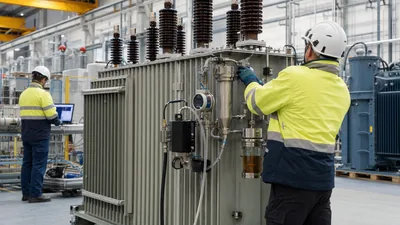
Yes, most medium- and high-voltage distribution and power transformers operate with their internal tank completely submerged in dielectric liquid. While engineers specify dry-type units for indoor installations with strict fire-safety requirements, liquid-immersed designs account for the vast majority of substation, industrial, and utility installations due to their higher thermal efficiency, compact footprint, and extended design life.
The distinction between liquid-immersed and dry-type units comes down to cooling medium and internal clearance. Dry-type transformers rely on ambient air convection or forced-air blowers through solid resin channels, as outlined in our dry type transformer guide. In contrast, liquid-immersed transformers use an electric transformer oil that circulates through winding ducts, carrying thermal losses directly to corrugated tank walls or external radiator banks. A liquid barrier possesses a much higher dielectric permittivity than atmospheric air, allowing design engineers to place high-voltage coils closer together, significantly reducing the required core size, tank volume, and total conductor weight for a given megavolt-ampere (MVA) rating.
Core Function of Oil in Transformer Operations
The primary function of oil in transformer systems is twofold: dielectric insulation and thermal dissipation. Operating voltages in power transformers often exceed several hundred kilovolts; the transformer insulating oil prevents flashovers between phase windings, winding layers, and the grounded steel tank. Working in tandem with solid cellulose pressboard and kraft paper, the fluid permeates every microscopic void, eliminating air pockets that would otherwise trigger destructive partial discharges.
Thermal cooling represents the second critical duty. Electrical losses within the silicon-steel core and copper or aluminium conductors generate substantial heat. The transformer fluid circulates via natural thermal siphoning or forced circulation pumps, absorbing thermal energy from hot surfaces and transferring it to external radiators. In systems using forced cooling mechanisms, detailed in our guide on ONAF transformer cooling, the viscosity and specific heat capacity of the liquid dictate thermal dissipation performance across ambient extremes.
Beyond cooling and insulation, the liquid acts as an internal diagnostic medium. Chemical breakdown of the hydrocarbon or ester chains under electrical or thermal stress releases characteristic fault gases. By sampling the transformer inside oil and performing Dissolved Gas Analysis (DGA), maintenance personnel can identify developing problems—such as arcing, partial discharge, or loose conductor joints—long before physical failure occurs.
Types of Oil Used in Transformer Applications
Engineers select from four primary dielectric fluids: naphthenic or paraffinic mineral oil, natural organic esters, synthetic esters, and silicone fluids. Each dielectric medium presents distinct performance trade-offs regarding fire safety, oxidation stability, environmental impact, and purchase cost.
Transformer mineral oil remains the industry benchmark. Refined from crude petroleum distillates, naphthenic mineral oil is prized for its low pour point (-40°C or lower) and excellent heat-transfer characteristics without generating heavy wax deposits at low operating temperatures. Standards such as IEC 60296 categorise mineral oils into uninhibited (Type U, containing no antioxidant additives) and inhibited (Type I, containing up to 0.40% by weight of 2,6-di-tert-butyl-p-cresol antioxidant inhibitor).
Natural esters, derived from renewable seed oils such as soybean or rapeseed, offer a high fire point above 300°C (categorised as K-class fluids per IEC 61039) and rapid environmental biodegradability. They are frequently specified in sensitive water-catchment areas or densely populated commercial substations where stringent mitigation rules apply, as explored in our transformer fire protection system guide. Synthetic esters (IEC 61099) provide similar fire-safety and ecological advantages alongside superior oxidation resistance, making them suitable for breathing transformers and traction applications. Silicone fluid (IEC 60836) delivers high thermal endurance up to 300°C but produces tenacious combustion byproducts and requires specialised disposal.
| Fluid Property (Unit) | Transformer Mineral Oil | Natural Ester (Seed Oil) | Synthetic Ester | Silicone Fluid |
|---|---|---|---|---|
| Applicable Standard | IEC 60296 / IEEE C57.106 | IEC 62770 / IEEE C57.147 | IEC 61099 / IEEE C57.121 | IEC 60836 / ASTM D4652 |
| Fire Point (°C) | 165 – 180 (O-class) | > 310 (K-class) | > 310 (K-class) | > 340 (K-class) |
| Flash Point (°C) | 140 – 155 | > 275 | > 250 | > 300 |
| Kinematic Viscosity at 40°C (mm²/s) | 9.0 – 11.0 | 32.0 – 35.0 | 28.0 – 30.0 | 35.0 – 40.0 |
| Pour Point (°C) | -40 to -50 | -18 to -25 | -50 to -60 | -50 to -55 |
| Biodegradability (21-day CEC) | < 30% | > 95% | > 85% | 0% (Persistent) |
| Relative Cost Factor | 1.0x (Baseline) | 2.2x – 2.8x | 3.5x – 4.5x | 4.0x – 5.5x |
Critical Dielectric and Physical Parameters
Specifying high-voltage fluid requires verified laboratory metrics to confirm that the liquid will perform safely under high electrical gradients. Key operational parameters include dielectric breakdown voltage, dissipation factor, moisture content, interfacial tension, and total acidity.
Dielectric breakdown voltage measures the electrical stress an oil electrical insulator can withstand without conductive failure. Under IEC 60156, oil is placed in a test cell fitted with mushroom-shaped electrodes spaced exactly 2.5 mm apart; voltage ramps upward at 2.0 kV per second until an arc bridges the gap. New, untreated mineral oil delivered in drums must achieve a minimum breakdown of 30 kV. Following factory vacuum dehydration and degasification on a completed tank, power transformer oil must exceed 60 kV for apparatus rated below 72.5 kV, and at least 70 kV for apparatus operating above 170 kV (IEC 60296 Table 2).
Dielectric dissipation factor (tan delta or power factor, measured at 90°C per IEC 60247) quantifies dielectric heating losses caused by ionic impurities and polar ageing products. Fresh mineral oil must exhibit a tan delta below 0.005 (0.5%). Moisture content, determined via Coulometric Karl Fischer titration (IEC 60814), must remain below 20 mg/kg (ppm) for distribution units and below 10 mg/kg for transmission units at fill. Water degrades dielectric withstand rapidly: an increase in moisture from 10 ppm to 30 ppm can cut dielectric breakdown voltage by more than half at room temperature.
Insulating Oil Testing and Sampling Procedure
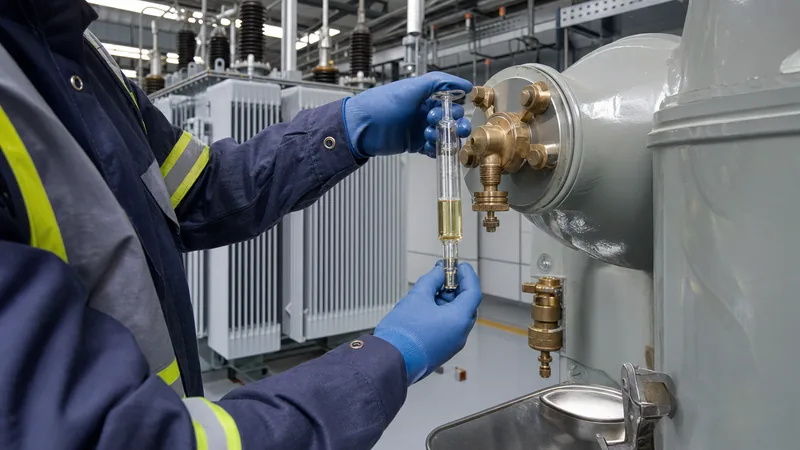
Accurate verification of transformer fluid requires strict compliance with standard sampling protocols, as outlined in IEC 60475 and ASTM D923. Contaminated sampling vessels or improper drain-valve preparation will distort dissolved moisture, interfacial tension, and particle counts.
- Inspect the sampling valve at the bottom of the transformer tank; clean the exterior threads thoroughly with solvent and dry lint-free wipes to remove accumulated ambient debris.
- Purge at least 2 to 4 litres of liquid through the valve into a waste receptacle to clear the dead-leg pipework of settled sediment and stagnant oil.
- Connect clean, dry, oil-resistant flexible tubing to the sampling port, ensuring no air bubbles are drawn into the discharge line.
- Rinse the specialised amber glass or stainless-steel sample container three consecutive times with the effluent oil before collecting the final test volume.
- Fill the bottle smoothly from the bottom to overflow to minimise exposure to atmospheric moisture, seal immediately with an airtight, Teflon-lined cap, and record operating temperature, tank pressure, and weather conditions.
- Conduct the laboratory breakdown voltage test according to IEC 60156 or ASTM D1816, recording the average of six consecutive electrical breakdowns spaced at 2-minute intervals.
- Evaluate dissolved gas concentrations per IEC 60567 to establish baseline values for hydrogen, methane, ethylene, acetylene, and carbon oxides.
Routine field monitoring and testing should align with broader site maintenance protocols, such as those covered in our transformer maintenance guide and power transformer testing procedures.
Transformer Oil Price and Sourcing Factors
Procurement costs for dielectric liquid depend directly on crude base-oil indices, chemical refining class, additive packages, and packaging logistics. While basic virgin uninhibited mineral oil typically trades at a competitive baseline, ester alternatives carry premium costs driven by specialised synthesis and supply chain constraints.
When reviewing a transformer oil price schedule or negotiating a project transformer oil rate, buyers must evaluate logistics and packaging options. Bulk shipments in ISO-tank containers (20,000 to 24,000 litres) offer the lowest cost per litre, whereas sealed steel drums (205 to 209 litres) carry packaging surcharges but simplify site handling for smaller pad-mounted or pole-mounted units. Specification requirements also influence final cost: ordering ultra-low-temperature naphthenic oil with specialized synthetic pour-point depressants, or requesting batch-certified low-viscosity ester fluids for cold climates, adds 15% to 30% to base commodity rates. Engineers must also consider total ownership costs; higher initial spending on synthetic ester fluid can eliminate expensive fire containment walls, deluge deluge systems, and high insurance premiums required by standard hydrocarbon fluids.
Next steps: specifying and sourcing
When specifying dielectric fluids for upcoming substation or industrial installations, provide complete environmental parameters, clearance limits, and fire risk profiles in your inquiry. State your preferred fluid standard (IEC 60296 for mineral oil or IEC 62770 for natural ester), required inhibitor levels, ambient temperature thresholds, and factory acceptance test (FAT) dielectric limits.
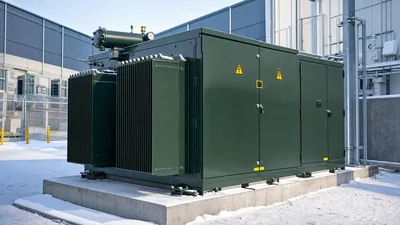
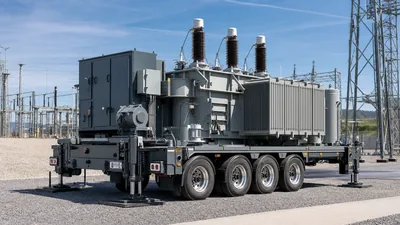
Explore our liquid-filled portfolio, including engineered oil-immersed distribution transformers, high-voltage power transformers, and compact utility pad-mounted transformers. To submit your technical specifications, discuss custom fluid options, or receive an itemised equipment quotation, visit our transformer quotation page or speak with our application engineering department via direct technical contact.
Frequently asked questions
do transformers have oil in them
Yes, most utility, industrial, and substation transformers contain insulating oil. The fluid submerges the internal core and winding assembly to provide electrical insulation between high-voltage conductors and to circulate heat away to cooling radiators. Only dry-type transformers operate without liquid.
What is the main function of oil in transformer equipment?
The main function of oil in transformer equipment is to provide electrical insulation and convective heat dissipation. It prevents dielectric breakdown between closely wound high-voltage coils and conducts heat generated by internal electrical losses out to the cooling radiators.
What is the difference between mineral oil and ester fluid?
Mineral oil is a refined petroleum distillate with low viscosity and established diagnostic profiles, but it has a moderate fire point of around 165°C. Ester fluids, derived from vegetable seeds or synthetic chemical processes, provide K-class fire points exceeding 300°C and biodegrade rapidly.
What causes insulating oil to deteriorate over time?
Insulating oil degrades primarily through oxidation, elevated operating temperatures, and moisture ingress. Heat combined with oxygen produces polar compounds, sludge, and organic acids that erode cellulose winding paper and reduce the liquid dielectric breakdown strength.
What is a good dielectric breakdown voltage for transformer oil?
New, filtered mineral transformer oil in a factory environment should achieve a breakdown voltage of at least 60 kV to 70 kV across a standard 2.5 mm electrode gap per IEC 60156. In-service oil should generally be reconditioned or replaced if it drops below 30 kV to 40 kV.
How often should transformer insulating oil be tested?
Critical substation and power transformers should undergo oil sampling and dissolved gas analysis (DGA) at least annually. High-capacity or heavily loaded industrial units often receive semi-annual testing, while online gas and moisture monitors provide continuous surveillance on vital transmission assets.
Tags: insulating oil transformer oil transformer fluid power transformer oil transformer mineral oil