Key takeaways
- Equipment supplied by Canadian transformer manufacturers must comply with CSA C802.1 or CSA C802.2 minimum efficiency standards mandated by Natural Resources Canada (NRCan).
- Standard Canadian ambient temperature specifications require magnetic fluid and mechanical components rated down to -40°C, with northern installations requiring -50°C cold-start capability.
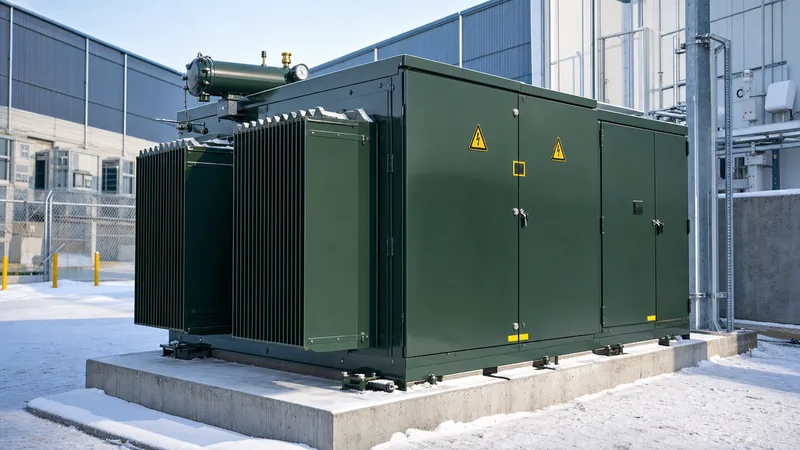
- Three-phase liquid-filled pad-mounted units must align strictly with CSA C227.4 dimensions, radial/loop termination configurations, and tamper-resistance protocols.
- Total Owning Cost (TOC) capitalisation formulas dictate selecting lower-loss grain-oriented silicon steel cores when evaluating quotes from transformer companies in Canada.
- Factory acceptance testing for Canadian grid interconnections mandates dielectric and loss verification per IEEE C57.12.90 and CSA C9-02 clauses before site shipment.
Quick answer: Sourcing from canadian transformer manufacturers requires strict adherence to CSA standards (such as CSA C227.4, CSA C9, and CSA C88), Natural Resources Canada (NRCan) energy efficiency regulations, and harsh sub-zero thermal ratings down to -40°C or -50°C. Buyers must evaluate core loss capitalisation, seismic resilience, and local grid code compliance when choosing qualified suppliers.
Canadian electrical networks operate under some of the most demanding environmental and regulatory conditions globally. From municipal distribution utilities in Ontario and Quebec to remote industrial mining sites in Alberta and the Northwest Territories, transformers must withstand extreme seasonal temperature differentials, heavy snow loads, and seismic hazards while maintaining high operational efficiency. Specifying engineers looking for a capable canada transformer manufacturer must look past surface-level marketing claims and rigorously audit structural design, insulating fluids, and factory testing documentation.
Procurement teams frequently weigh local Canadian fabrication against international factory sourcing. Regardless of where manufacturing takes place, meeting provincial electrical safety authorities (such as the Electrical Safety Authority in Ontario) mandates CSA certification or field evaluation to recognized Canadian model codes. Navigating these parameters requires understanding standard equipment layouts, efficiency calculations, and testing regimes designed specifically for the Canadian power landscape.
Sourcing from Canadian Transformer Manufacturers: Standards and Regulations
Canadian distribution and power equipment must satisfy a distinct framework of regional technical standards governed by the Canadian Standards Association (CSA) and federal energy mandates. When vetting canadian transformer manufacturers, the baseline requirement is compliance with NRCan Energy Efficiency Regulations, which incorporate CSA C802.1 for liquid-filled distribution units and CSA C802.2 for dry-type transformers. These regulations establish mandatory limits on no-load and full-load losses, legally prohibiting the import or inter-provincial sale of non-compliant units.
Equipment designs vary substantially depending on mounting style and physical enclosure requirements across Canada:
- Pad-mounted distribution transformers: Liquid-filled units must conform to CSA C227.4 for three-phase installations and CSA C227.5 for single-phase units. These standards define physical compartment sizing, high-voltage bushing heights, dead-front construct, and rigorous tamper-resistance testing against unauthorized probe insertion.
- Dry-type transformers: Indoor commercial and industrial installations refer to CSA C22.2 No. 47 for air-cooled power transformers and CSA C9-02 for dry-type transformers, aligning dielectric clearances with regional fire safety rules.
- Substation power transformers: Transmission and primary sub-station assets are specified under CSA C88, covering core-and-coil clamping strength, short-circuit withstand capabilities, and sound level thresholds.
Engineers preparing technical inquiries should consult our comprehensive transformer specification guide to align baseline insulation levels (BIL) and mechanical dimensions with regional provincial utility specifications.
Climatic and Environmental Design for Canadian Environments
Cold-weather durability is the defining engineering challenge for transformers deployed in Canada. Standard international equipment is routinely designed for a minimum ambient temperature of -25°C, but commercial specifications issued to transformer companies in canada require uninterrupted operation at -40°C, and as low as -50°C for northern mining and utility corridors.
Operating below -30°C introduces severe physical risks to transformer integrity. Gaskets fabricated from standard nitrile butadiene rubber (NBR) harden, lose elasticity, and fail to maintain seal compression, resulting in nitrogen pad leaks or fluid ingress. Qualified manufacturers specify low-temperature fluorosilicone or specialized hydrogenated nitrile (HNBR) elastomers capable of retaining elasticity at -50°C. Similarly, structural steels used for main tanks and lifting lugs must maintain Charpy V-notch impact toughness per CSA G40.21 Grade 350WT to prevent brittle fracture under cold mechanical stress.
Dielectric fluids must also be selected based on low-temperature kinematic viscosity. Standard uninhibited mineral oils suffer significant viscosity increases at -30°C, which restricts natural thermosiphon circulation through cooling radiators during cold energisation. For extreme climates, specifying low-viscosity synthetic esters, naphthenic mineral oils per ASTM D3487 Type II, or integrated winding pre-heating circuits avoids thermal hot-spots during no-load cold starts. Sizing calculations must factor in these thermal properties as outlined in our guide on standard transformer sizes.
Domestic vs Qualified Global Sourcing for Canadian Projects
Selecting between domestic transformer companies in canada and accredited global manufacturing partners requires balancing delivery lead times, upfront capital expenditure, and rigorous standard compliance. While domestic facilities offer direct proximity for engineering meetings, their manufacturing queues for utility-grade units often exceed 70 to 120 weeks due to localized supply chain constraints on grain-oriented electrical steel and specialized winding copper.
Global manufacturers that engineer equipment specifically to Canadian standards provide a viable, cost-effective alternative without compromising technical compliance. The table below outlines critical procurement criteria when comparing procurement options for Canadian project sites:
| Evaluation Metric | Domestic Canadian Transformer Manufacturers | Qualified Global Manufacturers | Engineering Impact |
|---|---|---|---|
| CSA / NRCan Certification | Native CSA listing standard | Available via CSA C/US or factory certification | Mandatory for provincial electrical inspection approval |
| Average Lead Times | 60 to 110+ weeks | 24 to 45 weeks (including ocean freight) | Affects critical path on utility and mining construction |
| Base Material Compliance | CSA G40.21 structural steel | Direct equivalent (e.g., ASTM A572 / EN 10025) | Guarantees low-temperature structural ductility |
| Seismic Rating (NBCC) | Designed to local building codes | Engineered to dynamic response spectra | National Building Code of Canada seismic qualification |
| Loss Capitalisation | Optimised for regional utility formulas | Configurable core geometries (step-lap mitered) | Directly impacts Total Owning Cost (TOC) over 30 years |
| Warranty and Service | Local field engineers | Third-party local commissioning partners | Affects on-site emergency repair and warranty claims |
Buyers looking for alternative primary plant equipment can evaluate purpose-built pad-mounted transformers or medium-voltage dry-type transformers tailored to Canadian building codes and winter environmental demands.
Step-by-Step Procurement Checklist for Canadian Installations
Following a systematic procurement procedure guarantees that equipment ordered from a canada transformer manufacturer meets site electrical demands and passes local utility interconnection audits. Electrical engineers and EPC contractors should implement this standardized five-step sequence when issuing requests for quotation (RFQs):
- Define site operating environment: Establish the exact minimum and maximum ambient temperatures (-40°C to +40°C), site altitude above sea level (derating begins above 1,000 metres per IEEE C57.12.00 Table 5), and seismic spectral acceleration values ($S_a(0.2)$ and $S_a(2.0)$) per the National Building Code of Canada (NBCC).
- Establish electrical ratings and impedance: Specify kVA rating, primary and secondary voltages, winding connections (e.g., Dyn11, YNyn0), and target short-circuit impedance percentage (%Z) per CSA guidelines. For commercial buildings, assess dry options using the dry-type transformer guide.
- Determine energy efficiency and loss evaluation parameters: Provide the manufacturer with project-specific no-load (core) and load (winding) loss capitalisation values ($A$ and $B$ factors in CAD per kilowatt) to ensure the core is engineered for the lowest Total Owning Cost rather than simply lowest initial cost.
- Select dielectric fluid and preservation system: For outdoor installations, specify whether standard naphthenic mineral oil, high-fire-point natural ester fluid (or synthetic equivalent per CSA C227.4), or dry-type isolation is required. Specify sealed-tank construction with a dry-nitrogen blanket for conservator-free designs.
- Mandate Factory Acceptance Testing (FAT) parameters: Require comprehensive witness testing or third-party verified test reports conforming to CSA C9 / IEEE C57.12.90, including lightning impulse tests, winding resistance measurements, temperature rise tests, and tank pressure-vacuum withstand tests before ocean or rail dispatch.
Loss Capitalisation: Worked NRCan Total Owning Cost Calculation
Evaluating bids from competing canadian transformer manufacturers requires comparing the Total Owning Cost (TOC), which accounts for the purchase price plus the discounted operational cost of electrical losses over the design life of the unit. Canadian utilities and industrial clients enforce TOC evaluations using standard loss capitalisation formulas.
The standard formula used to evaluate transformer efficiency is:
$$TOC = C_{bid} + (A \times P_0) + (B \times P_k)$$
Where:
- $C_{bid}$ = Quoted transformer purchase price ($ CAD)
- $A$ = Capitalisation factor for no-load losses ($ CAD/kW)
- $P_0$ = Guaranteed no-load losses (core loss) in kW
- $B$ = Capitalisation factor for load losses ($ CAD/kW)
- $P_k$ = Guaranteed load losses (winding resistance loss) at rated load in kW
Consider a practical comparison for a 2,500 kVA, 13.8 kV to 600 V oil-immersed pad-mounted transformer evaluated by an industrial plant in Ontario. The client specifies capitalisation values of $A = 8,500 CAD/kW$ and $B = 2,800 CAD/kW$ over a 30-year operational life.
Manufacturer Option 1 (Standard Core Design):
- $C_{bid}$ = $68,000 CAD
- $P_0$ = 2.80 kW
- $P_k$ = 22.50 kW
- $TOC_1 = 68,000 + (8,500 \times 2.80) + (2,800 \times 22.50) = 68,000 + 23,800 + 63,000 = 154,800 CAD$
Manufacturer Option 2 (High-Efficiency Core Design):
- $C_{bid}$ = $76,000 CAD (higher purchase price due to laser-scribed high-permeability silicon steel)
- $P_0$ = 1.95 kW
- $P_k$ = 19.80 kW
- $TOC_2 = 76,000 + (8,500 \times 1.95) + (2,800 \times 19.80) = 76,000 + 16,575 + 55,440 = 148,015 CAD$
Although Manufacturer Option 2 carries an $8,000 CAD initial purchase premium, it saves $6,785 CAD in Total Owning Cost over the operating lifecycle, while exceeding NRCan efficiency thresholds. Comprehensive calculations on load losses can be verified using the factory testing protocols outlined in our review of power transformer testing.
Factory Acceptance Testing and Verification for Canadian Codes
Factory Acceptance Testing (FAT) guarantees that transformers destined for Canadian sites will survive shipment, operate reliably within their thermal limits, and satisfy jurisdictional safety rules. Every batch or custom unit built by or for canadian transformer manufacturers must undergo rigorous routine and type testing prior to release from the factory floor.
Key verification testing procedures include:
- Dielectric and Insulation Tests: Routine verification includes applied-voltage tests and induced-voltage tests conducted according to IEEE C57.12.90 clause 10. Insulation power factor tests (dissipation factor) must yield values below 0.5% at 20°C for modern fluid-filled distribution and power assets.
- Temperature Rise Verification: Transformers are subjected to short-circuit thermal runs to verify that the average winding temperature rise does not exceed 65°C over a 30°C ambient average (for liquid-immersed units) or 80°C/115°C/150°C for dry-type designs per CSA C9-02.
- Mechanical Tank Pressure Tests: Pad-mounted tanks must withstand a positive internal pressure of 50 kPa (7.25 psi) and a full vacuum test for 24 hours without permanent distortion or weld compromise, matching CSA C227.4 requirements.
- Cold Temperature Impact Verification: Steel samples from the tank plates must undergo Charpy impact verification to certify structural ductility at the specified minimum operating temperature (-40°C or -50°C).
Project managers should require certified factory test reports signed by a registered professional engineer before authorizing shipping releases to Canada.
Next steps: specifying and sourcing
Developing a comprehensive Request for Quotation (RFQ) is the most effective way to source reliable power apparatus for Canadian projects. Prepare your site single-line diagram, required kVA capacity, primary and secondary distribution voltages, basic impulse level (BIL), and regional environmental constraints (such as -40°C ambient ratings and seismic profiles).
Explore our engineering offerings for heavy industrial and utility projects, including high-capacity power transformers, outdoor oil-immersed transformers, and tamper-resistant pad-mounted transformers. When you are ready to review equipment pricing, lead times, and custom CSA-compliant designs, submit your technical specification directly through our quote page or speak with an engineer via our contact page.
Frequently asked questions
What efficiency standards apply to transformers sold in Canada?
Natural Resources Canada (NRCan) enforces minimum efficiency levels defined in CSA C802.1 for liquid-filled distribution units and CSA C802.2 for dry-type transformers. Any transformer imported or sold between provinces must be certified compliant with these regulations.
Why do Canadian transformer specifications require -40°C or -50°C ratings?
Canadian winter ambient temperatures frequently drop below -30°C, causing standard rubber gaskets to lose elasticity and standard insulating oil to thicken excessively. Specifying -40°C or -50°C ratings ensures cold-temperature gasketing materials, structural impact-resistant steel, and appropriate fluid viscosity for safe cold energisation.
What is the difference between CSA C227.4 and standard IEEE pad-mounted transformer designs?
CSA C227.4 defines specific Canadian compartment dimensions, high- and low-voltage bushing arrangements, grounding provision layouts, and distinct anti-tamper locking requirements. Standard IEEE C57.12.34 units often require custom modifications to physical terminal spacing to meet Canadian utility standards.
Can equipment from non-Canadian transformer manufacturers be installed in Canada?
Yes, provided the equipment carries recognized Canadian certification (such as CSA, cUL, or cETL marks) or passes field evaluation to recognized Canadian model codes by an accredited Inspection Body before being energised on the provincial grid.
How does loss capitalisation impact transformer selection in Canada?
Loss capitalisation assigns a monetary cost to no-load and load losses over the transformer operating life using $A$ and $B$ factors. Transformers with lower losses—often featuring higher-grade silicon steel cores—frequently yield a lower Total Owning Cost (TOC) despite a higher upfront purchase price.
Tags: canadian transformer manufacturers canada transformer manufacturer transformer companies in canada transformer sizing CSA standards