Key takeaways
- Lithium-ion batteries store solar electricity chemically, with typical AC round-trip efficiency of about 85-92% for complete home and commercial systems.
- Heating 200 liters of water by 40 °C stores about 9.3 kWh of thermal energy, often the cheapest way to absorb surplus solar at home.
- Pumped hydro stores E = m × g × h; 1,000 m³ of water lifted 100 m holds only about 272 kWh, which is why it only works at very large scale.
- A grid-tied solar system without a battery exports surplus to the grid and, by anti-islanding rules, shuts down during outages.
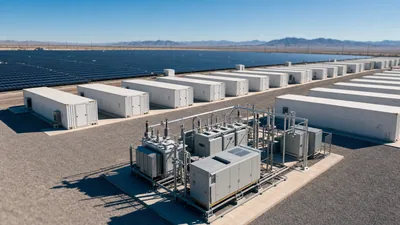
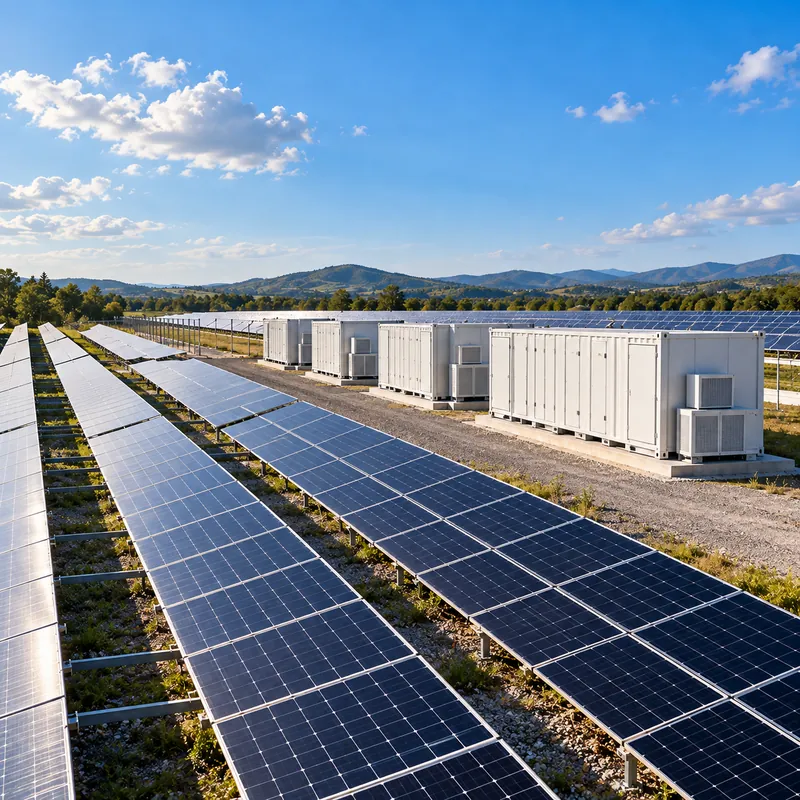
- Utility-scale solar plants increasingly pair arrays with containerized lithium BESS to shift midday output into evening demand peaks.
Quick answer: To store solar energy, convert surplus solar electricity into a form that can be released later. Homes mostly use lithium iron phosphate batteries charged through a hybrid or battery inverter. Other methods include heating water or thermal mass, pre-cooling buildings, and, at utility scale, pumped hydro, compressed air and hydrogen. Net metering credits exported energy but stores nothing physically.
Solar panels produce most of their energy around midday, while many homes and businesses use the most electricity in the evening. Storing solar energy bridges that gap, adds backup power during outages and lets solar keep working where export is limited or poorly paid. The best method depends on scale, how long the energy must be stored and what form it will be used in.
This guide is for homeowners, facility managers and students who want to know how solar energy is stored and which options are practical. It explains how solar batteries work, compares electrical, thermal and mechanical storage with real formulas, covers storing solar power without batteries and shows how the same principles apply at commercial and utility scale.
Can Solar Energy Be Stored?
Yes. Solar energy can be stored as chemical energy in batteries, as heat in water, rock or molten salt, as potential energy in elevated water, as compressed air, or as hydrogen. What cannot be stored is the electric current itself: it must be converted into another form and converted back when needed, with some loss each way.
Solar energy storage is any system that captures energy produced by solar panels or collectors at one time and releases it at another. Three questions decide which method fits:
- Duration: minutes (smoothing), hours (evening use), days (cloudy spells) or seasons.
- End use: electricity for appliances, or heat and cooling, which can often be stored more cheaply directly as heat or cold.
- Scale: a single home, a commercial building, or a utility grid.
For most homes and businesses, the practical answer for electricity is a lithium battery; for hot water and space heating, it is often a thermal store. Seasonal storage of solar electricity remains impractical at household scale and is addressed at grid level by long-duration energy storage technologies.
A common misconception is that net metering stores solar energy. It does not. Exported energy is consumed by neighbors in real time, and the utility credits it on your bill. Financially it can act like storage, but physically nothing is stored, and the home has no power during an outage.
Solar Energy Storage Methods Compared
| Method | Stored as | Typical round-trip efficiency | Typical duration | Practical scale |
|---|---|---|---|---|
| Lithium-ion battery (LFP) | Chemical | 85-92% AC-AC system | 1-4 hours, up to 8+ | Home to utility |
| Lead-acid battery | Chemical | 70-85% | Hours to days | Small off-grid |
| Flow battery | Chemical in liquid electrolyte | 60-80% | 4-12 hours | Commercial to utility |
| Hot water tank | Sensible heat | Not reconverted; heat retained over hours to a day | Hours to 1 day | Home |
| Ice or chilled water | Cold (latent or sensible) | Displaces cooling energy | Hours | Commercial buildings |
| Molten salt (with concentrated solar) | High-temperature heat | Reconverted via steam turbine | 6-15 hours | Utility |
| Pumped hydro | Gravitational potential | 70-85% | 6-24+ hours | Utility |
| Compressed air | Pressure | 40-70% | Hours to a day | Utility |
| Hydrogen | Chemical fuel | About 30-45% power-to-power | Days to seasons | Industrial, utility |
Round-trip efficiency is the share of energy put into storage that comes back out: η_RT = E_out / E_in. Thermal methods are not compared on this basis when the heat is used directly, because they avoid the electricity-to-heat conversion that would happen anyway. Mechanical options are explained in our guide to mechanical energy storage.
How Do Solar Batteries Work?
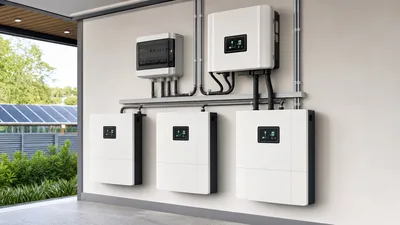
A solar battery is a rechargeable battery charged from a solar array, usually through a hybrid inverter or charge controller, and discharged to supply loads when solar output is low.
In a lithium iron phosphate (LFP) cell, charging drives lithium ions out of the iron phosphate cathode, through the electrolyte and separator, and into the graphite anode, while electrons flow through the external circuit. Discharging reverses the process and the electron flow powers the load. Nominal cell voltage is 3.2 V; cells are connected in series to build 12.8 V, 51.2 V or several hundred volts. The fundamentals are covered in our explainer on how batteries work and the chemistry in lithium iron phosphate batteries.
How solar battery storage works at system level:
- The PV array produces DC; the inverter's MPPT stage extracts maximum power.
- The controller supplies household loads first.
- Surplus charges the battery, limited by the BMS charge current and voltage.
- When the battery is full, surplus is exported or the PV is curtailed.
- When load exceeds solar output, the battery discharges through the inverter.
- During a grid outage, a backup-capable system isolates the home and runs critical circuits.
The battery management system (BMS) monitors every cell's voltage and temperature, balances cells, limits current and disconnects the pack if limits are exceeded. In a well-designed system, the BMS and inverter communicate continuously so charging follows the battery's real limits.
How to Store Solar Energy at Home: Sizing a Battery
Size a home battery for the job it must do, not the largest model available.
Evening self-consumption. Measure the energy used between sunset and sunrise on a typical day. If a home uses 6 kWh from 5 pm to 7 am, the battery needs about:
E_usable = E_evening / η_discharge = 6 / 0.95 ≈ 6.3 kWh usable
Also check that daytime surplus can fill it. A 6 kW array producing 24 kWh on a sunny day while the home consumes 8 kWh in daylight leaves 16 kWh of surplus, plenty to recharge.
Backup. List critical loads and hours of outage to cover. Critical loads averaging 500 W for 12 hours need 500 × 12 / 0.9 ≈ 6.7 kWh, after allowing for inverter losses and a margin.
Power rating. The battery and inverter must deliver the highest simultaneous load, including motor starting.
| Battery job | Typical usable capacity | Key specification |
|---|---|---|
| Evening self-consumption | 5-15 kWh | Cycle life, round-trip efficiency |
| Critical-load backup | 10-20 kWh | Backup transfer time, surge kW |
| Whole-home backup | 20-40 kWh | Continuous kW, 120/240 V capability |
| Tariff shifting | Matched to peak window kWh | Scheduling, grid-charging ability |
Battery and inverter architecture choices are in our hybrid solar inverter guide, and pricing in the solar battery price guide. Battery installation connects to service equipment and must follow local code and be done by a licensed electrician.
Storing Solar Energy Without Batteries
Several methods store solar energy without batteries, and some are the cheapest way to store solar energy at home.
Hot water diversion
A diverter sends surplus PV power to a water heater element instead of exporting it. Stored heat is Q = m × c × ΔT. For a 200-liter tank heated from 20 °C to 60 °C: Q = 200 kg × 4.186 kJ/kg·K × 40 K ≈ 33,500 kJ ≈ 9.3 kWh. That is comparable to a mid-size battery, at a fraction of the cost, but it can only be used as hot water.
Thermal mass and pre-cooling
Running a heat pump harder at midday to heat or cool the building's mass, or a hot-water buffer tank, shifts heating and cooling load into solar hours. Commercial buildings use ice or chilled-water storage the same way.
Load shifting
Scheduling dishwashers, laundry, pool pumps and EV charging into the middle of the day uses solar directly. It stores nothing, but it often captures much of the value of a battery for no hardware cost.
Why home pumped hydro does not work
Gravitational storage is E = m × g × h. One cubic meter of water raised 10 m stores 1,000 × 9.81 × 10 ≈ 98 kJ ≈ 0.027 kWh. Even 1,000 m³ raised 100 m stores only about 272 kWh. Pumped hydro works at grid scale with reservoirs of millions of cubic meters, not in a backyard.
A solar panel system without a battery is still worthwhile: it supplies daytime loads and exports the surplus. It simply does not provide backup, because grid-tied inverters shut down in an outage.
Commercial and Utility-Scale Solar Energy Storage
At commercial and utility scale, solar storage moves from home batteries to engineered battery energy storage systems (BESS). The aims change too:
- Peak shaving and demand-charge reduction for factories, cold stores and commercial buildings.
- Self-consumption of rooftop PV where export is limited or zero by utility rules.
- Time shifting at solar farms, moving midday output into the evening peak.
- Grid services: frequency regulation, ramp-rate control, voltage support and capacity.
- Backup and microgrid operation for critical facilities and remote sites.
A commercial BESS combines LFP battery racks, a bidirectional power conversion system (PCS), BMS, an energy management system (EMS), thermal management and fire suppression. Systems are listed to UL 9540, with cell- and module-level fire behavior tested to UL 9540A, and sited under NFPA 855 in the US; IEC 62619 and IEC 62933 apply in many other markets.
At solar farms, storage may be DC-coupled to the PV inverters or AC-coupled at the medium-voltage collector bus through step-up transformers. Integration options are covered in our guide to energy storage for solar farms and the broader renewable energy storage guide.
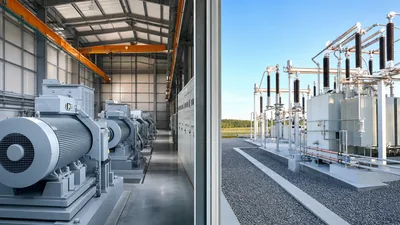
MARS manufactures this tier: liquid-cooled LFP cabinets from 93 to 372 kWh for commercial sites and containerized systems from 500 kWh to 10 MWh, plus the transformers and switchgear that connect them.
Next Steps: Specifying and Sourcing
Choosing a storage method is easiest with a short checklist:
- Define the purpose: evening self-consumption, backup, tariff shifting, demand reduction or grid services.
- Quantify the energy: kWh to be shifted per day and over what hours, from metered data.
- Quantify the power: peak kW the storage must deliver and any motor surge.
- Separate heat from electricity: store surplus as hot water or thermal mass wherever the end use is heat.
- Check the interface: existing inverter, service voltage, panel capacity, export limits.
- Check compliance: UL 9540, UL 9540A and NFPA 855 in the US, or IEC 62619 and local codes elsewhere.
Homeowners should work with a licensed installer for any battery connected to the home's electrical system. For commercial, industrial and utility projects, MARS supplies energy storage systems with integrated PCS, BMS, EMS and fire suppression, routine-tested at the factory, with FAT welcome and typical lead times of 60-90 days. Send your load profile and PV data through the quote request form.
Frequently asked questions
How is solar energy stored?
Solar electricity is most often stored chemically in lithium-ion batteries, charged through a hybrid or battery inverter. It can also be stored as heat in water tanks or building mass, as cold in ice or chilled water, and at utility scale as pumped hydro, compressed air or hydrogen. Each method converts energy into another form for later use.
Do solar panels need batteries?
No. Grid-tied solar panels work without batteries, supplying daytime loads and exporting surplus to the grid. Batteries are needed for off-grid systems, for backup power during outages, and to use more solar energy where export credits are low. Without a battery, a grid-tied system shuts down during a power cut.
What is the cheapest way to store solar energy?
For households, the cheapest way is usually to divert surplus solar into a water heater or hot-water buffer tank, and to shift dishwashers, laundry and EV charging into daytime. A 200-liter tank heated by 40 °C stores about 9.3 kWh as heat. Batteries cost more but store electricity for any use.
How long can solar energy be stored in a battery?
Lithium batteries hold charge for weeks to months with low self-discharge, typically a few percent per month, but they are designed for daily cycling rather than long-term storage. Most home systems store solar for hours, from midday to evening. Seasonal storage is impractical with batteries because of the very large capacity required.
Can you store solar energy without batteries?
Yes, as heat or cold. Surplus solar can heat water, warm or cool the building's thermal mass, or freeze ice for later cooling. Net metering is sometimes described as storage, but it only credits exported energy on the bill and does not provide power during an outage.
How do solar batteries work with solar panels?
Solar panels produce DC electricity that an inverter or charge controller uses first for household loads. Surplus charges the battery, managed by its BMS. When solar output falls below demand, the battery discharges through the inverter to power the home, and in backup systems it keeps critical circuits running during outages.
Written and reviewed by the MARS application engineering team in Shanghai, who specify and test transformers, switchgear, substations and battery storage for projects in 40+ countries. Last updated .
Tags: how to store solar energy solar energy storage how is solar energy stored how do solar batteries work solar energy storage methods