Key takeaways
- A battery stores chemical potential energy, not electricity; it converts that energy to electrical energy only when a circuit is connected.
- Cell voltage equals the difference between the electrode potentials, so a zinc-copper Daniell cell gives 0.34 − (−0.76) = 1.10 V.
- Electrons travel through the external wire from anode to cathode, while ions carry charge through the electrolyte to complete the circuit.
- Stored energy in watt-hours equals nominal voltage times amp-hour capacity, so a 3.2 V, 280 Ah LFP cell stores about 896 Wh.
- Rechargeable lithium-ion cells shuttle Li+ ions between graphite and a metal-oxide or phosphate cathode, reversing the reaction during charging.
Quick answer: Batteries work by converting stored chemical potential energy into electrical energy through a redox reaction. The anode releases electrons (oxidation), which flow through the external circuit to the cathode, where they are accepted (reduction). Ions move through the electrolyte inside the cell to balance the charge. The voltage comes from the difference in electrode potentials; the capacity comes from how much active material reacts.
Everyone uses batteries, yet the question of how a battery actually produces electricity is often answered with vague talk of "stored electricity". The real mechanism is chemistry: two materials with different appetites for electrons, kept apart so that the only way their reaction can proceed is by sending electrons through your device.
This explainer is for students, technicians and engineers moving into energy storage who want a correct, physics-based description of batteries, from the definition of a battery through electrode reactions, voltage and capacity calculations, to how rechargeable lithium-ion cells and grid-scale systems build on the same principles.
What Is a Battery? Definition in Physics
A battery is a device of one or more electrochemical cells that converts stored chemical energy directly into direct-current electrical energy. In physics, a battery is described as a source of electromotive force (EMF): it maintains a potential difference between its terminals by doing work on charges, using energy released by chemical reactions.
Strictly, a single unit is a cell, and a battery is several cells connected together, as in a 12 V lead-acid battery made of six 2 V cells. In everyday use the word covers both.
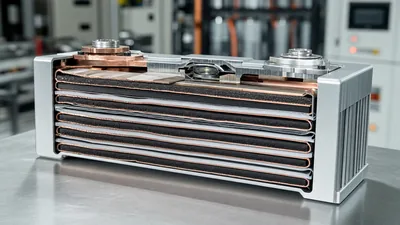
Every electrochemical cell has four essential parts:
- Anode, the negative electrode during discharge, where oxidation releases electrons.
- Cathode, the positive electrode during discharge, where reduction accepts electrons.
- Electrolyte, an ionic conductor that lets ions, but not electrons, move between the electrodes.
- Separator, a porous insulating membrane that keeps the electrodes from touching while allowing ions through.
The purpose of a battery is to provide portable or stored electrical energy where and when it is needed: in a phone, a vehicle, a backup system or a utility-scale plant. Batteries are classed as primary (single-use, such as alkaline) or secondary (rechargeable, such as lead-acid and lithium-ion). Our article on what is inside a battery shows these components in real cells, and the history of the device is covered in the invention of the electric battery.
What Type of Energy Is Stored in a Battery?
A battery stores chemical potential energy, energy held in the arrangement of atoms and electrons in its electrode materials. It does not store electricity in the sense of a tank of electrons; the number of electrons in a charged and discharged battery is the same. What changes is the chemical state of the electrodes.
Is a battery potential or kinetic energy? Potential. The energy is available because the reactants are in a higher-energy state than the products. Kinetic energy (moving charges) appears only once current flows in a circuit.
| Stage | Energy form | Where it is |
|---|---|---|
| Charged, idle | Chemical potential energy | Electrode materials and their bonds |
| Discharging | Electrical energy | Electrons moving through the external circuit |
| In the load | Light, heat, motion, sound | Lamp, motor, speaker, heater |
| Losses | Heat | Internal resistance and side reactions |
| Charging (rechargeable) | Electrical to chemical | Electrodes return to the high-energy state |
So the energy transformation of a battery during use is chemical to electrical, followed by electrical to whatever form the load needs. Other storage methods hold energy in different forms: pumped hydro and flywheels store mechanical energy, as explained in our guide to mechanical energy storage. For a deeper treatment of the physics of stored energy in cells, see what is battery energy.
How Does a Battery Produce Electricity?
The core of every battery is a redox reaction, a chemical reaction in which one substance loses electrons (oxidation) and another gains them (reduction). In a battery the two half-reactions are physically separated, so electrons must travel through the outside circuit to get from one to the other. That flow is the electric current.
Step by step during discharge
- A load connects the two terminals, providing an external path for electrons.
- At the anode, atoms are oxidized and release electrons into the electrode's current collector.
- Electrons flow through the wire and the device toward the cathode, doing useful work on the way.
- At the cathode, the arriving electrons reduce the cathode material.
- Inside the cell, ions migrate through the electrolyte and separator to keep each electrode electrically neutral.
- The reaction continues until the reactants are depleted or the voltage falls to the cut-off point.
What creates an electric current in a battery is therefore the difference in chemical potential between the electrodes, expressed as a voltage. Battery electron flow is always from anode to cathode through the external circuit; conventional current, defined in the opposite direction, flows from the positive terminal through the load to the negative terminal.
If ions could not move, charge would build up at each electrode and the reaction would stop within microseconds. This is why a battery is a closed loop: electrons outside, ions inside. If the separator fails and electrodes touch, electrons take the internal shortcut, releasing the energy as heat, which can trigger the processes described in our thermal runaway guide.
Worked Example: Calculating Cell Voltage and Energy
The Daniell cell, zinc in zinc sulfate and copper in copper sulfate, is the textbook example of how a battery's voltage arises.
- Anode (oxidation):
Zn → Zn²⁺ + 2e⁻, standard potential E° = −0.76 V. - Cathode (reduction):
Cu²⁺ + 2e⁻ → Cu, E° = +0.34 V.
Standard cell voltage is E°_cell = E°_cathode − E°_anode = 0.34 − (−0.76) = 1.10 V.
The chemical energy released per mole of reaction follows from the Gibbs free energy relation ΔG = −n × F × E, where n is electrons transferred and F is Faraday's constant, 96,485 C/mol:
ΔG = −2 × 96,485 × 1.10 = −212,267 J/mol ≈ −212 kJ/mol.
The negative sign means the reaction releases energy spontaneously. The theoretical charge per gram of zinc is 2 × 96,485 / (65.38 × 3.6) ≈ 820 mAh/g.
From cell to useful numbers
For practical cells, stored energy is E (Wh) = V_nominal × Q (Ah). A 3.2 V, 280 Ah LFP cell stores 3.2 × 280 = 896 Wh. Sixteen in series form a 51.2 V module of about 14.3 kWh. The amount of charge remaining relative to full is the state of charge, which is explained in our battery SoC guide.
How Do Rechargeable Batteries Store Energy?
In a rechargeable battery the reactions are reversible. Applying an external voltage greater than the cell voltage forces electrons back into the anode and drives ions back across the electrolyte, restoring the high-energy chemical state.
In a lithium-ion cell, the mechanism is intercalation: lithium ions slot into and out of the crystal structures of the electrodes without the electrodes themselves dissolving or re-forming.
- Charging: Li⁺ ions leave the cathode (for example LiFePO4 or a nickel-manganese-cobalt oxide), cross the electrolyte and insert between graphite layers in the anode; electrons travel through the charger to the anode.
- Discharging: Li⁺ ions return to the cathode, and electrons flow through the load.
| Chemistry | Nominal cell voltage | Rechargeable | Typical use |
|---|---|---|---|
| Alkaline (Zn/MnO2) | 1.5 V | No | Household devices |
| Nickel-metal hydride | 1.2 V | Yes | Rechargeable AA cells, hybrids |
| Lead-acid | 2.0 V | Yes | Vehicle starting, UPS |
| Lithium-ion NMC | 3.6–3.7 V | Yes | Electronics, EVs |
| Lithium iron phosphate (LFP) | 3.2 V | Yes | Stationary storage, buses |
| Sodium-ion | About 3.0–3.1 V | Yes | Emerging stationary and EV use |
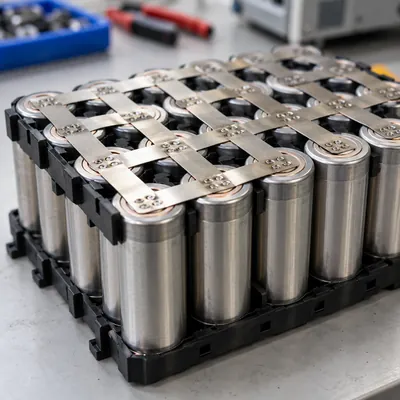
Each cycle causes small irreversible changes, such as growth of the solid electrolyte interphase on graphite, which is why capacity fades over time. Chemistry trade-offs are compared in LFP vs NMC, and the cylindrical format most people know is explained in our 18650 lithium battery guide.
What Is the Role of a Battery in a Circuit?
In circuit terms, a battery is modeled as an ideal voltage source (its EMF) in series with an internal resistance r. Terminal voltage under load is:
V_terminal = EMF − I × r
For example, a 12.8 V LFP battery with 20 mΩ internal resistance delivering 100 A has a terminal voltage of 12.8 − 100 × 0.020 = 10.8 V, and dissipates I² × r = 100² × 0.020 = 200 W as internal heat. This is why high-current batteries need low internal resistance and thermal management.
Key ratings that describe a battery's function in a system:
- Capacity (Ah): total charge deliverable between full and cut-off.
- Energy (Wh or kWh): voltage times capacity.
- Power (W or kW): rate at which energy can be delivered.
- C-rate: current relative to capacity; 1C empties the battery in about one hour.
- Round-trip efficiency: energy out divided by energy in, roughly 92–96% for LFP and 75–85% for lead-acid.
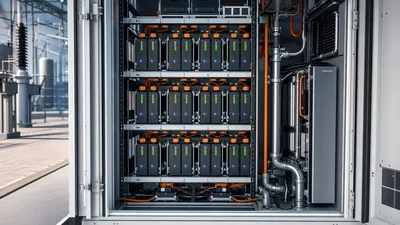
In large systems, thousands of cells are combined with a battery management system, power conversion system and controls. These building blocks are set out in our guide to battery energy storage system components.
Next Steps: Specifying and Sourcing
Understanding how batteries work is the foundation for specifying them. When moving from theory to a real project, translate the chemistry into requirements: nominal and operating voltage window, usable energy in kWh, continuous and peak power, cycle life at a stated depth of discharge, operating temperature, round-trip efficiency and safety certifications such as IEC 62619, UL 1973, UL 9540 and UL 9540A.
It also helps to compare chemistries on usable energy, cycle life and safety behavior rather than on nominal voltage alone. For stationary storage, LFP is generally preferred because its phosphate cathode is thermally stable and supports thousands of cycles, while NMC offers higher energy density for weight-sensitive uses.
MARS manufactures stationary lithium iron phosphate energy storage systems that apply these principles at commercial and utility scale: liquid-cooled C&I cabinets of 93–372 kWh and containerized systems from 500 kWh to 10 MWh, complete with PCS, BMS/EMS and fire suppression. Every unit receives routine tests, factory acceptance testing is welcome, and typical lead time is 60–90 days. To discuss a project, send your load profile and site details through our quotation request.
Frequently asked questions
How does a battery work in simple terms?
A battery contains two different materials separated by an electrolyte. One material wants to give up electrons and the other wants to accept them. When you connect a device, electrons flow from one side to the other through the device, powering it, while ions move inside the battery to keep the reaction going.
What form of energy is stored in a battery?
A battery stores chemical potential energy in the chemical bonds and electron arrangement of its electrode materials. It converts that to electrical energy when a circuit is connected. It does not store electric charge in the way a capacitor does; the electrons are present in equal number whether charged or discharged.
Why do batteries go flat?
A battery goes flat when its reactive materials have been converted from their high-energy state to their low-energy state, so the voltage falls to the cut-off point. Rechargeable batteries can be restored by forcing current backward with a charger; primary batteries cannot be safely recharged because their reactions are not reversible.
Do electrons flow through the battery?
Electrons flow through the external circuit, from the anode to the cathode, during discharge. Inside the battery, charge is carried by ions moving through the electrolyte, not by electrons. The separator is an electronic insulator; if electrons could cross inside the cell, it would short-circuit and release its energy as heat.
What determines a battery's voltage?
Voltage is set by the chemistry: the difference in electrode potentials between the cathode and anode materials. Zinc and copper give 1.10 V; lead-acid about 2.0 V per cell; lithium-ion 3.2–3.7 V per cell. Higher voltages are obtained by connecting cells in series, so six lead-acid cells make a 12 V battery.
What is the difference between a cell and a battery?
A cell is a single electrochemical unit with one anode, one cathode and electrolyte, producing a voltage set by its chemistry. A battery is a group of cells connected in series, parallel or both to achieve a higher voltage, capacity or both. In everyday language both are called batteries.
Written and reviewed by the MARS application engineering team in Shanghai, who specify and test transformers, switchgear, substations and battery storage for projects in 40+ countries. Last updated .
Tags: how do batteries work how does a battery work define battery what type of energy is stored in a battery how do batteries store energy