Key takeaways
- A single-phase 5 kVA transformer carries 10.4 A at 480 V, 20.8 A at 240 V and 41.7 A at 120 V, from I = VA / V.
- Primary-only protection under NEC 450.3(B) for 10.4 A is 125%, or 13 A, rounded up to a 15 A standard fuse or breaker.
- Dual-voltage 240 × 480 V primaries and 120/240 V secondaries are reconfigured by series or parallel jumpers between H and X terminals.
- Starting a 1 hp, 120 V motor drawing about 96 A locked-rotor current can dip a 3% impedance 5 kVA transformer's voltage by roughly 7%.
- Most 5 kVA units are encapsulated in resin for NEMA 3R outdoor use, while 1:1 versions with electrostatic shields serve as isolation transformers.
Quick answer: A 5 kVA transformer is a small, usually single-phase dry-type transformer that delivers 5,000 VA: 41.7 A at 120 V or 20.8 A at 240 V. A 5kVA transformer 480V to 120V draws 10.4 A from the primary and is commonly protected by a 15 A primary device. Typical uses are lighting, controls, signage, workshop circuits and 1:1 isolation for sensitive equipment.
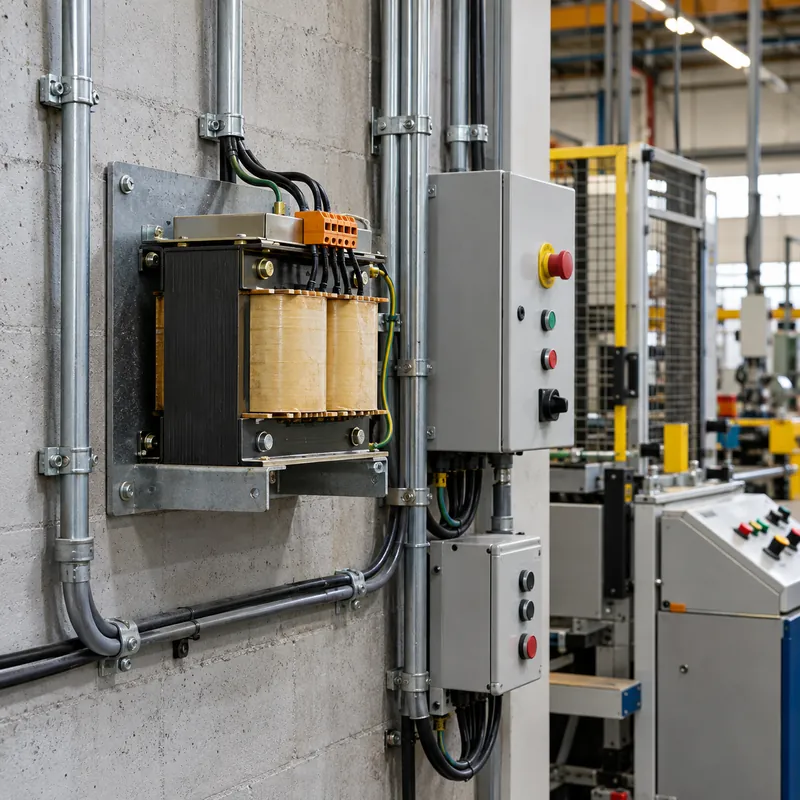
The 5 kVA rating is the workhorse of small electrical jobs: a 120 V lighting circuit in a 480 V plant, a sign on a parking lot pole, a 240 V machine in a workshop fed from a different system, or a clean, isolated supply for a laboratory bench. It is small enough to mount on a wall or a strut channel frame, yet large enough that sizing and protection mistakes do cause real problems.
This guide is for contractors, maintenance electricians and engineers selecting a 5kVA transformer. It focuses on single-phase designs, the 480 V to 120 V application, multi-tap wiring, isolation versions and the checks that matter when motors or electronic loads are involved. Connections to building wiring must follow local code and be made by a licensed electrician.
What Is a 5 kVA Transformer?
A 5 kVA transformer is a transformer rated to supply 5,000 volt-amperes continuously at rated voltage within its design temperature rise. In real power terms, it supplies 5 kW only at unity power factor; at 0.8 PF it delivers 4 kW. That distinction matters for motor and inductive loads.
Most 5 kVA units fall into four product types:
| Type | Construction | Typical voltages | Typical use |
|---|---|---|---|
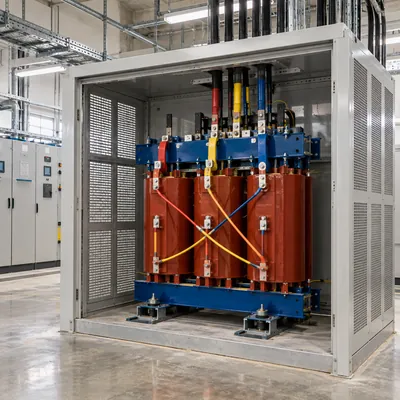
| General-purpose encapsulated | Core and coil potted in resin, NEMA 3R | 240 × 480 V to 120/240 V | Lighting, signs, receptacles, outdoor loads |
| Ventilated dry-type | Open windings in louvred enclosure | Same, indoor | Indoor electrical rooms |
| Isolation (1:1, shielded) | Separate windings with electrostatic shield | 120:120, 240:240, 480:480 V | Lab benches, medical carts, sensitive electronics |
| Industrial control transformer | Open core and coil, high inrush capability | 240/480 V to 120 V or 24 V | Control circuits with contactors and solenoids |
Control transformers are sized differently, using inrush VA of contactor coils rather than steady kVA; our 24V control transformer guide explains the method. Small toroidal transformers also exist at this rating for equipment manufacturers, covered in our toroidal transformer guide.
Three-phase 5 kVA units are uncommon; for three-phase loads the next practical size is usually 9 or 15 kVA. For larger panels see our 30 kVA transformer guide.
5 kVA Transformer Amps at Common Voltages
For single-phase units, I = VA / V. For the rare three-phase unit, I = VA / (√3 × V).
| Voltage | Single-phase 5 kVA | Three-phase 5 kVA |
|---|---|---|
| 600 V | 8.3 A | 4.8 A |
| 480 V | 10.4 A | 6.0 A |
| 277 V | 18.1 A | Not applicable |
| 240 V | 20.8 A | 12.0 A |
| 208 V | 24.0 A | 13.9 A |
| 120 V | 41.7 A | Not applicable |
In practical terms, a 5 kVA transformer at 120 V can supply about two fully loaded 20 A branch circuits at the 80% continuous limit (2 × 16 A = 32 A), with some margin. At 120/240 V split-phase, each 120 V leg carries up to 20.8 A when balanced.
Short-circuit level. Small encapsulated transformers often have impedance in the range of about 2–5%. With 3% impedance and a stiff source, secondary bolted fault current at 120 V is about 41.7 / 0.03 ≈ 1,390 A, well within the 10 kA rating of standard branch breakers.
If your 120 V supply comes from a 277 V lighting circuit rather than 480 V, the same 5 kVA rating draws 18.1 A on the primary; our 277 to 120 transformer guide covers that variant.
5kVA Transformer 480V to 120V: Wiring and Protection
The 5kVA transformer 480V to 120V application, a 120 V supply from a 480 V industrial bus, is the most searched configuration. Most units sold for it are multi-tap: a 240 × 480 V primary and a 120/240 V secondary, each made of two equal coils.
Primary connections
- 480 V: coils in series. Jumper H2 to H3; supply on H1 and H4.
- 240 V: coils in parallel. Jumper H1 to H3 and H2 to H4; supply on H1 and H4.
Secondary connections
- 120/240 V three-wire: coils in series. Jumper X2 to X3 and use it as the neutral (X0); lines on X1 and X4.
- 120 V two-wire, full 5 kVA: coils in parallel. Jumper X1 to X3 and X2 to X4; output on X1 and X4.
Always follow the nameplate diagram, since terminal arrangements vary. Our guide on how to connect a step-down transformer covers polarity and bonding in more detail.
Worked protection example (480 V to 120 V two-wire):
- Primary current:
5,000 / 480 = 10.4 A. NEC 450.3(B) primary-only:10.4 × 1.25 = 13.0 A, next standard size up: 15 A. - Secondary current:
5,000 / 120 = 41.7 A. - For a single-phase two-wire secondary, NEC 240.21(C)(1) allows the primary device to protect the secondary conductors if the primary rating does not exceed the conductor ampacity times the voltage ratio.
15 A × (480 / 120) = 60 A, so secondary conductors rated at least 60 A satisfy this rule. - Alternatively, install a secondary breaker of 50 A, or up to 60 A (the next standard size above
41.7 × 1.25 = 52 A) where conductors allow, and size conductors to that breaker.
The secondary is a separately derived system: bond X2 (or the neutral) to ground under NEC 250.30. See our transformer fuse sizing guide for the alternative primary-and-secondary method.
5 kVA Isolation Transformer: When You Need 1:1
A 5 kVA isolation transformer keeps the same voltage on both sides but separates the circuits galvanically. Typical ratings are 120 V to 120 V (41.7 A), 240 V to 240 V (20.8 A) or 230 V to 230 V for IEC markets (21.7 A).
Good reasons to specify one at this size:
- Laboratory and test benches where a floating secondary reduces the shock path for technicians working on equipment under test.
- Medical carts and imaging accessories where leakage current must meet IEC 60601-1 limits for a medical electrical system.
- Audio, video and instrumentation suffering from ground loops or common-mode noise; an electrostatic shield bonded to ground diverts capacitively coupled noise.
- Marine shore power to stop galvanic corrosion currents flowing between vessel and shore ground.
- Equipment with a grounding scheme incompatible with the building supply.
Key specification points are the shield (single or multiple), interwinding capacitance and leakage current, insulation class, whether the secondary will be grounded or floating, and any listing requirement. Our isolation transformer guide explains grounding choices, IEC 61558 types and the limits of what isolation achieves.
Note that an isolation transformer does not regulate voltage or remove harmonics. For heavily non-linear loads such as switch-mode supplies, oversize by one step or choose a K-rated design.
Can a 5 kVA Transformer Start a Motor?
Motor starting is where small transformers most often disappoint. Running current may be well within rating, but locked-rotor current during starting is typically about six times full-load current, and the transformer's impedance turns that surge into a voltage dip.
A quick estimate of voltage dip:
Dip (%) ≈ Starting kVA / (Transformer kVA / Z) × 100
where Z is transformer per-unit impedance, ignoring source impedance.
Example: a 1 hp, 120 V single-phase motor with full-load current of about 16 A and locked-rotor current of about 96 A.
- Starting kVA:
120 × 96 = 11.5 kVA. - Transformer short-circuit capacity with 3% impedance:
5 / 0.03 = 167 kVA. - Dip:
11.5 / 167 ≈ 6.9%.
A 7% dip is usually acceptable for the motor, but can flicker lights and drop out sensitive contactors or electronics on the same transformer. Larger motors (2 hp at 240 V and above) will cause larger dips; the options are a bigger transformer, a separate supply for lighting and controls, or a soft starter. Background on starting current is in our transformer inrush current guide, which also covers the transformer's own energizing inrush, a reason to prefer time-delay primary fuses.
Installation and Enclosure Considerations
Even small transformers need proper installation:
- Enclosure rating: encapsulated units are typically NEMA 3R for outdoor use; confirm the rating if mounting on a pole, roof or wash-down area. In IEC markets specify the IP code.
- Mounting orientation: many encapsulated units can be wall-mounted with conduit entries from below only; follow the nameplate instructions to keep rain out of the wiring compartment.
- Clearance: NEC 450.21(A) requires 12 in from combustible material for indoor dry-type units of 112.5 kVA or less unless a barrier is used, and ventilation openings must stay clear under NEC 450.9.
- Grounding: bond the enclosure and the secondary neutral per NEC 250.30, using a grounding electrode conductor to the building electrode system or structural steel where permitted.
- Temperature: encapsulated units run warm on the surface; avoid mounting in direct sun in hot climates without derating, and keep them away from walkways where people could touch hot surfaces.
- Noise: small transformers produce low but noticeable hum; avoid quiet offices and bedrooms or use vibration isolators.
Label the transformer with source, voltages and the location of its primary disconnect, and include it on the facility's one-line drawing so future maintenance staff can isolate it safely.
Next Steps: Specifying and Sourcing
For a 5 kVA transformer, the specification can be short but should be complete:
- kVA rating, single- or three-phase, and frequency (50 or 60 Hz).
- Primary and secondary voltages, taps and whether dual-voltage windings are needed.
- Type: encapsulated, ventilated, shielded isolation or industrial control.
- Load description: lighting, receptacles, motors (with horsepower) or electronics, so inrush and harmonics can be considered.
- Enclosure rating, mounting method and ambient conditions.
- Listing and standards: UL 1561 or UL 5085 for small units in North America, IEC 61558 or IEC 60076-11 elsewhere.
MARS's dry-type transformer range is focused on distribution ratings, including cast-resin units for buildings and industrial plants, alongside HV and LV switchgear and complete substations. When small 5 kVA supplies are part of a wider project that also needs distribution transformers or switchboards, list them in the same RFQ so the engineering team can advise on scope. MOQ is one unit, routine tests are performed on every transformer and typical lead time is 25–45 days. Send details through the quote page.
For one-off replacements, copy the full nameplate of the old unit, including impedance and terminal diagram, so the new transformer matches.
Frequently asked questions
How many amps can a 5 kVA transformer handle?
A single-phase 5 kVA transformer handles 41.7 A at 120 V, 20.8 A at 240 V and 10.4 A at 480 V. A three-phase 5 kVA unit handles 13.9 A at 208 V and 6.0 A at 480 V. Divide 5,000 VA by the voltage for single-phase, or by √3 times line voltage for three-phase.
What size breaker do I need for a 5 kVA transformer on 480 V?
A 5 kVA single-phase transformer draws 10.4 A at 480 V. With primary-only protection under NEC 450.3(B), the maximum is 125%, or 13 A, which rounds up to a 15 A breaker or time-delay fuse. Secondary conductors also need protection under NEC 240.21(C), either through the primary device ratio rule or a secondary breaker.
How much load can a 5 kVA transformer run?
A 5 kVA transformer can run up to 5,000 VA continuously, which is about 4 kW at 0.8 power factor or 5 kW of resistive load. At 120 V that equals roughly two fully loaded 20 A circuits at the 80% continuous limit. Motor starting surges and non-linear electronic loads reduce the practical capacity.
Is 5 kVA the same as 5 kW?
No. kVA is apparent power and kW is real power. A 5 kVA transformer delivers 5 kW only to a purely resistive load at unity power factor. With a typical 0.8 power factor load it delivers 4 kW. Transformers are rated in kVA because their heating depends on current, regardless of the load's power factor.
Can I use a 5 kVA transformer backwards to step up voltage?
Many general-purpose dry-type transformers can be reverse-fed to step up voltage, but small units may have compensated windings that give slightly low output when reversed, and inrush is higher when energizing the low-voltage winding. Neutral and grounding arrangements also change. Check the manufacturer's approval and nameplate before reverse feeding, and have a licensed electrician install it.
Do I need a shielded 5 kVA isolation transformer?
A shielded 5 kVA isolation transformer is worthwhile when you need to break ground loops, reduce common-mode electrical noise for instruments, audio or medical equipment, or provide a floating secondary for test benches. For ordinary lighting or receptacle loads where voltage conversion is the only goal, a standard general-purpose transformer is sufficient.
Written and reviewed by the MARS application engineering team in Shanghai, who specify and test transformers, switchgear, substations and battery storage for projects in 40+ countries. Last updated .
Tags: 5 kva transformer 5kva transformer 5kva transformer 480v to 120v 5 kva isolation transformer single phase 5 kva transformer