Key takeaways
- A three-phase 30 kVA transformer carries 36.1 A at 480 V, 72.2 A at 240 V and 83.3 A at 208 V on each phase.
- A single-phase 30 kVA unit carries 62.5 A at 480 V and 125 A at 240 V, which suits a 125 A or 150 A secondary panel.
- Primary-only protection under NEC 450.3(B) for a 480 V, 30 kVA three-phase unit is 125% of 36.1 A, giving a maximum 50 A fuse or breaker.
- NEC 450.21(A) requires dry-type units of 112.5 kVA or less indoors to be 12 in from combustible material unless separated by a fire-resistant barrier.
- Sizing at 80–85% of nameplate after demand factors leaves headroom; a 26.5 kVA calculated load fits a 30 kVA unit at about 88%.
Quick answer: A 30 kVA transformer is a common three-phase dry-type size for small commercial panels. On a 480 V primary it draws 36.1 A; its 208Y/120 V secondary delivers 83.3 A per phase. The most popular configuration is 480 V delta to 208Y/120 V for lighting and receptacles, while 480 to 240 V versions serve 240 V equipment. Typical ventilated units weigh roughly 200–350 lb.
The 30 kVA rating sits at a practical sweet spot. It is large enough to supply a full 42-circuit panel of lighting, receptacles and small equipment, yet small enough to wall-mount or tuck into an electrical closet without a dedicated transformer vault.
This guide is for electrical engineers, contractors and facility managers selecting a 30kVA transformer for a commercial building, workshop, retail fit-out or equipment skid. It covers current values at common voltages, the main configurations, typical dimensions and weights, a worked load-sizing example and installation rules. Work on building feeders must follow local code and be carried out by a licensed electrician.
What Is a 30 kVA Transformer Used For?
A 30 kVA transformer is a transformer rated to deliver 30,000 volt-amperes of apparent power continuously at rated voltage without exceeding its design temperature rise. kVA is used instead of kW because the transformer's heating depends on current, regardless of load power factor; our kVA vs kW guide explains the difference.
Typical applications include:
- Tenant and floor panels: stepping a 480Y/277 V building service down to 208Y/120 V for receptacles, small HVAC and IT equipment in offices and retail spaces.
- Workshops and light industry: supplying 240 V three-phase machines or 120/240 V single-phase loads from a 480 V plant bus.
- Equipment skids and packaged plant: pumps, compressors and controls imported for a different voltage.
- Isolation duty: creating a separately derived system for sensitive loads, with an electrostatic shield where common-mode noise matters.
- Outdoor and site services: NEMA 3R enclosed units for parking lighting, signage or temporary power.
Most 30 kVA units are three-phase, ventilated dry-type transformers with aluminium or copper windings and class 220 °C insulation. Single-phase 30 kVA units are less common but used for 120/240 V supplies in rural and residential-type applications. Smaller panels may be better served by a 15 kVA, or by the 5 kVA single-phase units discussed in our 5 kVA transformer guide.
30 kVA Transformer Amps at Common Voltages
Full-load current is the starting point for selecting conductors, overcurrent protection and the secondary panel. Use I = kVA × 1,000 / (√3 × V) for three-phase and I = kVA × 1,000 / V for single-phase.
| Voltage | Three-phase 30 kVA | Single-phase 30 kVA |
|---|---|---|
| 600 V | 28.9 A | 50.0 A |
| 480 V | 36.1 A | 62.5 A |
| 415 V | 41.7 A | 72.3 A |
| 400 V | 43.3 A | 75.0 A |
| 240 V | 72.2 A | 125.0 A |
| 208 V | 83.3 A | 144.2 A |
| 120 V | Not applicable | 250.0 A |
The 208 V figure applies per phase on the 208Y/120 V secondary of a three-phase unit. Each 120 V line-to-neutral circuit draws from one phase, so the panel must be balanced to keep every phase below 83.3 A. With 4–6% impedance, which is typical at this size, secondary bolted fault current at 208 V is roughly 83.3 / 0.04 ≈ 2,100 A or lower with real source impedance, comfortably within a 10 kA panelboard rating.
For protection, NEC 450.3(B) primary-only protection gives 36.1 × 1.25 = 45.1 A, so a 50 A device is the maximum. Secondary conductors still need protection under NEC 240.21(C), usually a 100 A main breaker on the panel, which is close to 83.3 × 1.25 = 104 A. Our transformer fuse sizing guide covers the primary-and-secondary alternative and inrush checks.
30 kVA Transformer 480 to 120/208: The Standard Configuration
The 30 kVA transformer 480 to 120/208 V, delta primary and wye secondary, is by far the most specified version in North American commercial buildings. The delta primary needs only three conductors and a ground from the 480 V switchboard; the grounded wye secondary provides 208 V three-phase and 120 V single-phase from the same panel.
Key characteristics:
- Connection: 480 V delta to 208Y/120 V, commonly with a 30° phase shift (equivalent to Dyn1 in IEC terms).
- Taps: typically two 2.5% taps above and four 2.5% taps below nominal on the primary, allowing adjustment for a high or low 480 V supply.
- Separately derived system: the secondary neutral must be bonded to ground at the transformer or first disconnect under NEC 250.30, with a grounding electrode conductor.
- Harmonics: computer and LED loads produce triplen harmonics that add in the neutral and circulate in the delta. For heavily non-linear loads specify a K-4 or K-13 rating and a 200% neutral; see our K-factor transformer guide.
For wiring details, including terminal markings H1–H3 and X0–X3 and secondary bonding, see our 480 to 208 transformer wiring diagram guide. Outside North America the equivalent is a 30 kVA, 400 V or 415 V to 400/230 V or 230 V isolating unit, or a small cast-resin unit fed from an MV supply.
30 kVA Transformer 480 to 240: Delta, High-Leg and Single-Phase Options
A 30 kVA transformer 480 to 240 V can be built three ways, and choosing the wrong one is a common field problem.
| Configuration | Secondary voltages | Best for | Watch out for |
|---|---|---|---|
| 3-phase, 480 V delta to 240 V delta | 240 V 3-phase only | Three-phase 240 V motors and machines | No neutral; ungrounded or corner-grounded secondary needs careful design |
| 3-phase, 480 V delta to 240 V delta with 120 V center tap (high-leg) | 240 V 3-phase, 120/240 V single-phase, 208 V high-leg to neutral | Shops with both 240 V 3-phase and 120 V loads | High leg must be orange-marked and on phase B per NEC 110.15 and 408.3(E) |
| Single-phase, 480 V to 120/240 V | 120/240 V split-phase | Residential-type panels, lighting, single-phase equipment | Draws 62.5 A from only two 480 V phases; check upstream balance |
The high-leg delta is useful but restrictive: only one third of its capacity is easily available for 120 V loads from the center-tapped winding, and the 208 V high leg must never feed 120 V circuits. Our 3 phase high-leg delta transformer article explains how to rate the lighting winding. For a broader look at the voltage pair, see the 480V to 240V transformer guide.
If the load is mainly 240 V single-phase equipment, a single-phase unit is simpler and cheaper; if it is three-phase motors, a straight delta-delta or delta-wye 480 to 240Y/139 V design is preferable.
30 kVA Transformer Dimensions and Weight
Searches for 30 kVA transformer dimensions usually come from contractors planning closet space or wall mounting. Dimensions vary significantly with winding material, temperature rise, K-rating, efficiency level and enclosure type, so use the manufacturer's outline drawing for final layout. The ranges below are indicative for ventilated, three-phase, 480 V to 208Y/120 V units with 150 °C rise.
| Parameter | Indicative range | What increases it |
|---|---|---|
| Height | About 24–34 in (610–860 mm) | Lower temperature rise, copper-to-aluminium differences, K-rating |
| Width | About 18–25 in (460–635 mm) | Higher efficiency core, electrostatic shield |
| Depth | About 14–20 in (355–510 mm) | Weathershields for NEMA 3R |
| Weight | About 200–350 lb (90–160 kg) | Copper windings, 80 °C or 115 °C rise |
Allow for more than the box itself:
- Ventilation: NEC 450.9 requires ventilation openings to be kept clear; manufacturers usually specify a minimum clearance, often around 6 in, from walls behind ventilated units.
- Combustibles: NEC 450.21(A) requires 12 in separation from combustible material for indoor dry-type units of 112.5 kVA or less, unless a fire-resistant, heat-insulating barrier is installed.
- Working space: NEC 110.26 working clearance in front of the wiring compartment.
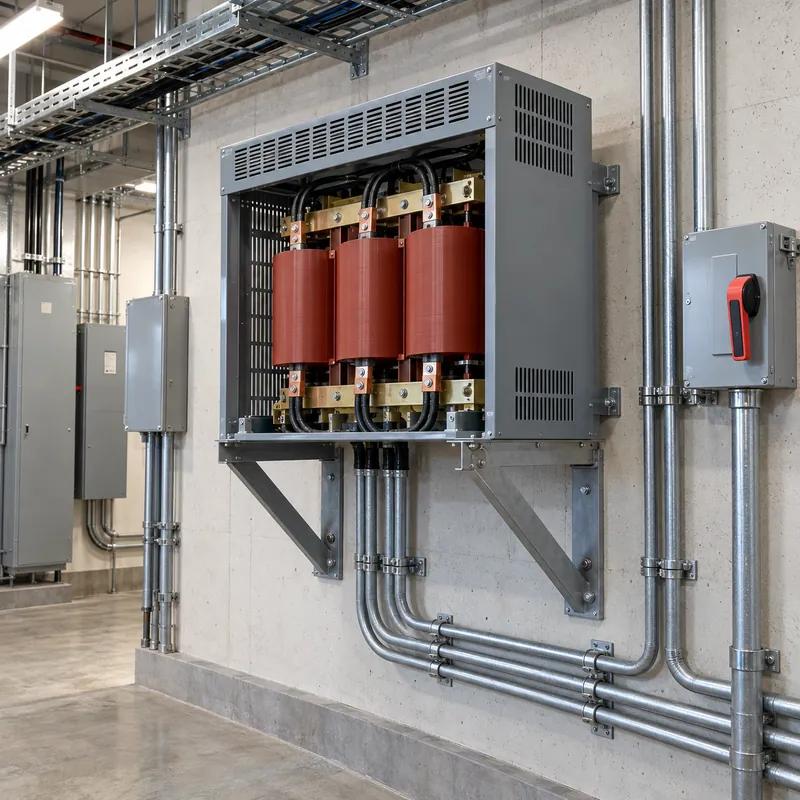
- Mounting: wall brackets or ceiling trapeze supports must carry the full weight with margin; floor mounting needs a level pad and vibration isolation if noise is a concern.
Our transformer weight and dimensions guide gives ranges across the full kVA scale.
Worked Example: Is 30 kVA Enough for This Panel?
A retail fit-out needs a 208Y/120 V panel fed from the building's 480Y/277 V service. Loads, after applying NEC Article 220 rules:
- Lighting: 7.6 kVA LED lighting, continuous, so
7.6 × 1.25 = 9.5 kVAfor sizing. - Receptacles: 18 kVA connected. NEC 220.44 demand: first 10 kVA at 100% plus remainder at 50%, giving
10 + 4 = 14 kVA. - Miscellaneous equipment: signage, small split AC and a door heater, 3.0 kVA.
- Total:
9.5 + 14 + 3.0 = 26.5 kVA.
Selection: 26.5 / 30 = 88% of nameplate. A 30 kVA unit works, though with limited growth margin. If the tenant expects more than about 10% additional load, a 45 kVA unit is the safer choice; transformer losses at light load are small compared with the cost of replacement later.
Secondary current: 26,500 / (1.732 × 208) = 73.6 A per phase if perfectly balanced. With the typical imbalance of a real panel, the heaviest phase might be 80 A, close to the 83.3 A rating, so careful circuit allocation matters.
Harmonics check: if more than about half the load is LED drivers, computer equipment and electronic ballasts, consider a K-4 rated unit. The online transformer sizing calculator can be used to test alternative load mixes.
Next Steps: Specifying and Sourcing
A clear specification for a 30 kVA transformer should include:
- Rating and phases: 30 kVA, three-phase or single-phase, 60 Hz or 50 Hz.
- Primary and secondary voltages and connections, e.g., 480 V delta to 208Y/120 V, and tap arrangement.
- Winding material (aluminium or copper), insulation class and temperature rise (150 °C, 115 °C or 80 °C).
- K-factor rating and neutral capacity if loads are non-linear.
- Efficiency requirement, for example compliance with US DOE 10 CFR Part 431 for LV dry-type units, or IEC 60076-11 and local efficiency rules elsewhere.
- Enclosure: indoor ventilated, NEMA 3R outdoor or IP rating, and mounting method.
- Standards and listing: IEEE C57.12.01, UL 1561 or IEC 60076-11.
MARS manufactures dry-type transformers in standard and custom ratings, plus oil-immersed transformers for outdoor distribution, with ANSI/IEEE and IEC variants at 50 or 60 Hz. MOQ is one unit, every transformer is routine-tested, FAT witness is welcome and typical lead time is 25–45 days. Send your voltages, load list and site details through the quote page.
If several tenant panels need identical units, specify them together; one design and test record covers the batch.
Frequently asked questions
How many amps is a 30 kVA transformer?
A three-phase 30 kVA transformer carries 36.1 A at 480 V, 72.2 A at 240 V and 83.3 A at 208 V. A single-phase 30 kVA unit carries 62.5 A at 480 V, 125 A at 240 V and 250 A at 120 V. Use I = kVA × 1000 / (√3 × V) for three-phase and I = kVA × 1000 / V for single-phase.
What size breaker do I need for a 30 kVA transformer?
For a three-phase 30 kVA transformer with a 480 V primary, NEC 450.3(B) primary-only protection allows up to 125% of 36.1 A, which rounds up to a 50 A breaker. The 208 V secondary typically has a 100 A main breaker on the panel to protect secondary conductors under NEC 240.21(C). Confirm conductor ampacity and inrush.
What size wire is needed for a 30 kVA transformer?
Wire size depends on the overcurrent device, conductor material, insulation temperature rating and installation conditions. As an example, a 50 A primary breaker commonly pairs with 8 AWG copper at 75 °C, and a 100 A secondary main with 3 AWG copper, subject to NEC 310.16, voltage drop and termination ratings. A licensed electrician or engineer should verify.
How much does a 30 kVA transformer weigh?
A ventilated three-phase 30 kVA dry-type transformer typically weighs roughly 200 to 350 lb (90 to 160 kg). Copper windings, lower temperature rise designs, K-factor ratings and outdoor enclosures add weight. Always check the manufacturer's outline drawing before designing wall brackets or ceiling supports, and allow a safety margin on the support structure.
Can a 30 kVA transformer be used for 480 to 240 V?
Yes. A 30 kVA transformer can be built as 480 V delta to 240 V delta for three-phase motors, 480 V delta to 240 V delta with a 120 V center tap for mixed loads, or single-phase 480 V to 120/240 V. Choose based on whether loads are three-phase, single-phase or both, and on neutral and grounding needs.
Is a 30 kVA transformer enough for a house?
A 30 kVA single-phase transformer provides 125 A at 240 V, which can supply a typical home with moderate electric loads. Homes with electric heating, several EV chargers or large heat pumps may need more. Utility service transformers are sized by the utility using diversity across several houses; customer work must follow local code and use a licensed electrician.
Written and reviewed by the MARS application engineering team in Shanghai, who specify and test transformers, switchgear, substations and battery storage for projects in 40+ countries. Last updated .
Tags: 30 kva transformer 30kva transformer 30 kva transformer dimensions 30 kva transformer 480 to 120 208 30 kva transformer 480 to 240