Key takeaways
- Standard transformer maintenance services prevent dielectric breakdown through regular oil sampling, physical inspection, and electrical diagnostic testing.
- Dissolved Gas Analysis (DGA) in accordance with IEC 60599 and IEEE C57.104 serves as the most critical non-invasive diagnostic for identifying thermal and electrical faults.
- Dielectric dissipation factor (tan delta) testing on high-voltage bushings and windings detects moisture ingress and insulation deterioration before catastrophic flashover occurs.
- On-load tap changers account for roughly 30% of power transformer failures, requiring dedicated mechanical overhaul and contact wear profiling every 50,000 to 100,000 operations.
- Industrial plant managers should evaluate transformer testing companies based on ISO 17025 laboratory accreditation, calibrated test equipment, and multi-standard compliance.
Quick answer: Transformer maintenance services encompass routine visual inspections, insulating fluid diagnostic testing, electrical insulation screening, on-site mechanical servicing, and corrective repairs. Engaging certified engineering teams for periodic maintenance mitigates catastrophic dielectric breakdown, extends asset lifespan beyond 30 years, and ensures compliance with IEC 60076 and IEEE C57 standards.
High-voltage and medium-voltage transformers form the backbone of industrial facilities, renewable installations, and utility substations. When an unexpected outage occurs, the cost of unplanned downtime frequently exceeds the replacement value of the transformer itself. Implementing systematic transformer maintenance services enables asset managers to detect latent thermal, mechanical, and dielectric defects early. From annual fluid screening to advanced offline winding diagnostics, standard-driven servicing guarantees that fleet assets maintain continuous operating capability under heavy cyclic loads. For a fundamental overview of asset servicing programmes, consult our comprehensive transformer maintenance guide.
Core Scope of Transformer Maintenance Services
Professional maintenance services split into three distinct categories: preventive servicing, predictive condition assessment, and corrective refurbishment. Each tier addresses specific failure modes outlined in IEEE C57.125.
Preventive maintenance focuses on scheduled physical upkeep to arrest environmental and thermal degradation. Routine field activities include:
- Regasketing weeping valves, inspection covers, and high-voltage turret flanges using high-grade nitrile or fluorocarbon elastomers.
- Servicing oil preservation systems, including recharging or replacing desiccant breathers (silica gel) and testing nitrogen blanketing regulators set between 0.5 psi and 5.0 psi (3.4 kPa to 34.5 kPa).
- Cleaning and inspecting porcelain or composite transformer bushings to remove airborne pollutants that cause surface tracking.
- Testing cooling bank operation, including forced-air fan motors, circulation pumps, and automatic thermal control relays set against winding temperature indicators (WTI) and top-oil temperature indicators (OTI).
Predictive maintenance uses diagnostic testing to determine the precise health index of the asset, while corrective services address physical defects identified during testing before re-energisation.
Diagnostic Transformer Testing Services and Standards
Comprehensive transformer testing services combine chemical oil diagnostics with advanced electrical screening to determine insulation degradation without disassembling the main tank. Accredited service providers conduct these tests strictly according to IEC 60076-1 clause 11 and IEEE C57.12.90.
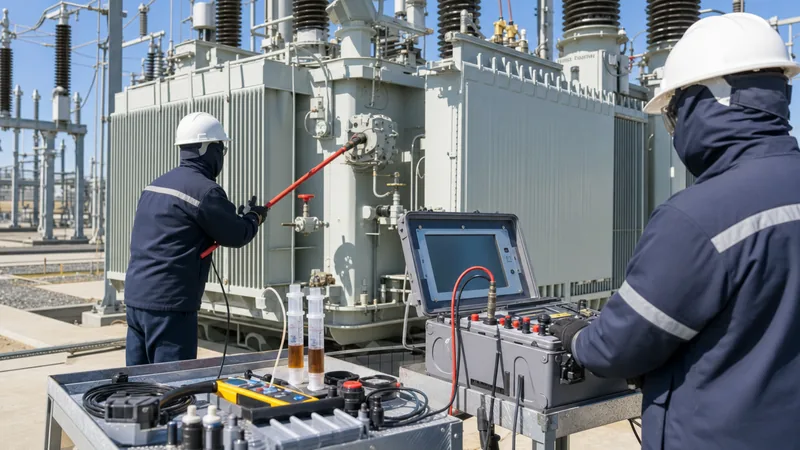
Insulating liquid analysis serves as the frontline screening tool. According to IEC 60422 for mineral insulating oils, service engineers extract bottom-valve samples using sealed glass syringes to prevent atmospheric contamination. Key fluid metrics evaluated during testing include:
- Dielectric Breakdown Voltage (IEC 60156): Minimum 30 kV for distribution equipment; minimum 50 kV to 60 kV for extra-high-voltage units across a 2.5 mm electrode gap.
- Moisture Content (IEC 60814): Karl Fischer titration identifying water in oil; acceptable thresholds sit below 15 ppm for service-aged equipment rated up to 69 kV, and below 10 ppm for assets rated at 230 kV and above.
- Interfacial Tension (ASTM D971): Measures polar contaminants and oxidation by-products; values below 25 mN/m signal advanced oil ageing requiring reclamation.
- Dissolved Gas Analysis (IEC 60599 / IEEE C57.104): Quantifies trace concentrations of hydrogen (H2), methane (CH4), ethylene (C2H4), ethane (C2H6), and acetylene (C2H2). The presence of acetylene exceeding 1 ppm to 2 ppm indicates active high-energy internal arcing.
When fluid metrics indicate active degradation, teams perform offline electrical screenings. Detailed instructions on factory-grade diagnostic procedures are covered in our guide on power transformer testing.
Transformer Repair and Maintenance: On-Site vs Factory Overhaul
Deciding between field repairs and a full factory rebuild requires clear assessment of tank integrity, winding geometry, and core losses. Field-based transformer repair and maintenance avoids heavy transport logistics, reducing total downtime from months to days when faults remain localised.
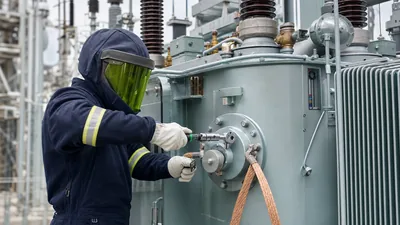
Field technicians can execute vacuum oil filling, online or offline oil processing, bushing replacements, and full on-load tap changer (OLTC) overhauls directly on the pad. Vacuum dry-out processes in the field can lower insulation paper moisture to under 1.0% by circulating hot oil alongside deep vacuum cycles down to 1 mbar (100 Pa).
However, when internal electrical diagnostics indicate severe winding distortion, inter-turn shorts, or core burn-through, factory overhaul becomes mandatory. The following decision matrix guides engineering teams when evaluating site repair versus factory intervention:
| Failure Mode / Condition | Diagnostic Indicator | Recommended Action | Typical Field Duration |
|---|---|---|---|
| Gasket degradation & external oil leaks | Visual inspection, fluid level drop | On-site regasketing | 1 to 3 days |
| High moisture in insulation paper (>3.0%) | Dielectric Frequency Response (DFR) | On-site vacuum hot-oil dry-out | 5 to 10 days |
| Severely degraded mineral oil (IFT < 20 mN/m) | Oil screening, acidity > 0.2 mg KOH/g | On-site oil reclamation or retrofit | 2 to 4 days |
| OLTC transition contact wear | Acoustic monitoring, dynamic resistance | On-site OLTC mechanism overhaul | 2 to 3 days |
| Winding deformation from through-fault | SFRA deviation exceeding IEEE C57.149 | Factory de-tanking and rewind | 6 to 12 weeks |
| Inter-turn winding short circuit | TTR error > 0.5%, elevated C2H2 | Factory rewind / core inspection | 8 to 16 weeks |
Maintenance Schedule Matrix: Intervals and Acceptance Criteria
A structured maintenance schedule establishes clear operational envelopes for field crews and substations engineers. The maintenance matrix below presents baseline testing frequencies, governing standards, and baseline acceptance thresholds for mineral-oil-immersed power and distribution units.
| Test / Inspection Parameter | Target Component | Frequency | Governing Standard | Standard Acceptance Limit |
|---|---|---|---|---|
| Visual & Gauges (OTI, WTI, Pressure) | Overall unit, coolers | Monthly | IEEE C57.93 | Readings within load profile; no active leaks |
| Dissolved Gas Analysis (DGA) | Insulating fluid | 6 to 12 months | IEC 60599 / IEEE C57.104 | Total Combustible Gas < 720 ppm (Condition 1) |
| Fluid Dielectric Breakdown | Insulating fluid | 12 months | IEC 60156 / ASTM D877 | ≥ 40 kV (≤ 69 kV); ≥ 50 kV (> 69 kV) |
| Insulation Resistance (IR / PI) | Windings to ground | 36 to 60 months | IEEE C57.152 | Polarisation Index (PI) ≥ 2.0; IR > 1,000 MΩ |
| Winding Resistance Test | Phase windings | 36 to 60 months | IEC 60076-1 clause 11.2 | Phase-to-phase balance within ± 2.0% variation |
| Winding Turns Ratio (TTR) | Winding taps | 36 to 60 months | IEEE C57.12.90 clause 6 | Ratio error ≤ ± 0.5% from nominal plate ratio |
| Power Factor / Tan Delta (δ) | Windings & bushings | 36 to 60 months | IEEE C57.152 clause 7.2 | Winding tan δ ≤ 0.5% at 20°C (new/aged limits) |
| Sweep Frequency Response (SFRA) | Core & windings | Post-fault / 5-yearly | IEC 60076-18 | No baseline curve shift across 20 Hz to 2 MHz |
For step-by-step guidance on instrument setup during planned outages, review our field guide on how to test a transformer.
Evaluating Transformer Testing Companies: Technical RFQ Checklist
Industrial procurement teams must audit the technical credentials of third-party transformer testing companies before awarding service-level contracts. Substation equipment demands specialised test instrumentation, certified technicians, and laboratory traceability to avoid misdiagnoses.
When compiling a Request for Quotation (RFQ) for plant servicing, verify the contractor against these five criteria:
- Personnel Certifications: Require lead field engineers to hold ISO 9712 vibration/infrared certifications or NETA (InterNational Electrical Testing Association) Level III or IV credentials, ensuring familiarity with high-voltage hazards.
- Laboratory Accreditation: Mandate that oil testing services operate within an ISO/IEC 17025 accredited laboratory, guaranteeing repeatability in DGA, furan analysis (IEC 61198), and dielectric strength reporting.
- Calibrated Test Equipment: Ensure all test sets—such as 10 kV/12 kV insulation power factor bridges, micro-ohmmeters, and SFRA analysers—carry National Metrology Institute-traceable calibration certificates dated within the prior 12 months.
- Safety and Environmental Protocols: Service providers must possess formal spill-containment and vacuum-handling procedures compliant with local environmental laws for hydrocarbon recovery, alongside Arc Flash NFPA 70E compliance.
- Comprehensive Diagnostic Reporting: Field reports must provide temperature-corrected values (normalised to 20°C or 75°C where specified) and clear trend lines against original factory acceptance test (FAT) documentation.
Next steps: specifying and sourcing
Whether planning routine condition assessments, ordering an emergency tap-changer repair, or procuring new replacement assets, precise technical specifications reduce plant downtime. If your existing fleet has exceeded its operational life or DGA profiling shows irreversible insulation ageing, our engineering facility produces standard-compliant power transformers, highly reliable oil-immersed transformers, and compact pad-mounted transformers rated up to 110 kV.
Submit your substation single-line diagrams, site load profiles, and nameplate details through our transformer quotation page, or discuss your immediate engineering requirements with our technical team via the contact page.
Frequently asked questions
What is included in standard transformer maintenance services?
Standard transformer maintenance services include visual inspection of tanks and gauges, insulating fluid testing (dielectric breakdown, moisture, and dissolved gas analysis), winding resistance and turns ratio measurements, insulation power factor testing, and cooling equipment servicing.
How often should power transformers undergo oil testing?
Power transformers should undergo insulating oil testing at least once every 12 months under normal operating conditions. Critical substation units, heavily loaded industrial assets, or units exhibiting rising gas trends require semi-annual or quarterly dissolved gas analysis (DGA).
What is the acceptable power factor limit for transformer winding insulation?
For modern mineral-oil-filled power transformers, the acceptable winding insulation power factor (tan delta) at 20 degrees Celsius is typically below 0.5 percent according to IEEE C57.152. Readings between 0.5 and 1.0 percent require close monitoring, while values above 1.0 percent indicate significant degradation.
Can transformer repairs be completed on-site without de-tanking?
Yes, many repairs can be completed on-site, including complete valve regasketing, bushing replacement, cooling fan refurbishment, on-load tap changer contact overhaul, and vacuum oil dehydration. Internal core and winding rebuilds generally require shipment to an equipped factory.
Why is Sweep Frequency Response Analysis (SFRA) performed during maintenance?
Sweep Frequency Response Analysis (SFRA) is performed to detect physical winding displacement, core movement, or mechanical clamping failure caused by high short-circuit through-fault currents. It compares frequency response footprints across a spectrum from 20 Hz to 2 MHz against factory baselines.
Tags: transformer maintenance services transformer repair and maintenance transformer testing services transformer testing companies