Key takeaways
- In star each winding receives V/√3, so star-start line current and torque fall to one third of the direct-on-line values for the same motor.
- Wye-delta starting requires a motor rated delta at line voltage, such as 400 V Δ / 690 V Y on a 400 V supply, with six leads brought out.
- Main and delta contactors carry winding current of FLC / √3, about 58 percent of FLC, while the star contactor carries about 33 percent of FLC.
- The overload relay sits in the winding circuit and is set to 0.58 × motor FLC, not to the full line current.
- The star-to-delta changeover should happen at 80 to 90 percent of rated speed, typically 5 to 15 seconds, to avoid a near-DOL current spike.
Quick answer: A star delta starter (wye-delta starter) starts a three-phase motor with its windings connected in star, so each winding sees line voltage divided by √3, then switches them to delta for running. Starting line current and torque both fall to one third of direct-on-line values. The motor must be rated for delta at the supply voltage and have six accessible winding leads.
The star delta starter has been the default reduced-voltage starter for medium-sized pumps, fans and compressors for decades, especially in IEC markets where 400 V Δ motors are standard. It uses only contactors and a timer, generates no harmonics, and cuts starting current to one third, at the price of one-third starting torque and a current transient at changeover.
This guide is for panel designers, electricians and maintenance engineers who need to wire, size or troubleshoot a wye delta starter. It explains star and delta motor connections, 6-lead terminal wiring in both IEC and NEMA labeling, the starter's control sequence, a full sizing example and the common failure modes. For a comparison with other starter types, see our motor starter types guide.
What Is a Star Delta Starter?
A star delta starter is a reduced-voltage motor starter that uses three contactors and a timer to connect the motor windings first in star (wye) for acceleration and then in delta for normal running. In North America the same device is called a wye delta starter or Y delta motor starter, and the method is described as wye start, delta run.
The principle relies on the two ways three motor windings can be connected:
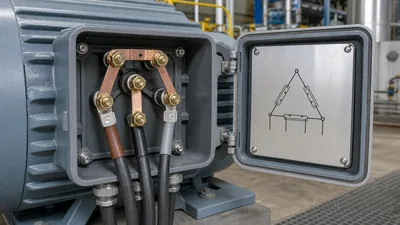
- Star (wye): one end of each winding is joined at a star point, and the line voltage is applied across two windings in series. Each winding sees
V_phase = V_line / √3. - Delta: the windings are connected end to end in a triangle, and each winding sees the full line voltage.
A motor designed for 400 V across each winding will run at full power in delta on a 400 V supply. Started in star on the same supply, each winding receives only 231 V. The motor accelerates with lower current and torque, and once it is near speed the starter reconnects the windings in delta.
Star delta starting is common for motors from about 7.5 kW to 200 kW driving loads that need little torque at standstill: centrifugal pumps against a closed valve, fans with dampers closed, and screw compressors started unloaded. The underlying connections are explained further in our star delta connection guide.
Delta vs Wye Motor Wiring: Why Current Falls to One Third
The one-third ratio comes from two √3 factors that multiply. Consider a motor whose winding impedance at standstill is Z per phase, on line voltage V.
- Delta (DOL start): each winding sees V, so winding current is
V / Z. Line current is √3 times the winding current:I_line,Δ = √3 × V / Z. - Star start: each winding sees
V / √3, so winding current isV / (√3 × Z). In star, line current equals winding current:I_line,Y = V / (√3 × Z). - Ratio:
I_line,Y / I_line,Δ = [V / (√3 × Z)] / [√3 × V / Z] = 1/3. - Torque is proportional to the square of winding voltage:
(1/√3)² = 1/3.
| Quantity | Star (wye) | Delta |
|---|---|---|
| Voltage across each winding | V_line / √3 | V_line |
| Line current vs winding current | Equal | Line = √3 × winding |
| Starting line current | 1/3 of DOL | 100% of DOL |
| Starting torque | 1/3 of DOL | 100% of DOL |
| Running use | Higher-voltage supply (e.g., 690 V) | Rated supply (e.g., 400 V) |
The difference between a delta vs wye motor is therefore not in the motor itself but in how its six leads are connected. The same motor nameplated 400 V Δ / 690 V Y runs in delta on 400 V and in star on 690 V. Only the delta-at-supply-voltage case allows star delta starting. More on winding arrangements is in our article on the coil arrangement in a delta-connected motor.
6 Lead Wye Delta Motor Wiring: Terminal Connections
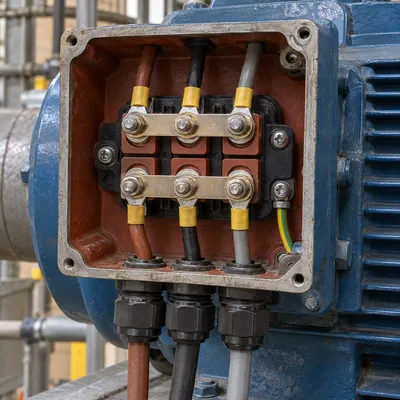
A star delta motor must have both ends of every winding brought to the terminal box: six leads. IEC motors label them U1, V1, W1 (start of windings) and U2, V2, W2 (ends). NEMA 6-lead wye-delta motors label them T1 to T6.
| Connection | IEC terminals | NEMA 6-lead terminals |
|---|---|---|
| Star (start) | L1–U1, L2–V1, L3–W1; U2, V2, W2 joined | L1–T1, L2–T2, L3–T3; T4, T5, T6 joined |
| Delta (run) | L1–U1–W2, L2–V1–U2, L3–W1–V2 | L1–T1–T6, L2–T2–T4, L3–T3–T5 |
For star delta starting, the terminal box links are removed and all six leads run to the starter: U1, V1, W1 to the main contactor, U2, V2, W2 (or W2, U2, V2 depending on the delta contactor wiring) to the delta and star contactors. This means six motor cables instead of three, each sized for winding current rather than line current.
Important wiring checks:
- Phase sequence at changeover: the delta contactor must connect each winding end so that the field rotates in the same direction in star and delta. A wrong pairing produces a reversed or unbalanced field at transition and a heavy current surge. Verify with the rotation method in our phase rotation guide.
- 9-lead dual-voltage motors (230/460 V wye-connected) cannot be wye-delta started. Use a 6-lead or 12-lead motor rated delta at line voltage.
- Motor nameplate: confirm "Δ" at the supply voltage, for example 400 V Δ, 480 V Δ or 690 V Δ.
Detailed diagrams for other motor connections are in our three-phase motor wiring diagrams guide.
How Does a Wye Delta Starter Work? Control Sequence
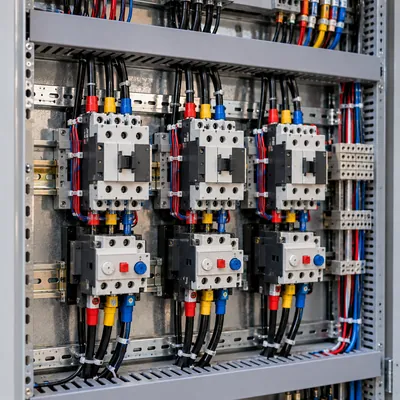
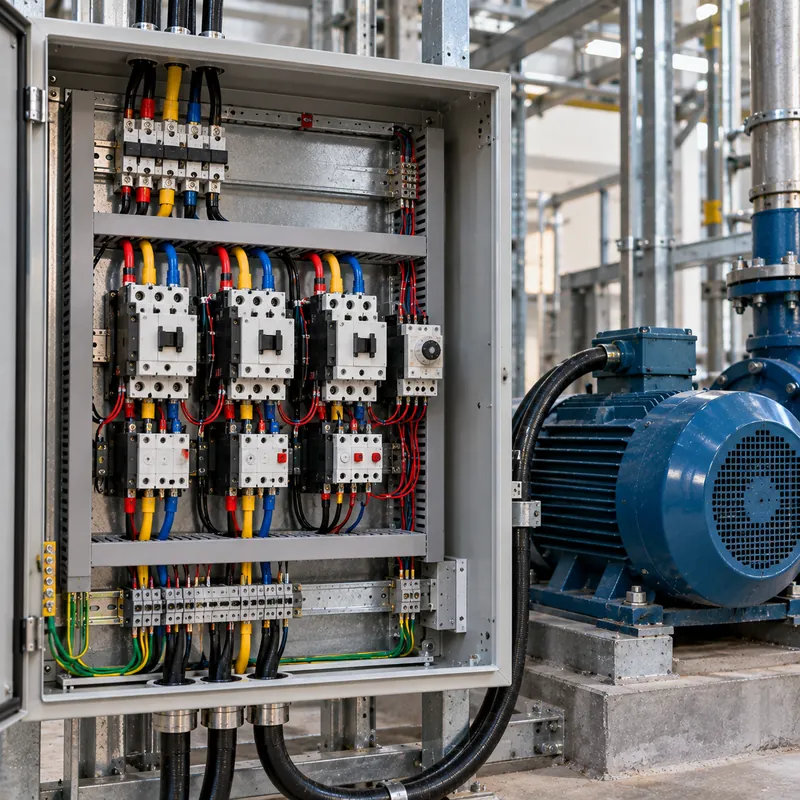
The power circuit uses three contactors: KM1 main (feeds U1, V1, W1), KM2 delta (connects U2, V2, W2 back to the line phases), and KM3 star (shorts U2, V2, W2 together). A star-delta timer and interlocks complete the starter.
- Start command: KM3 (star) closes first, then KM1 (main), so the main contactor makes the current while the star point is already formed. The motor starts in star.
- Acceleration: the timer runs while the motor accelerates on one-third torque.
- Star dropout: when the timer expires, KM3 opens. The motor is briefly disconnected from the star point but still connected to the line via KM1.
- Transition pause: a dead time, typically 30 to 80 ms, lets the star contactor's arc extinguish before delta closes. Without it, KM2 closing while KM3 still arcs creates a phase-to-phase short circuit.
- Delta closes: KM2 closes and the motor runs in delta at full voltage.
- Stop: KM1 and KM2 open together.
KM2 and KM3 must be mechanically and electrically interlocked so they can never close together. Most dedicated star-delta timers include the transition pause; general-purpose timers may not, which is a common cause of contactor welding. Schematic symbols for timers and interlocks are shown in our motor control symbols guide.
This is an open-transition starter. During the pause, the spinning motor's residual flux generates voltage that may be out of phase with the supply when delta closes, causing a short current and torque transient that can reach DOL levels. Closed-transition starters add a fourth contactor and resistors that keep the windings energized during changeover, limiting this transient on sensitive loads.
Sizing a Star Delta Starter: 55 kW Worked Example
Given: a 55 kW, 400 V Δ / 690 V Y, 4-pole motor driving a centrifugal pump on a 400 V, 50 Hz supply. Nameplate FLC 100 A. DOL locked-rotor current 7 × FLC. Locked-rotor torque 2.2 × FLT.
- Main contactor KM1 carries winding current in delta:
I = FLC / √3 = 100 / 1.732 = 58 A. Select a contactor with AC-3 rating of at least 58 A. - Delta contactor KM2: same current, at least 58 A AC-3.
- Star contactor KM3 carries star current only during start:
I ≈ FLC / 3 = 33 A. Select at least 33 A AC-3; many designers choose one frame size up for frequent starts. - Overload relay in the winding circuit after KM1: set to
0.58 × 100 = 58 A. - Starting current: DOL would be
7 × 100 = 700 A; star start draws700 / 3 = 233 A. - Starting torque:
2.2 / 3 = 0.73 × FLT. A centrifugal pump needs little torque at low speed (load torque rises with speed squared), so the motor accelerates to near full speed in star. - Motor cables: six conductors, each sized for 58 A plus installation derating.
- Branch protection: size the breaker or fuses for the full 100 A line current and the transition peak, coordinated with the starter per IEC 60947-4-1 Type 2.
| Component | Current basis | Value for 100 A FLC |
|---|---|---|
| KM1 main | FLC / √3 | 58 A |
| KM2 delta | FLC / √3 | 58 A |
| KM3 star | FLC / 3 | 33 A |
| Overload setting | 0.58 × FLC | 58 A |
Setting the Star-Delta Timer and Avoiding Common Faults
The timer setting decides whether the starter delivers its benefit. Switch to delta too early and the motor, still at low speed, draws close to DOL current in delta. Switch too late and the motor runs in star near its torque limit, overheating windings.
Practical timer setting:
- Target changeover at 80 to 90 percent of rated speed, where star current has fallen close to its running value.
- Start with 5 to 10 seconds for pumps and fans, then have a qualified technician, wearing the PPE the arc-flash label requires, measure line current with a clamp meter during a start. The star current should fall to near the no-load level before the timer expires.
- High-inertia fans may need 15 to 30 seconds; check that the overload trip class permits this.
Common faults and causes:
| Symptom | Likely cause |
|---|---|
| Heavy current spike at changeover | Timer too short, or wrong phase pairing on delta contactor |
| Motor stalls in star | Load torque above one-third LRT; wrong application |
| Star or delta contactor welded | No transition pause, or contactors undersized |
| Overload trips during start | Overload set to line current or trip class too fast |
| Motor hums, does not accelerate | One winding open or star point not formed |
Star delta is a poor choice for loaded conveyors, positive displacement pumps and crushers that need high breakaway torque. A soft starter or VFD suits those. When a star delta motor trips repeatedly, test winding insulation before replacing parts; see our motor insulation test guide.
Next Steps: Specifying and Sourcing Star Delta Starters
A star delta starter specification should include motor kW, voltage and nameplate connection (Δ at supply voltage), FLC, load type and starting torque requirement, starts per hour, open or closed transition, timer type with transition pause, overload trip class, short-circuit coordination type and enclosure or MCC location. Confirm that six motor cables and terminals are included in the cable schedule. For retrofits, record the existing motor nameplate and terminal box layout, because older motors may have only three leads brought out and need rewinding or replacement.
Starters for more than a few motors are best grouped in a motor control center, where star-delta units occupy standard withdrawable compartments with defined heat dissipation and tested coordination. Our motor control center guide covers the line-up design.
MARS does not sell stand-alone starters. We build star-delta, DOL, soft-starter and VFD functional units into GCS and MNS low-voltage switchboards and MCCs to IEC 61439-2, with Type 2 coordinated components, routine tests on every assembly and FAT available. Typical lead time is 25 to 45 days. Explore our HV and LV switchgear, and send your motor schedule through the quote form.
Frequently asked questions
What is the difference between star and delta connection in a motor?
In star, one end of each winding joins a common point and each winding sees line voltage divided by √3. In delta, windings connect end to end and each sees full line voltage. A motor rated 400 V delta runs at full power in delta on 400 V; starting it in star cuts current and torque to one third.
Why is a star delta starter used?
It reduces starting line current to one third of direct-on-line current, limiting voltage dip on the supply and mechanical shock on the load. It uses only contactors and a timer, so it is inexpensive and harmonic-free. It suits pumps, fans and compressors that start with low load torque.
Can any motor be wye delta started?
No. The motor must be rated for delta connection at the supply voltage and have all six winding leads accessible, such as a 400 V Δ / 690 V Y motor on 400 V. A 9-lead dual-voltage wye motor cannot be wye-delta started; a 12-lead motor rated delta at line voltage can.
What should the star delta timer be set to?
Set the timer so changeover happens at 80 to 90 percent of rated speed, typically 5 to 15 seconds for pumps and fans and longer for high-inertia fans. Confirm by measuring line current during a start: it should drop near its running level in star before switching to delta.
How do you size the overload for a star delta starter?
When the overload relay is in the winding circuit after the main contactor, as in most designs, set it to motor full-load current multiplied by 0.58, because winding current is line current divided by √3. For a 100 A motor, the setting is 58 A.
What does wye start delta run mean?
Wye start, delta run describes a starting method in which motor windings are first connected in wye, giving reduced voltage per winding and one-third starting current, then reconnected in delta once the motor approaches full speed so it can deliver full rated power and torque.
Written and reviewed by the MARS application engineering team in Shanghai, who specify and test transformers, switchgear, substations and battery storage for projects in 40+ countries. Last updated .
Tags: star delta starter wye delta starter wye start delta run delta vs wye motor 6 lead wye delta motor wiring