Key takeaways
- One mechanical horsepower equals 745.7 watts, so motor shaft output in kW is horsepower multiplied by 0.7457 regardless of whether the supply is single or three-phase.
- Running input kVA equals shaft kW divided by efficiency and power factor, giving about 0.9 to 1.0 kVA per horsepower for standard induction motors.
- NEC Table 430.250 lists 124 A full-load current for a 100 hp, 460 V three-phase motor, which corresponds to about 99 kVA.
- Locked-rotor kVA per horsepower is given by the NEMA code letter in NEC Table 430.7(B), for example 5.6 to 6.29 kVA per hp for code G.
- A direct-on-line start of a 100 hp code G motor on a 500 kVA, 5.75 percent impedance transformer causes roughly a 6 percent voltage dip.
Quick answer: To convert hp to kVA, multiply horsepower by 0.746 to get output kW, then divide by motor efficiency and power factor: kVA = hp × 0.746 / (η × PF). For a typical induction motor at η 0.91 and PF 0.86, one horsepower needs about 0.95 kVA, so engineers use roughly 1 kVA per hp for running load and 6 kVA per hp or more for starting.
Motors are rated in horsepower in North America and in kW elsewhere, but the transformers, generators and switchgear that supply them are rated in kVA and amps. Converting horsepower to kVA correctly, with efficiency, power factor and starting current included, is what separates a supply that runs smoothly from one that trips or browns out every time the largest compressor starts.
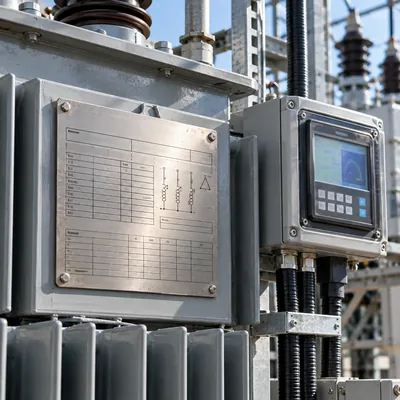
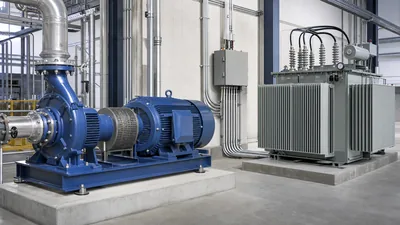
This guide gives the conversion formulas between hp, kW, kVA and amps, shows how to use NEC full-load current tables and code letters, and works through transformer sizing for motor loads. MARS does not manufacture motors; the focus here is on sizing the transformers, substations and switchgear that feed them.
How Do You Convert Horsepower to kVA?
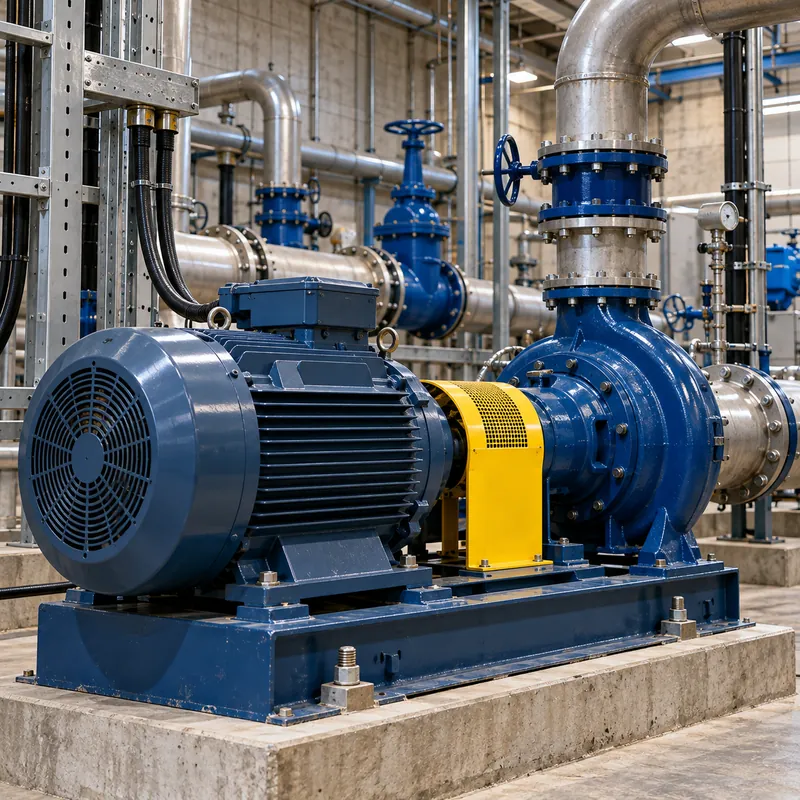
A horsepower (hp) is a unit of mechanical power equal to 745.7 W; motor nameplates state output power at the shaft. Converting horsepower to kVA requires three steps because the supply sees electrical input, which is larger than shaft output.
- Shaft output in kW:
kWout = hp × 0.7457 - Electrical input in kW:
kWin = kWout / η, where η is efficiency at the operating load - Apparent input in kVA:
kVA = kWin / PF
Combined: kVA = hp × 0.746 / (η × PF).
Worked example: a 75 hp, 460 V premium-efficiency motor with η = 94.5 percent and PF = 0.86 at full load. Shaft output is 75 × 0.7457 = 55.9 kW. Input is 55.9 / 0.945 = 59.2 kW. Apparent power is 59.2 / 0.86 = 68.8 kVA, so this motor needs about 0.92 kVA per hp.
The kVA per hp ratio is higher for small motors (lower efficiency and PF) and for lightly loaded motors (PF falls sharply below 50 percent load). That is why the long-standing rule of thumb is 1 kVA per hp for running load: it is slightly conservative for large motors and about right for 5 to 20 hp units.
For the underlying apparent versus real power relationship, see the kVA vs kW guide.
HP to kW Conversion for Three-Phase Motors
Searches for hp to kW 3 phase are common, but the horsepower to kilowatt conversion is the same for single-phase and three-phase motors. Horsepower is mechanical output; the number of supply phases affects current, not shaft power.
kW = hp × 0.7457hp = kW / 0.7457 = kW × 1.341
| Rating | Conversion | Result |
|---|---|---|
| 12 hp to kW | 12 × 0.7457 | 8.95 kW |
| 30 kW to hp | 30 × 1.341 | 40.2 hp |
| 50 hp to kW | 50 × 0.7457 | 37.3 kW |
| 100 hp to kW | 100 × 0.7457 | 74.6 kW |
| 400 kW to hp | 400 × 1.341 | 536 hp |
Where three-phase matters is the step from kW to current. Converting kW to hp tells you nothing about how many amps the motor will draw; that needs I = kWin × 1,000 / (√3 × V × PF).
One practical caution: IEC motor ratings come in kW steps (37, 45, 55, 75, 90 kW) and NEMA ratings in hp steps (50, 60, 75, 100, 125 hp). A 55 kW IEC motor equals 73.8 hp, not exactly 75 hp, so replacing one with the other requires checking the driven load and frame size.
Metric horsepower (PS or CV), at 735.5 W, is about 1.4 percent smaller than mechanical hp and appears on some European and Asian equipment. Confirm which unit is meant on imported machinery.
Using NEC Full-Load Current to Get kVA per Horsepower
For design work in North America, NEC 430.6(A)(1) requires motor circuit conductors and short-circuit protection to be sized from the code tables, not from nameplate current. Table 430.250 lists full-load current for three-phase induction motors. Converting those currents to kVA gives a code-based kVA per hp figure.
| Motor hp | NEC FLC at 460 V | kVA = √3 × 460 × FLC | Shaft kW | kVA per hp |
|---|---|---|---|---|
| 10 hp | 14 A | 11.2 kVA | 7.5 kW | 1.12 |
| 25 hp | 34 A | 27.1 kVA | 18.6 kW | 1.08 |
| 50 hp | 65 A | 51.8 kVA | 37.3 kW | 1.04 |
| 100 hp | 124 A | 98.8 kVA | 74.6 kW | 0.99 |
| 200 hp | 240 A | 191 kVA | 149 kW | 0.96 |
The table confirms the 1 kVA per hp guideline and shows it is slightly conservative above 100 hp. Code values are deliberately on the high side of typical nameplate currents, so kVA derived from them includes some margin.
At 230 V, the table currents are double the 460 V values (for example 28 A for 10 hp) and kVA is the same. At 575 V for Canadian 600 V systems, currents are 80 percent of the 460 V values. More on voltage and nameplate relationships is in our 460V 3-phase guide, and nameplate-based current calculation is covered in the full load amps calculator guide.
How to Convert Amps to Horsepower
An amp to horsepower calculator reverses the motor current formula. It is useful when a motor nameplate is missing and you have only a measured current.
- Three-phase:
hp = √3 × V × I × PF × η / 746 - Single-phase:
hp = V × I × PF × η / 746 - DC:
hp = V × I × η / 746
Example: a pump motor draws 40 A at 460 V three-phase. Assuming PF 0.85 and η 0.91, output is 1.732 × 460 × 40 × 0.85 × 0.91 / 746 = 33.0 hp. The motor is likely a 40 hp unit running at about 83 percent load, or a 30 hp unit slightly overloaded; check the frame and the driven pump curve before deciding.
Limitations of the ampere to hp calculation:
- Power factor and efficiency both drop at part load, so a lightly loaded motor's current overstates its output.
- Variable frequency drives change input current and PF; measure on the motor side with a suitable meter or read the drive's output power.
- Voltage imbalance above 1 percent raises current unevenly; average the three phase currents.
For field verification of motor condition alongside current measurement, see the 3-phase motor testing guide.
Motor Starting kVA: Code Letters and Locked-Rotor Current
Running kVA is only half the picture. When an induction motor starts direct-on-line, it draws locked-rotor current, typically 6 to 8 times full-load current, at a very low power factor for several seconds. The NEMA code letter on the nameplate defines locked-rotor kVA per horsepower, listed in NEC Table 430.7(B).
| Code letter | Locked-rotor kVA per hp | Typical motors |
|---|---|---|
| F | 5.0 to 5.59 | Large, high-efficiency motors |
| G | 5.6 to 6.29 | Common general-purpose motors |
| H | 6.3 to 7.09 | Medium general-purpose motors |
| J | 7.1 to 7.99 | Smaller motors |
| K | 8.0 to 8.99 | Small and high-torque motors |
| L | 9.0 to 9.99 | Fractional and special designs |
Voltage dip example: a 100 hp code G motor (midpoint 5.95 kVA/hp) has starting kVA of 100 × 5.95 = 595 kVA. It is fed from a 500 kVA transformer with 5.75 percent impedance, whose short-circuit capacity (infinite source) is 500 / 0.0575 = 8,696 kVA. Approximate dip: 595 / (595 + 8,696) = 6.4 percent. That is usually acceptable for other loads; above about 10 to 15 percent, contactors may drop out and lighting flickers visibly.
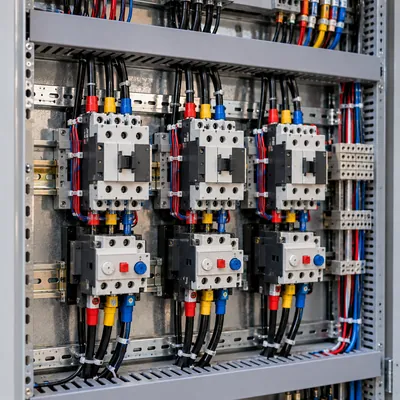
Reduced-voltage starting changes the result. A star-delta start cuts starting kVA to one-third; soft starters and drives reduce it further. These options are compared in our motor starter types guide and the star-delta starter guide.
How to Size a Transformer for Motor Loads
Follow these steps to size a transformer that supplies one or more motors.
- List all motors with hp, voltage, efficiency, PF and code letter.
- Convert running loads to kVA using
hp × 0.746 / (η × PF)or NEC FLC, and add non-motor loads. - Apply diversity: not every motor runs at full load simultaneously; use measured or process-based factors.
- Check the largest motor starting with all others running, using the code-letter starting kVA and the voltage dip formula.
- Select transformer kVA at least equal to running kVA plus 20 to 25 percent margin, and large enough that starting dip stays within the acceptable limit.
- Confirm impedance: lower impedance reduces dip but raises fault current and downstream breaker duty.
Example: a pump station has three 50 hp duty pumps and one 50 hp standby on a 480 V system, plus 15 kVA of auxiliaries. Running kVA: 3 × 51.8 + 15 = 170 kVA. With 25 percent margin, 213 kVA, so a 225 kVA unit. Starting the third pump (code G, 298 kVA) on a 225 kVA, 5 percent unit (4,500 kVA short-circuit capacity) gives a dip of about 6.2 percent. A 300 kVA unit would give more growth margin and a smaller dip.
Generator sizing for motor loads follows similar logic but with much higher source impedance; see three-phase electric motor guide for motor behavior during starting.
Next Steps: Specifying and Sourcing Transformers for Motor Loads
When you request a transformer for a motor-dominated site, give the supplier enough data to check both running and starting duty:
- Motor list with hp or kW, voltage, starting method and code letter.
- Maximum acceptable voltage dip at the LV bus.
- Upstream fault level, which affects the effective source impedance.
- Preferred impedance, vector group (Dyn11 or delta-wye grounded) and cooling class.
- Any drive harmonic content, to confirm thermal margin.
MARS manufactures oil-immersed transformers and MV and LV switchgear, including IEC 61439 motor-feeding boards, to IEC and ANSI/IEEE variants at 50 or 60 Hz. Use the transformer sizing calculator as a first check, then send your motor list through the quote request.
Frequently asked questions
How many kVA is 1 hp?
One horsepower of motor output requires about 0.9 to 1.1 kVA of electrical supply, depending on motor efficiency and power factor. The calculation is hp x 0.746 divided by efficiency times power factor. For a typical motor at 91 percent efficiency and PF 0.86, 1 hp equals 0.95 kVA.
How do you convert hp to kW for a three-phase motor?
Multiply horsepower by 0.7457. The conversion is identical for single-phase and three-phase motors because horsepower measures mechanical shaft output. A 20 hp three-phase motor delivers 14.9 kW. Electrical input is higher, equal to output kW divided by efficiency, and that input determines current.
How much is 400 kW in hp?
400 kW equals about 536 mechanical horsepower, calculated as 400 x 1.341. In metric horsepower, at 735.5 W each, 400 kW equals 544 PS. Motor catalogs in IEC markets would list a 400 kW frame, while NEMA catalogs would offer 500 or 600 hp ratings.
How do you convert amps to horsepower?
For a three-phase motor, multiply 1.732 by voltage, current, power factor and efficiency, then divide by 746. For example, 40 A at 460 V with PF 0.85 and 91 percent efficiency equals about 33 hp. Results are approximate because power factor and efficiency fall at part load.
What size transformer do I need for a 50 hp motor?
A 50 hp, 460 V motor draws 65 A per NEC Table 430.250, about 52 kVA running. With margin, a 75 kVA transformer handles the running load, but starting a code G motor direct-on-line requires about 300 kVA, so check voltage dip; a 112.5 kVA unit or reduced-voltage starting is often chosen.
Is 1 kVA equal to 1 hp?
Not exactly, but it is a useful approximation. One horsepower of motor output needs roughly 0.95 kVA of supply for standard induction motors at full load. Smaller and lightly loaded motors need more, sometimes 1.2 kVA per hp, while large premium-efficiency motors may need slightly less.
Written and reviewed by the MARS application engineering team in Shanghai, who specify and test transformers, switchgear, substations and battery storage for projects in 40+ countries. Last updated .
Tags: hp to kva horsepower to kva hp to kw 3 phase convert amps to horsepower calculator 400kw to hp