Key takeaways
- Michael Faraday discovered mutual electromagnetic induction in 1831, creating the operational physics behind all subsequent transformer development.
- Hungarian engineers Károly Zipernowsky, Ottó Bláthy, and Miksa Déri (the ZBD team) patented the first modern closed-core, parallel-connected AC transformer in 1885.
- William Stanley Jr. engineered the first commercially viable transformer using interlocking E-shaped sheet laminations in 1885 and energized Great Barrington in 1886.
- Mikhail Dolivo-Dobrovolsky developed the first three-phase transformer in 1889, introducing the three-limb core configuration still governed by IEC 60076 standards.
- The core electromagnetic relationship formulated in the 19th century—Faraday's Law, E = 4.44 · f · N · B_max · Ac—remains the governing design equation for modern dry-type and oil-immersed transformers.
Quick answer: The modern alternating current (AC) transformer was invented in 1885 by Hungarian engineers Károly Zipernowsky, Ottó Bláthy, and Miksa Déri (the ZBD team), who created the first closed magnetic core connected in parallel. Their breakthrough built upon Michael Faraday's 1831 discovery of mutual induction and was commercialised in 1886 by William Stanley Jr.
For modern electrical consultants, EPC contractors, and substation engineers, knowing who invented transformer equipment is more than a historical footnote. The architectural decisions made during the 1880s—closed magnetic circuits, parallel branch connections, laminated electrical steel, and oil-based dielectric cooling—continue to dictate how industrial step-up and step-down units are specified under modern standards such as IEC 60076 and IEEE C57.12. Understanding how these pioneers solved severe core losses, voltage drop, and circuit instability provides direct insight into contemporary AC transformer engineering principles and modern power distribution topologies.
Who invented transformer technology: the foundational timeline (1831 to 1885)
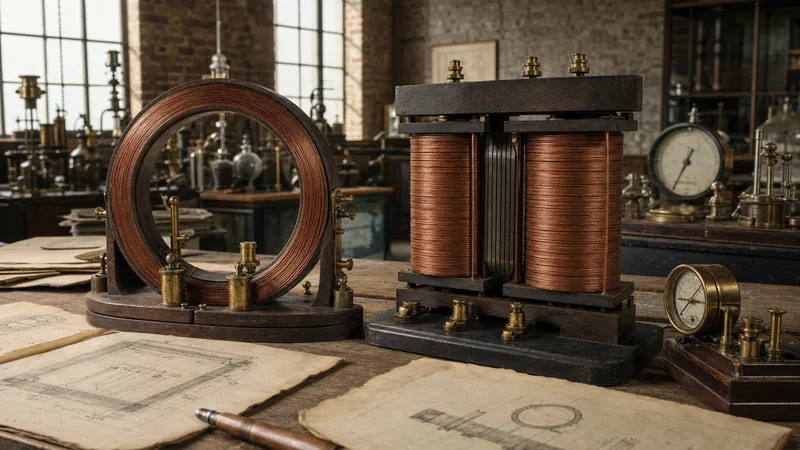
Transformer technology began on 29 August 1831, when British experimentalist Michael Faraday discovered mutual induction using a hand-wrapped soft iron ring wound with two separate insulated copper coils. Faraday connected the primary coil to a voltaic battery and observed that a transient current was induced in the secondary winding only when the primary circuit was completed or interrupted. He expressed this physical phenomenon mathematically through Faraday's Law of Induction:
e = -N · (dΦ / dt)
Where e is the induced electromotive force (EMF), N represents the winding turn count, and dΦ/dt denotes the time rate of change of magnetic flux in Webers per second (Wb/s). While Faraday demonstrated the core physics, his apparatus was an intermittent laboratory device rather than a continuous power-transfer machine.
Over the next five decades, various inventors advanced the concept through induction coils (such as Nicholas Callan in 1836 and Heinrich Ruhmkorff in 1851), but these devices relied on DC interruptors and suffered from low efficiency. In 1882, French inventor Lucien Gaulard and English businessman John Dixon Gibbs patented what they termed a "secondary generator" in London. The Gaulard-Gibbs device used an open-ended linear iron wire core with secondary windings connected in series across high-voltage AC circuits. Although Gaulard and Gibbs demonstrated long-distance transmission across 40 kilometres between Turin and Lanzo in 1884, their open-core topology created excessive magnetic reluctance. More critically, wiring secondary loads in series meant switching an individual lamp on or off altered the impedance of the entire network, causing severe voltage instability across all other connected loads. As detailed in our comprehensive analysis of transformer core design and materials, open magnetic circuits cannot maintain tight voltage regulation under variable loading conditions.
Who is the inventor of transformer systems for practical AC grids?
The inventor of transformer systems suitable for practical, scalable AC utility networks is shared between the Hungarian ZBD trio—Károly Zipernowsky, Ottó Bláthy, and Miksa Déri—and American electrical engineer William Stanley Jr.
In 1884, engineers at the Ganz Works factory in Budapest examined the Gaulard-Gibbs apparatus at the Turin electrical exhibition and recognized its two fundamental flaws: the open magnetic path and the series circuit architecture. Between late 1884 and May 1885, the ZBD team engineered a transformative alternative. Ottó Bláthy proposed enclosing the magnetic circuit entirely in iron to minimize reluctance, creating a toroidal closed-core transformer wrapped in external copper windings. Simultaneously, Miksa Déri and Károly Zipernowsky developed a shell-type design where insulated coils formed the inner core, surrounded by iron wire. Most importantly, ZBD proved that transformers must be connected in parallel across a constant-voltage AC line. This allowed individual consumer loads to switch independently without disturbing grid-wide voltage regulation. The Ganz engineers officially filed patent application No. 10476 on 1 May 1885 and coined the word "transformer" to replace the ambiguous term "secondary generator".
While ZBD established the theoretical and physical archetype, William Stanley Jr., working under George Westinghouse in the United States, developed the manufacturing methodology that enabled mass industrial production. In 1885, Stanley realized that toroidal and continuous wire-wound cores were virtually impossible to wind and insulate efficiently at commercial scale. Stanley designed interleaved, E-shaped stamped sheets of electrical iron that could be slid into machine-wound copper bobbins and clamped together. On 20 March 1886, Stanley energized a commercial demonstration in Great Barrington, Massachusetts, stepping 500 V generation up and down to 100 V to supply 23 business premises over 1.2 kilometres of line, effectively establishing the architecture of the modern electric utility grid.
When were transformers invented: key developmental milestones
Transformers were invented across a progressive sequence of engineering breakthroughs between 1831 and 1889, moving from laboratory discovery to mass-producible utility equipment. The progression answered distinct technical challenges, moving through magnetic circuit design, lamination development, and polyphase power handling.
| Year | Key Inventor(s) | Core Topology & Configuration | Circuit Coupling Mode | Engineering Milestone & Grid Impact |
|---|---|---|---|---|
| 1831 | Michael Faraday | Closed soft iron ring (toroid) | DC pulsed battery switching | Discovery of mutual electromagnetic induction; established fundamental physical laws. |
| 1882 | Lucien Gaulard & John Dixon Gibbs | Open linear iron wire bundle | Series AC line connection | First long-distance AC transmission (40 km); flawed load regulation due to open flux path. |
| 1885 | K. Zipernowsky, O. Bláthy, M. Déri (ZBD) | Closed-core toroidal and shell structures | Parallel constant-voltage AC | First high-efficiency closed magnetic circuits (>95%); coined the term "transformer". |
| 1886 | William Stanley Jr. | Interleaved E-shaped sheet laminations | Parallel distribution (500 V to 100 V) | First mass-manufacturable core with pre-wound bobbins; first commercial US municipal grid. |
| 1889 | Mikhail Dolivo-Dobrovolsky | Three-limb laminated magnetic core | Three-phase AC network | Invented the three-phase transformer, eliminating the need for three separate single-phase cores. |
Each chronological iteration directly solved an operational bottleneck. While Faraday provided the magnetic physics, the ZBD team eliminated reactive drop through closed magnetic circuits, Stanley eliminated assembly bottlenecks via interlocking laminations, and Dolivo-Dobrovolsky integrated polyphase flux cancellation.
How 19th-century transformer architecture governs modern industrial design
Modern distribution and transmission transformers manufactured today operate on the identical electromagnetic relationships quantified during the late 19th century. When electrical engineers calculate core sizing under IEC 60076-1 or IEEE C57.12.00, they rely on the classic EMF equation derived directly from Faraday's induction formula:
Erms = 4.44 · f · N · Bmax · Ac
Where f is line frequency (50 Hz or 60 Hz), N is winding turn count, Bmax represents maximum operational magnetic flux density in Tesla (T), and Ac is the effective cross-sectional core area in square metres (m²). In modern high-efficiency units, Bmax is typically engineered between 1.6 T and 1.75 T using Cold-Rolled Grain-Oriented (CRGO) silicon steel to prevent core saturation.
Furthermore, the early recognition of core heating led directly to our modern understanding of no-load core losses (P0), which comprise two distinct physical components:
- Hysteresis losses (Ph): The energy consumed by reversing magnetic domains within the core material each cycle, quantified by the Steinmetz empirical formula: Ph = η · f · Bmax1.6. High-permeability silicon alloys minimize this coefficient.
- Eddy current losses (Pe): Circulating currents induced within the conductive steel by alternating flux, calculated as: Pe = ke · f2 · Bmax2 · t2, where t is lamination sheet thickness in millimetres. Stanley's early thin-sheet approach has evolved into modern 0.23 mm to 0.30 mm laser-scribed steel laminations insulated with inorganic coatings (C-5 class) to suppress eddy currents.
Engineers specifying plant equipment can evaluate these core characteristics across various equipment configurations in our guide to different types of transformers and their industrial applications.
Evolution from single-phase prototypes to modern three-phase power transformers
The evolution from single-phase prototypes to three-phase power transformers was completed in 1889 when Russian engineer Mikhail Dolivo-Dobrovolsky designed the first three-limb three-phase transformer at the Allgemeine Elektricitäts-Gesellschaft (AEG) in Germany. Dolivo-Dobrovolsky recognized that under balanced three-phase operation, the sum of the instantaneous magnetic fluxes across the three phases equals zero:
ΦA(t) + ΦB(t) + ΦC(t) = 0
By arranging three vertical laminated iron cores joined by common top and bottom horizontal yokes, the return flux of any single phase naturally conducts through the remaining two phases. This eliminated the return magnetic path required by single-phase units, cutting total core steel requirements by approximately 30% to 35% compared to three discrete single-phase transformers. For a comprehensive analysis of connection topologies such as Dyn11 and Ynd11, consult our three-phase transformer buyers and engineering guide.
The engineering sequence that transitioned early 19th-century prototypes into modern utility-grade assets followed five definitive stages:
- Magnetic circuit closure (1885): Transitioning from linear open-core geometries to closed toroidal and shell paths to reduce excitation current and leakage reactance.
- Core lamination and insulation (1886): Slicing bulk iron into thin, electrically insulated sheets to suppress eddy current heating and no-load losses.
- Three-phase integration (1889): Merging polyphase magnetic paths onto shared yokes, lowering weight, footprint, and manufacturing material costs.
- Liquid dielectric insulation (1890s): Introducing inhibited mineral oil and sealed tanks to achieve basic impulse levels (BIL) and dissipate winding heat via convection.
- Standardised regulatory performance: Codifying impedance (%Z), temperature rise limits (e.g., 65°C average winding rise), and short-circuit withstand tolerances under IEC 60076 and IEEE C57 benchmarks.
Next steps: specifying and sourcing
Specifying high-performance power equipment requires translating historical magnetic principles into rigorous project specifications. When requesting an engineering evaluation or commercial tender, project engineers should define rated capacity (kVA or MVA), primary and secondary voltages, connection vector group, impedance voltage (%Z), operating ambient temperature, and required no-load and full-load loss guarantees.
To review industrial-grade configurations built to strict IEC, ANSI/IEEE, and GB standards, evaluate our ranges of oil-immersed distribution transformers, cast resin dry-type transformers, and high-voltage power transformers. For bespoke substation layouts, customized impedance matching, or project-specific quotations, submit your electrical single-line diagrams directly to our engineering team via the transformer quotation portal or connect through our engineering contact page.
Frequently asked questions
who invented transformer
The modern transformer was invented in 1885 by Hungarian engineers Ottó Bláthy, Miksa Déri, and Károly Zipernowsky (the ZBD team) at the Ganz Works factory. They developed the closed magnetic core and parallel AC circuit architecture, building upon Michael Faraday's 1831 induction discovery.
who is the inventor of transformer
The title of inventor is shared between the Hungarian ZBD team (Bláthy, Déri, and Zipernowsky), who patented the closed-core parallel transformer in 1885, and American engineer William Stanley Jr., who refined the design in 1885–1886 by inventing stamped E-shaped sheet laminations for practical commercial mass production.
when were transformers invented
Transformers were invented between 1831 and 1889 across distinct milestones. Michael Faraday proved mutual induction in 1831, the ZBD team engineered the closed-core AC transformer in 1885, William Stanley deployed the first commercial AC distribution grid in 1886, and Mikhail Dolivo-Dobrovolsky invented the three-phase transformer in 1889.
Why were early open-core transformers unviable for municipal grids?
Early open-core transformers, such as the 1882 Gaulard-Gibbs design, suffered from severe magnetic leakage and required series electrical connections. In a series circuit, switching any individual load altered the line impedance, causing uncontrolled voltage swings across all other connected loads on the network.
Who invented the 3-phase transformer?
The three-phase transformer was invented in 1889 by Russian electrical engineer Mikhail Dolivo-Dobrovolsky at AEG in Germany. His three-limb core configuration exploited the natural 120-degree phase displacement of balanced three-phase power, allowing returning magnetic flux to cancel and reducing iron mass by over 30%.
What role did Michael Faraday play in transformer history?
Michael Faraday provided the core physics governing transformer operation by discovering electromagnetic mutual induction on 29 August 1831. His experiment with two insulated coils wrapped around a soft iron ring proved that a changing magnetic flux induces an electromotive force (EMF) in an adjacent circuit.
Tags: who invented transformer who is the inventor of transformer when were transformers invented transformer history electrical transformer origins