Key takeaways
- Residential pole-mounted units generally cost between £1,200 and £3,800, whereas commercial 500 kVA to 2,500 kVA distribution transformers range from £8,500 to £45,000 depending on cooling and winding metallurgy.
- Copper windings increase upfront equipment prices by 18% to 30% compared to aluminium, but they significantly reduce total lifetime load losses in heavy-duty cycles.
- Loss capitalisation formulas in accordance with IEC 60076-1 demonstrate that a transformer with a 15% higher initial purchase price often yields a lower total cost of ownership over a 25-year operational lifecycle.
- Dry-type cast resin units command a 25% to 40% price premium over standard mineral-oil-immersed equivalents due to epoxy encapsulation materials and indoor fire-safety compliance.
- Factory acceptance testing (FAT), such as lightning impulse and temperature rise tests, alongside freight and oil containment civil works, typically adds 12% to 25% to base procurement budgets.
Quick answer: The baseline transformer cost ranges from £1,200 to £4,000 for a small residential unit, £7,000 to £35,000 for standard commercial distribution units (315 kVA to 1,600 kVA), and £90,000 to over £500,000 for large industrial or primary substation power transformers. Final pricing depends on core material, winding metallurgy, voltage class, and loss efficiency ratings.
Procuring medium-voltage (MV) and high-voltage (HV) plant requires balancing initial capital expenditure against continuous operational expenses. For project developers, EPC contractors, and plant engineers, calculating the total transformer cost involves evaluating not just the physical unit purchase order, but also civil foundation requirements, factory testing, delivery logistics, and efficiency ratings. Material indices for electrical steel and copper fluctuate dynamically, which directly influences manufacturing lead times and the delivered transformer price across global supply chains.
Understanding equipment benchmarks and market variables ensures that engineering specifications avoid costly over-design while guaranteeing long-term thermal compliance with international benchmarks such as IEC 60076 and IEEE C57.12.00.
How much does a transformer cost by type and capacity?
When budgeting for capital equipment, the primary determinant of equipment pricing is rated apparent power (kVA or MVA) alongside insulation medium and operating voltage. A small electrical transformer rated for light commercial step-down duty requires significantly fewer core laminations and cooling radiators than a utility-grade unit step-up (GSU) transformer.
The benchmark table below outlines average factory-gate pricing ranges across standard configurations, referencing common global standards such as IEC 60076-1 Table 1 and IEEE C57.12.20.
| Transformer Type | Capacity Range | Primary Voltage Class | Cooling Medium | Estimated Cost (GBP / USD) | Typical Factory Lead Time |
|---|---|---|---|---|---|
| Single-phase Pole-mounted | 15 kVA – 100 kVA | 11 kV to 33 kV | Mineral Oil (ONAN) | £1,200 – £3,800 ($1,500 – $4,800) | 6 – 10 Weeks |
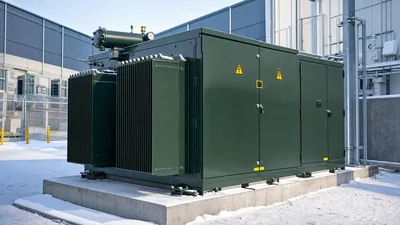
| Three-phase Pad-mounted | 315 kVA – 2,500 kVA | 11 kV to 34.5 kV | Mineral Oil / Ester Fluid | £9,500 – £38,000 ($12,000 – $48,000) | 10 – 16 Weeks |
| Dry-type Cast Resin (CRT) | 500 kVA – 3,150 kVA | 11 kV to 33 kV | Air Natural (AN/AF) | £12,000 – £52,000 ($15,000 – $65,000) | 8 – 14 Weeks |
| Oil-immersed Distribution | 250 kVA – 2,000 kVA | 6.6 kV to 22 kV | Mineral Oil (ONAN) | £6,500 – £26,000 ($8,200 – $33,000) | 8 – 12 Weeks |
| Medium Power Substation | 5 MVA – 20 MVA | 33 kV to 66 kV | ONAN / ONAF | £85,000 – £240,000 ($110,000 – $300,000) | 20 – 32 Weeks |
| Primary Transmission Substation | 25 MVA – 63 MVA | 110 kV to 132 kV | ONAF / OFAF | £280,000 – £650,000+ ($350,000 – $820,000+) | 36 – 52 Weeks |
Buyers sourcing dry-type equipment can examine design variations in our Dry Type Transformer Guide, which explains how environmental classes (E2, C2, F1 per IEC 60076-11) alter mechanical production requirements and baseline pricing.
How much does a residential transformer cost?
The hardware purchase price for a standard residential transformer typically ranges from £1,200 to £4,500 ($1,500 to $5,800), though full turnkey installation costs often total £5,000 to £14,000 ($6,500 to $18,000). For residential subdivision electrification or rural dwellings, units are deployed either as single-phase pole-top transformers or compact ground-mounted pad-mounts.
Engineers assessing residential network infrastructure must factor in specific line items that dictate the final electrical transformer cost:
- Base equipment: A single-phase 25 kVA or 50 kVA pole-mounted unit (stepping down 11 kV or 19.1 kV to split-phase 120/240 V or standard single-phase 230 V) costs between £1,200 and £2,600. Pad-mounted equivalents housed in tamper-resistant, galvanised steel enclosures range from £3,200 to £4,800.
- Overcurrent protection and switching: Bay-o-net expulsion fuses, current-limiting backup fuses, and internal under-oil load-break switches add £400 to £900 to the bill of materials.
- Surge arresters and earthing: Metal-oxide varistor (MOV) surge arresters rated to standard lightning impulse withstand levels (BIL) per IEEE C57.12.00 Table 5 cost £250 to £500 per set, alongside driven copper earth rods and test pits.
- Utility interconnection and site labour: Utility inspection, line isolation, crane hire for mounting, and secondary termination bring site labour charges to between £2,500 and £8,000 depending on regional utility regulations.
For rural estates or isolated sites where a balanced secondary system is required, single-phase configurations can be explored in detail within our Single Phase Transformer Guide.
Technical factors that drive transformer price variations
A quotation for an industrial transformer is primarily dictated by raw material commodities, thermal insulation ratings, and winding construction. Understanding these mechanical and electrical trade-offs enables consultants to avoid over-specifying equipment beyond actual duty requirements.
Key engineering drivers governing the transformer for electricity price include:
- Conductor metallurgy (Copper vs Aluminium): Copper provides superior electrical conductivity and smaller physical coil cross-sections, lowering short-circuit mechanical forces. However, specifying electrolytic copper windings typically adds an 18% to 30% premium over aluminium windings for the equivalent temperature rise class.
- Magnetic core steel grades: Core losses depend heavily on lamination selection. Standard grain-oriented electrical steel (CRGO, such as grade M3 or M4) offers an economical capital expenditure balance. Moving to laser-scribed high-permeability steel or amorphous alloy reduces no-load idle losses by up to 70%, but increases the baseline core purchase cost by 20% to 35%.
- Dielectric fluid selection: Conventional mineral oil (IEC 60296) is the industry economic baseline. Upgrading to natural or synthetic esters (IEC 61099) with higher fire points (K-class fluids, fire point >300°C) increases fluid expenditure by a factor of 2.5 to 3, adding roughly 10% to 15% to total unit costs.
- Tap changer automation: A manual off-circuit tap changer (OCTC, ±2 × 2.5%) adds minimal cost. Conversely, an on-load tap changer (OLTC) complete with an automatic voltage regulating relay, vacuum interrupters, and motor drive mechanism introduces £12,000 to £35,000 in additional component expenditure.
- Enclosure ingress and corrosion protection: Standard C3-grade industrial paint schemes are standard; severe coastal or offshore marine environments require marine-grade high-durability epoxy/polyurethane coatings or hot-dip galvanised tanks, raising fabrication expenses by 8% to 14%.
Specifiers designing multi-building medium-voltage networks can review layout choices in our guide on Radial Feed vs Loop Feed distribution configurations.
Evaluating total cost of ownership: loss capitalisation calculation
Determining the true financial commitment of electrical infrastructure requires evaluating the total cost of ownership (TCO) rather than purchasing strictly on the lowest factory bid. Because distribution and power transformers operate continuously over 25 to 40 years, the operational cost of dissipated heat losses frequently exceeds the initial purchase figure several times over.
In procurement tenders complying with IEC 60076-1 Annex B or IEEE C57.120, buyers utilise loss capitalisation formulas to evaluate competing bids on an equivalent financial plane:
TCO = C0 + (A × P0) + (B × Pk)
Where:
- C0: Initial purchase price of the transformer (GBP/USD).
- P0: Guaranteed no-load losses (core losses) measured in kilowatts (kW).
- Pk: Guaranteed load losses (winding losses at rated current and reference temperature) measured in kilowatts (kW).
- A: Capitalisation factor for no-load losses (currency per kW), reflecting continuous 8,760 annual operating hours.
- B: Capitalisation factor for load losses (currency per kW), accounting for plant loading factor and duty cycles.
Consider an engineering comparison between two 1,600 kVA, 11 kV / 400 V three-phase oil distribution transformers operating under an industrial utility tariff:
- Evaluated evaluation values: A-factor = £4,500/kW; B-factor = £1,500/kW.
- Transformer Option A (Standard Design): Purchase price = £14,000; No-load loss (P0) = 1.70 kW; Load loss (Pk) = 14.5 kW.
TCO_A = £14,000 + (£4,500 × 1.70) + (£1,500 × 14.5) = £14,000 + £7,650 + £21,750 = £43,400 - Transformer Option B (High-Efficiency Low-Loss Core): Purchase price = £17,500; No-load loss (P0) = 1.05 kW; Load loss (Pk) = 11.8 kW.
TCO_B = £17,500 + (£4,500 × 1.05) + (£1,500 × 11.8) = £17,500 + £4,725 + £17,700 = £39,925
Although Option B carries a £3,500 (25%) purchase price premium, its superior core and winding design yields a net lifetime savings of £3,475. Detailed comparative electrical configurations are explored further in the 3 Phase Transformer Guide.
Factory testing, logistics, and site installation expenses
A fully budgeted installation includes factory quality verifications, transport logistics, and on-site positioning that extend beyond the core equipment invoice. Overlooking these peripheral scope items frequently results in commercial disputes or unexpected budget creep during site handovers.
Project managers should allocate resources across the following operational stages:
- Factory Acceptance Testing (FAT): Routine tests (winding resistance, voltage ratio, short-circuit impedance, and insulation resistance per IEC 60076-1 clause 10) are included in standard pricing. However, witness testing, temperature rise tests, and lightning impulse tests (IEC 60076-3) typically carry separate test bay fees ranging from £1,500 to £6,000. For further information on testing regimes, consult our engineering review of Power Transformer Testing.
- Freight and handling: Delivering medium and large units requires low-bed transport trailers, impact recorders for core monitoring during transit, and specialised offloading. Domestic heavy transport generally costs between £1,000 and £4,500, whereas intercontinental sea-freight with marine insurance can add £3,500 to £15,000 depending on total shipping volume and mass.
- Civil works and environmental containment: Liquid-immersed installations mandate an oil containment bund or catch-basin sized to hold 100% of the transformer dielectric volume plus rainwater margins (as stipulated by IEEE 980 and local environmental agencies). Constructing reinforced cast-in-place concrete foundations with integrated fire-retardant gravel costs between £3,000 and £12,000.
- On-site testing and energisation: Cold commissioning checks—including oil dielectric breakdown voltage (BDV) testing, transformer turns ratio (TTR) checks, sweep frequency response analysis (SFRA), and primary cable hi-pot testing—typically require 2 to 3 engineering days, costing £2,000 to £5,500.
Procurement checklist to control electrical transformer cost
Optimising capital layout requires drafting unambiguous request-for-quotation (RFQ) schedules so that manufacturers deliver strictly compliant bids without inflated contingency margins. Eliminating ambiguous performance clauses ensures transparent commercial evaluations.
When compiling equipment schedules for manufacturers, ensure the following parameters are explicitly finalised:
- Rated power and thermal margin: Specify precise continuous kVA/MVA ratings under defined ambient temperatures (e.g., 40°C maximum, 30°C daily average per IEC 60076-2), avoiding unnecessary over-sizing.
- Voltage ratios and vector configuration: Define exact primary and secondary nominal voltages (e.g., 11,000 V to 415/240 V) and vector group (e.g., Dyn11 or Dyn1) to match regional grounding schemes.
- Impedance tolerance (%Z): State the nominal short-circuit impedance (typically 4.0% to 6.0% for distribution units). Tight impedance tolerances (±5% instead of standard ±10% per IEC) necessitate tighter manufacturing controls and increase component expenditure.
- Loss evaluation constants: Provide actual A and B capitalisation values directly in the tender package so the factory design office can optimise copper weight versus core steel dimensions specifically for your commercial criteria.
- Auxiliary monitoring instruments: Select only necessary instrumentation; magnetic oil level gauges (MOG), dial-type oil and winding temperature indicators (OTI/WTI) with micro-switches, and Buchholz relays (IEC 60255) provide sufficient protection for standard industrial installations without requiring expensive remote SCADA fibre packages.
Next steps: specifying and sourcing
Minimising your transformer investment requires balancing operational reliability, thermal compliance, and manufacturing lead times. When you are ready to obtain an accurate commercial quotation, prepare your detailed Single-Line Diagram (SLD), site environmental parameters, required vector group, and loss capitalisation rates. You can view our manufacturing capabilities across medium-voltage equipment on our oil-immersed transformer and dry-type transformer category pages. For direct technical appraisals, project feasibility analyses, or custom tender proposals, visit our transformer quotation request page to connect directly with our application engineering team.
Frequently asked questions
how much does a transformer cost
A standard transformer costs anywhere from £1,200 for a small residential pole-mounted unit to over £250,000 for a multi-megawatt transmission substation transformer. Commercial 500 kVA to 2,000 kVA distribution transformers typically range between £7,500 and £35,000 depending on winding metallurgy and core efficiency.
how much is a transformer
A small distribution transformer is typically priced between £1,200 and £8,000, while commercial facility units average £10,000 to £45,000. High-voltage utility-scale substation units exceed £100,000, governed primarily by physical core mass, copper content, and insulation medium.
how much does a residential transformer cost
A residential transformer hardware unit costs between £1,200 and £4,500, depending on whether it is an overhead pole-top or ground-mounted pad-mount. Fully installed costs, including utility drop connections, metering, civil pads, and civil labour, typically total between £5,000 and £14,000.
Why are dry-type transformers more expensive than oil-filled transformers?
Dry-type transformers cost 20% to 40% more than oil-filled units due to the high volume of epoxy casting resin, specialised vacuum mould manufacturing, and larger overall physical dimensions required to achieve equivalent air-cooled dielectric clearance.
How does winding material affect the transformer price?
Specifying copper windings increases the transformer price by 18% to 30% compared to aluminium windings. However, copper offers lower resistivity, enhanced short-circuit mechanical strength, and reduced physical footprint, which can lower structural civil installation costs.
What is transformer loss capitalisation in procurement?
Loss capitalisation is a commercial evaluation method that adds the calculated lifetime cost of wasted electrical heat losses (no-load and load losses) to the initial purchase price. This ensures buyers select equipment offering the lowest total cost of ownership over decades of operation.
Tags: transformer cost transformer price electrical transformer cost commercial transformer distribution transformer