Key takeaways
- FAT stands for factory acceptance test, performed at the manufacturer before shipment; SAT is performed after installation and before the owner accepts the equipment.
- A transformer SAT typically repeats insulation resistance, turns ratio, winding resistance and oil tests, comparing results with the FAT report within defined tolerances.
- IEC 60076-1 sets turns ratio tolerance at the lower of ±0.5% of declared ratio or one-tenth of measured impedance, a common SAT acceptance criterion.
- Winding resistance must be corrected to a reference temperature, using R75 = Rm × (235 + 75) / (235 + tm) for copper, before comparing site and factory values.
- Switchgear and BESS SATs add secondary injection of protection relays, interlock checks, communication tests and, for BESS, safety system verification per NFPA 855.
Quick answer: A site acceptance test (SAT) is the set of inspections and tests performed after equipment is installed on site to prove it arrived undamaged, was installed correctly and works with the rest of the system. It follows the factory acceptance test (FAT), repeats key measurements for comparison, and adds functional, protection and energization checks before handover.
Electrical equipment is tested at least twice before it carries load: once in the factory and once on site. The two sets of tests answer different questions. The factory acceptance test proves the equipment was built to specification. The site acceptance test proves it survived transport, was installed and connected correctly, and integrates with protection, control and communication systems that did not exist in the factory.
This guide is for project engineers, commissioning managers, owners' engineers and EPC contractors preparing FAT and SAT plans for transformers, switchgear, compact substations and battery energy storage. It defines the terms, compares FAT vs SAT, lists checklist items for each equipment type, shows a worked comparison of site against factory results and sets out an acceptance test procedure you can adapt.
What Is a Site Acceptance Test?
A site acceptance test is a structured verification, performed at the installation site, that confirms equipment meets the contract specification in its final installed condition and is ready for energization and handover. It is usually witnessed by the owner or owner's engineer and documented in signed test sheets.
An acceptance test in general is any test that a purchaser uses to decide whether to accept delivered work. In electrical projects there are typically three layers:
- Factory acceptance test (FAT): performed at the manufacturer's works before shipment.
- Site acceptance test (SAT): performed after installation, before energization or at first energization.
- Commissioning and performance tests: system-level tests under load, sometimes merged with SAT and sometimes treated separately, for example a trial-run period.
For electrical power equipment the main references for site tests are the manufacturer's instructions, the equipment standards (IEC 60076 series, IEC 62271 series, IEC 61439, IEEE C57.12.90, IEEE C37 series) and the ANSI/NETA Acceptance Testing Specifications (ATS), which many owners in North America adopt as the SAT baseline. For BESS, UL 9540 and NFPA 855 set the safety framework that commissioning must verify.
A sound SAT is not an exhaustive repeat of the FAT. It focuses on what transport and installation can change, and on what could not be tested in the factory.
What Does FAT Stand For? FAT Meaning in Manufacturing
FAT stands for factory acceptance test. In manufacturing, FAT means a formal test performed at the supplier's facility, in the presence of the buyer or their inspector, to demonstrate that the finished product meets the contract requirements before it is released for shipment. It is a contractual milestone, often tied to a payment.
For transformers and switchgear, a FAT factory acceptance test typically includes the routine tests required by the product standard, any type or special tests specified in the contract, and a visual, dimensional and documentation inspection.
Factory acceptance test checklist items
- Drawings, nameplate, rating plate and terminal markings match the approved design.
- Dimensions, painting thickness, enclosure IP rating and accessories as specified.
- Routine tests per standard, for a transformer: winding resistance, ratio and vector group, impedance and load loss, no-load loss and current, applied and induced voltage tests, insulation resistance, and leak test for oil-filled units.
- For switchgear: power-frequency withstand of main circuits, auxiliary circuit dielectric tests, main-circuit resistance, mechanical operation and interlocks, wiring checks.
- Calibration certificates for the test instruments used.
- Punch list of deviations and agreed corrective actions.
Our detailed transformer factory acceptance testing checklist lists test-by-test criteria. The aim of how to create an effective factory acceptance test checklist is simple: every line should trace to a specification clause, have a measurable acceptance criterion and leave space for the measured value, not just a tick.
FAT vs SAT: What Is the Difference?
FAT and SAT are complementary. One cannot replace the other, and duplicating tests unnecessarily wastes time on site where conditions are harder.
| Aspect | Factory acceptance test (FAT) | Site acceptance test (SAT) |
|---|---|---|
| Location | Manufacturer's works | Installation site |
| Purpose | Prove design and build meet specification | Prove no transport or installation damage and correct integration |
| Test conditions | Controlled lab, full-voltage test sets | Variable weather, portable instruments, often reduced voltages |
| Typical transformer tests | Full routine tests including losses, impedance, applied and induced voltage | IR, ratio, winding resistance, oil BDV and moisture, DGA baseline, SFRA if specified |
| Protection and control | Wiring and device function in isolation | Secondary injection, end-to-end trips, SCADA points, interlocks with other panels |
| Dielectric test level | 100% of specified level | Reduced level or not repeated, per contract and standard |
| Who performs | Manufacturer, witnessed by buyer | Installer or commissioning contractor, witnessed by owner; manufacturer may supervise |
| Outcome | Release for shipment | Release for energization and handover |
The link between them is the FAT report. SAT measurements of ratio, resistance and insulation are compared directly with factory values, so the FAT report must record test configurations, temperatures and instruments clearly enough for site staff to reproduce them.
Site Acceptance Test Checklist by Equipment Type
The SAT site acceptance test scope depends on the equipment. Typical items are:
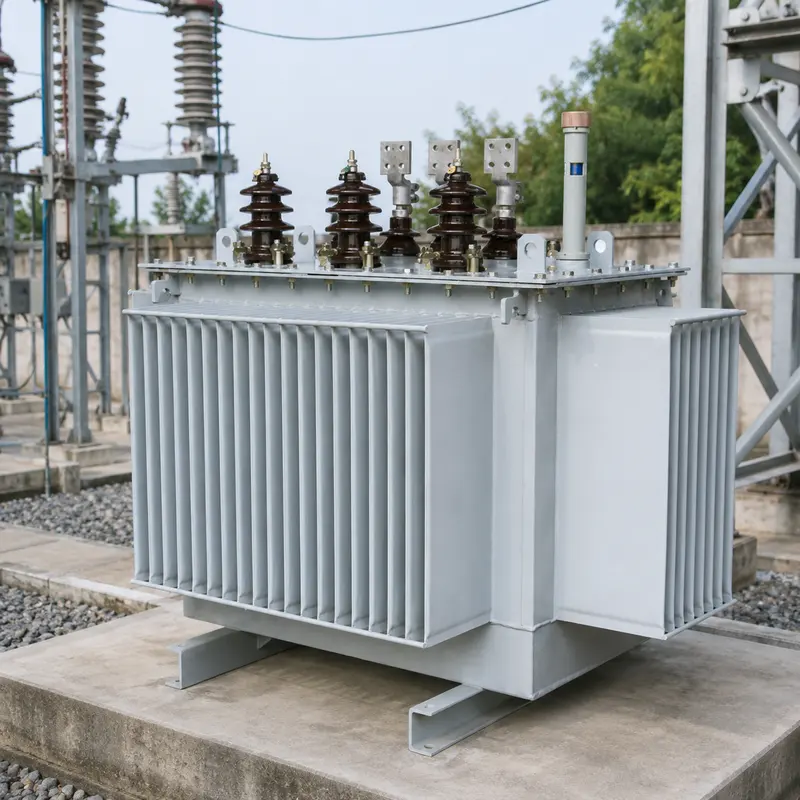
Power and distribution transformers
- Inspection: shipping damage, impact recorder readings, nitrogen or dry-air pressure on arrival for large units, oil level, leaks, bushing condition.
- Insulation resistance and polarization index, winding to winding and to ground.
- Turns ratio on all taps and vector group verification; see our TTR test guide.
- Winding resistance on all taps; see winding resistance testing.
- Oil breakdown voltage, moisture and a baseline dissolved gas analysis; see our DGA oil test guide.
- Sweep frequency response analysis (SFRA) where specified, compared with factory fingerprint.
- Function of protective devices: Buchholz, pressure relief, oil and winding temperature indicators, tap changer.
MV and LV switchgear
- Torque check of bus joints, main-circuit resistance, IR and, where specified, power-frequency withstand at reduced level.
- Breaker timing and operation, SF6 pressure for gas-insulated units, interlocks and earthing switches.
- CT and VT ratio and polarity, relay secondary injection, trip circuit and end-to-end tests.
Battery energy storage systems
- Inspection of racks, cabling and enclosure; HVAC or liquid cooling function.
- BMS cell voltage and temperature readings, insulation monitoring, PCS functional tests.
- Fire detection and suppression, gas detection and ventilation per NFPA 855 and the approved design.
- EMS control modes, grid-code functions and communications. Our containerised BESS specification guide covers what to require.
Worked Example: Comparing Site Results With FAT Values
A 10 MVA, 33/11 kV transformer arrives on site. The SAT team measures and compares with the FAT report.
Winding resistance
Factory: HV phase A-B at principal tap, 0.6176 Ω corrected to 75 °C. Site: 0.512 Ω measured at 22 °C oil temperature. Correct to 75 °C for copper:
R75 = Rm × (235 + 75) / (235 + tm) = 0.512 × 310 / 257 = 0.6176 Ω
The difference is under 0.1%, well inside a typical ±2% acceptance limit. A larger deviation on one phase would suggest a loose connection or tap-changer contact problem.
Turns ratio
Declared ratio at principal tap: 33,000 / 11,000 = 3.000 (phase-to-phase basis, Dyn11). Site TTR reads 3.006 on phase A. Deviation: (3.006 − 3.000) / 3.000 = 0.20%, inside the IEC 60076-1 tolerance of ±0.5% (or one-tenth of impedance if lower).
Insulation resistance
| Measurement | FAT (20 °C) | SAT measured (28 °C) | SAT corrected to 20 °C | Result |
|---|---|---|---|---|
| HV to LV + ground | 6.2 GΩ | 3.4 GΩ | about 5.9 GΩ | Accept |
| LV to HV + ground | 3.8 GΩ | 2.1 GΩ | about 3.7 GΩ | Accept |
| PI, HV to LV + ground | 2.6 | 2.5 | — | Accept |
Correction uses the approximate halving per 10 °C: factor 2^(8/10) = 1.74. Corrected values within about 10% of factory confirm the insulation stayed dry during transport. Our insulation resistance tester guide explains PI and temperature correction further.
Acceptance Test Procedure: How to Run a SAT
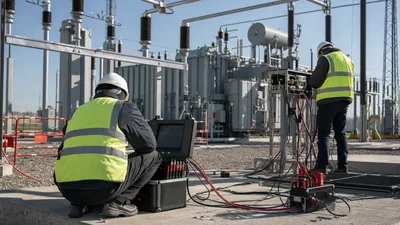
An acceptance test procedure (ATP) turns the checklist into an executable plan. A practical sequence is:
- Prepare the ITP and ATP. Agree the inspection and test plan with hold and witness points, acceptance criteria and test sheets, referencing FAT values. Issue it before equipment arrives.
- Receive and inspect. Check delivery against packing lists, inspect for damage and read impact recorders. Record anything abnormal before signing the delivery note.
- Install and complete mechanical work. Confirm foundations, anchoring, earthing connections, cable terminations, torque values and oil filling or gas filling as per manufacturer instructions.
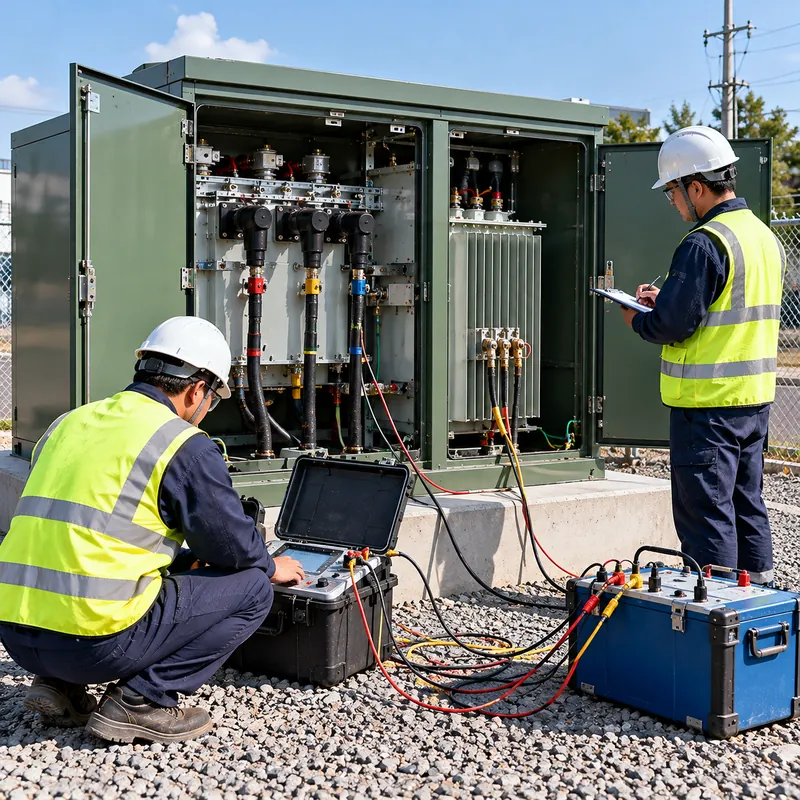
- Perform static electrical tests. IR, ratio, resistance, oil tests, CT/VT checks, main-circuit resistance and any reduced-voltage withstand tests. Compare with FAT.
- Perform functional tests. Relay secondary injection, interlocks, alarms and trips, tap changer operation, cooling control, SCADA point-to-point checks, BMS and EMS functions.
- Pre-energization review. Close out punch items, confirm settings applied, remove temporary grounds, issue energization permit.
- Energize and soak. Energize at no load, typically holding for a period such as 24 hours while monitoring sound, temperatures and protection, then apply load in stages.
- Hand over. Compile signed test sheets, as-built drawings, settings files and the punch list into the SAT dossier.
Energization and switching must be done by authorized personnel under the site's switching and safety rules. Our substation testing engineering guide covers system-level tests in more depth.
Factory Acceptance Test Software and Digital Records
Many teams now manage FAT and SAT with digital tools rather than paper. Factory acceptance test software generally means applications that hold the ITP, present test sheets on tablets, capture measurements directly from instruments, attach photos and record electronic signatures. The benefits are traceability and fast comparison between FAT and SAT values.
Whatever tool you use, the record set matters more than the platform. Make sure each test record includes:
- Equipment serial number, location and test configuration (which terminals energized, which grounded or guarded).
- Instrument model class, serial number and calibration due date.
- Ambient and equipment temperatures, humidity and weather for site tests.
- Measured value, acceptance criterion, pass/fail and tester and witness names.
- Deviations and their disposition.
Store FAT reports in a format the site team can access offline. A surprising number of SAT delays come from the commissioning engineer not having the factory values, temperature references or vector group at hand. Planning test sheets so that FAT and SAT columns sit side by side avoids this. For transformer-specific test methods, see our power transformer testing guide and, for dielectric tests, the dielectric withstand test guide.
Next Steps: Specifying and Sourcing
Write FAT and SAT requirements into the purchase specification so that both supplier and installer price them correctly:
- List routine, type and special tests for FAT with the standard and edition, plus witness and hold points and notice period.
- Require the FAT report to state configurations, temperatures and instruments so SAT comparisons are possible.
- Define the SAT scope, acceptance tolerances against FAT values and who supplies test equipment and supervision.
- For BESS and substations, include integration tests with SCADA, EMS and protection, and safety system verification.
MARS performs routine tests on every unit and welcomes FAT witnesses at our Shanghai facility for power transformers, distribution transformers, compact and containerised substations, switchgear and BESS. Test reports are supplied with each shipment to support your SAT. Contact us through the quote request form with your ITP requirements.
Frequently asked questions
What is the difference between FAT and SAT?
A factory acceptance test is performed at the manufacturer before shipment to prove the equipment meets specification. A site acceptance test is performed after installation to prove it was not damaged in transport, was installed correctly and works with site systems. SAT results are compared against FAT values.
What does FAT stand for in testing?
FAT stands for factory acceptance test. It is a formal inspection and test at the supplier's works, usually witnessed by the buyer, covering routine tests required by the product standard, any contract-specified tests, and visual, dimensional and documentation checks. A successful FAT releases the equipment for shipment.
What tests are included in a transformer site acceptance test?
Typical transformer SAT tests are visual and impact recorder inspection, insulation resistance and polarization index, turns ratio on all taps, winding resistance, vector group, oil breakdown voltage and moisture, a baseline dissolved gas analysis, SFRA where specified, and functional checks of protection devices, cooling and the tap changer.
How do you create an effective factory acceptance test checklist?
Trace every item to a specification clause, state a measurable acceptance criterion, record the measured value and test conditions, and include instrument calibration details. Group items by inspection, routine tests, special tests and documentation, and leave space for deviations and agreed corrective actions.
Who performs the site acceptance test?
Usually the installation or commissioning contractor performs the tests, the owner or owner's engineer witnesses and signs them, and the equipment manufacturer may provide a supervisor for critical items such as large transformers or BESS. Responsibilities should be defined in the contract and the inspection and test plan.
Is high-voltage withstand testing repeated at site?
Not always. Many contracts rely on the factory dielectric tests and perform only insulation resistance at site. Where withstand tests are repeated, for example on switchgear after assembly or on cables, they are usually at reduced levels defined by the standard or contract to avoid unnecessary stress.
Written and reviewed by the MARS application engineering team in Shanghai, who specify and test transformers, switchgear, substations and battery storage for projects in 40+ countries. Last updated .
Tags: site acceptance test factory acceptance testing fat and sat factory acceptance test checklist acceptance test procedure