Key takeaways
- Demand side response pays consumers to reduce or shift grid demand for periods typically ranging from seconds for frequency services to several hours for capacity events.
- Programs split into incentive-based schemes such as capacity, emergency and ancillary services, and price-based schemes such as time-of-use, critical peak and real-time pricing.
- A demand response management system dispatches site assets using open protocols such as OpenADR, standardised as IEC 62746-10-1, or IEEE 2030.5 for distributed resources.
- Battery storage delivers DSR without process disruption; a 500 kW / 1,000 kWh system holds a 500 kW reduction for about 1.7 hours after usable depth of discharge and losses.
- Verified performance is measured against a baseline, so metering at 15-minute or shorter intervals and accurate baseline methods decide what a site is actually paid.
Quick answer: Demand side response (DSR) is the deliberate change of a site's electricity consumption, by reducing, shifting or replacing grid load, in response to a price signal or a grid operator's instruction. Sites earn payments or avoid charges by curtailing processes, shifting flexible loads, running on-site generation or discharging batteries during system peaks or frequency events.
Grids have always balanced supply and demand by moving generation. Demand side response turns that around: the consumer becomes a flexible resource that system operators, suppliers and aggregators can call on. For an industrial or commercial site, that flexibility can be sold, used to avoid peak charges, or both.
This guide is for energy managers, facility engineers and project developers evaluating demand response solutions. It explains the meaning of DSR, the program types, how dispatch and measurement work, which assets suit which services, and how to size a battery for flexibility revenue without compromising backup or operations.
What Is Demand Side Response?
Demand side response is a change in electricity use by end consumers, away from their normal pattern, in response to changes in price or to incentive payments designed to lower consumption when system reliability is at risk. In US usage the term is usually shortened to demand response (DR); in the UK and parts of Europe, demand side response or demand side flexibility is more common. The meaning is the same.
DSR in energy markets takes three physical forms:
- Load reduction (curtailment): switching off or turning down load, such as chillers, pumps, compressors or lighting, for the event duration.
- Load shifting: moving energy use to another time, for example pre-cooling a building, running batch processes overnight or delaying EV charging.
- Load substitution: keeping the process running but supplying it from on-site generation or batteries, so the grid sees reduced import.
DSR is one class of distributed energy resources, alongside rooftop solar and small generators. Its value comes from avoiding the cost of peaking plant and network reinforcement that would otherwise be built for a few hours of demand per year.
What separates DSR from simple energy efficiency is timing. Efficiency lowers consumption all the time; demand side response lowers it at the specific moments the grid or the tariff values most. A site that cuts 300 kW for two hours on the ten tightest days of the year may contribute more system value than one that saves the same energy spread evenly across the year.
Types of Demand Response Programs and Services
Demand side response services fall into two families. The table summarises the common types; program names, rules and payments vary by market and operator.
| Service type | Signal | Typical response time | Typical duration | Payment basis |
|---|---|---|---|---|
| Capacity / reliability | Operator dispatch on forecast peak | Minutes to hours notice | 1–4 hours | Availability (per kW-month or kW-year) plus performance |
| Emergency DR | Grid emergency declaration | 10–60 minutes | 1–6 hours | Per event or availability |
| Frequency response / regulation | Grid frequency or operator signal | Sub-second to seconds | Seconds to 30 minutes | Availability per MW per hour |
| Operating reserve | Operator instruction | Minutes | 30 minutes to 2 hours | Availability and utilisation |
| Time-of-use / critical peak pricing | Published tariff or day-ahead notice | Planned | Peak window | Avoided energy cost |
| Demand charge management | Site meter peak | Seconds to minutes | 15–60 minute peaks | Avoided demand charge |
Incentive-based programs pay for the ability to respond and for verified delivery. Price-based programs pay nothing directly; savings come from moving consumption out of expensive periods. Many sites stack both, using one asset for demand charge reduction most days and committing it to a capacity program for a limited number of event days.
Demand charge management is closely related; the mechanics are covered in our guide on demand charge reduction.
How Does a Demand Response Management System Work?
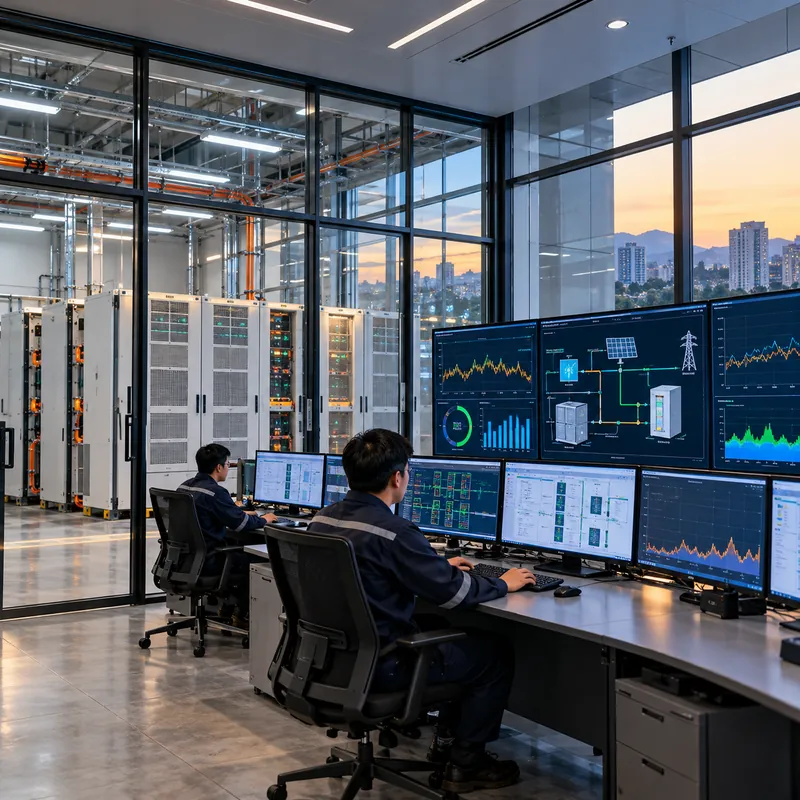
A demand response management system (DRMS) is the software and control layer that receives grid or market signals, decides which site assets to dispatch, sends commands and reports metered performance. At utility scale the DRMS is run by the operator or aggregator; at site level it is often part of an energy management system.
The signal chain usually looks like this:
- Event notification: the operator or aggregator issues an event with start time, duration and target reduction, using a protocol such as OpenADR (IEC 62746-10-1) or IEEE 2030.5.
- Site optimisation: the site controller checks battery state of charge, process schedules and comfort limits and builds a dispatch plan.
- Dispatch: commands go to the battery PCS, building management system, generator controller or process PLCs over protocols such as Modbus TCP, BACnet or IEC 61850.
- Measurement: revenue-grade interval meters record import at the point of connection.
- Settlement: metered demand is compared with a baseline to calculate delivered kW and payment.
The battery side of this stack, PCS control, state-of-charge reservation and scheduling, is described in more detail in EMS for battery storage. Where a site also has solar, generators or islanding capability, the same functions sit inside a microgrid energy management system.
Communications and cybersecurity matter. Programs that pay for fast response usually require telemetry at second-level resolution and secure, auditable command paths, so plan network architecture before committing to a service.
Which Assets Can Provide Demand Side Response?
Any load or source that can change grid import on request can participate, but assets differ sharply in speed, duration and the cost of each event to the business.
| Asset | Speed | Sustainable duration | Impact on operations | Best-fit services |
|---|---|---|---|---|
| HVAC and chillers | Minutes | 1–3 hours (thermal mass) | Comfort drift | Capacity, TOU |
| Process loads (pumps, crushers, furnaces) | Minutes | Depends on storage of product | Production loss if not buffered | Capacity, emergency |
| Standby generators | 1–10 minutes | Hours | Fuel, emissions limits, wear | Emergency, capacity where permitted |
| EV charging | Seconds | Hours (deferral) | Charging delay | TOU, demand charges |
| Battery energy storage | Milliseconds to seconds | Set by energy rating, typically 1–4 h | None to process | All, including frequency response |
Generators are often restricted by emissions permits to emergency use, so check local rules before enrolling a diesel set; our generator sizing guide explains why standby-rated sets are not intended for regular peak duty.
Batteries stand out because the response is fast and invisible to the process. They also do the same job outside event days, through peak shaving and energy shifting, which spreads their capital cost across several value streams.
Worked Example: Sizing a Battery for Demand Side Response
A manufacturing site has a typical afternoon import of 1,400 kW. It wants to offer 500 kW in a capacity program with events of up to 2 hours, while also reducing its monthly demand peak.
Step 1, power: the PCS must deliver the committed reduction plus a margin for metering and baseline error. Using 10%: P = 500 × 1.1 = 550 kW.
Step 2, energy: E = P × t / (DoD × η), where DoD is usable depth of discharge and η is the discharge-path efficiency from battery to grid. With 550 kW for 2 h, 90% usable window and 95% discharge efficiency: E = 550 × 2 / (0.90 × 0.95) = 1,287 kWh.
Step 3, selection: a 1.29 MWh requirement points to a containerised LFP system of about 1.5 MWh with a 550–630 kW PCS, leaving headroom for capacity fade over the project life.
Step 4, value check (illustrative only): if a demand charge were 15 per kW-month and the battery cut the monthly peak by 400 kW, avoided demand charges would be 400 × 15 = 6,000 per month in local currency. Capacity payments are added on top where the program allows stacking. Real tariffs and program rates vary widely by market and date and must come from the utility or aggregator contract.
Step 5, reservation: on forecast event days the EMS must hold state of charge at full before the window, so demand charge discharges earlier in the day are limited.
How to Choose Demand Response Companies and Solutions
Demand response companies fall into a few groups: utilities running their own programs, independent aggregators that pool many sites into a portfolio, energy suppliers offering flexibility-linked tariffs, and equipment and software providers that supply the on-site controls. Many sites use an aggregator for market access and a separate supplier for the battery or controls.
Questions to ask before signing:
- Which programs and markets will the site be enrolled in, and who carries the penalty for non-delivery?
- How is the baseline calculated, and how does it treat weather and production changes?
- What revenue share or fixed fee applies, and for how long is the contract?
- Can the site opt out of events, and how often, without losing payments?
- Who owns and maintains the controls, meters and communication equipment?
- Does the scheme permit stacking with demand charge savings or backup duty?
For the hardware side, the battery must be sized for both the program duration and the site's other uses, with grid connection and protection approved by the network operator. Grid-connected inverters normally require compliance with IEEE 1547 or the local grid code, and the battery system itself with UL 9540 or IEC 62619 depending on market.
The best demand response solution for a site is usually the one that creates value on ordinary days too, rather than relying only on a handful of event payments.
Next Steps: Specifying and Sourcing DSR-Ready Storage
A battery intended for demand side response should be specified around measurable performance, not nameplate capacity alone. Include in the RFQ:
- Committed power, maximum event duration and expected events per year
- Response time and telemetry requirements of the target program
- Interval load data for at least 12 months, ideally at 15-minute resolution
- Connection voltage, available transformer capacity and point of common coupling
- Required standards: UL 9540 / UL 9540A or IEC 62619, NFPA 855 siting, IEEE 1547 or grid code
- EMS interfaces: OpenADR or IEEE 2030.5 to the aggregator, Modbus TCP or IEC 61850 on site
MARS supplies LFP liquid-cooled C&I cabinets from 93 to 372 kWh and containerised systems from 500 kWh to 10 MWh with integrated PCS, BMS/EMS and fire suppression, along with the step-up transformers and switchgear for MV connection. Explore the energy storage system range or the liquid-cooled ESS cabinets, and review how to specify a containerised BESS.
Share your load profile and target program through the quote request page for a sized proposal; typical BESS lead time is 60–90 days.
Frequently asked questions
What is demand side response in simple terms?
Demand side response means a business or household changes when or how much electricity it takes from the grid when asked or when prices are high. It may switch off flexible equipment, shift use to cheaper hours, or run batteries or generators instead. In return it receives payments or lower bills, and the grid avoids building extra peak capacity.
What is the difference between demand response and demand side response?
There is no technical difference. Demand response is the common term in North America, while demand side response is widely used in the UK and Europe. Both describe consumers adjusting electricity demand in response to price signals or operator instructions, and both include curtailment, load shifting and on-site generation or storage.
How do companies get paid for demand side response?
Payments usually combine an availability fee for being ready to respond, measured per kW or MW committed, and a utilisation or performance payment for verified delivery. Delivery is calculated by comparing metered demand with a baseline. Price-based schemes pay indirectly through lower energy and demand charges. Exact rates depend on the market and contract.
What is a demand response management system?
A demand response management system is software that receives grid or market event signals, decides which loads, batteries or generators to dispatch, sends control commands and reports metered performance for settlement. It commonly uses OpenADR or IEEE 2030.5 externally and Modbus, BACnet or IEC 61850 to talk to on-site equipment.
Can a battery be used for demand response and backup at the same time?
Yes, if the energy management system reserves enough state of charge for backup and the program duration. A common approach is to size energy for the event duration plus a backup reserve, then prioritise events on dispatch days. The inverter must also support islanding and the switchgear must allow safe transfer during outages.
How long does a demand response event last?
It depends on the service. Frequency response events can last from seconds to around 30 minutes, operating reserves up to a couple of hours, and capacity or emergency events commonly one to four hours, sometimes longer. Program rules state the maximum duration, notice period and the number of events per season.
Written and reviewed by the MARS application engineering team in Shanghai, who specify and test transformers, switchgear, substations and battery storage for projects in 40+ countries. Last updated .
Tags: demand side response what is demand side response demand response solutions demand response management system demand side response services