Key takeaways
- The storage supply chain splits into cell makers, system integrators, PCS makers, EPC contractors and service providers, and each carries different performance risks.
- A complete BESS should hold a UL 9540 listing or IEC 62619 and IEC 62933 compliance, backed by UL 9540A test data for the exact configuration offered.
- Compare offers on lifetime discharged MWh, combining usable depth of discharge, round-trip efficiency and guaranteed end-of-life capacity, not on nameplate kWh price.
- Modern 20 ft liquid-cooled containers built with 280–314 Ah LFP cells commonly hold about 3.4–5 MWh, far more than earlier air-cooled designs.
- Factory acceptance testing should verify insulation, BMS protection trips, PCS functions, cooling performance and fire system interlocks before shipment.
Quick answer: To choose among energy storage companies, first decide which type you need: cell maker, system integrator, PCS supplier or EPC contractor. Then score BESS manufacturers on certified safety (UL 9540, UL 9540A, IEC 62619), bankable warranty and degradation terms, round-trip efficiency, thermal design, controls integration, factory testing and local service, and compare offers on cost per delivered MWh, not cost per nameplate kWh.
The number of battery storage companies has grown so fast that buyers now face the opposite of the old problem: too many suppliers, with similar-looking datasheets and very different engineering behind them. A container that looks identical on paper may differ in cell grade, cooling margin, BMS architecture, test evidence and the financial strength behind its warranty.
This buying guide is for developers, utilities, EPC contractors and commercial and industrial energy managers selecting battery energy storage system manufacturers or suppliers. It explains how the supply chain is organized, what to evaluate, which certifications matter, how to compare offers on lifetime value and how to run factory acceptance testing. It deliberately names no vendors; the method applies to any shortlist.
What Types of Energy Storage Companies Are There?
"Energy storage company" covers several distinct business models. Knowing which one you are dealing with tells you where accountability for performance sits.
| Company type | What they supply | Strengths | Watch points |
|---|---|---|---|
| Cell manufacturer | Cells, sometimes modules and racks | Cell-level data, scale, cost | System integration and site warranty often limited |
| System integrator / BESS manufacturer | Racks or cabinets, BMS, thermal system, fire system, enclosure, often PCS and EMS | Single point of responsibility for the DC or AC block | Depth of in-house engineering varies widely |
| PCS manufacturer | Bidirectional inverters, MV skids | Grid code compliance, power electronics | Battery interfacing depends on integrator |
| EPC contractor | Design, procurement, construction, commissioning | Site works, permitting, interconnection | Equipment risk often passed through |
| Developer / owner-operator | Projects, offtake, operation | Commercial structuring | Usually buys from the categories above |
| O&M provider | Maintenance, monitoring, augmentation | Availability guarantees | Access to OEM data and spares |
For most C&I and utility buyers, the critical choice is the system integrator, because it combines cells, BMS, cooling, fire protection and controls into a product that must be certified as a whole. Grid scale battery storage companies often contract the integrator for an AC block including PCS and MV transformer, simplifying interfaces. A description of each subsystem is in our guide to BESS components.
What Is a BESS Container and What Should It Include?
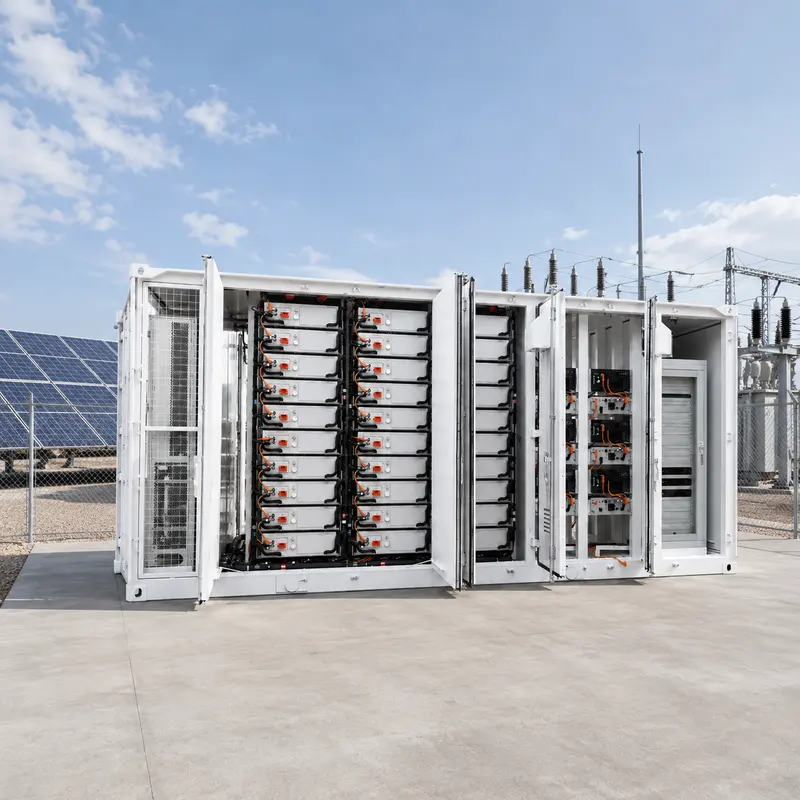
A containerized battery energy storage system is a factory-assembled enclosure, usually in a 20 ft or 40 ft ISO-style footprint, that houses battery racks, BMS, thermal management, fire detection and suppression, auxiliary power and controls, ready for connection to a PCS and grid transformer.
Key specification items for a bess container:
- Energy: nameplate and usable MWh at beginning of life, at a stated C-rate and temperature.
- Cell: LFP prismatic, typically 280–314 Ah; a 20 ft liquid-cooled unit commonly holds about 3.4–5 MWh.
- DC voltage window: often around 1,000–1,500 V DC, matched to the PCS.
- Thermal system: liquid cooling with a specified maximum cell temperature spread; see liquid-cooled vs air-cooled storage.
- Safety: off-gas, smoke and heat detection, suppression, and explosion control per NFPA 68 or NFPA 69.
- Enclosure: IP54–IP55 per IEC 60529, corrosion category for the site, seismic and wind ratings.
- Communications: BMS-to-EMS and EMS-to-PCS protocols such as Modbus TCP or IEC 61850.
Smaller C&I projects use outdoor cabinets of roughly 100–400 kWh instead, which follow the same requirements at smaller scale. Our article on how to specify a containerized BESS provides a full specification template.
How to Evaluate BESS Manufacturers: A Scorecard
A weighted scorecard keeps evaluation objective and auditable. Adjust weights to the project; the structure below suits a typical C&I or utility tender.
| Criterion | Weight | Evidence to request |
|---|---|---|
| Safety and certification | 20% | UL 9540 listing or IEC 62619 / IEC 62933-5-2 reports; UL 9540A cell, module, unit reports |
| Performance guarantees | 20% | Usable energy, RTE at point of measurement, degradation curve, availability |
| Engineering depth | 15% | In-house BMS, thermal modeling, single-line and protection design |
| Manufacturing quality | 15% | ISO 9001, cell incoming inspection, traceability, routine test records |
| Controls and integration | 10% | EMS functions, PCS compatibility, grid code compliance (IEEE 1547, UL 1741 or local code) |
| Track record | 10% | Installed references with operating data, similar climate and duty |
| Service and warranty backing | 10% | Local service, spares, response times, financial strength or insurance |
Score each criterion 1–5, multiply by weight and sum. Any supplier scoring below a threshold on safety should be excluded regardless of price.
Controls deserve more attention than they usually get. The EMS determines whether the system actually performs peak shaving, arbitrage or frequency response as modeled; our guide to EMS for battery storage lists the functions to verify.
Which Certifications Should Battery Storage Manufacturers Hold?
Certification requirements depend on market, but a credible energy storage manufacturer should be able to document most of the following for the exact product offered:
- UL 9540: safety of energy storage systems and equipment, the system-level listing usually required in North America.
- UL 9540A: test method for thermal runaway fire propagation, used by authorities applying NFPA 855.
- UL 1973: stationary battery modules and racks.
- IEC 62619: safety of industrial lithium cells and batteries; IEC 62933 series for grid-integrated storage systems.
- UL 1741 and IEEE 1547, or local grid codes, for the PCS interconnection; IEC 62477-1 for power electronic converter safety.
- UN 38.3: transport testing for lithium cells and batteries.
- ISO 9001, ISO 14001, ISO 45001: quality, environmental and occupational safety management.
Ask for the certificate and the test report, check the scope covers the configuration and cell model offered, and confirm the certifying body is accredited in your market (for example an NRTL in the US). A certificate for a different cell or rack layout is not evidence for your system.
Fire performance is where certification and real-world risk meet. Understanding the failure mode makes it easier to review UL 9540A data; see our thermal runaway guide.
Comparing Offers: Cost per Delivered MWh
Nameplate price per kWh is a misleading comparison because suppliers differ in usable depth of discharge, efficiency and degradation. Compare lifetime discharged energy instead:
E_life ≈ E_nameplate × DoD × [(1 + SOH_EOL) / 2] × cycles/year × years
where SOH_EOL is the guaranteed state of health at end of term; the bracket approximates average capacity over life with linear degradation.
Worked example: two 2 MWh offers, one cycle per day for 15 years
- Offer A: 95% DoD, 70% end-of-life SOH.
2 × 0.95 × 0.85 × 365 × 15 = 8,842 MWh. - Offer B: 90% DoD, 60% end-of-life SOH.
2 × 0.90 × 0.80 × 365 × 15 = 7,884 MWh. - If Offer A costs 100 price units and Offer B costs 92, cost per delivered MWh is
100 / 8,842 = 0.0113for A and92 / 7,884 = 0.0117for B.
Offer A is cheaper per useful MWh despite the higher price. Add round-trip efficiency to the comparison: each percentage point of RTE changes the energy that must be bought for charging over the life. Also check where RTE is measured (DC terminals, PCS AC output or point of interconnection) and whether auxiliary loads such as cooling are included.
Indicative system prices vary by market, date, duration, scope and grid requirements; see commercial battery storage costs for cost drivers. In the US, tax credit eligibility rules, including domestic content and sourcing restrictions, change over time; our battery storage tax credit guide covers the framework, and current rules should be verified with tax advisers.
Factory Audit and FAT: How to Verify a BESS Supplier
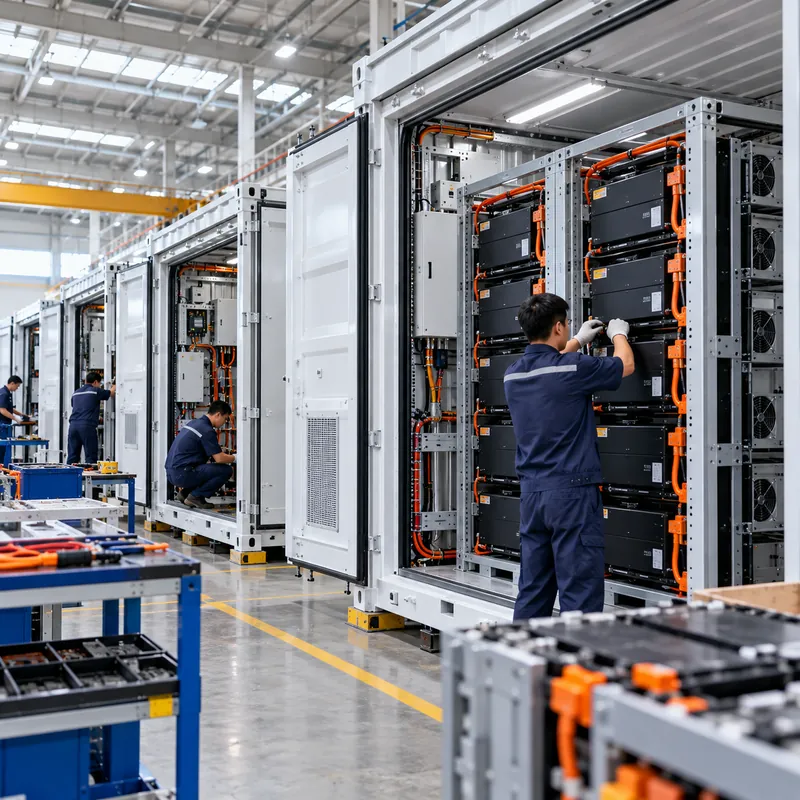
Documents show what a supplier claims; a factory visit shows what it does. A structured audit and factory acceptance test (FAT) is standard for utility projects and increasingly common for C&I.
- Pre-audit questionnaire: production capacity, organization chart, quality system, key subcontractors and cell source.
- Factory audit: inspect cell incoming inspection, module assembly, welding or bolting process control, torque records, cleanliness and ESD control.
- Witness routine tests: insulation resistance and dielectric tests, BMS calibration, cell voltage and temperature sensor checks.
- Functional FAT: charge and discharge at rated power, BMS protective trips (over-voltage, under-voltage, over-temperature), contactor operation and emergency stop.
- Auxiliary systems: cooling capacity and temperature spread, HVAC, fire detection and suppression interlocks, door switches.
- Communications: BMS-EMS-PCS data points and control commands against the agreed points list.
- Documentation review: as-built drawings, test certificates, O&M manuals and spare parts lists before release for shipment.
Utility-scale projects add site acceptance and capacity tests after commissioning. The broader design considerations for large systems are in our utility-scale battery storage guide.
Record any deviations found during FAT in a punch list with agreed corrective actions and re-test dates, and do not release final shipment payment until the list is closed or formally accepted.
Next Steps: Specifying and Sourcing
Before approaching suppliers, prepare a clear RFQ package: application and duty cycle (cycles per day, duration, C-rate), usable energy and power at the point of interconnection, grid voltage and frequency, site climate and altitude, applicable codes (NFPA 855, local fire and grid codes), certification requirements, performance guarantees sought, scope split (DC block, AC block or turnkey), FAT and commissioning expectations, and warranty and service terms. Ask every bidder to respond in the same format so the scorecard and lifetime-energy comparison can be applied directly.
MARS is a manufacturer and integrator of LFP storage and grid equipment based in Shanghai. We supply liquid-cooled ESS cabinets of 93–372 kWh for C&I sites and containerized energy storage systems from 500 kWh to 10 MWh with PCS, BMS/EMS and fire suppression, together with step-up transformers and MV switchgear, designed to IEC standards with ANSI/IEEE variants for 50 and 60 Hz grids. We operate ISO 9001, 14001 and 45001 systems, perform routine tests on every unit and welcome FAT; typical BESS lead time is 60–90 days. Send your RFQ through our quotation page.
Frequently asked questions
What is the difference between a BESS manufacturer and a battery cell manufacturer?
A cell manufacturer produces the electrochemical cells. A BESS manufacturer or integrator combines cells with BMS, thermal management, fire protection, enclosure and often PCS and EMS into a certified system, and takes responsibility for system-level performance and safety. Most project buyers contract with the integrator rather than the cell maker.
How do I compare battery storage companies?
Use a weighted scorecard covering safety certification, performance guarantees, engineering depth, manufacturing quality, controls integration, track record and service backing. Then compare shortlisted offers on cost per delivered MWh over the warranty term, accounting for usable depth of discharge, round-trip efficiency and guaranteed end-of-life capacity.
What certifications should a BESS have in the USA?
Projects in the US typically require a UL 9540 system listing, UL 9540A test data for fire propagation, UL 1973 for battery modules, and a PCS certified to UL 1741 with IEEE 1547 interconnection compliance. Installation follows NFPA 855, NFPA 70 and the local fire code, and authorities may require additional large-scale fire testing.
How much energy does a BESS container hold?
It depends on the cell and cooling design. Modern 20 ft liquid-cooled containers using 280–314 Ah LFP cells commonly hold about 3.4–5 MWh, while older air-cooled 40 ft designs held 2–3 MWh. Usable energy is lower than nameplate once depth of discharge limits and efficiency are applied.
What warranty should I expect from energy storage suppliers?
Typical warranties combine a product warranty, often several years for workmanship and components, with a performance warranty guaranteeing a minimum state of health or energy throughput over 10–20 years, subject to stated cycling and temperature conditions. Check exclusions, the measurement method and the financial backing behind long-term guarantees.
Should I buy a DC block or an AC block BESS?
A DC block includes batteries, BMS, cooling and fire protection, leaving PCS and MV integration to the buyer or EPC. An AC block adds PCS and often the MV transformer, giving one supplier responsibility for AC performance. AC blocks simplify interfaces and guarantees; DC blocks give more freedom to choose power electronics.
Written and reviewed by the MARS application engineering team in Shanghai, who specify and test transformers, switchgear, substations and battery storage for projects in 40+ countries. Last updated .
Tags: energy storage companies bess manufacturers battery storage companies bess container energy storage system suppliers