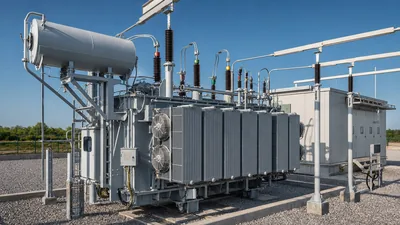
Key takeaways
- Vetting distribution transformer suppliers requires comparing Capitalised Cost of Losses (TOC) rather than evaluating initial purchase price alone.
- Factory acceptance testing must verify routine tolerances in accordance with IEC 60076-1 clause 10 or IEEE C57.12.00 Table 5 before dispatch.
- Compact box-type substations demand specific thermal dissipation, clearance, and bushing arrangement coordination defined by IEC 62271-202.
- Core material selection, whether grain-oriented electrical steel or amorphous metal, directly dictates no-load loss performance and physical dimensions.
- Direct vendor audits should inspect automated foil winding machinery, vacuum pressure impregnation or drying autoclaves, and calibrated test bays.
Quick answer: Qualified distribution transformer suppliers are evaluated on core-and-coil manufacturing quality, guaranteed no-load and load loss levels, compliance with standards such as IEC 60076 and IEEE C57.12, and compatibility with modular box-type substations. Sourcing decisions should prioritize Total Owning Cost (TOC) calculations and certified factory routine testing over initial capital expenditure alone.
Procuring medium-voltage distribution equipment requires balancing electrical performance, thermal limits, short-circuit withstand capability, and mechanical layout constraints. For engineering, procurement, and construction (EPC) contractors and plant engineers, partnering with reliable distribution transformer suppliers ensures that equipment integrates predictably with existing medium-voltage switchgear, low-voltage switchboards, and prefabricated enclosure assemblies. Sourcing mismatches frequently result in excessive site modifications, premature insulation breakdown, or unexpected penalty losses under utility grid codes.
Technical Criteria for Evaluating Distribution Transformer Manufacturers
Evaluating distribution transformer manufacturers requires a systematic review of core construction, winding conductors, insulation thermal classes, and short-circuit withstand validation. A competent factory must demonstrate automated core cutting and stacking using high-grade, cold-rolled grain-oriented (CRGO) silicon steel or amorphous metal alloys. Step-lap mitered joints are essential to minimize magnetizing currents and excitation losses.
Windings should use high-purity electrolytic copper (Cu-ETP) or electrical-grade aluminum (grade 1350), insulated with thermally upgraded kraft paper for liquid-filled units or Class F/H resin systems for cast resin dry-type designs. When integrating transformers into a unit substation engineering design, engineers must verify impedance values (%Z) against prospective system short-circuit currents to ensure both fault-current limitation and busbar bracing compatibility. Suppliers must provide certified type-test reports from independent laboratories verifying dynamic and thermal short-circuit withstand in full compliance with IEC 60076-5.
Total Owning Cost Calculation for Equipment Selection
Total Owning Cost evaluation reveals that the initial purchase price represents only 15% to 25% of a distribution transformer's lifetime expenditure, with electrical losses accounting for the remainder. Leading distribution transformer suppliers provide contractual guarantees for no-load losses ($P_0$) and load losses ($P_k$). Sourcing teams evaluate bids using the standard capitalisation formula:
$$\text{TOC} = C_{bid} + (A \times P_0) + (B \times P_k)$$
Where $C_{bid}$ is the purchase price, $A$ is the capitalised cost of no-load losses ($/kW), $B$ is the capitalised cost of load losses ($/kW), $P_0$ is guaranteed core loss in kW, and $P_k$ is guaranteed copper loss at rated current and reference temperature in kW.
Consider a tender for an 11 kV to 415 V, 1,600 kVA distribution transformer for an industrial site operating 8,760 hours per year over a 20-year design horizon. Assume an electricity cost of $0.12/kWh, an average loading factor of 65%, and an internal rate of return of 8%. The resulting loss capitalisation values calculate to $A = \$6,200/\text{kW}$ and $B = \$2,100/\text{kW}$.
Supplier A submits an initial unit price of $24,500 with $P_0 = 1.95\text{ kW}$ and $P_k = 14.50\text{ kW}$. The calculated TOC is:
$$\text{TOC}_A = \$24,500 + (6,200 \times 1.95) + (2,100 \times 14.50) = \$24,500 + \$12,090 + \$30,450 = \$67,040$$
Supplier B quotes a higher initial purchase price of $28,000 using higher-grade laser-treated CRGO laminations, achieving $P_0 = 1.30\text{ kW}$ and $P_k = 12.00\text{ kW}$. The calculated TOC is:
$$\text{TOC}_B = \$28,000 + (6,200 \times 1.30) + (2,100 \times 12.00) = \$28,000 + \$8,060 + \$25,200 = \$61,260$$
Although Supplier B is $3,500 more expensive on initial capital expense, it yields a net lifecycle saving of $5,780. Accurate transformer sizing calculator metrics prevent overpaying for unneeded capacity while controlling loss-penalty costs.
Comparing Oil-Immersed and Dry-Type Transformer Specifications
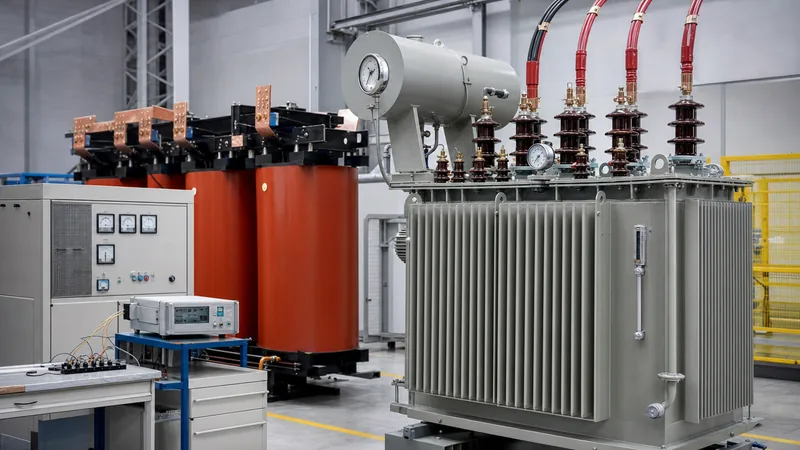
Distribution transformer suppliers provide both liquid-immersed and dry-type units, each engineered for distinct environmental, fire safety, and maintenance requirements. Selection dictates enclosure volume, ventilation provisions, and auxiliary protection within packaged installations.
| Engineering Parameter | Hermetically Sealed Oil-Immersed | Cast Resin Dry-Type (CRT) | Synthetic/Natural Ester Filled |
|---|---|---|---|
| Standard Compliance | IEC 60076-2 / IEEE C57.12.00 | IEC 60076-11 / IEEE C57.12.01 | IEC 60076-2 / ASTM D6871 |
| Dielectric Fluid | Mineral insulating oil (Class I/II) | None (Epoxy quartz powder) | High-fire-point ester liquid (>300°C) |
| Fire Class Rating | Class O1 (Flash point ~145°C) | Class F1 (Self-extinguishing) | High-fire-point classification (Less flammable) |
| Winding Temp Rise Limit | 65 K (top oil 60 K) | 100 K (Class F) / 125 K (Class H) | 65 K or 75 K (high-temp insulation) |
| Ingress Protection (Typ.) | IP54 to IP65 tank assembly | IP00 core-coil, ventilated protective housing | IP54 to IP65 tank assembly |
| Footprint within Substation | Compact, external radiators | Moderate (requires airflow space) | Compact, external radiators |
| Maintenance Demands | Periodic DGA and dielectric tests | Surface dust removal, torque checks | Extended fluid sampling intervals |
| Typical Applications | Outdoor pads, standard kiosks | Indoor vaults, high-rise, tunnels | Urban kiosks, eco-sensitive basins |
For installations serving loop distribution, confirm whether units require dead-front elbow connections or conventional porcelain bushings as outlined in our guide to radial feed vs loop feed networks.
Factory Acceptance Testing Protocols for Distribution Transformers
Factory Acceptance Testing (FAT) validates that the supplied transformer complies with contractual specifications, dielectric insulation levels, and guaranteed losses before crating and dispatch. Buyers must insist on witnessed routine tests in an ISO 17025 accredited laboratory.
- Winding resistance measurement: Performed across all tap positions on high-voltage and low-voltage windings using a precision micro-ohmmeter to identify terminal joint defects and calculate $I^2R$ copper losses (IEC 60076-1 clause 10.2).
- Voltage ratio and vector group verification: Confirms turns ratios and polarity across all taps within the standard tolerance of ±0.5% (IEC 60076-1 clause 10.3).
- Insulation resistance and polarization index: Megohmmeter tests applied between HV-LV, HV-Ground, and LV-Ground at 2.5 kV or 5.0 kV DC, checking dielectric integrity.
- No-load loss and excitation current measurement: Measured at rated frequency and 100% rated voltage with a precision power analyzer to verify core losses against guaranteed values (subject to IEC's +15% single-component tolerance limit).
- Short-circuit impedance and load loss measurement: Conducted at rated frequency with low-voltage terminals short-circuited, correcting results to reference temperature (75°C or 85°C) per IEC 60076-1 clause 10.4.
- Separate source AC withstand and induced overvoltage: Applied voltage test at power frequency alongside double-voltage, double-frequency induced overvoltage testing to stress turn-to-turn and phase-to-phase insulation.
Reviewing certified procedures in our guide to power transformer testing provides full pass/fail acceptance thresholds for advanced tests such as Partial Discharge (PD) and Frequency Response Analysis (FRA).
Box-Type Substation Integration Requirements
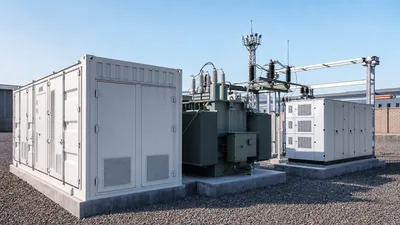
Integrating units into prefabricated compact or box-type substations requires coordinating thermal ventilation, mechanical dimensions, and electrical connection interfaces defined by IEC 62271-202. Distribution transformer suppliers must account for the enclosure class (e.g., Class 10, Class 15, or Class 20), which designates the internal temperature rise increment caused by the kiosk housing.
For example, placing an oil-immersed transformer with a standard 65 K winding temperature rise into a Class 10 enclosure means the effective ambient inside reaches 50°C when outdoor ambient is 40°C. Suppliers must either derate the continuous kVA rating or apply higher-temperature thermally upgraded insulation paper to avoid accelerated thermal aging of the dielectric fluid and cellulose. Cable compartment interfaces require precise terminal heights, whether incorporating bolted air-insulated bushings or screened separable connector bushings conforming to EN 50180/EN 50181 Type C interfaces.
Vendor Audit and Procurement Procedure for Sourcing Transformers
A disciplined audit of distribution transformer manufacturers mitigates project delivery risks, latent manufacturing defects, and non-compliant test documentation. Sourcing teams should complete this five-step supplier qualification workflow before issuing formal purchase orders:
- Documentation and qualification review: Verify ISO 9001, ISO 14001, and ISO 45001 management systems, alongside independent type-test certificates for temperature rise, lightning impulse (BIL), and short-circuit withstand for the proposed kVA frame.
- Raw material supply chain traceability: Confirm that the manufacturer sources magnetic steel from certified mills and uses electrolytic grade conductor stock. Request quality assurance records for dielectric oil batches (breakdown voltage >60 kV, moisture <15 ppm).
- Shop-floor manufacturing inspection: Inspect active-part assembly lines. Confirm that winding rooms maintain positive air pressure and temperature control to prevent particulate ingress. Verify vacuum drying chambers achieve vacuums below 1 mbar before liquid filling under vacuum.
- Quality plan and testing bay sign-off: Review the supplier's Quality Inspection Plan (ITP). Check that testing bay instrumentation carries valid third-party calibration certificates traceable to national standards.
- Protective packaging and shipping provisions: Mandate robust export packing: nitrogen-blanketed or dry-air pressurized tanks for dry-type cores, silica gel breathers capped for transport, impact recorders installed on transport skids, and hot-dip galvanized external hardware for corrosive coastal and industrial environments.
Next steps: specifying and sourcing
Preparing a complete technical requisition ensures clear commercial bids from distribution transformer suppliers without scope gaps. Submit your Single-Line Diagram (SLD), continuous kVA rating, primary and secondary voltages, BIL levels, vector configuration (such as Dyn11), tap changer requirements, and enclosure constraints. Explore our integrated transformer substation assemblies, engineered oil-immersed transformer units, and high-performance pad-mounted transformer solutions. Contact our engineering desk or submit project datasheets directly via our quotation inquiry portal for application support and competitive factory direct pricing.
Frequently asked questions
What is the typical lead time from distribution transformer suppliers?
Lead times for standard distribution transformers typically range from 8 to 14 weeks, depending on kVA rating and raw material availability. Custom configurations, specialized tap changers, or non-standard vector groups can extend production schedules to 16 to 24 weeks.
How do distribution transformer manufacturers calculate loss penalties?
Manufacturers calculate loss penalties by comparing guaranteed no-load and load losses against actual measured values during FAT. If losses exceed guaranteed figures beyond the allowable tolerances defined in IEC 60076-1, contractual financial penalties are deducted directly from the contract value.
What core materials do distribution transformer suppliers use?
Suppliers predominantly use Cold-Rolled Grain-Oriented (CRGO) silicon steel laminations with step-lap joints. For ultra-high-efficiency applications, suppliers utilize amorphous metal alloys, which reduce no-load core losses by up to 70% compared to conventional silicon steel.
What is the difference between hermetically sealed and conservator distribution transformers?
Hermetically sealed transformers eliminate atmospheric contact by utilizing corrugated tank fins or expansion radiators to accommodate oil expansion, preventing oil oxidation and moisture ingress without an air breather. Conservator designs use an expansion tank and silica gel desiccant breather, requiring more periodic fluid maintenance.
Can distribution transformer suppliers provide units suitable for harsh coastal environments?
Yes, suppliers engineer units for severe coastal environments by specifying hot-dip galvanized tanks, multi-layer marine-grade epoxy paint systems, 316 stainless steel hardware, and high-creepage porcelain or composite bushings designed to resist severe salt fog and atmospheric corrosion.
Tags: distribution transformer suppliers distribution transformer manufacturers box-type substations unit substations factory acceptance testing