Key takeaways
- Compare quotes on installed price per watt: total price divided by DC array watts, before and after any incentives you are certain to receive.
- Annual yield equals array kWp times specific yield, typically about 1,000-1,700 kWh per kWp per year depending on location and orientation.
- Simple payback equals net system cost divided by annual bill savings; savings depend heavily on retail tariff and export credit rules.
- Levelized cost of energy divides lifetime cost, including an inverter replacement, by lifetime kWh, accounting for module degradation of about 0.4-0.8% per year.
- South-facing roofs in the northern hemisphere at 20-40° tilt produce the most; east or west faces typically yield roughly 10-20% less.
Quick answer: The cost of solar panels for a home is best compared as installed price per watt of DC capacity, which bundles modules, inverter, racking, labor, permits and overhead. Modules are usually a minority of the total. Whether solar is a good investment depends on that price, local sunshine, roof orientation and shading, and how your utility values the energy you use and export.
Solar panel prices are quoted in at least three different ways: per panel, per watt and per system. Each can make the same offer look cheap or expensive, and none of them on its own tells you whether the investment pays back. The useful questions are what you pay per watt installed, how many kilowatt-hours the system will generate on your roof, and what each of those kilowatt-hours is worth to you.
This guide is for homeowners deciding whether solar is right for their house, and for small business and office managers comparing affordable systems. It explains the cost structure, gives worked payback and LCOE calculations, shows how to judge roof suitability and lists the honest pros and cons. Battery pricing is covered separately in our solar battery price guide.
How Much Do Solar Panels Cost? Price per Watt Explained
Installed price per watt is the total system price divided by the array's DC rating at standard test conditions. It is the standard metric because it normalizes systems of different size and panel wattage:
$/W = Total installed price / (Number of panels × Panel watts)
Example: what do 15 solar panels cost? Fifteen 400 W panels make a 6.0 kW array. If a quote totals $18,000 (an illustrative figure), the price is 18,000 / 6,000 = $3.00/W. A competing 6.6 kW quote at $18,800 is $2.85/W, cheaper per watt although higher in total.
Indicative ranges. In the United States, residential installed prices are often reported in the range of roughly $2.50 to $3.50 per watt before incentives, with wide variation by state, installer, roof complexity and equipment; commercial systems are usually lower per watt because of scale. These are indicative only: prices vary by market and date, so use local quotes. Our article on solar panel cost in New York shows how one market's conditions shape pricing.
Module price alone is a different number. Panels bought individually, such as a small 100 W panel for a shed or RV, are priced per unit and carry retail margins, so their per-watt cost is not comparable with a utility-scale or installed residential figure.
What Makes Up the Cost of Solar Electric Panels Installed?
A typical residential quote combines hardware and soft costs:
| Cost component | Main drivers | Ways to reduce |
|---|---|---|
| PV modules | Efficiency, cell technology, warranty, supply market | Standard-efficiency modules where roof space allows |
| Inverter | String vs microinverters vs optimizers, hybrid readiness | String inverter on unshaded single-plane roofs |
| Racking and roof work | Roof type, pitch, number of planes, structural reinforcement | Simple layouts; ground mount where land allows |
| Electrical balance of system | Conduit runs, disconnects, rapid shutdown, panel upgrades | Inverter near main panel; check busbar rating early |
| Labor | Local wages, roof access, crew size | Avoid complex multi-plane designs |
| Permits, inspection, interconnection | Jurisdiction and utility processes | Experienced local installer |
| Customer acquisition and overhead | Sales model, financing fees | Get several direct quotes |
Soft costs, everything except hardware, often account for a large share of residential solar prices, which is why commercial and utility projects achieve much lower per-watt costs. Panel cost per square meter is sometimes quoted for roofing comparisons: a 400 W module measuring about 1.9 m² delivers about 400 / 1.9 ≈ 210 W/m², so per-m² cost equals per-watt cost times about 210.
Plan for ongoing costs as well, including inspection, cleaning and an inverter replacement after 10-15 years; see our guide to solar panel maintenance cost.
Is My House Good for Solar Power?
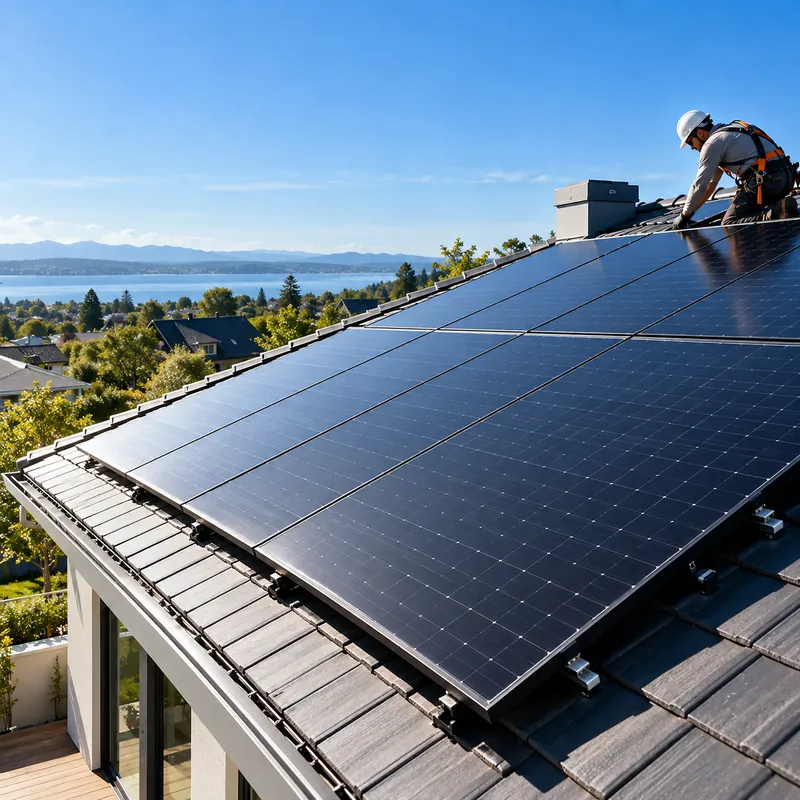
A roof's suitability decides how many kilowatt-hours each dollar buys. Check these factors before requesting quotes:
- Orientation. In the northern hemisphere, south-facing roofs produce the most annual energy; east and west faces typically produce about 10-20% less, and north faces much less unless very low pitched.
- Tilt. Tilts of about 20-40° are close to optimal across most mid-latitudes; flat roofs use tilted racking.
- Shading. Trees, chimneys and neighboring buildings can cut output sharply, especially on string systems without module-level electronics. Morning and afternoon shade matter less than midday shade.
- Roof area and condition. A 6 kW array needs roughly 30-35 m² of usable roof after setbacks. If the roof needs replacing within ten years, replace it first.
- Electrical service. An older or small main panel may need an upgrade to accept backfed solar under NEC 705.
- Consumption and tariff. High electricity use and high retail tariffs improve the economics.
Specific yield is the annual energy per kW of panels: Annual kWh = kWp × specific yield. Values of roughly 1,000 kWh/kWp in cloudy northern climates to 1,700 kWh/kWp or more in sunny regions are typical. An installer's shade report or a public solar-resource map gives a site-specific figure. Our solar system sizing guide explains how to match array size to consumption.
Are Solar Panels a Good Investment? Payback Worked Example
Simple payback is the number of years for bill savings to repay the net system cost:
Payback (years) = Net system cost / Annual savings
Illustrative example. An 8 kW system at an illustrative $3.00/W costs $24,000. With a specific yield of 1,300 kWh/kWp, it produces 8 × 1,300 = 10,400 kWh per year. If every kWh is valued at the retail tariff (full net metering), payback varies with the tariff:
| Value per kWh | Annual savings | Simple payback |
|---|---|---|
| $0.15 | $1,560 | 15.4 years |
| $0.25 | $2,600 | 9.2 years |
| $0.35 | $3,640 | 6.6 years |
Where exported energy earns less than the retail rate, value only self-consumed energy at retail and exports at the export credit. For example, if 60% is self-consumed at $0.25 and 40% exported at $0.06, savings are 10,400 × (0.6 × 0.25 + 0.4 × 0.06) ≈ $1,810, and payback stretches to about 13 years. That is the situation in which adding storage, or shifting loads to daytime, improves returns; see are solar batteries worth it.
Any incentive that reduces net cost shortens payback proportionally, but incentive rules change; in the US, federal residential credit rules changed in 2025, so confirm current eligibility before including one. Rising tariffs over the system's 25-year life also improve returns, while panel degradation slightly reduces them.
Levelized Cost of Solar Energy: What Each kWh Really Costs
Payback answers "when do I break even". The levelized cost of energy (LCOE) answers "what does each kilowatt-hour from my roof cost", which you can compare directly with the utility tariff. A simplified, undiscounted version:
LCOE = (Capital cost + Lifetime O&M) / Lifetime energy
Worked example. The 8 kW system above costs $24,000, plus an illustrative $3,000 for an inverter replacement and occasional maintenance over 25 years. Lifetime energy with an average degradation factor of 0.94 (about 0.5% per year):
E_life = 10,400 × 25 × 0.94 ≈ 244,400 kWhLCOE = (24,000 + 3,000) / 244,400 ≈ $0.11/kWh
If the household pays more than about $0.11/kWh for grid electricity, the system produces cheaper energy over its life, before the time value of money. A discounted LCOE, which spreads costs and energy using a discount rate, gives a higher figure and is the correct basis for comparing with loans or other investments.
Panels with stronger performance warranties, typically guaranteeing about 80-90% output after 25-30 years, reduce LCOE by delivering more lifetime kWh. Larger arrays usually achieve lower LCOE because fixed soft costs are spread over more energy, as our 10 kW solar system guide illustrates.
Solar Panel Pros and Cons
Solar suits many homes but not all. Weigh these points honestly:
| Pros | Cons |
|---|---|
| Generates electricity for 25-30+ years with no fuel cost | High upfront cost or financing commitment |
| Reduces exposure to future tariff increases | Savings depend on utility export rules, which can change |
| Low maintenance; no moving parts in panels | Inverter replacement typically needed once in the system's life |
| Can add battery storage for backup and self-consumption | Grid-tied systems without batteries shut down during outages |
| Lowers carbon emissions from household electricity | Shaded, small or poorly oriented roofs yield poorly |
| May add value to the property in some markets | Roof work must be coordinated; removal and reinstallation if the roof is replaced |
Why do people use solar panels despite the drawbacks? For most owners it is a combination of long-term savings, price stability and environmental benefit, with backup power increasingly important where outages are frequent.
For businesses and offices, affordable solar is often easier to justify: daytime consumption matches solar output, so most energy is self-consumed at the full retail rate, and larger roofs lower the price per watt. Commercial design considerations are covered in our commercial solar panels guide.
Next Steps: Specifying and Sourcing
To get comparable and fair solar quotes:
- Gather 12 months of bills to establish annual kWh and tariff structure, including export credit terms.
- Decide the goal: maximum savings, backup capability, or offsetting a target share of consumption.
- Request at least three quotes with the same scope, and compare installed $/W, estimated annual kWh and projected kWh per dollar.
- Check equipment specifications: module and inverter warranties, listings (UL 61730 modules, UL 1741 inverters in the US), and rapid-shutdown method.
- Confirm electrical scope: whether a main panel upgrade or supply-side connection is included.
- Verify incentives and permits before signing, and confirm that installation will be performed by licensed professionals to local code.
Installation on a home connects to service equipment and must follow local code and be carried out by a licensed electrician; our solar installation guide explains the process. MARS does not sell solar panels. For businesses adding storage, transformers or switchgear alongside PV, explore our energy storage systems and send project data through the quote request form.
Frequently asked questions
How much does a whole house solar system cost?
A whole house system's cost equals its size in watts times the installed price per watt. A 6 to 10 kW residential array is common. In the US, residential installed prices are often reported around $2.50 to $3.50 per watt before incentives, but prices vary by market, roof and date, so obtain local quotes.
Are solar panels worth it for my home?
Solar is usually worth it when the roof is unshaded and well oriented, electricity tariffs are moderate to high, and export credits are fair. Calculate simple payback as net cost divided by annual savings; paybacks under about 10 to 12 years on a system lasting 25 years or more are generally attractive.
How much does solar energy cost per watt?
Installed residential solar is commonly quoted per watt of DC capacity, often in the range of roughly $2.50 to $3.50 per watt in the US before incentives. Commercial systems usually cost less per watt because of scale. Module-only prices are much lower than installed prices because they exclude labor and other soft costs.
How long does it take for solar panels to pay for themselves?
Payback typically ranges from about 6 to 15 years, depending on system price, sunshine, tariff level and export credit rules. For example, an 8 kW system costing $24,000 and saving $2,600 per year pays back in about 9 years. Incentives and rising tariffs shorten payback.
Is my home a good candidate for solar panels?
A good candidate has a south, east or west-facing roof in the northern hemisphere with little midday shade, about 20 to 40 degrees of tilt, enough usable area for the desired array, a roof with many years of life remaining, and an electrical panel able to accept solar under NEC 705.
How much does a small solar panel cost?
Small panels of 50 to 200 W for sheds, RVs and gadgets are sold individually at retail and are priced per unit rather than per watt installed. Their per-watt cost is usually higher than large residential modules, and they also need a charge controller and battery to be useful.
Written and reviewed by the MARS application engineering team in Shanghai, who specify and test transformers, switchgear, substations and battery storage for projects in 40+ countries. Last updated .
Tags: cost of solar panels solar panels for your home price cost of solar electric panels are solar panels a good investment solar power home system cost